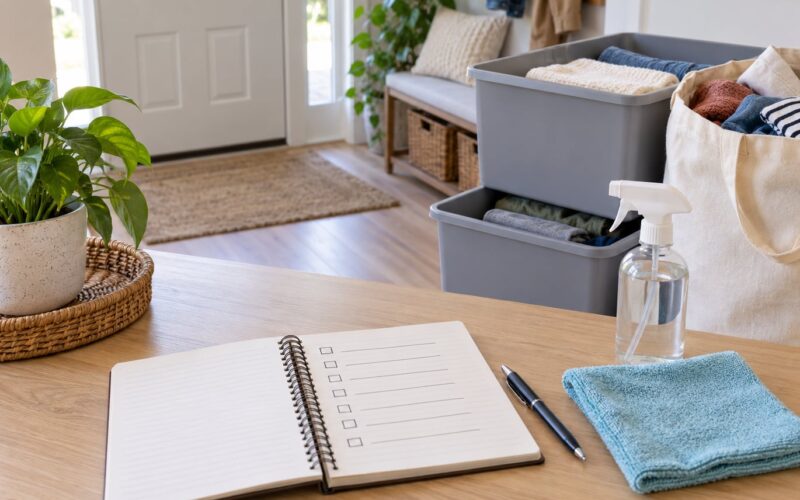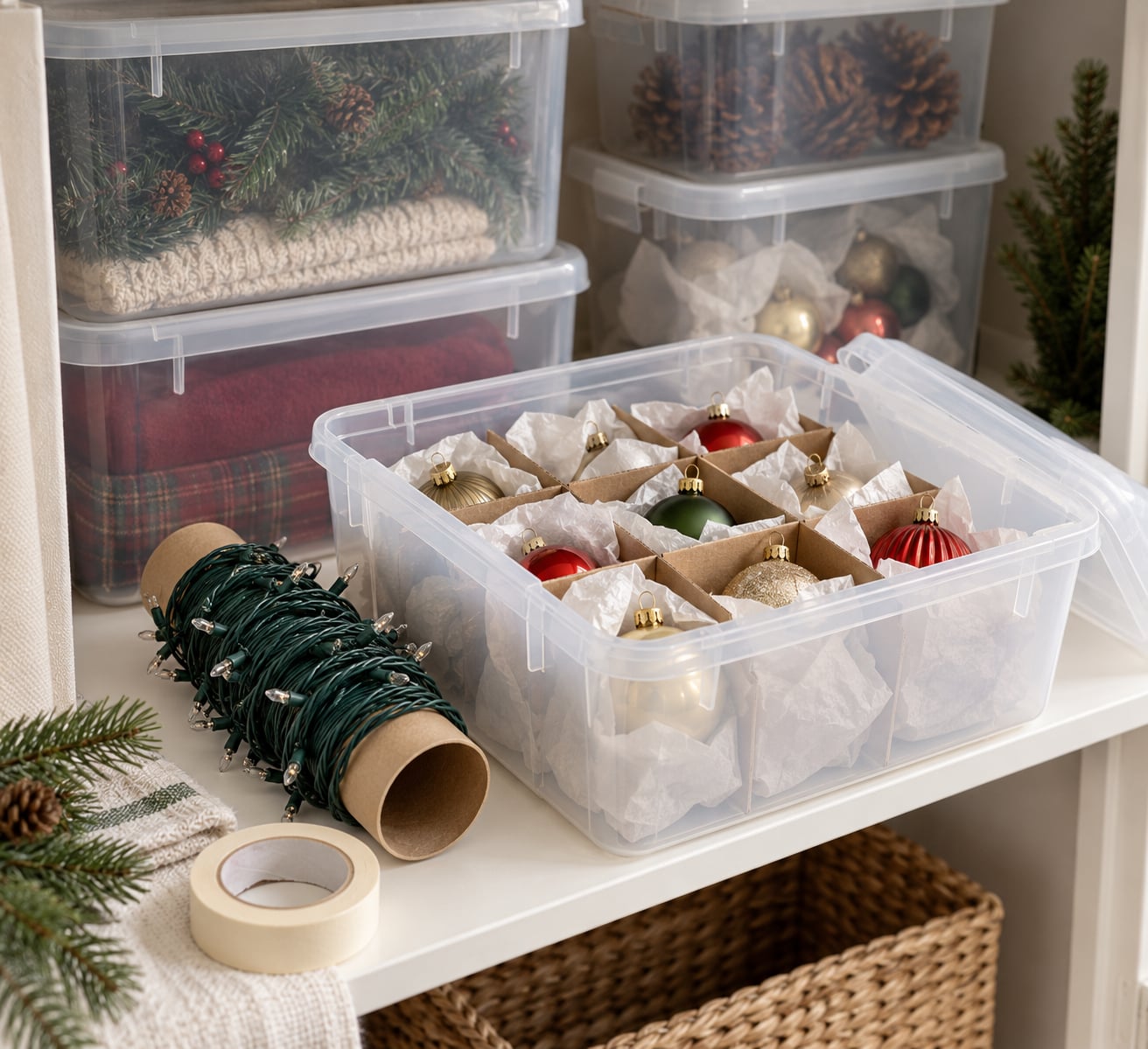
The best way to store holiday decorations so nothing breaks is to give every item its own job: fragile pieces wrapped and separated, string lights wound onto a cardboard core, greenery compressed in its own bag, and everything sealed in a labeled, lidded container kept somewhere dry and temperature-stable. Breakage traces back to four things — tangles, crushing, heat and moisture, and pests — and each one has a fix that takes a few minutes. A careful pack-up on a lazy Sunday in January turns next December into a 30-minute setup instead of an archaeological dig.
I run this cycle every year with my own ornaments, the majority of them hand-blown glass bought one at a time, and the difference between a good year and a bad one is almost never the containers. It is the wrapping, the labels and where the boxes end up.
Table of Contents
- What You Need
- Step-by-Step: How to Store Holiday Decorations So Nothing Breaks
- Sort Decorations by Type and Fragility
- Clean and Dry Every Decoration
- Wrap Ornaments Individually
- Coil, Fold and Protect Lights and Garlands
- Use the Right Container for Each Category
- Label, Inventory and Store in a Dry Location
- Common Mistakes
- Frequently Asked Questions
- What is the best way to store holiday decorations?
- How do you keep ornaments from breaking in storage?
- How do you store Christmas lights without tangling them?
- Is it okay to store Christmas decorations in the garage?
- Can you store Christmas decorations in the attic?
- Where to put a Christmas tree when you have no room?
- Conclusion
What You Need
Gather everything before you start taking anything down. Packing with no plan is how glass ends up under a bin of linens.
- Sturdy lidded bins with clasping lids. Clear so you can see inside without opening anything, and solid enough to stack two high. Avoid oversized sacks: they crush and tangle, and organizers call them the single most common packing mistake.
- An ornament storage box with molded dividers, or a flat cardboard box with a homemade grid of slotted strips tucked into it.
- Acid-free tissue paper, shredded paper and bubble wrap. Tissue for the surface of fragile pieces, shredded paper to fill voids, bubble wrap for thick figurines.
- Cardboard cores for winding. Gift-wrap tubes, paper-towel tubes, or a coffee can with a slot cut in the lid.
- Zip ties or twist ties, a few lengths of twine, and a spool of ribbon.
- A label maker, or masking tape and a marker. Both ends of every container, plus the lid.
- Your phone, for one photo of the finished setup before the teardown and one photo of each box’s contents.
- Cedar blocks and moisture absorbers if anything will live in a garage, attic or basement.
- A dry cleaning spot — a laundry tub, utility sink or bathtub — with a soft cloth and a little mild dish soap.
Step-by-Step: How to Store Holiday Decorations So Nothing Breaks
Sort Decorations by Type and Fragility
Start on the floor, not in a bin. Set out six zones: glass and ceramic ornaments, artificial greenery, lights and extension cords, textiles like tablecloths and stockings, freestanding pieces such as figurines and signs, and anything damaged or retired.
The fragile pile needs its own container and its own packing method. That includes anything with a hook, a thin stem, a painted surface or a hand-blown finish, plus beaded garlands and anything with moving parts.
Photo each zone before you pack. A single wide shot of the mantel plus the tree tells you next year exactly what belonged there, and it turns setup into assembly rather than guesswork.
Clean and Dry Every Decoration
Dust, food residue and sap cause real damage over eleven months. Damp fabric stored in a closed bin smells musty for years, and a candle with wax drips will ruin everything it touches.
Wipe ornaments and figurines with a barely damp cloth and let them air-dry completely on a towel. Wash linens and stockings on a cool cycle and dry them fully — a bin that holds even a little moisture invites mildew.
Fix what is broken now, while you can still see it. Replace tired bulbs, straighten bent hooks, glue a lifted cap back on, and swap out any strand with a wire you can see through the insulation.
Wrap Ornaments Individually
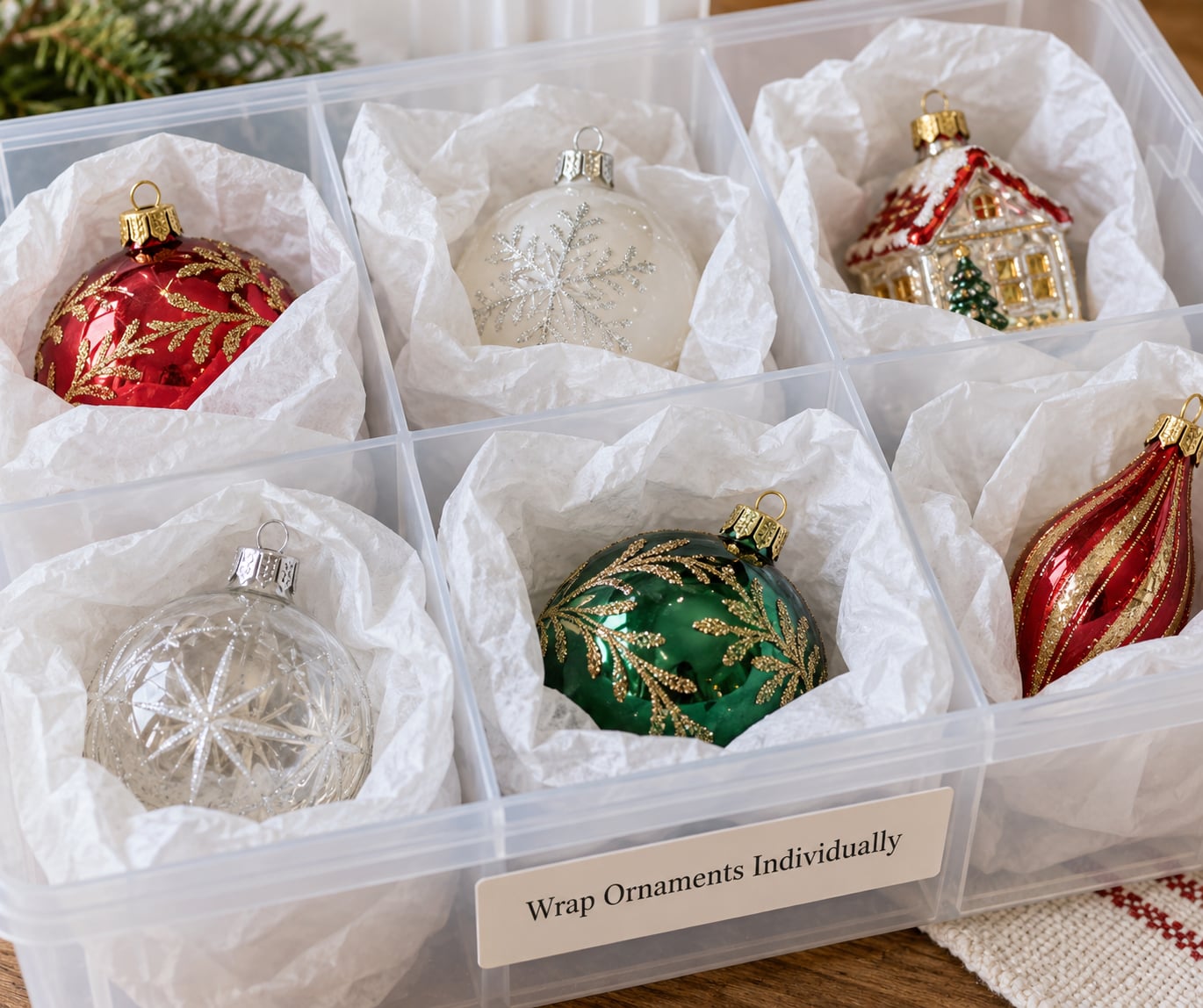
How to store holiday decorations so nothing breaks comes down to contact: two baubles that touch in a bin will rub, and rubbing strips paint and chips edges. Every fragile piece gets its own layer.
Wrap each ornament in tissue paper, twisted closed at the top, or in a square of bubble wrap with the ornament cupped in the middle. For very small pieces, egg cartons work well — the molded cups already separate them.
Then pack by category, not by color. Fill the bottom of the container with shredded paper, stand wrapped ornaments upright in it so nothing moves side to side, and leave two inches of empty space at the top for cushioning. Never stack loose ornaments on top of wrapped ones; that is exactly how a bauble ends up with a chip nobody noticed until January.
Coil, Fold and Protect Lights and Garlands
Do not ball string lights up and drop them in a box. Balled lights become a knot no amount of patience will undo — the single most common complaint on organizing forums.
Wind them instead. Lay the strand out, find the plug end, and wrap it around a cardboard core in the same direction, layer over layer, with a zip tie every few turns. Slip a loop of ribbon or twist tie around the finished coil so it cannot unwind in the box. A coffee can with a slot cut in the lid does the same job and holds a longer run.
Fold extension cords loosely rather than winding them tight; copper conductors crease and break under a tight coil. Give bead garlands and light-swag strands their own container with tissue between the loops, and tuck a cedar block in any garage bin holding fabric or paper.
Use the Right Container for Each Category
Match the container to what is going in it, not to what is left over. A bin bag full of mixed greenery and lights is the worst of both worlds.
- Glass and ceramic ornaments: a compartmented ornament box, or a small rigid bin with dividers you cut from corrugated cardboard.
- String lights: shallow bins so the coils lie flat instead of standing on edge.
- Artificial trees: a tree bag with straps. Disassemble by branch section and compress gently; never fold branches back into the original box, because the snaps bend and stay bent.
- Wreaths: a wreath bag or hard-shell case, hung flat on a hook rather than stacked.
- Garland: wound on a core, or loosely folded in its own bin with tissue between loops.
- Linens and stockings: a bin with a dry-clean plastic bag or vacuum bag inside, half-filled so nothing compresses.
- Candles: upright in a snug box, wrapped so the ends cannot rub.
Keep heavy bins on the bottom shelf and light ones on top. Total weight on a typical closet shelf tops out around 40 to 50 pounds, and a stack of six totes will quietly overwhelm it.
Label, Inventory and Store in a Dry Location
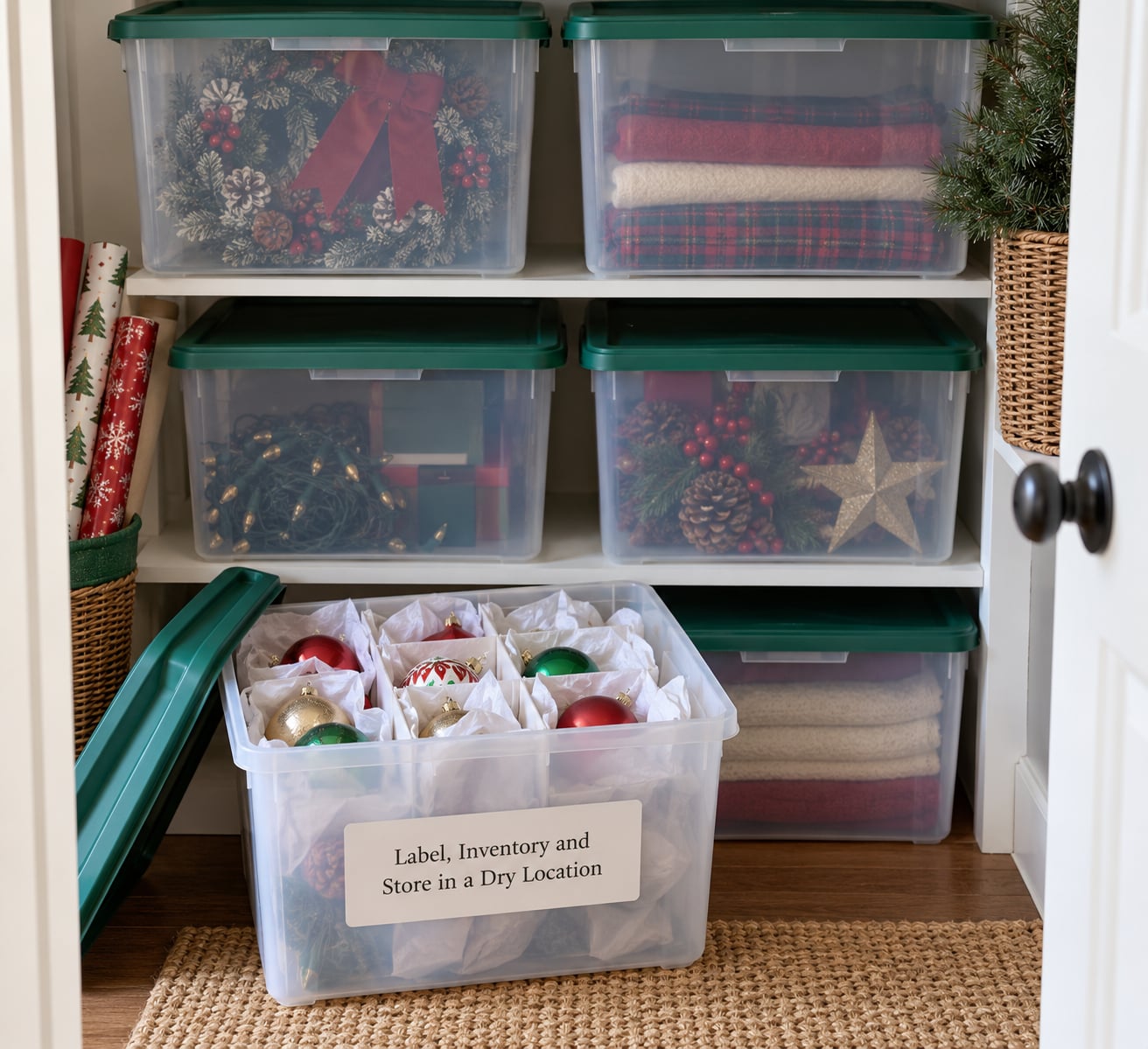
Label both sides of every container and the lid itself, then date it. A box marked “Ornaments — 12 — fragile” tells you next year whether it is worth keeping, and a date is how you notice that half the contents have not been touched in three seasons.
Write a short inventory list on your phone: how many wreaths, how many light strings, which room each one belongs to. It takes two minutes and answers the question organizers hear most often, which is not where the decorations go but what was actually inside the boxes in the first place.
Choose the coolest, driest spot you have. A closet shelf inside the house beats an attic in almost every case, because heat swings make plastic brittle, soften glue and fade fabric. In a garage or basement, line bins off the floor, use lidded containers with clasps so mice cannot reach the cords, and add cedar blocks or moisture absorbers. Stack no more than two high, and leave a path so you are not hauling a full bin over your head in December.
Common Mistakes
Almost every broken ornament traces back to one of these, and each has a simple correction.
- Dumping everything into one mixed bin. Weight from linens and boxes below crushes shapes. Fix: one container per category, and fragile pieces in their own small container.
- Coiling lights in a ball. Fix: wind onto a cardboard core and secure every few turns.
- Stacking ornament boxes full. A box with no headroom lets pieces shift and knock together in transit. Fix: fill voids with shredded paper and leave two inches at the top.
- Forcing branches back into the original tree box. Fix: use a tree bag with straps, compress gently, and accept a smaller silhouette.
- Stacking wreaths flat. Fix: hang each one on a hook in a bag or case so it keeps its round shape.
- Attic or garage storage for anything fragile. Fix: move glass, paper, fabric and wax indoors. Keep only plastic and sturdy metal out there.
- Unlabeled boxes. Fix: label the front, the back and the lid before it goes on the shelf.
- Packing damp linens. Fix: dry everything fully, and skip the vacuum bag if the fabric is even slightly damp.
Two habits do more than any container. Take the setup photo before you touch anything, and date every box when you close it. Together they turn packing into a system rather than a chore.
Do not store what you will not use. One honest pass at the end of the season — donate what is in good condition, discard what is broken beyond repair — often frees a whole bin, and bin space is the real constraint most of us are fighting.
Frequently Asked Questions
What is the best way to store holiday decorations?
Sort decorations into categories, clean and dry each one, wrap glass and ceramic pieces individually, wind string lights onto a cardboard core, and seal everything in labeled lidded containers kept in a cool dry room. Ornament boxes with dividers protect fragile pieces best, and shallow bins keep light coils from tangling again.
How do you keep ornaments from breaking in storage?
Give every fragile piece its own wrapper and its own space. Tissue paper or bubble wrap handles surface protection; shredded paper fills empty space so pieces cannot shift; and two inches of cushioning at the top stops anything moving when the bin is lifted. Avoid bin bags entirely, since they crush as soon as anything rests on them.
How do you store Christmas lights without tangling them?
Never ball a strand up. Lay it flat, plug end first, and wind it around a cardboard core in one direction, adding a zip tie every few turns, then loop a ribbon or twist tie around the whole coil. Store coils lying flat in a shallow bin rather than standing on edge, and never wind a strand too tightly or you risk creasing the wire.
Is it okay to store Christmas decorations in the garage?
A garage is fine for sturdy plastic and metal decorations in lidded, clasping containers kept off the concrete floor. Leave glass, ceramics, paper ornaments, fabric, candles and anything with glue out of it, since temperature swings make plastic brittle and fabric musty. Add cedar blocks or moisture absorbers, and remember that mice chew light cords inside bins.
Can you store Christmas decorations in the attic?
Only if the attic is finished, floored and reasonably insulated. Unconditioned attics swing widely between freezing and overheating, which fades fabric, softens glue, warps wreaths and cracks plastic. An indoor closet, under-bed bin or a raised shelf in a dry basement is safer for anything fragile. If the attic is your only option, use sealed lidded bins and no fragile pieces.
Where to put a Christmas tree when you have no room?
Use a tree bag with straps rather than the original box: compress each branch section gently and lay it flat inside. Slide the bag under the bed, stand it upright in a closet, or hang it from a ceiling hook so it does not occupy floor space at all. If you skip the bag entirely, set the tree on its side in a large bin with tissue between the layers.
Conclusion
Start where the risk is highest: wrap the fragile ornaments first, wind the lights before you pack them away, and label every container the moment you close it. Then pick the coolest, driest space you have and keep heavy bins low. Do one declutter pass before the boxes go on the shelf, and take a photo of the setup before you touch anything — that single photo is what makes next year quick.
That is the whole method behind how to store holiday decorations so nothing breaks: one category per container, a wrapper around every fragile piece, and a label on the lid. Storage does not need to be a big job. It needs to be boring and repeatable, and the same method every January is what keeps the breakages at zero.