How to declutter a room in one weekend comes down to two focused days plus Friday prep: set up sorting stations Friday night, make the decisions Saturday, then clean, put away and restyle on Sunday. Pick one room, pull everything out of it, sort it into keep, donate, sell and trash, and return only what earns a place. Budget around ten hours total and the room is finished, not halfway.
The trick is resisting the urge to do the whole house. A weekend is enough for one room done properly, and one finished room gives you something you can actually maintain. Sorting in place while you decide is where most projects stall, so this plan pulls each zone out onto the floor and works through it.
Pick the room that annoys you most, not the one that looks worst. If you spend ten hours there and it works, you will keep doing it. If you start with the room you secretly dread, you will abandon it by Saturday lunch.
Table of Contents
- What You Need
- How to Declutter a Room in One Weekend: Step-by-Step Plan
- Friday: Set Up Sorting Stations and Clear the Room
- Saturday Morning: Make Quick Decluttering Decisions
- Saturday Afternoon: Organize What You Are Keeping
- Sunday Morning: Clean the Empty Space
- Sunday Afternoon: Style the Room and Finish
- Common Mistakes
- Frequently Asked Questions
- What are some tips for decluttering a room?
- What are the four C’s of decluttering?
- Is it possible to declutter in one week?
- What are 6 things I can do every day to keep my house clean?
- How do I get rid of stuff I feel emotionally attached to?
- Should I buy organizing products before decluttering?
- Start With the Biggest Clutter Zone
What You Need
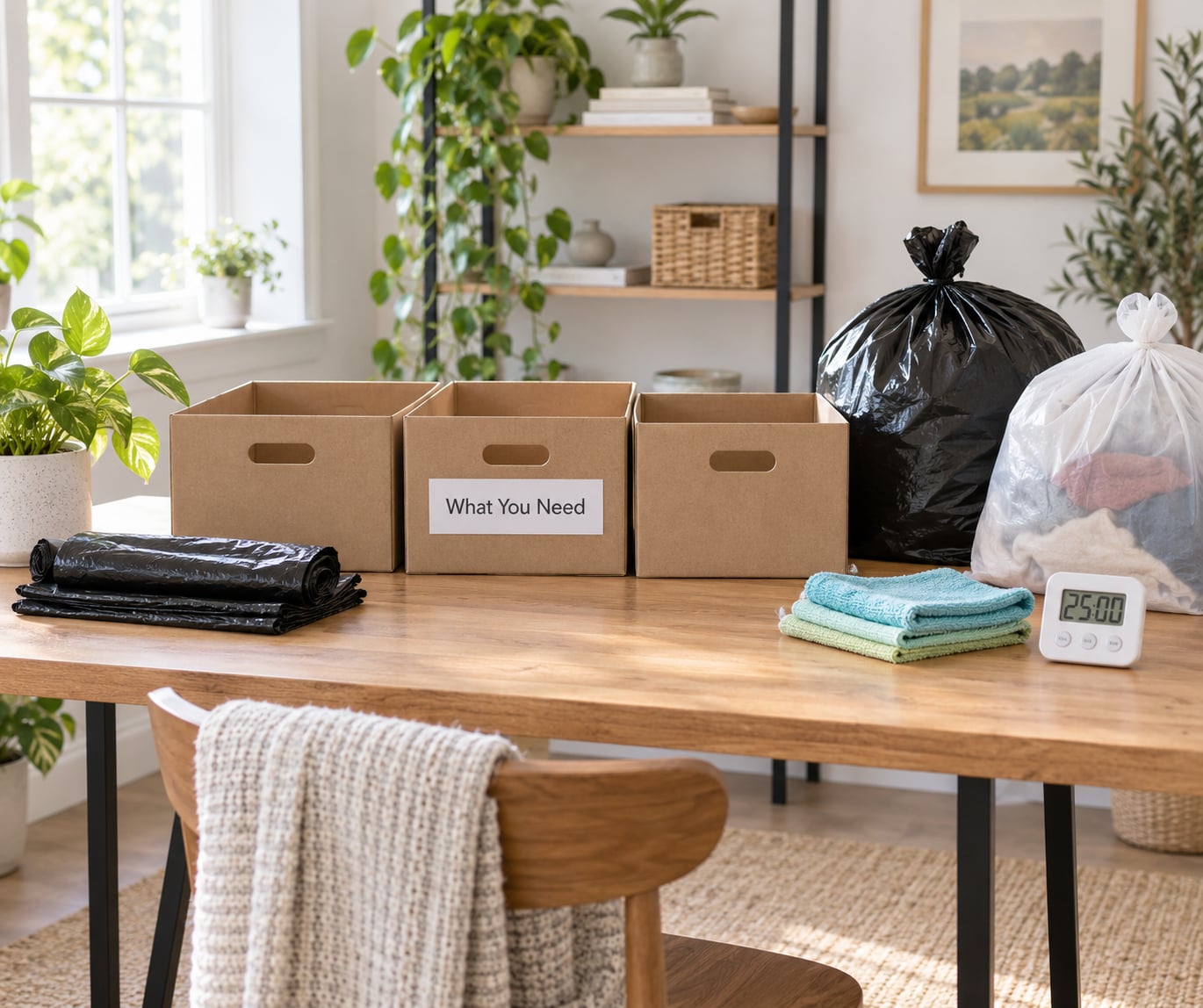
You need containers for the destinations before you start, not after. Set these up on Friday and the whole weekend runs faster.
- Trash and recycling bags for paper, broken items and packaging. Keep two bags open at all times so you never walk to the bin mid-pile.
- Sturdy boxes or laundry baskets for donate and sell. Label each one in marker so you can see the destination without lifting anything.
- One tote for items that belong in another room. This stops the pile of things you meant to put away somewhere else from climbing back onto the floor.
- A shredder or the recycling bin for papers. Most clutter piles hide a stack of mail, statements and old paperwork that no longer needs a home.
- A timer, phone alarm or kitchen timer. Setting ten minutes per zone is the single most effective tool for beating decision fatigue.
- Cleaning supplies: all-purpose cleaner, microfiber cloths, a duster, a vacuum, and a mop or broom for the floor once it is exposed.
- Painter tape and a marker for labelling shelves, bins and the re-entry spots so Sunday’s put-away goes fast.
What you do not need is a shopping trip. Matching bins, drawer dividers, decanted canisters and labelled baskets all look like progress and hide the real work. People who declutter report the same thing over and over on cleaning forums: organizers bought at the start turn a decision into a purchase, and the pile ends up sorted into new containers instead of sorted out.
Use what you already own. Tupperware, ice cube trays, shoeboxes and the good basket do the job fine for a weekend. If you want containers afterwards, you will buy the right sizes instead of guessing.
Decide what happens to each category before you start, and write it down. Keep items go back. Donate items go in the labelled box. Sell items get a price and a date, with a hard rule that anything unsold by the following Saturday goes to the donation box. Relocate items go in the tote for their actual room. Trash goes in the bag.
How to Declutter a Room in One Weekend: Step-by-Step Plan
Here is a realistic time budget. Adjust the times to your stamina, but keep the order, because each block depends on the one before it.
| When | Zone | What You Do |
|---|---|---|
| Friday, 45 to 60 minutes | Setup | Clear a floor area in the room, choose the first zone, label containers, empty all bins and drawers loose items |
| Saturday morning, 90 minutes | Surfaces and floor | Pull everything off shelves, counters and the floor into one pile, then sort |
| Saturday afternoon, 2 to 3 hours | Closets, drawers, under-bed | Empty each container completely, wipe it out, sort contents, return only what stays |
| Saturday evening, 45 minutes | Papers, books, linens, decor | Shred old paperwork, stack books, pair linens, box up fragments |
| Sunday morning, 90 to 120 minutes | Cleaning | Dust, wipe, scrub, vacuum and mop every exposed surface while the room is empty |
| Sunday afternoon, 60 to 90 minutes | Styling and finish | Return keeps, arrange surfaces, test the room’s function, bag up donations for removal |
Friday evening is setup only. Do not start making decisions on Friday, because a tired Friday night decision is a decision you will question on Saturday.
Friday: Set Up Sorting Stations and Clear the Room
Pick one room and one first zone. For a bedroom that is usually the closet or the nightstand. For a living room, start with the coffee table or one end of the sofa. Starting with something you can finish builds momentum, and people who tackle the worst room first tend to stop there.
Empty the trash and recycling bins completely so you are working with empty containers. Then pull every loose item off surfaces and out of drawers and drop it in one central pile on the floor. Do not sort yet. The unsorted pile is the point, because it shows you the true volume of what you own.
Now set your stations along one wall: keep bag or box, donate box, sell box, relocate tote, trash bag. Label each with tape and marker. Keep your timer somewhere you can see it.
Write one sentence on paper describing what “done” looks like for this room, such as a clear floor, a made bed and a closet you can shut. That sentence is what you judge Sunday against, and it stops the project from expanding into the rest of the house. It is also the habit that makes how to declutter a room in one weekend repeatable rather than a one-off.
Saturday Morning: Make Quick Decluttering Decisions
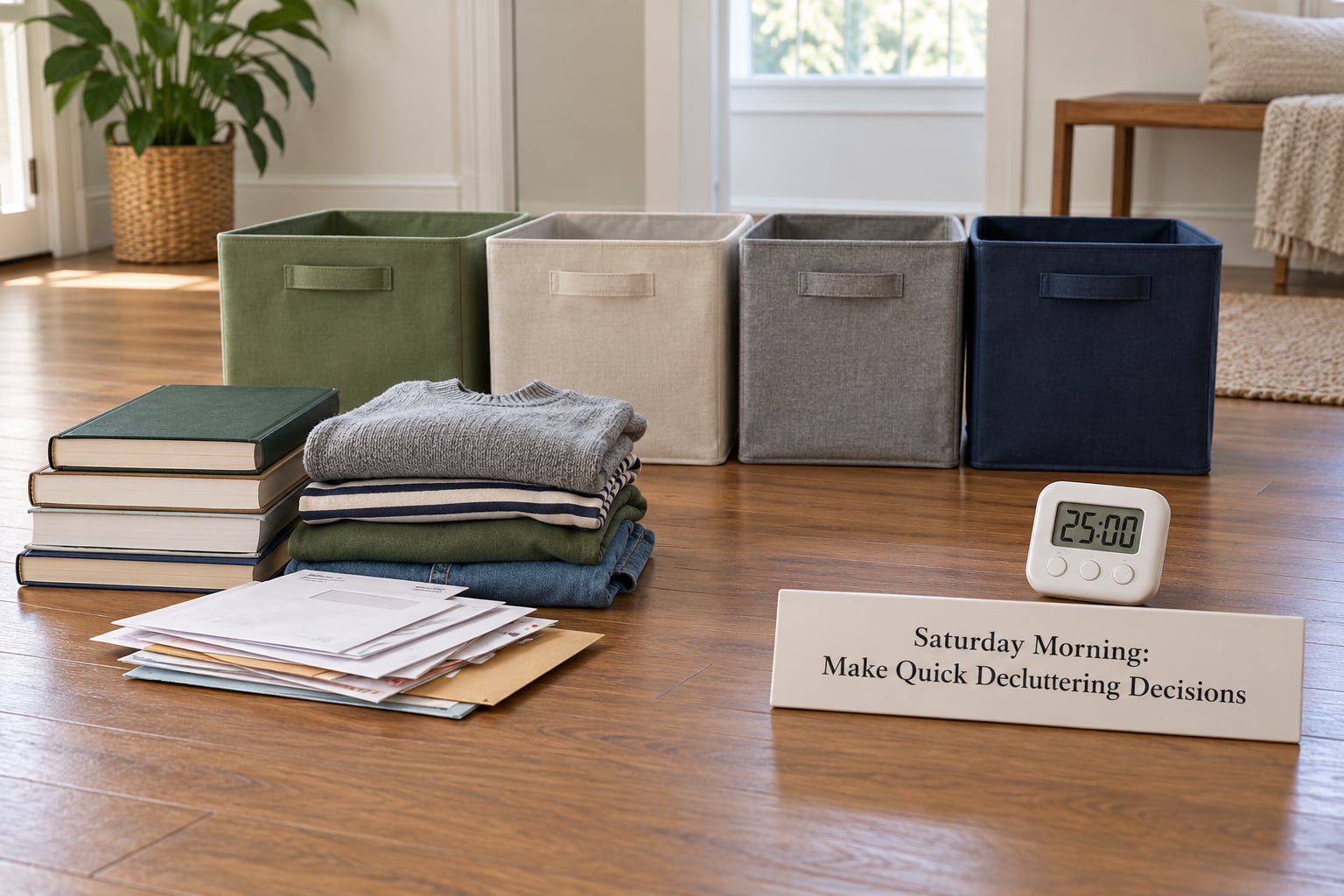
Set the timer for ten minutes and sort the central pile. No pausing, no circling back. Put each item in a destination and move on. When the timer rings, clear the bag or box into the next zone and reset it.
The ten-minute rule works because sorting speed comes from not thinking, not from being thorough. Most of what you own has an obvious answer, and the hesitation is about a hypothetical future version of yourself rather than the object in your hand.
A few shortcuts make the morning go faster:
- The 12-month rule. If you have not used or thought about it in the past year, it is a donate or trash candidate. Calendar gifts, hobby gear you abandoned and half-finished projects fall here quickly.
- The 10-minute use test. Anything you do not need for the next ten minutes around the room does not go back into the room.
- The one-in, one-out rule. Once the room is done, anything new coming in sends one equivalent thing out.
- The maybe bag with a date. Put uncertain items in a labelled bag, write today’s date on it and a decision deadline before the weekend ends. A bag with a date is a decision you have already scheduled, not a pile you avoid.
Handle categories separately rather than mixing them. Papers first: shred or recycle statements, junk mail and anything older than a year you never opened. Then books, then linens, then decor. Mixed piles cause circling, which is the single biggest time sink during a declutter, and it is where a lot of weekend attempts quietly lose an hour.
People on decluttering forums describe this exact sequence as the working method: pull everything out, sort it into destination boxes, and never make someone else’s decisions. Anything belonging to a partner or a child goes into a labelled bag and gets discussed later rather than discarded on the spot.
Saturday Afternoon: Organize What You Are Keeping
Before returning anything, wipe out the empty spaces. Dust the shelves, wipe the drawers, vacuum the baseboards and corners. Cleaning an empty container takes two minutes; cleaning it once it is full takes twenty.
Give every retained item a specific home before it goes back. An item without an assigned spot is an item that will migrate back onto the floor by Wednesday. Work zone by zone and finish one before starting the next.
Group similar things together and keep each group’s count visible. When you can see nine mugs, six of them leave. Stack books vertically or in short horizontal piles you can actually lift. Use the vertical space on shelf ends and the wall above, since most rooms have more empty air than closed storage.
Containment has one hard test: if you cannot see the bottom of a bin from the front, it is too full and the excess goes to the donation box. Storage that hides clutter is not organization, it is delay.
Sunday Morning: Clean the Empty Space
With the room still mostly empty, cleaning goes fast and the result looks dramatically better. Work top to bottom and far to near so you never drag dust over a finished floor.
- Dust the tops of shelves, the crown moulding, the tops of door frames, the baseboards and any vents or returns.
- Wipe down shelf surfaces, drawer interiors, cabinet doors and the hardware on drawers and knobs with an all-purpose cleaner on a microfiber cloth.
- Wash the window glass if it is interior, and wipe the light switch plates and door frames, which is where the visual grime hides.
- Vacuum the corners and edges, then mop hard floor from the far corner toward the door.
- Empty and wipe the bins you are using for this room before they go back to work.
Allow about two hours for a standard room. If the room still feels dirty after cleaning, it was probably still too full while you cleaned, which is why the Saturday pull-everything-out step matters. Most of the effort in how to declutter a room in one weekend is that pull, not the mop.
Sunday Afternoon: Style the Room and Finish
Return the keeps in a specific order: large items first, then mid-size, then small things last. Group them so the eye reads a few deliberate clusters rather than even spacing across every surface.
Style sparingly. Put one object on top of a dresser, one on a shelf corner, leave the rest of the surface empty. Empty space is what makes the weekend’s work visible, and it is the first thing that gets filled back in, so leave room for it.
Test the room’s function now. Can you still walk through, sit down, find the light switch and clear the surface you use daily? If anything is blocked, that item goes rather than gets rearranged.
Then close the loop on everything you removed. Bag up the donate box, load the sell box and either list it tonight or commit it to the donation box. Set an alarm for a drop-off or pickup slot. Donation piles that sit in a corner for six weeks generate the guilt that stops people starting again.
Electronics and batteries go to a proper e-waste drop-off rather than the regular bin. Textiles with no resale or donation value often qualify for textile recycling bins instead of landfill. Take a quick photo of the finished room for your own reference, then do a final five-minute sweep.
Common Mistakes
Sorting in place. This is the most common failure. If you sort an item and immediately put it back somewhere else, you circle the same room repeatedly and never see the full volume. Pull the whole zone out first, then sort.
Buying organizers at the start. Matching bins and drawer dividers give the feeling of finishing without any of the decisions. Declutter with what you already have, and buy storage only after you know the exact sizes you need.
Letting the project spread. If you migrate items into three other rooms, you have made three other rooms messier and gained three more zones. Use the relocate tote only for things with an obvious destination, and finish everything in the box on Sunday.
An open-ended maybe bag. Without a date, a maybe bag becomes permanent storage and the room is not actually finished. Write the date on the bag and deal with it before the weekend ends.
Spending all Saturday deciding. Decision fatigue is what makes people quit at hour four. Ten minutes per zone with a running timer keeps you moving, and most decisions take seconds once you stop debating them.
Discarding other people’s things without asking. Clothes, hobby gear and memorabilia belonging to a partner, a kid or a deceased relative need a conversation, not a bin. Use a labelled bag and a scheduled chat.
Stopping halfway and hiding the evidence. If Saturday runs out, that is fine. Close the boxes you sorted, put the donate bag by the door and finish the next session rather than shuffling everything back into a drawer. Reversing your work is what turns one unfinished weekend into a room that looks worse than it did before.
Then protect the result. A daily ten-minute reset where you return things to their assigned home and wipe the counters prevents most of the rebound. Add a weekly fifteen-minute purge for one drawer or one surface, and keep the one-in, one-out rule running permanently.
Do the digital version too. On the same weekend, clear the downloads folder, delete apps you stopped opening and archive the emails older than a year. It takes twenty minutes and it is the same muscle you just used on the closet.
Frequently Asked Questions
What are some tips for decluttering a room?
Start with one room and one zone, and pull everything out before you sort anything. Label containers for keep, donate, sell, relocate and trash before you begin, then work in ten-minute blocks with a timer. Use the 12-month rule for anything unused in the past year, keep a maybe bag with a written decision date, and buy no organizers until the sort is finished.
What are the four C’s of decluttering?
The four C’s are Categorize, Cut, Contain and Control. Categorize means grouping your belongings into clear categories so you can see them together. Cut is the decision stage, where you donate, sell or discard. Contain means giving each kept category a specific, reachable home. Control is the maintenance step that keeps the room clear once the weekend is over.
Is it possible to declutter in one week?
One room in a weekend is realistic and one whole house in a week usually is not. Weekly free time is fragmented, and most of the work is decision-making rather than cleaning, which is hard to do in short evening sessions. Pick the room that bothers you most, finish it completely including cleaning, and let that finished room be the proof that the method works before moving on.
What are 6 things I can do every day to keep my house clean?
Six daily habits cover most of it: return items to their assigned home immediately, put dirty laundry in the basket rather than on a chair, wipe kitchen and bathroom counters nightly, run the dishwasher before it stops overnight, do a two-minute sweep of each room before bed, and clear your desk and coffee table at the end of each day.
How do I get rid of stuff I feel emotionally attached to?
Give each meaningful item a decision date rather than deciding in the moment. Photograph the item, note who or what it is connected to, and keep one or two pieces that hold the real memory. For the rest, ask whether keeping the object serves you or only creates guilt every time you open that drawer. Guilt is a poor storage system.
Should I buy organizing products before decluttering?
No. Buying bins and dividers before the sort turns a decision into a purchase, and you will end up organizing clutter instead of removing it. Use the containers you already have, finish the sort and the clean, then measure what actually needs containing. Most people end up buying a fraction of what they would have bought on Friday night.
Start With the Biggest Clutter Zone
If you do one thing this weekend, choose the room you walk past most, pull everything out of it and label your five containers before you sort a single item. That single decision, the pull-everything-out step, is what separates a room that gets finished from a weekend that ends with everything back in the drawer. If you want a repeatable version of how to declutter a room in one weekend, write that one sentence of intent on paper first.
Work one room at a time and finish it completely, including the clean, before you start anywhere else. A finished room teaches you how much stuff you actually own, and it gives you a daily ten-minute habit worth protecting.
One last practical detail: take a photo of the cleared floor before you start. Most people underestimate how much they own, and that photo is usually what keeps them going at hour three on Saturday.