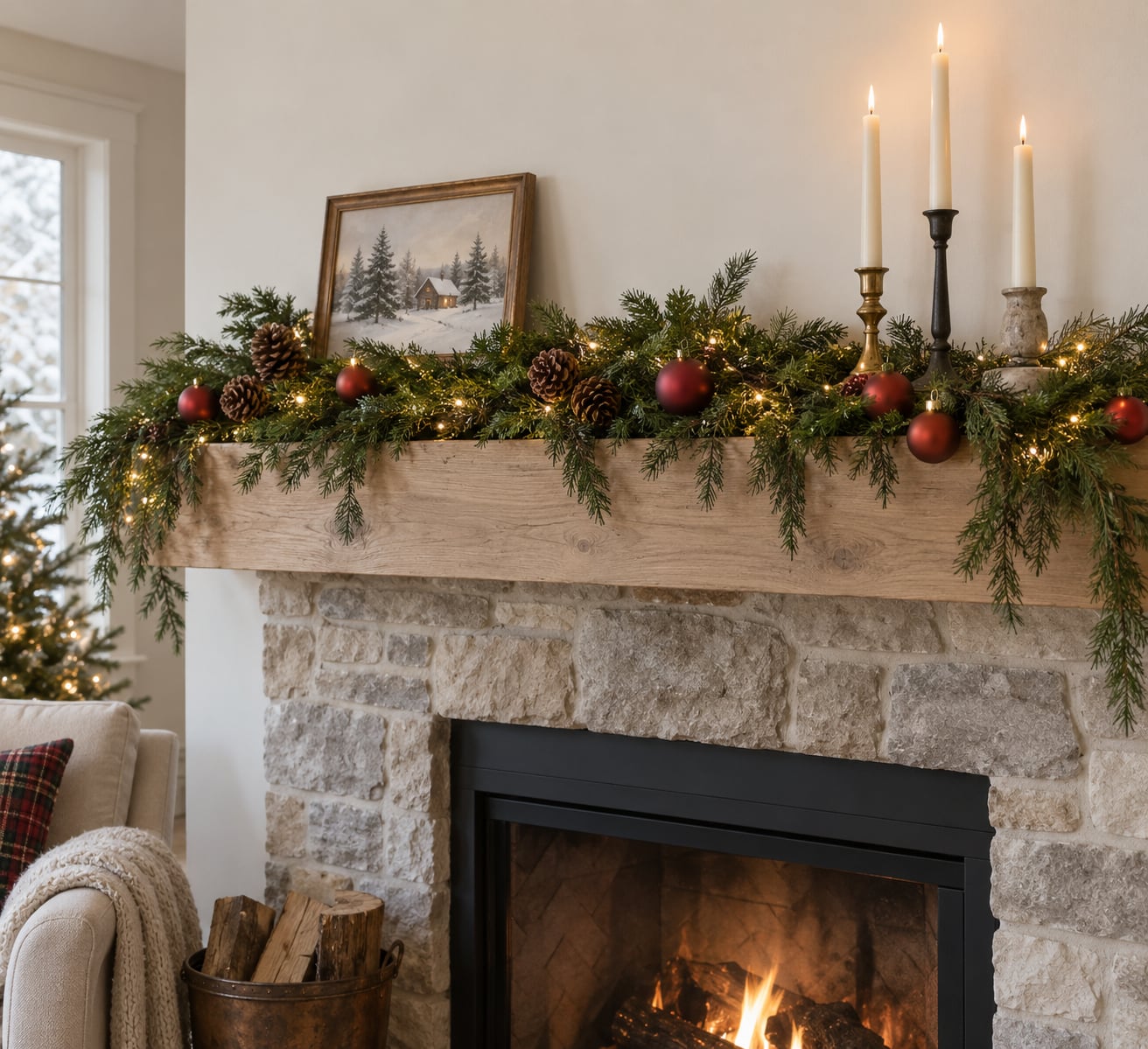
To decorate a mantel for Christmas, run one full-length evergreen garland across the back of the shelf, build two or three groupings of objects at staggered heights, then hang stockings along the front edge and weave warm lights through everything. On a standard 48 to 60 inch mantel that takes about an hour, start to finish, and most of the pieces can come from a closet, a thrift store or the yard.
The reason the mantel feels like the hardest decorating surface in the house is that it is a narrow shelf with a mirror or a firebox hanging above it, so there is nowhere for a mistake to hide. What works is a repeatable formula rather than a specific theme: greenery as the base, one anchor piece, groups of three or five, and a limit of two accent colors.
I have re-decorated the same family mantel for years with nothing but a dollar-store garland, thrifted frames and whatever pinecones came off the yard tree. The shelf never looks empty because the formula fills the space every time. This guide breaks that formula into five steps, plus the rules on height, the ways to hang garland without marking the wood, and what to do when your mantel is narrow, your ceiling is low, or your fireplace is actually working.
Table of Contents
- What You Need
- Greenery base
- One focal piece
- Groups of three or five
- Texture accents
- Stockings and lights
- Basic tools
- Step-by-Step: How to Decorate a Mantel for Christmas
- Measure and Clear the Mantel
- Create a Greenery Base
- Add a Main Focal Piece
- Layer Objects in Odd Numbers
- Add Lights and Warm Details
- Common Mistakes
- Frequently Asked Questions
- What are the rules for decorating a fireplace mantel?
- How do I hang garland on a mantel without damaging the wood?
- How do you hang stockings on a mantel without a stocking holder?
- How do I decorate a fireplace with no mantel?
- How much garland do I need for my mantel?
- Is it safe to decorate a mantel above a working fireplace?
- Conclusion
What You Need
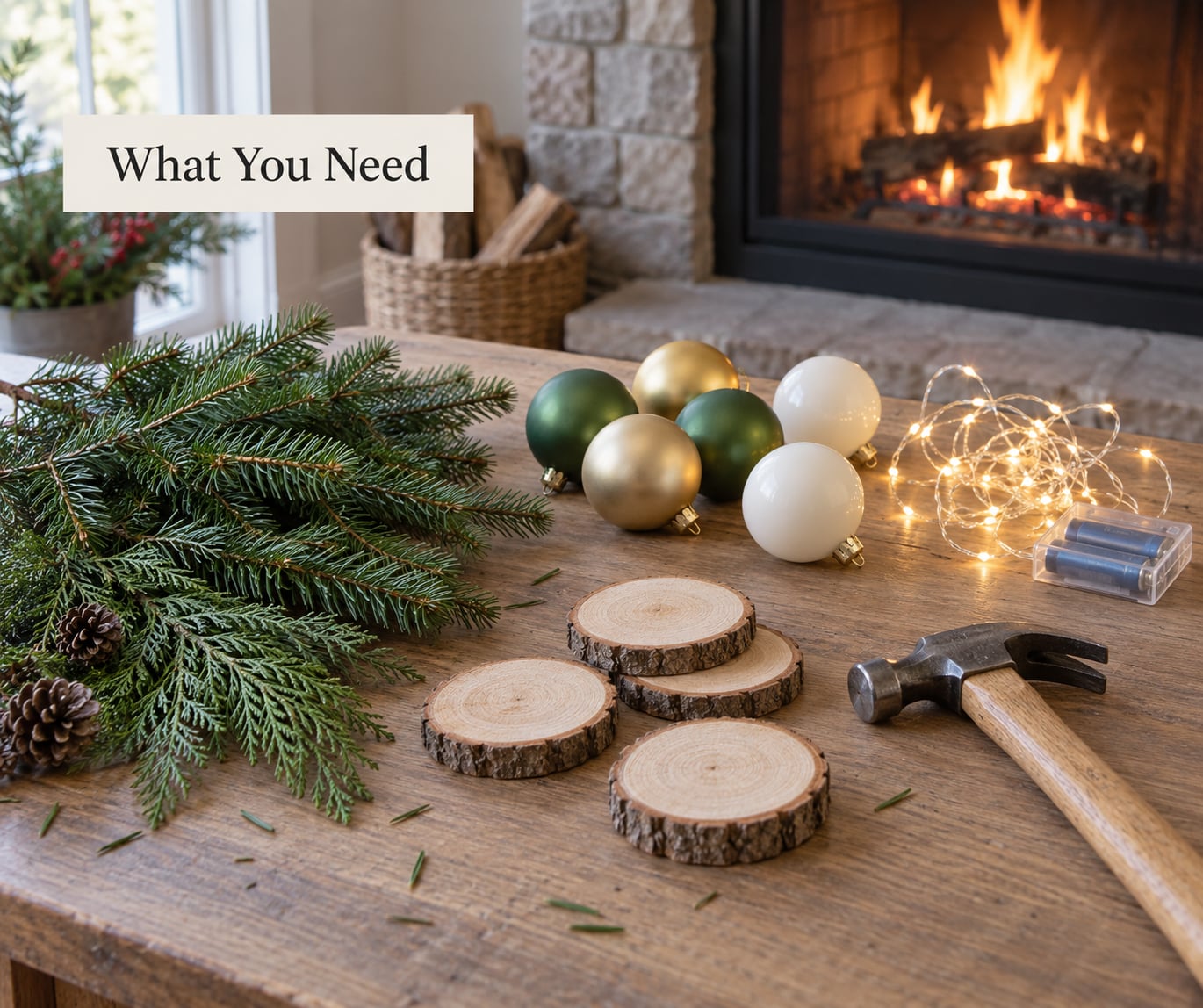
You need less than a shopping list implies, because most mantel decor is a shape problem, not a supply problem. Pick one item from each group below and you can build a full display.
Greenery base
A pre-lit garland is the fastest route, since the lights are already threaded and evenly spaced. Unlit garland lets you control where the light sits, which matters on a shallow shelf. Fresh-cut fir, pine, cedar or boxwood looks best for the first two weeks and needs a light mist of water every other day. Magnolia and eucalyptus are the two workhorses for a warmer, less traditional palette.
One focal piece
A framed sign, a small mirror, an oversized ornament, a pair of candlesticks or a set of antique books. This is the single tallest or widest thing on the shelf, and it belongs near one end or dead center, not everywhere.
Groups of three or five
Odd-numbered groupings read as intentional because the eye completes the pattern. Mix heights and materials: one tall, one medium, one short, and let two of them share a material so the third stands out.
Texture accents
Pinecones, dried orange slices, wood slices, cinnamon sticks, velvet ribbon, small bells. These fill the gaps between your groups and keep the display from looking empty in the middle.
Stockings and lights
One stocking per family member plus a spare, and warm white lights. Battery-operated lights solve the extension cord problem entirely, which is the single most common complaint I hear about mantel displays.
Basic tools
Command hooks or removable adhesive strips, floral wire, scissors, a small tack hammer, and a ruler or tape measure. That is the whole list.
Nearly every item above has a substitute already in your house. Plain glass jars, thrifted frames, a wooden crate, a cutting board leaned against the wall, or a stack of old books all work as focal pieces. If you want to skip greenery entirely, a row of candlesticks with taper candles and a few framed holiday cards is a legitimate, calm-looking mantel.
Step-by-Step: How to Decorate a Mantel for Christmas
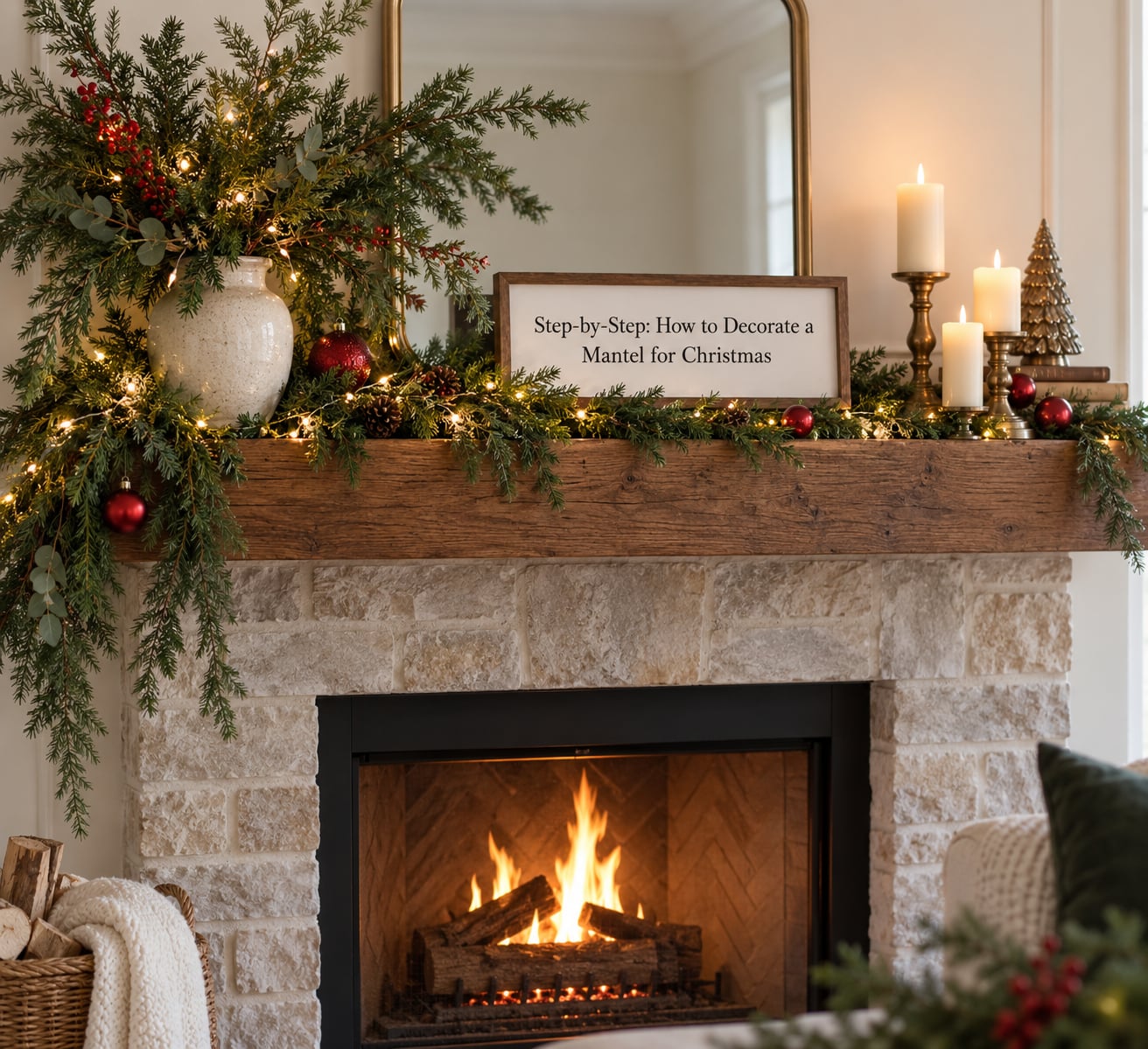
Work in this order every year. The order matters because the greenery base sets your depth, and everything else gets placed relative to it.
Measure and Clear the Mantel
Measure the width of the shelf from end to end and note the ceiling height above it. Most mantels run 48, 60 or 72 inches, and anything under about 30 inches wide should be treated as a small mantel with its own rules. Then take everything down, dust the shelf and the surround, and wipe the finish with a damp cloth before anything goes back up.
Before you place a single thing, decide where the largest visual element will sit. If it goes dead center, everything else balances around a single point. If it sits off to one end, you get an asymmetrical look that is more forgiving on a wide or uneven shelf. I decide this before I unbox anything, because rearranging a built display is the slow part.
Create a Greenery Base
Lay the garland along the back edge of the shelf so the front third of wood stays visible, then secure it so it will not creep forward. A swag that droops over the front edge is a deliberate style choice, but if you did not plan for one, it will read as a mistake by December 5.
For garland length, measure the mantel width and multiply by one and a half for a full, heavy drape or by two if you want a deep swag. Ten feet of garland on a six foot mantel gives you the drop. For a top-edge-only look with no trailing length, lay a flatter, bendable garland straight across the back and let it support itself, which is also the cleanest option under a low ceiling.
If you want volume rather than length, add separate sprigs in clusters of three, angling the stems in different directions. Real greenery belongs in a jar of water at the back if you have room; faux greenery gets fluffed and bent by hand first, because it comes out of the box looking like a pipe cleaner.
Add a Main Focal Piece
Add a main focal piece next, and make it the tallest object on the mantel. A useful ceiling rule: nothing on the shelf should come within about 12 inches of the ceiling line, and nothing should rise above the top of the fireplace opening by much, or it starts to compete with whatever hangs above the mantel.
Whatever you choose, keep it from blocking the firebox. A wide mirror works as the background itself rather than sitting on the shelf. A framed sign can lean against the surround, which stops it from needing any hardware. An oversized ornament on a small stand takes up the visual space of something twice its actual footprint, which is useful on a narrow shelf.
Layer Objects in Odd Numbers
Build two or three groupings across the shelf. One grouping plus a focal piece covers a narrow mantel; three groupings cover a wide one. Inside each group, vary the heights by a few inches so the tallest item is not in the same spot in every group, and do not line anything up in a straight line across the mantel.
Mix textures deliberately. A smooth glass ornament against rough pinecone, a matte ceramic next to shiny metal, soft velvet ribbon under a hard wooden frame. That contrast is what makes a small group read as designed rather than accumulated.
Fill the negative space between groups with the low stuff: pinecones, wood slices, small bells, a folded length of ribbon. If you stand the mantel back from the wall a few inches, this is also where you route the light cord so it disappears behind the greenery.
Add Lights and Warm Details
Weave warm white lights through the greenery and let the bulbs sit at different depths, some tucked in and some facing forward. If you use a plug, run the cord behind the surround and plug into the nearest outlet, which is usually the one at the base of the fireplace. If the cord is the wrong color, a short roll of cord cover in your wall color fixes it in about a minute.
On a narrow mantel, cut everything back instead of squeezing it in. Drop to one grouping plus the focal piece, keep the tallest object under about 10 inches, and push the greenery into a shallow band at the back so it does not eat the walking surface. If your ceiling is under nine feet, skip the tall centerpiece entirely and build the display in two low tiers instead, because a single tall piece in a low room reads as top-heavy no matter how good it is.
On a very long mantel, resist the urge to spread one theme evenly across the whole length. Break it into two separate scenes with a clear gap of bare wood between them, each with its own grouping. The gap is what stops the shelf from reading as one stretched-out row.
For stockings, hang them from the front edge of the shelf with removable strips or Command hooks, spacing them a few inches apart and varying which ones hang slightly lower. Stocking holders are optional. They just weigh the stocking so it does not swing.
Finish with candles. Three to five taper candles in mismatched holders at different heights is the classic move; flameless LED candles are the right call on any working fireplace. Put the candles in front of the greenery rather than behind it so the glow reads.
And then turn everything off except the lights, walk into the room, and look at it from where your sofa sits. That is the view that matters, and it is the only real test of whether the display is balanced.
Common Mistakes
Overcrowding the shelf. When everything competes, nothing reads. Remove a group and look again; if the display gets stronger, it was too full. As a rough budget, leave about a quarter of the shelf surface bare.
Too many colors. Pick two accent colors and let greenery and wood be the neutrals. A third color is almost always the one making things look busy.
Every object at the same height. This is the flattest, most common mistake. Stagger heights by two or three inches inside each group and the same objects suddenly look styled.
Crowding the corners. The far ends of a mantel should breathe. Push the outermost objects in a few inches from each end and the display looks wider and calmer.
Visible cords. An exposed extension cord across the front of a mantel is the detail people notice most and like least. Use battery-operated lights, route the cord behind the surround, or cover it.
Decor that ignores the room. A red and white scheme in a warm neutral living room looks borrowed. Pull two colors from what is already in the room, the rug, the curtains, the sofa, and let the mantel follow the house.
Ignoring heat. Real wax candles, dry greenery and paper decorations within about 12 inches of a working firebox opening is how mantel displays get scorched. Push everything outward, keep the chimney breast above clear, and check the clearance numbers in your fireplace manual.
Frequently Asked Questions
What are the rules for decorating a fireplace mantel?
Keep objects between 3 and 15 inches tall, group them in odd numbers of three or five, and use two or three groupings across the shelf. Leave about a quarter of the surface bare, avoid lining objects up in a row, and keep the tallest piece near one end or dead center. Add contrast in texture rather than adding more objects.
How do I hang garland on a mantel without damaging the wood?
For most mantels the simplest fix is enough. Bendable garland laid along the back edge usually holds itself up. Where it will not, twist green floral wire around the stems at three or four points and pin it to the back of the shelf. Removable adhesive strips or Command hooks work for lightweight garland. Weighted hangers need no adhesive at all.
How do you hang stockings on a mantel without a stocking holder?
Attach removable strips or small Command hooks to the underside of the front edge and hang each stocking from one. Space them a few inches apart and vary the height slightly so the row looks casual. Heavy or wool stockings pull harder on the adhesive, so use a second strip per stocking and check them every few days.
How do I decorate a fireplace with no mantel?
With no shelf to work on, build the display vertically instead. Use the chimney breast or the wall above the opening: hang a wreath, a set of stockings on a tension rod, or a swag of greenery fixed with removable strips. A mantel-less electric unit usually has a narrow ledge, so treat it as a small mantel and keep everything low and stable.
How much garland do I need for my mantel?
Measure the mantel width and multiply by one and a half for a full drape with a modest drop, or by two for a deep swag that hangs over the front edge. For a flat top-edge look with no trailing length, the mantel width plus about a foot is enough. Add half again if you plan to layer two garlands.
Is it safe to decorate a mantel above a working fireplace?
Yes, with common sense spacing. Keep real candles, paper items, dry foliage and fabric out of the heat zone around the firebox opening, and leave the chimney breast above clear. Use flameless LED candles and battery-operated lights anywhere near the heat. Check your fireplace manual for its stated clearance and follow it over any general rule.
Conclusion
Five moves, in this order: clear and measure the shelf, run one full-width garland along the back and secure it, place a single focal piece near one end or center, build two or three groupings of three or five at staggered heights, then hang the stockings along the front edge and weave in warm lights. Everything above that, the texture accents and the odd-number rule, is detail.
Start tonight with the measurement and the decision about where the tall piece goes. Those two minutes decide whether the rest of the decorating takes an hour or an evening of second-guessing.