How to decorate for fall on a budget comes down to three levers: use what you already own, gather free things from outside, and spend only on the handful of pieces that carry a room. Most people do the opposite and wonder why the bill adds up fast. Updated for 2026, this plan covers a whole home and takes about one weekend, no craft experience required.
The trick is that fall decor is not a shopping list. It is a set of spots in your home that need one warm thing each, and those things are almost always cheaper than the seasonal aisle suggests if you swap instead of buy.
Table of Contents
- What You Need
- Already in the house
- Free from outside
- Cheap to buy, and only if you need it
- How to Decorate for Fall on a Budget by Tier
- Step-by-Step: How to Decorate for Fall on a Budget
- Step 1: Pick two colors and one accent
- Step 2: Audit what you already own
- Step 3: Refresh textiles and hardware before buying objects
- Step 4: Make two or three accents, not eight
- Step 5: Give every room one focal point
- Step 6: Light it, scent it, add the natural details
- Common Mistakes
- Frequently Asked Questions
- Where can I find inexpensive fall decorations?
- What colors work best for budget-friendly fall decor?
- Do I need to decorate every room for fall?
- How can I make fall decor look expensive without buying new furniture?
- What is the easiest way to decorate a living room for fall?
- Can I reuse fall decorations for Thanksgiving and Christmas?
What You Need

Before you buy anything, take stock. The list below is deliberately built from things most households already have, and only the last group costs money.
Already in the house
- Every neutral throw pillow and blanket you stashed in summer
- Glass jars, wooden bowls, cutting boards and metal trays
- Candles in jars you already burned down to the bottom
- Burlap or muslin fabric scraps and spare ribbon
- A hammer and nails, a staple gun, hot glue, scissors and a brush
- Baking soda and any chalk paint you have left over
Free from outside
- Leaves that have already fallen, kept dry where they will not brown further
- Pinecones, seed pods and interesting fallen branches
- Dried seed heads from late-season garden plants
- Apples or citrus sliced thin and dried in the oven for garlands
- Thin twigs from a pruning day, or a neighbor who is clearing out
Cheap to buy, and only if you need it
- One or two artificial mums, since live ones wilt within about a week of warmth
- Warm-white string lights, which are far more forgiving than cool white
- A plain foam wreath form or a grapevine ring for a DIY wreath
- Faux stems sold in bulk by the stem, not by the bouquet
- Small glass votives, which are cheap enough to scatter generously
How to Decorate for Fall on a Budget by Tier
The single biggest factor is how many rooms you insist on finishing at once. Pick a tier, buy for that tier, and stop. Prices shift week to week, so this table counts pieces instead of dollars.
| Tier | What it covers | Shape of the spend | How it will look |
|---|---|---|---|
| Tight tier | Entryway and one main room | Five to eight accent pieces, no textiles | Seasonal but restrained, mostly natural materials |
| Middle tier | Entryway, living room, dining table, kitchen | Two or three textile swaps plus one hero piece per room | Warm and layered, the point where it starts to look styled |
| Whole-home tier | Every room plus the porch | One hero piece per room plus a coordinated repeat buy | Full seasonal refresh that still avoids disposable decor |
Step-by-Step: How to Decorate for Fall on a Budget

Work in this order. Changing textiles before you know your palette is the most common reason a room ends up feeling busy rather than cozy.
Step 1: Pick two colors and one accent
Two main colors plus one accent is enough for a whole house. A safe pairing is rust and deep olive with cream as the accent, or burnt orange and warm brown with brass. Anything beyond that and the room starts asking for more pieces than you have budget for.
Write the three colors on an actual note. Refer back to it every time you unbox something, because a thrifted find in a fourth color is the item that breaks a scheme.
Step 2: Audit what you already own
Walk room by room and list what could already pass for fall. A rust throw, a plaid blanket, a dark wood bowl, an amber glass jar. Most homes already contain nine or ten fall pieces that were put away in June.
This is the free tier of decorating and it is the step people skip. Pull it all out, spread it across the floor, and look at it as a pile rather than room by room.
Step 3: Refresh textiles and hardware before buying objects
Swap throw pillows and blankets first. This is the cheapest seasonal upgrade that still looks expensive, because it changes the whole seating area for the price of a cushion cover.
Next, change what is visible and touchable: a coffee table runner, a dining runner in burlap or plaid, a dishtowel in the kitchen, a bed throw. Hardware comes after that if you have any, and only if it already exists to repaint.
Step 4: Make two or three accents, not eight
Small gatherings of one kind of thing always look more considered than scattered singles. These three projects need no sewing and no fine motor skills, which matters because the loveliest fall ideas online are usually the ones that quietly assume you enjoy crafting.
Dried citrus garland. Slice oranges or lemons thin, dry them at a low oven until leathery, then string with a needle and heavy thread. Use them on a dining table runner or a kitchen shelf. Budget: nearly nothing. Time: about 40 minutes plus drying.
Leaf and pinecone garland. Glue dried leaves and pinecones onto a length of twine or the edge of a burlap strip. Use a mix rather than a single leaf, because varied shapes read as gathered instead of purchased. Budget: the cost of twine. Time: 30 minutes once the leaves are dry.
Baking soda painted pumpkins. Mix chalk paint with a spoonful of baking soda until it is thick, then paint a thrifted foam pumpkin. The mixture dries chalky and textured, closer to ceramic than to craft paint. Add a slice of dried orange or a bit of moss at the stem. Budget: a small tin of paint. Time: 45 minutes plus drying.
Set a hard limit of three. Projects expand until the whole weekend disappears and half of them never get displayed.
Step 5: Give every room one focal point
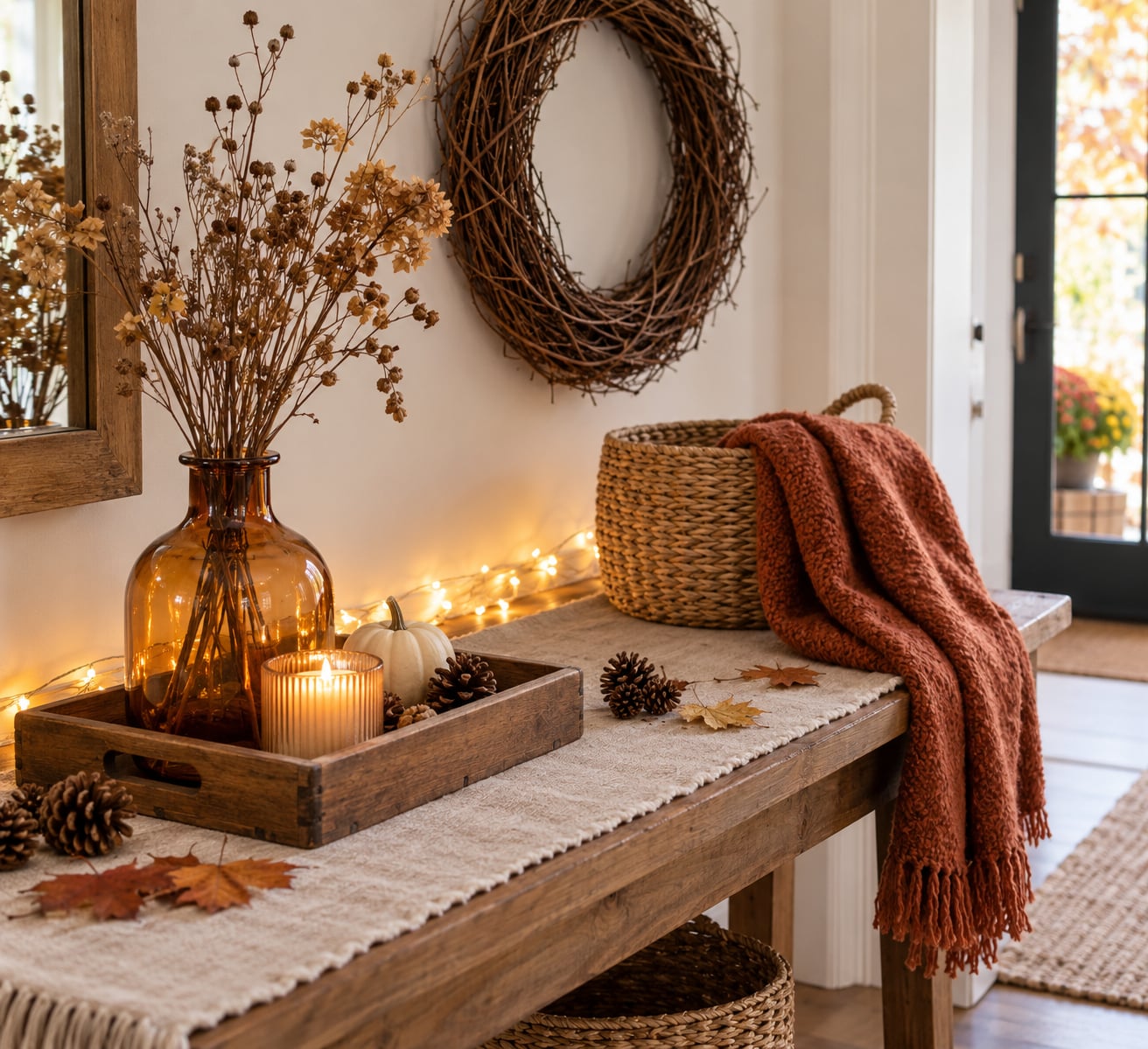
One focal point per room is the rule that makes budget rooms look deliberate. In the living room it might be the mantel, in the dining room the table, in the kitchen a shelf of jars, and in the bedroom the bed itself with layered throws.
Then stop and walk to the doorway and look back in. If you can point at the focal point in three seconds and cannot point at a second one, the room is balanced. That test works better than any rule about how much to put out.
A few reminders for apartments and rentals: leaning frames and shelves against a wall, adhesive hooks rated for the surface, and borrowing a rug rather than buying one you will not keep. No drilling, no damage to the deposit.
Step 6: Light it, scent it, add the natural details
Lighting does more per unit of effort than anything else you will do. Warm-white bulbs, a lamp with a low shade, and a few votives on the coffee table will make an undecorated room look like an autumn photo.
Then swap one candle for a seasonal scent, place three natural objects within sight of where you sit, and call the room done. Pinecones in a shallow bowl beat a fake arrangement every time at a fraction of the cost.
Timing matters for anything fresh. Mums hold for a week or two in heat, so buy them in early October rather than August. Whole pumpkins last eight to twelve weeks uncarved, and carved ones only a few days, so buy carved ones the morning of a gathering.
| Item | Best window | Cheapest source | Note |
|---|---|---|---|
| Live mums | Early to mid October | Farmers market, grocery endcap | Buy cool, never during a warm spell |
| Whole pumpkins | September and October | Farmers market, roadside stands | Often the cheapest real pumpkin route |
| Carved pumpkins | One or two days ahead | Any grocery or big box | Do not buy early, they soften fast |
| Faux stems and mums | August and September | Craft chains, discount home stores | Hold up for years, this is the reusable buy |
| String lights | September | Craft chains, hardware stores | Warm white only, cool white reads clinical |
| Wreath forms and ribbon | August | Craft chains, dollar stores | Basic forms work, decoration does not |
If you swap your summer pieces out in late September and wait until early October for mums and pumpkins, you get a full season without the August panic-buy. Harvesting decor straight from your own garden is another way to spend nothing, and people who grow their own seed heads for arrangements tend to end up with more than they need.
Common Mistakes
Most of what makes a home look cheap is not the budget itself. It is a handful of specific habits, and every one has a fix.
- Buying the whole set at once. You will almost always regret it by November. Fix: buy the mantel first, live with it a week, then decide what the room still needs.
- Using more than three colors. A fourth color reads as a collection of unrelated finds. Fix: pick two mains and one accent before the first purchase.
- Crowding every surface. Stuffing each shelf and side table kills the coziness that makes fall rooms work. Fix: leave a third of each surface empty.
- Ignoring the furniture you have. Fresh decor around tired furniture looks like a showroom staged around someone else’s sofa. Fix: refresh textiles and hardware before adding objects.
- Buying single-season pieces. Halloween-only decor ends up in a donation pile in January. Fix: buy things that stretch from October through Thanksgiving into winter, and swap contents rather than pieces.
- Choosing flimsy decor. Seasonal goods are often thin plastic and felt, and items built to last one season are the most common complaint about budget fall finds. Fix: buy almost nothing breakable, and choose things that can be stored and reused.
- Making too many DIY projects. Three unfinished crafts read as clutter. Fix: cap the list at three and finish all three.
- Skipping warm lighting. Flat overhead lighting undoes every good choice you made. Fix: lamps at low height, warm-white bulbs, a few real candles.
- Forgetting the entryway. It is the first thing guests see and the last thing most people style. Fix: one wreath, one mat, one warm light.
- Buying for trends you do not own the rest of. A trend borrowed without matching furniture and color simply looks borrowed. Fix: borrow the color, skip the object.
Two habits keep it affordable after the first weekend. First, keep every piece in one bin so next October takes twenty minutes instead of an afternoon. Readers with small apartments often solve this with lanterns and jars whose contents change for each season, because the container stays and only the filling swaps.
Second, write down what you spent before putting things away. Most households discover the total was lower than they feared, which makes the following year genuinely free.
Frequently Asked Questions
Where can I find inexpensive fall decorations?
Thrift stores, yard sales and free Buy Nothing or marketplace groups produce the best finds, especially for wood, glass and metal pieces you can repaint. Dollar stores and craft chains cover the small stuff like votives, ribbon, faux stems and wreath forms. Farmers markets and roadside stands are usually the cheapest route for real mums and pumpkins, if you buy them in early to mid October rather than August.
What colors work best for budget-friendly fall decor?
Pick two main colors and one accent, and stick to them. Rust with deep olive and cream, or burnt orange with warm brown and brass, are dependable. Keeping the palette small is what makes a low-cost room look styled rather than cluttered. Add nothing in a fourth color, even if it is on sale, and your limited budget will stretch much further.
Do I need to decorate every room for fall?
No. The entryway, living room and dining table cover most of what guests notice, and many households do only those three. If your space is small, a lit corner and a warm doormat can carry the whole seasonal feel. The trick is doing the rooms you choose completely, with one focal point each, instead of spreading thin effort across everything.
How can I make fall decor look expensive without buying new furniture?
Swap your textiles first. A rust throw, a plaid blanket and a table runner change the feel of a seating area instantly and cost a fraction of new decor. Repaint thrifted wood candlesticks with metallic spray paint, add warm-white lighting at low height, and limit each surface to one focal item. Layering texture does more than adding objects.
What is the easiest way to decorate a living room for fall?
Work outward from the mantel or the coffee table, since those are the two spots the eye lands on. Give that area one focal piece, add two or three seasonal textiles, then scatter three natural objects such as pinecones or dried seed heads in a bowl. Finish with warm-white lighting and skip everything else. That sequence takes about an hour.
Can I reuse fall decorations for Thanksgiving and Christmas?
Yes, and that is the smarter way to buy. Choose neutral pieces such as wood, glass, woven baskets, greenery and cream or rust textiles, then change the contents. Fill the same lanterns and jars with pinecones for fall, bare branches and gold tones for Thanksgiving, and greenery or greenery-adjacent stems for winter. The container does all the work, so you buy once.
Start tonight with the free part, because how to decorate for fall on a budget is mostly a swap job rather than a shopping job. Pull your summer textiles out, choose two colors and one accent, and swap the throws and blankets in the room you use most. Once you see how much that alone changes, you will know exactly which single piece is worth spending money on, and the rest of the season takes an afternoon instead of a weekend.