Updating a bathroom on a budget comes down to changing the surfaces you look at most and leaving the expensive plumbing alone. Repaint the walls, repaint or restyle the vanity, swap the hardware, refresh the lighting, redo the grout and caulk, then restyle with thrifted storage and new textiles. Most of it is a weekend of work and a few hundred dollars of materials, not a contractor.
A full bathroom remodel runs somewhere in the range of 15,000 to 25,000 dollars, and almost all of that is demolition, new plumbing and new tile. Cosmetic work is a fraction of it, and cosmetic work is what changes how a room feels every morning you use it.
I have redone three builder-grade bathrooms in this style — the same tired beige, the same builder hardware, the same vanity that looks like it came from a warehouse shelf. What always surprises people is how much the small metal and surface changes carry. You can repaint a vanity for less than the price of dinner out, and it reads as a different room the moment it’s dry.
Table of Contents
- What You Need for a Budget Bathroom Makeover
- Tools and gear that matter
- Optional tools worth borrowing, not buying
- Conditions that make the job go well
- How to Update a Bathroom on a Budget: Step by Step
- Step 1: Set a Budget and Choose the Highest-Impact Changes
- Step 2: Remove Clutter and Prep the Room
- Step 3: Paint the Walls or Add a Color Accent
- Step 4: Upgrade the Mirror, Lighting, and Hardware
- Step 5: Add Affordable Storage and Organization
- Step 6: Refresh the Textiles and Finishing Details
- Common Mistakes That Ruin a Budget Bathroom Update
- Frequently Asked Questions
- What is the cheapest way to modernize my bathroom?
- What is the average cost to update a bathroom?
- Can you remodel a bathroom for 5,000 dollars?
- Is peel and stick tile good for bathrooms?
- What are the most regretted bathroom upgrades?
- How can I update a rental bathroom without losing my deposit?
- Conclusion: Where to Start This Weekend
What You Need for a Budget Bathroom Makeover
Essentials first. Most of the tool list is stuff you already own or can borrow from a neighbor, and the material list is short enough to write on the back of an envelope.
Tools and gear that matter
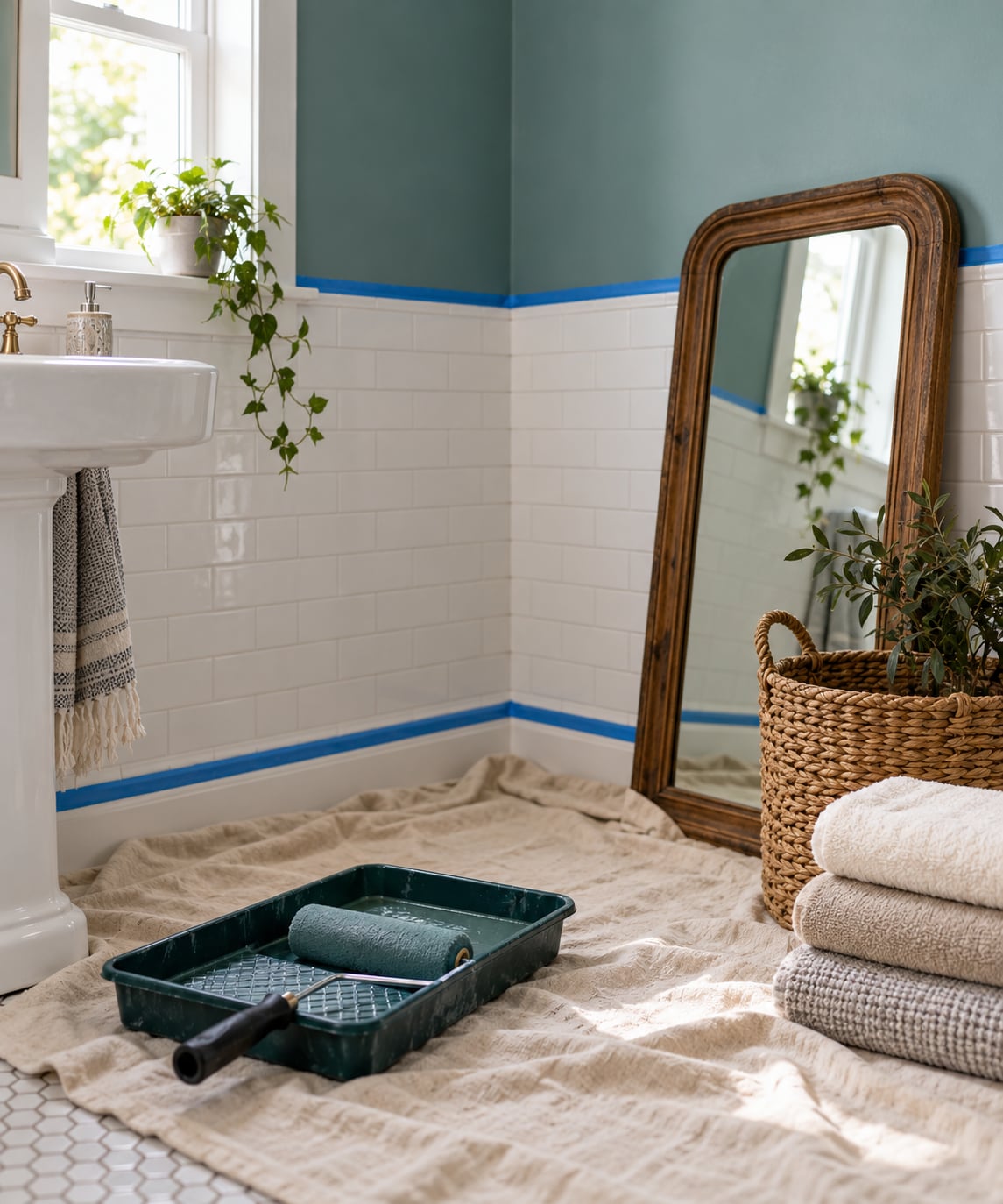
- Drop cloth and painter’s tape. A canvas drop cloth protects the floor better than a plastic sheet, which turns every footstep into a scuff.
- Painter’s pad, angled brush, and a good roller. A cheap roller sheds lint onto the wall and shows in every raking light.
- Dust sheet and a small vacuum. Bathrooms are small, so dust goes everywhere. Clean it before you patch, not after.
- Sandpaper in two grits, tack cloth, painter’s primer. Fine for scuffs, coarse for the vanity’s old finish.
- Grout scraper, grout sponge, and a tube of silicone caulk. The cheapest visible improvement in the room.
- Safety gear: nitrile gloves for caulk and old finish, a dust mask when sanding, and eye protection. Ventilate when using caulk or spray products, and close the door so moisture does not drift into the hallway.
- Painter’s pyramid or a small offcut surface for painting the vanity doors. A door laid flat on sawhorses or a folded blanket will not dry with a sag.
Optional tools worth borrowing, not buying
A rotary tool with a grout-removal bit saves hours if you are regrouting. A paint sprayer gives a smoother cabinet finish than a brush, but the overspray means you have to mask the whole room, which often costs more time than it saves. A stud finder keeps new shelving off the tile surround. Any of these can be rented for a day.
Conditions that make the job go well
Work in a dry, ventilated room with the door propped open. Paint and caulk need a few hours without fog or damp on the surface, so pick a dry weekend rather than a humid one. If the walls are peeling or the plaster is soft, stop and find out why first — moisture behind paint will bubble your new coat within a month.
How to Update a Bathroom on a Budget: Step by Step
Step 1: Set a Budget and Choose the Highest-Impact Changes
Before you buy anything, stand in the doorway and write down the two or three things you actually dislike. Usually it is the beige walls, the builder-grade vanity, or the lighting that makes everyone look unwell. Those become your shopping list.
Audit what is already there, too. Thrifted cabinets, marketplace finds and a frame around an existing mirror often cost a fraction of new and look better than the cheapest big-box version. One r/Renovations thread documented a full refresh built from a thrifted mirror, a gallon of paint and found storage — the total came to less than fifty dollars.
Then pick a tier and stick to it. Costs are typical US ranges that vary by region and shift over time.
| Total budget | What it buys |
|---|---|
| Under 100 dollars | New caulk and a grout pen refresh, new towel bars and hooks, a thrifted mirror, new towels and a shower curtain |
| 250 to 400 dollars | All of the above plus repainted walls, repainted vanity, brighter LED vanity bulbs and a new shower curtain rod |
| 500 to 800 dollars | Everything above plus a new faucet or showerhead, a peel-and-stick accent wall and thrifted storage |
| Around 1,000 dollars | Paint plus a new vanity, a new light fixture and a properly refinished tub |
| Around 5,000 dollars | A full cosmetic refresh with some labor hired out, still on the original tub, tile and plumbing layout |
Step 2: Remove Clutter and Prep the Room
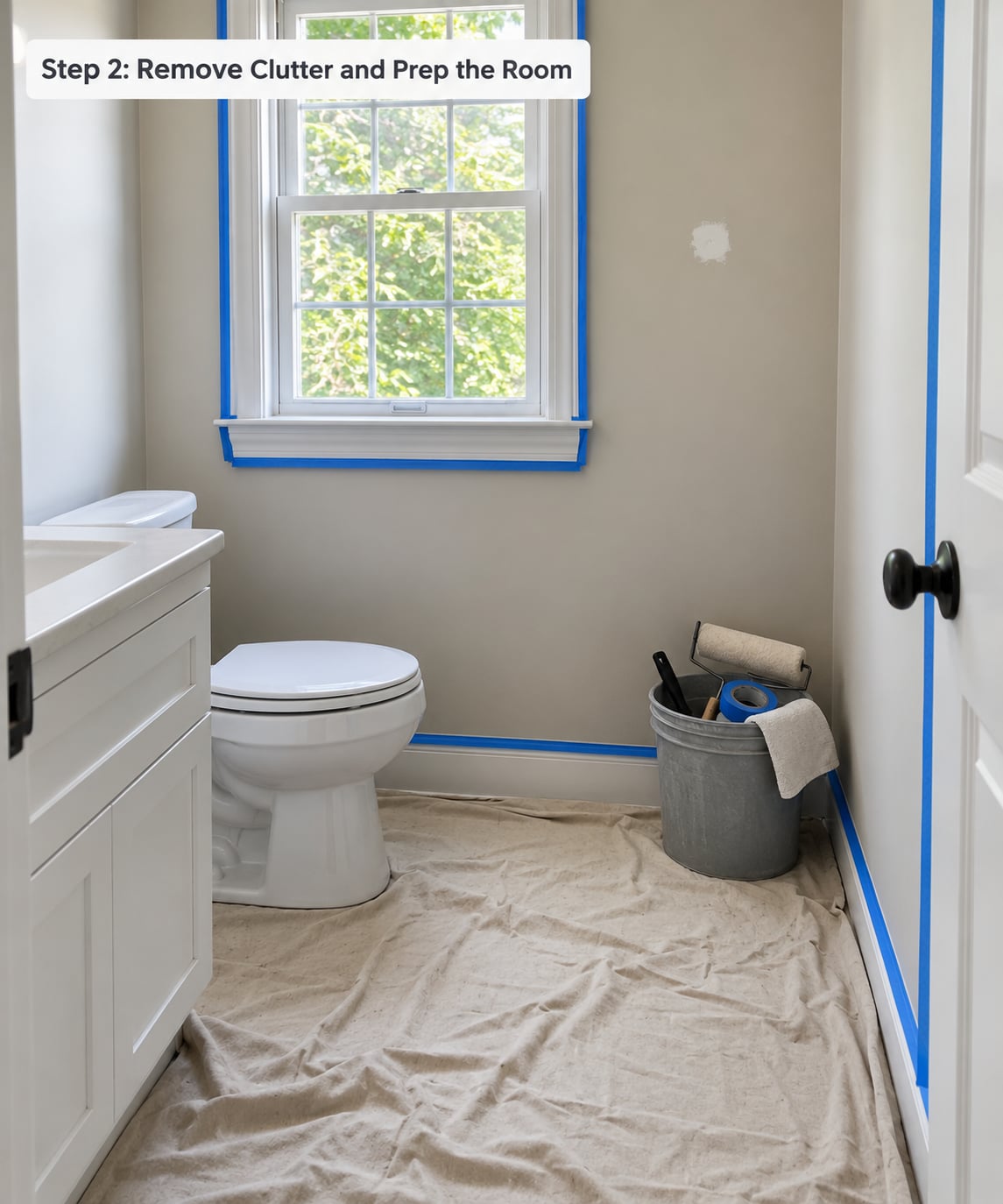
Clear every surface first. Most of the visual improvement people attribute to new paint is really just removing the objects that were crowding the room. Take it all out, including the stuff inside the vanity and behind the door.
Then prep properly. Patch nail holes and small dents with a lightweight filler, sand the patch flat, and wipe dust away with a tack cloth. Clean the walls with a degreaser or dilute TSP, because paint will not stick to a wall that has soap scum and hairspray on it.
Protect the trim, the fixtures and the floor. Remove and set aside the hardware you plan to reuse, bag it, and label the bag. Stuff a towel in the drain before you start so a dropped screw does not vanish.
Renters, read this part twice. Painting, wallpapering, and anything fixed with screws can cost a whole deposit. Ask for written permission before painting, and if the answer is no, everything in this guide has a reversible version: tension-rod curtains, peel-and-stick accents, and thrifted pieces you take with you when you move. A removable mirror film and a new light bulb change a room noticeably and leave nothing behind.
Know the line between a Saturday job and a licensed professional’s job. Anything hardwired, anything behind a finished wall, anything involving a moved drain or supply line, and any structural or mold finding goes to a pro. Ignoring that line is how a 400-dollar refresh becomes a 6,000-dollar repair.
Step 3: Paint the Walls or Add a Color Accent
Paint is the single best value in the whole project. A gallon covers a small bathroom’s walls in two coats, and the color change does more for the room than any accessory.
Choose a bathroom paint rated for high humidity in an eggshell or semi-gloss finish. Flat paint looks great in a bedroom and shows every handprint in a small room. Semi-gloss also reflects the light fixture and makes a tight space read bigger.
Light colors expand a small bathroom; a deeper tone can make it feel intentional and cozy if the fixtures are light. If you are nervous about committing, paint one wall as an accent in a deeper shade and leave the rest in a soft off-white.
Cut in the edges with the angled brush first, then roll the middle sections, and always keep a wet edge so the roller does not leave lap marks. Two full coats, not one, even when the can says one coat is enough. Let the walls dry overnight before you push furniture back or hang anything.
The same paint logic applies to the vanity, with one difference: use paint made for cabinets. Cabinet paint bonds harder and stands up to scrubbing and steam where ordinary interior latex eventually peels at the edges of a door. Sand the old finish, prime if the existing paint is glossy or a different color, then two thin coats.
Two honest warnings. Do not paint over wallpaper without scoring it and priming it properly, or the whole sheet can peel off later in one strip. And if grout behind your tub is already failing or soft, do not paint over it hoping to seal it — fix the grout first, or you will be chasing water through the wall.
Step 4: Upgrade the Mirror, Lighting, and Hardware
These three swaps carry more visual weight than almost anything else in the guide, and they cost the least.
The mirror. Measure the existing opening before anything else. A thrifted wood-framed mirror in a warm finish instantly reads as an upgrade over a builder plastic-framed one. If the framing is decent, a thrifted frame or a mirror-tape kit can update it in place.
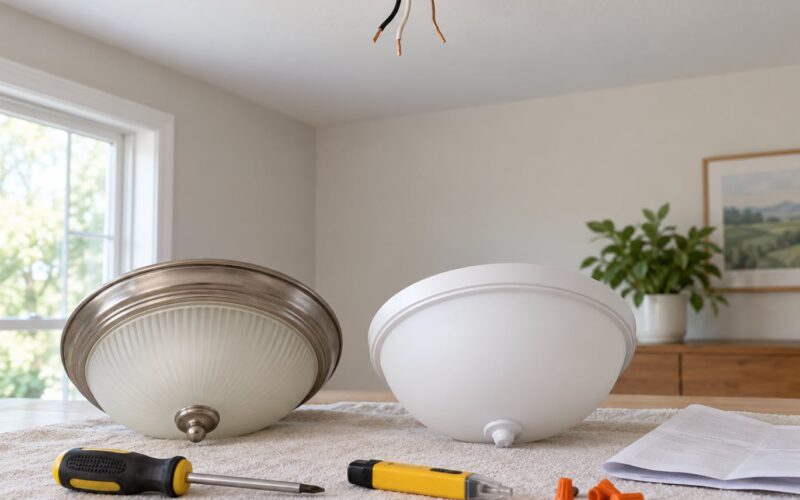
The lighting. Swapping bulbs is a five-minute job with the biggest payoff per dollar in the room. Warm white, around 2700 to 3000 Kelvin, flatters skin tones; anything above 4000 Kelvin makes a small bathroom look like a clinic. If you want more, replace the fixture only with one rated for damp or wet locations, and call an electrician for anything hardwired.
The hardware. Towel bars, hook sets, cabinet pulls and the toilet paper holder are cheap to swap and impossible to ignore when they clash. Pick one metal finish for the whole room and repeat it in at least three places. Matte black reads modern and hides water spots; brushed brass and warm nickel suit older homes and warm paint.
What you replace here is cheap compared with what the same swap costs in a plumbing fixture. A new showerhead or a new faucet moves a real number, and both require shutting off water and working around code. Both are doable, but both are also where a beginner’s mistake gets expensive fast.
Step 5: Add Affordable Storage and Organization
Bathrooms lose their calm when there is nowhere to put things. Storage fixes that for the price of a basket.
- Woven baskets and lidded canisters hold towels and toilet paper out of sight and add texture to a flat wall.
- Over-the-toilet shelving uses dead vertical space. Add a basket or two on top and the wall stops looking bare.
- A thrifted narrow cabinet or a secondhand side table gives a surface for towels without taking floor space.
- Wall-mounted organizers and hooks above the toilet or behind the door use space most bathrooms waste.
- A medicine cabinet swap is worth it if yours is builder plastic; a thrifted wood cabinet costs less than most new ones.
Measure every space before you buy, and measure twice if something hangs on the wall or clears a door swing. Then stop. Three baskets placed well beat twelve containers crammed onto every surface, which is the single most common reason a budget bathroom looks cluttered rather than cheap.
Step 6: Refresh the Textiles and Finishing Details
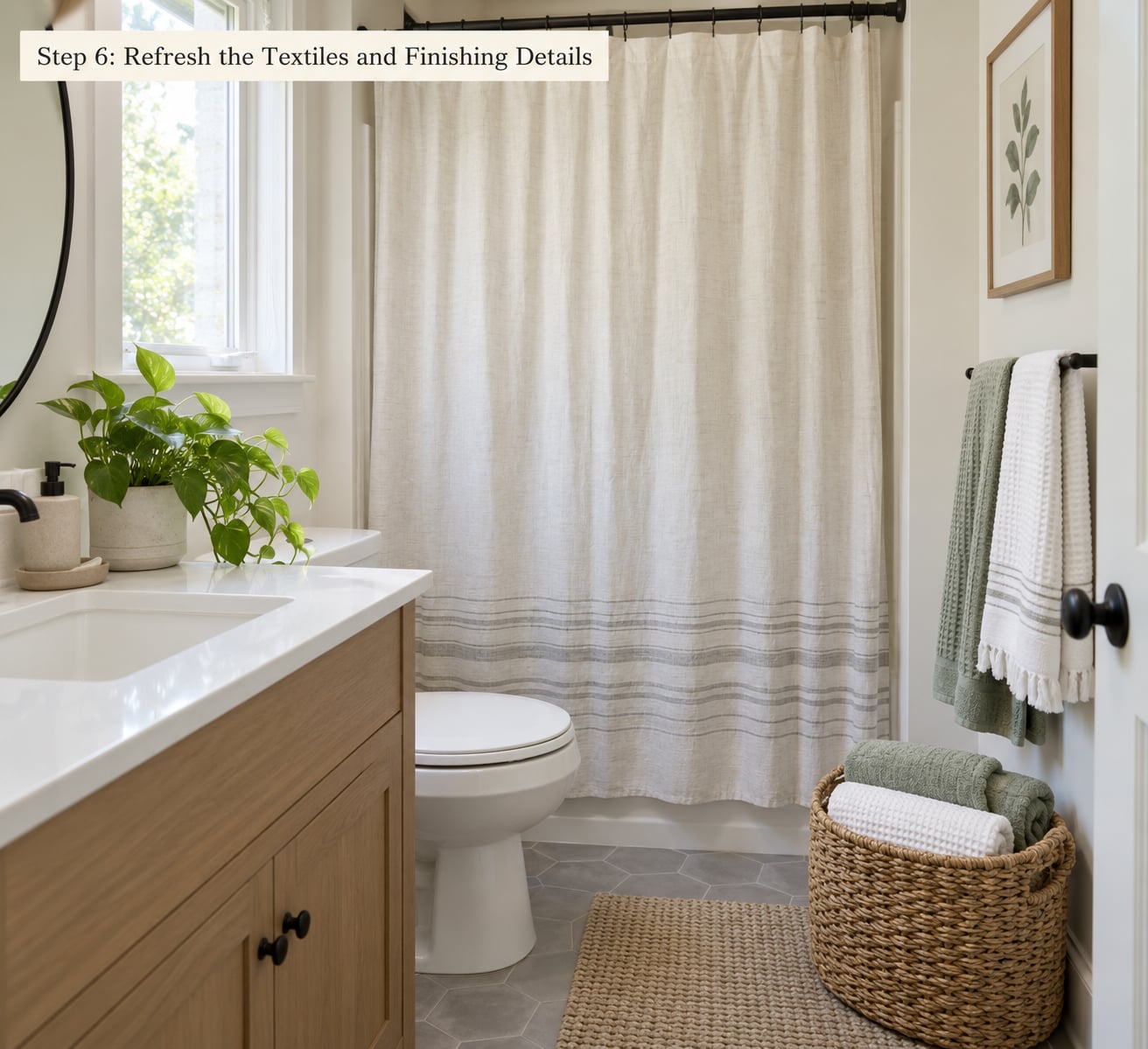
Textiles change the room instantly and cost nothing to remove later, which makes them the right choice for renters too. Pick cotton or cotton-blend towels in one color, a washable bath mat, and a solid or simple-patterned shower curtain.
Materials matter more than the label. Everything in a bathroom needs to survive humidity and repeated washing, so choose washable cotton or a moisture-resistant polyester blend rather than anything delicate. If a curtain sits against the tub, a washable liner underneath prevents the fabric from wicking water into the floor.
Finish with the low-cost details. A thrifted wooden tray, one small plant that likes indirect light, a single framed print hung at eye level, and a matching soap dispenser set finish the room for very little.
Here is the whole project in one place. Times assume one person with basic tools, and materials are typical US ranges.
| Project | Materials | DIY time | Difficulty |
|---|---|---|---|
| Repaint walls | 60 to 120 dollars | Half a day plus overnight dry | Easy |
| Repaint vanity | 40 to 90 dollars | One evening, full dry in 24 hours | Easy to moderate |
| Grout pen refresh | 10 to 20 dollars | 2 to 3 hours | Easy |
| Recaulk tub or sink | 15 to 30 dollars | Half a day plus cure time | Easy |
| Hardware swap | 30 to 150 dollars | 1 to 3 hours | Easy |
| LED bulbs or vanity light | 15 to 200 dollars | 15 minutes to 1 hour | Easy |
| New faucet | 80 to 350 dollars | 2 to 4 hours | Moderate |
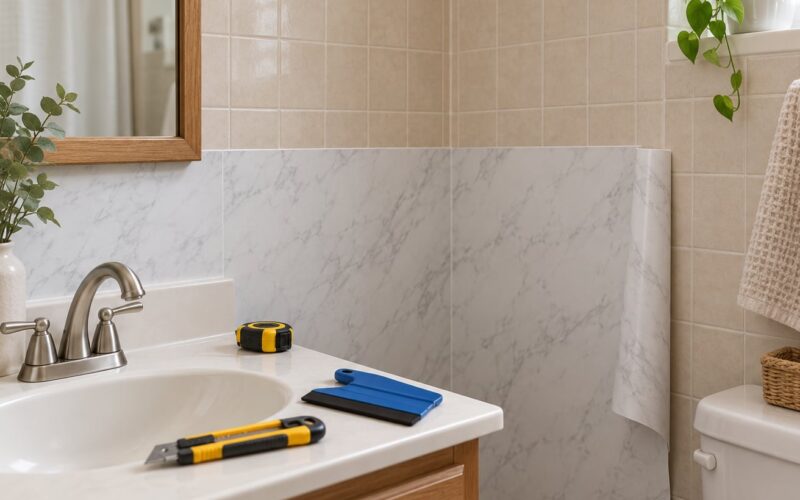
| Peel-and-stick accent wall | 40 to 150 dollars | Half a day | Easy |
| Tub refinishing | Hire out, roughly 350 to 650 dollars | 1 to 2 days if you do it | High, recommend hiring |
Common Mistakes That Ruin a Budget Bathroom Update
Skipping the prep. Paint over grease, dust or gloss and it peels within months. The prep is boring and it is the whole difference between a wall that lasts three years and one that lasts ten. Clean, sand, patch, then roll.
Using ordinary latex on the vanity. Interior paint on a cabinet door will chip at the edges around the handle, where hands and steam hit it. Cabinet paint is formulated for that abuse and costs only a little more.
Buying before measuring. Rod length, shelf depth and mirror width are all easy to get wrong, and the wrong size is a trip to the store you will repeat. Tape the measurement on the wall and take a photo of it.
Filling every surface with accessories. Small rooms punish clutter hard. Leave counter and sink space empty, group items in odd numbers, and keep anything that does not earn its place out of the room entirely.
Trusting peel-and-stick tile in a wet zone. It works well for a dry backsplash or a half-bath wall. On a shower floor or a tub surround, edges lift at the grout lines within months, and lifting edges trap water. Homeowners in one r/DIYUK thread concluded flatly that it is not a good idea in those spots. Use real tile or a proper waterproof membrane there.
Painting over failing grout. Cosmetic paint does not stop water. One r/BathroomRemodeling thread describes grout failing around a tub and water reaching the plasterboard behind it. Cut out soft or crumbly grout and redo it before anything gets painted.
Messing with hardwired electrical or supply lines. Shut-off and bonding work is not a budget skill. Get it wrong and the cost is not the savings you planned.
Mixing metal finishes. Chrome pulls, brass towel bars and black hooks in one small room reads as an accident. Designers keep it simple on purpose: one finish, repeated.
One last styling tip that costs almost nothing. Clear the counter completely for a single day after you finish. A bathroom with nothing on the sink looks dramatically calmer than the same room with the usual clutter, and it costs you nothing but the effort of putting things in a drawer.
Frequently Asked Questions
What is the cheapest way to modernize my bathroom?
The cheapest way to modernize a bathroom is to change what the eye lands on first: paint the walls in a bathroom-rated eggshell or semi-gloss finish, repaint the vanity with cabinet paint, and swap the towel bars, hooks and cabinet pulls for a different metal finish. Add fresh caulk and a grout pen, then hang thrifted storage and coordinated towels. That combination typically stays under 100 dollars.
What is the average cost to update a bathroom?
A cosmetic update usually lands between 300 and 1,000 dollars for materials, depending on how much you do yourself. Walls, a vanity repaint, hardware, caulk and grout are the cheap tier. A new faucet, better lighting and thrifted storage push it higher. Hiring out labor or refinishing a tub adds several hundred more. Costs vary by region and change over time.
Can you remodel a bathroom for 5,000 dollars?
You can refresh a bathroom for 5,000 dollars, but not truly remodel one. That budget buys new paint, hardware, lighting, storage and often a new vanity and refinished tub, while the tile, tub and plumbing layout stay exactly as they were. Moving a drain, adding a shower or replacing tile blows past that number quickly, because the cost is labor behind the wall.
Is peel and stick tile good for bathrooms?
It works well on a dry backsplash or a half-bath wall where nothing gets wet. On a shower floor or around a tub it is a gamble: edges lift at the grout lines within a few months and trap water underneath. Use it for accents you can remove, and use real tile with a waterproof membrane anywhere water lands directly.
What are the most regretted bathroom upgrades?
The most regretted upgrades are usually the ones bought for the wrong reason. Peel-and-stick tile in a wet zone, cheap LED fixtures that buzz or flicker, a trendy faucet finish that fights everything else in the room, and paint applied over failing grout. Spending on one good vanity light and one set of matching hardware tends to age far better.
How can I update a rental bathroom without losing my deposit?
Stay reversible: tension-rod shower curtains, peel-and-stick backsplash accents, removable mirror film, thrifted storage and new textiles all leave the surfaces untouched. Swap light bulbs rather than fixtures, and confirm in writing what your lease allows before hanging anything. Take every item with you when you leave and photograph the bathroom on move-in day.
Conclusion: Where to Start This Weekend
The changes that pay off most in a budget bathroom makeover are paint, the vanity, hardware, lighting and grout. Everything else is styling on top of those five, and none of them require opening a wall.
So start by measuring the mirror, the towel bar spacing and any shelf you are thinking about. Then pick one color or one focal point and commit to it. Paint the walls, repaint the vanity with cabinet paint, and swap the hardware in a single finish before you buy anything decorative.
Do those three first, live with the room for a week, and only then decide where the remaining money goes. A bathroom that looks calmer is usually three changes done well, not twelve done at once.