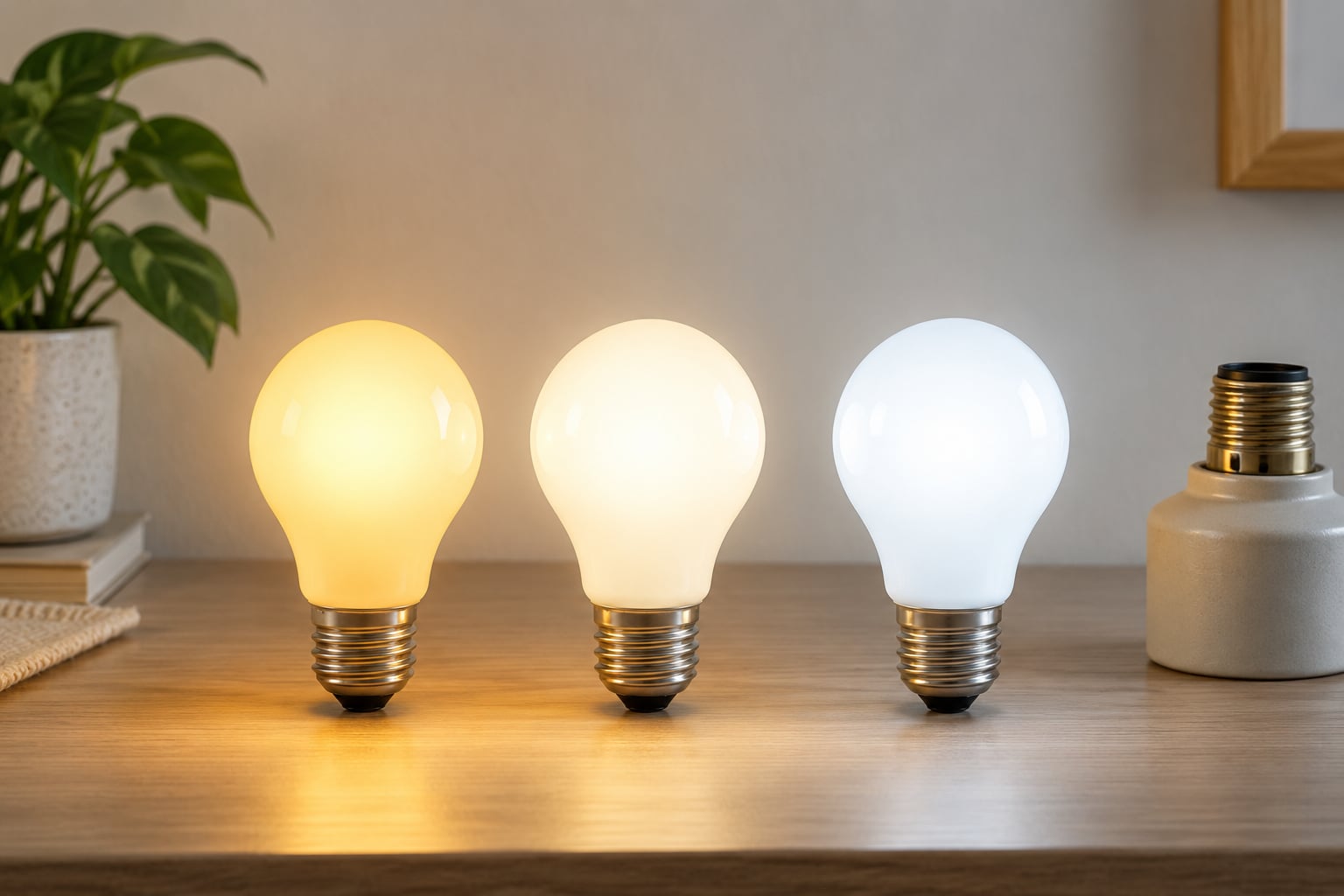
Short answer: pick 2700K or 3000K for living rooms, bedrooms and hallways, 3000K to 3500K for bathrooms, 3500K to 4000K for kitchens and home offices, and 5000K only in a garage or workshop. Color temperature is simply how warm or cool the light looks, measured in Kelvin (K) — a low number is amber and cozy, a high number is bluish and crisp. Get the number right and the whole room settles; get it wrong and nothing else you buy will look as good.
I have replaced bulbs in about a dozen rentals and homes, and the same mistake came up every time: buying whatever said “warm white” on the front of the box. Two bulbs with the same friendly label turned out to be 2700K and 4000K, and the room looked like two different rooms stapled together. Once you start reading the Kelvin number instead of the label, you will never make that mistake again. It takes about a minute per bulb once you know what you’re looking for.
Here is how to choose a light bulb color temperature without guesswork, in the order I use it.
Table of Contents
- What You Need
- Step-by-Step: How to Choose a Light Bulb Color Temperature
- Step 1: Decide What the Room Needs
- Step 2: Learn the Kelvin Ranges
- Step 3: Match the Bulb to the Fixture
- Step 4: Check the Finish and Dimmability
- Step 5: Test Before Replacing Every Bulb
- Common Mistakes
- Frequently Asked Questions
- Is 2700K or 3000K warmer?
- Is 2700K or 3000K better for a living room?
- Which is better for a living room, 3000K or 4000K?
- Is 3000K too warm for a bedroom?
- What’s better, cool white or daylight?
- Should all light bulbs in my house be the same color temperature?
- Conclusion
What You Need
Nothing physical, mostly. You need four pieces of information before you shop, and all four are free to find.
- The old bulb. Keep one working bulb from the room. Its box, base printing, or simply your memory of how the room looked is the reference everything else has to match.
- The room’s job. Is it where you relax, where you chop onions, where you sleep, or where you do eight hours of close-up work? That one answer narrows the Kelvin range more than anything else.
- The hours. A room you use at 9pm and a room you use at 9am do not want the same light. Evening rooms want the low end of the scale.
- The fixture limits. Check the base type (E26, E27, candelabra E12, GU10), the shape (standard A-shape, globe, reflector, flood), and the maximum wattage printed on the socket or the fixture’s label.
Add one more if a dimmer is involved: whether that dimmer is rated for LED bulbs. Old magnetic dimmers from the 1990s and earlier are the usual culprit behind flickering.
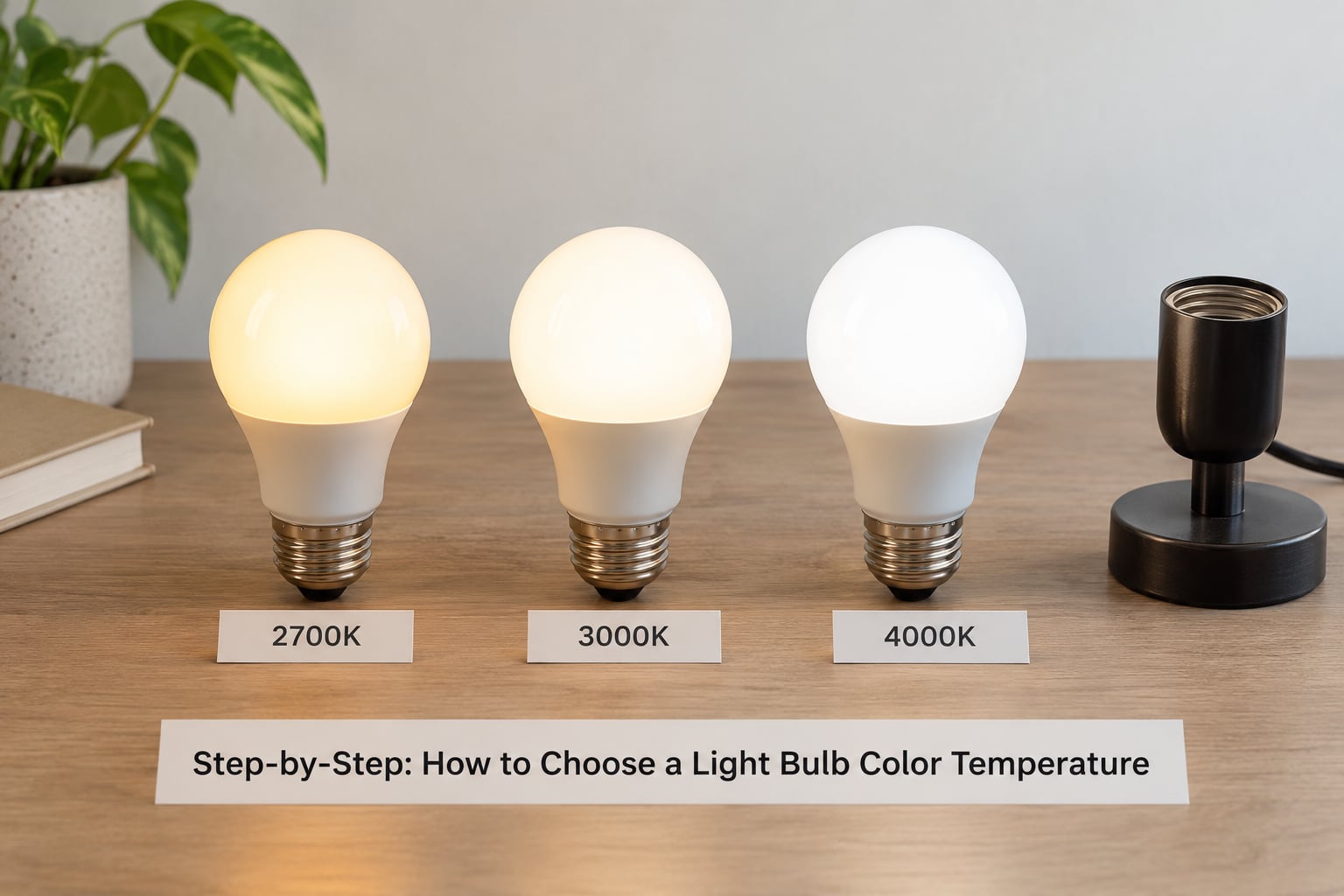
Step-by-Step: How to Choose a Light Bulb Color Temperature
Step 1: Decide What the Room Needs
Warm light (2200K to 3000K) relaxes you and makes wood look rich. Neutral light (3500K to 4000K) keeps colors honest and helps you see detail. Cool light (5000K and up) belongs in a garage, a laundry room, or a sewing table, not in a living room. Most homes live between 2700K and 3500K, and that is not a failure of ambition — it is the range where skin tones and wood grain both hold up.
| Room | Best Kelvin | Why it works |
|---|---|---|
| Living room | 2700K to 3000K | Relaxed evening light that flatters skin and warms wood furniture |
| Bedroom | 2200K to 2700K | Low blue content in the evening, which helps you wind down |
| Kitchen and under-cabinet | 3500K to 4000K | Enough contrast to see food color and knife edges |
| Bathroom vanity | 3000K to 3500K | Skin looks believable without going clinical |
| Home office | 4000K | Reads as alert through the afternoon without the blue cast of 6500K |
| Hallway and stairs | 2700K to 3000K | Guides the eye through the house without announcing itself |
| Dining room | 2700K to 3000K | Makes food and table surfaces look richer |
| Garage and workshop | 5000K | Color accuracy and visibility beat atmosphere here |
Now the part most guides skip: light color changes how your decor actually reads. The same greige wall looks creamy and soft under 2700K, then turns greenish and institutional under 4000K. Navy reads almost black at 2700K and true navy at 4000K. Oak and walnut go amber and rich at 2700K, then flatten to a dull tan at 5000K. Terracotta is the big winner at 2700K and loses its glow almost immediately above 3500K.
That is why picking bulbs after painting creates so much friction. If you painted the room cool-neutral, buy 3000K to 3500K and the paint will look like the sample. If you are still deciding on paint, take two large swatches into the room at different hours and look at them under the bulbs you already own. Paint stores use 5000K showroom lighting, which is brighter and cooler than almost anything in a home, and that gap surprises people.
One honest trade-off about 2700K: it is genuinely harder to match clothing colors in a low warm bulb. Nobody picks an outfit under a single warm bedside lamp, but if your bedroom doubles as a closet, 3000K is the smarter number.
Step 2: Learn the Kelvin Ranges
The scale runs from about 2000K to 6500K. Named after Lord Kelvin, it describes the color a black body would glow at that temperature — lower numbers look like firelight, higher numbers like open sky.
| Kelvin | Light color | Feels like | Best for |
|---|---|---|---|
| 2000K to 2200K | Candlelight amber | Firelight, very orange | Candles, lamps in a dark room, some bulbs are unavailable here |
| 2200K to 2700K | Warm white | Cozy, golden, evening | Bedrooms, living rooms, dining rooms |
| 2700K to 3000K | Soft white to warm white | Still warm but cleaner | Most of a home, kitchens that want warmth |
| 3000K to 3500K | Neutral warm | Balanced, flattering | Bathrooms, entryways, dining |
| 3500K to 4000K | Cool white to neutral | Clean, slightly blue | Kitchens, offices, laundry, closets |
| 4000K to 5000K | Daylight | Bright, clinical | Workspaces, garages, utility rooms |
| 5000K to 6500K | Cool daylight | Blue-white, harsh at home | Commercial, industrial, dental and lab light |
Two corrections that clear up most of the confusion. First, Kelvin is not brightness — lumens are brightness, and they have nothing to do with each other. A 2700K bulb can put out more lumens than a 5000K bulb of the same wattage, and people who think “warm bulbs are dimmer” are usually remembering an old incandescent, not an LED. Second, the marketing labels on the box are close to useless and they differ by brand and by country. “Soft white” can mean 2700K on one package and 3000K on another, and “warm white” is not reliably interchangeable. Buy by the Kelvin number printed on the box, always.
A related spec worth glancing at is CRI, the Color Rendering Index, scored 1 to 100. It measures how truthfully a bulb shows colors, and low-CRI bulbs make wood look flat and food look dull. Buy CRI 90 or higher for a bathroom mirror, a closet, a dining table, or anywhere you judge color. A low-CRI bulb will make even a good Kelvin look like a mistake.
Step 3: Match the Bulb to the Fixture
Getting the Kelvin right and the bulb wrong means a trip back to the store. Match three things: the base, the shape, and the wattage ceiling.
- Base. E26 and E27 are the standard household screw bases and are interchangeable in most sockets. E12 is the small candelabra base found in chandeliers and sconces. GU10 is the twist-and-lock base used in many recessed and track fixtures. Look at the old bulb, not the box.
- Shape. A-shape (standard) bulbs go in table lamps and ceiling fixtures. Globe (G) bulbs are round and meant for exposed vanity fixtures where the globe is visible. Reflector (R) and flood (BR) bulbs have a flat face and a reflector to push light forward, which is what you want in a recessed can. The shape controls the beam pattern, not the color.
- Wattage. Never exceed the maximum wattage printed on the fixture or socket. LEDs make this simple, since an LED that draws 9 watts replaces a 60-watt incandescent, so you almost always end up well under any limit printed before about 2010.
Also check whether the fixture is rated for enclosed bulbs. A fixture with a glass shade or a closed lantern needs a bulb marked “rated for enclosed fixtures,” otherwise the bulb overheats and dies early. Follow the fixture’s own label or manual when it says anything specific.
Step 4: Check the Finish and Dimmability
Finish changes how the light looks before it reaches anything. A clear bulb throws crisp light and works well in most shaded lamps. A frosted or “soft white” bulb diffuses the glow and hides the filament or LED array, which is why it reads softer in a bare socket. A globe bulb looks smooth and even from every angle, so pick it where the glass is visible.
For dimmers, buy a bulb labeled dimmable and pair it with a dimmer rated for LED loads. A non-dimmable LED on a dimmer usually means flicker, buzzing, or a bulb that only dims halfway before dropping out, and that pattern gets mistaken for a bad bulb. Many modern dimmers have a low-level trim screw you can turn until the flicker disappears.
Here is the nice part: a good dimmable LED does not just get dimmer, it gets warmer as it goes down. A 2700K bulb at full output may read close to 2700K, and at 10 percent it can drop toward 2000K, close to candlelight. That is a free second mood, which is why a 2700K dimmable bulb in a bedside lamp does more work than any smart bulb you can buy.
Step 5: Test Before Replacing Every Bulb
The single most useful habit here is buying one bulb before buying ten. Install it in the fixture you care about most, then look at the room in the morning, at midday, and after dark. Paint, wood, and fabric all change with the light around them, and only your own eyes settle the argument.
If you need to match bulbs you already own instead of guessing, here are three ways to find the Kelvin of a bulb in your hand.
- Read the printing. Most LED bulbs have the color temperature stamped on the base or the side of the housing, along with the model number and wattage. Look for the number with a K after it.
- Find the original box or receipt. If the bulb is still in its packaging, the Kelvin is on the back panel. A phone photo of the box is worth keeping for the next time a bulb dies.
- Compare it in a known fixture. Put the mystery bulb into a fixture with a bulb whose Kelvin you already know, and switch between them. People doing this in lighting forums say this is the fastest and most reliable method when the printing is worn off.
While you are testing, watch for the one combination that always looks broken: different Kelvin values inside a single multi-bulb fixture, like a three-bulb vanity or a five-bulb chandelier. Mixing across a room is fine when the zones are visually separate — a warm floor lamp and a cool desk lamp in the same office is normal. Mixing inside one fixture is not, because the eye reads the mismatch as a defect.
Common Mistakes
Choosing by wattage. Wattage tells you energy use, not light color, and in an LED bulb it is only useful as a rough stand-in for brightness. Decide Kelvin first, then check that the lumens feel right for the room: about 800 lumens for a bedside lamp, 1100 to 1500 for a living room ceiling fixture, 2000 to 3000 for a kitchen or a room with no other fixtures.
Assuming a lower Kelvin means dimmer. It does not. Warm and cool describe color; lumens describe brightness. If your new 2700K room feels dim, the problem is lumen output or fixture count, not the color.
Mixing Kelvin values in one fixture. Buy a matched set for any fixture with more than one bulb, or use bulbs with selectable color temperature and set them all to the same value.
Ignoring the fixture’s limits. Exceeding the maximum wattage, using the wrong base, or putting a non-enclosed bulb inside a closed shade are the fastest ways to kill a bulb early.
Putting a non-dimmable bulb on a dimmer. It will flicker or cut out. Buy the dimmable version, and replace a magnetic dimmer from before 2000 if the flicker persists.
One last option worth knowing: tunable white smart bulbs let you slide a single bulb between roughly 2700K and 6500K from your phone, which solves the room-by-room-renovation problem outright. They cost more and they add one more thing to set up, so for a room you have already decided about, a fixed 3000K bulb is the simpler answer.
Frequently Asked Questions
Is 2700K or 3000K warmer?
2700K is warmer. Lower numbers mean warmer, more amber light: 2200K looks like candlelight, 2700K like a warm living room lamp, and 3000K sits a step cleaner and more neutral. The difference between the two is small enough that many people cannot see it side by side, but they notice it against cool paint or blue-gray tile, where 3000K shows less yellow. Choose 2700K for a softer, more traditional feel; choose 3000K if you want warmth without the gold cast.
Is 2700K or 3000K better for a living room?
Both work, and the difference is smaller than most packaging suggests. 2700K suits rooms with warm wood, warm paint, and soft fabrics, and it looks best in the evening. 3000K keeps a similar warmth while rendering paint and skin tones more accurately, which helps in a north-facing room or one full of cool gray and navy. If you are unsure, 3000K is the safer modern default; if you want a room that feels like a lamp at 8pm, go 2700K.
Which is better for a living room, 3000K or 4000K?
3000K, for almost every living room. 4000K is a genuinely different room: it is crisp and slightly blue, closer to a doctor’s office or a modern office than to a home. It suits a room that gets used mostly during the day for reading and paperwork, especially with white or cool paint. If your walls are warm-toned, terracotta, cream, or wood-heavy, 4000K will flatten all of it. Save 4000K for a kitchen, an office, or a laundry room.
Is 3000K too warm for a bedroom?
No, 3000K is a solid bedroom choice and plenty of people use it happily. If you are trying to sleep better, the number that matters most is the one in the last two hours before bed, not the one during the day. Bright blue-leaning light in the evening can delay melatonin, so keep bedside lamps at 2200K to 2700K and dim them low. A dimmable 2700K bulb does both jobs: warm in the morning, candlelike at night.
What’s better, cool white or daylight?
For a home, cool white. Cool white generally sits around 3500K to 4000K and daylight sits from 4000K to 5000K and up. The difference is how blue the light reads, and daylight gets that way fast. Cool white is fine for a kitchen or a workspace; daylight at 5000K or higher is a workshop bulb and makes most living spaces feel clinical. Judge by the Kelvin number on the box, not by the words warm, soft, or cool on the front.
Should all light bulbs in my house be the same color temperature?
They should match within a fixture, and they do not need to match across the house. Most homes look best with two or three temperatures in use: 2700K to 3000K for living and sleeping spaces, 3500K to 4000K for kitchens, bathrooms, and offices. If you are renovating one room at a time, buy the Kelvin that matches the bulb already in the room you are copying so nothing shifts when you walk from space to space.
Conclusion
Do this first: decide what the room is for, then pick the Kelvin band that matches — 2700K or 3000K for living and sleeping spaces, 3500K to 4000K for kitchens, offices, and bathrooms. Next check the base, shape, wattage limit, and dimmer compatibility so the bulb actually fits. Then buy one, live with it for an evening, and only replace the rest once the number on the box has earned your trust. Updated for 2026, and still the cheapest way to make a room look like the one in the photo.