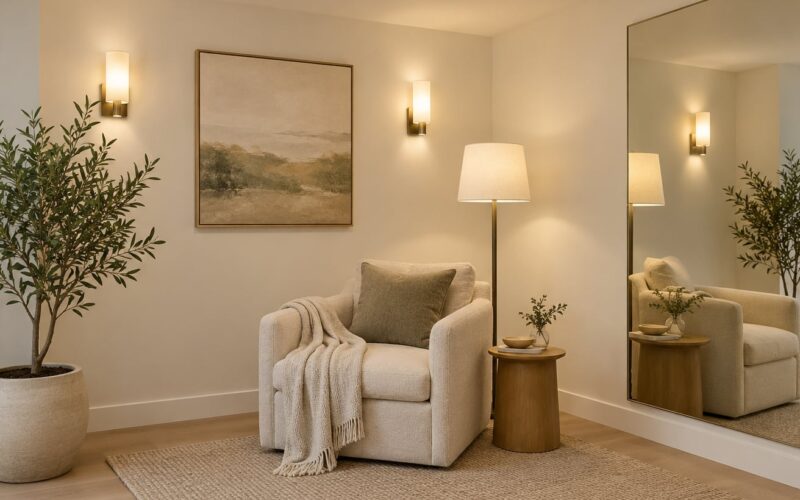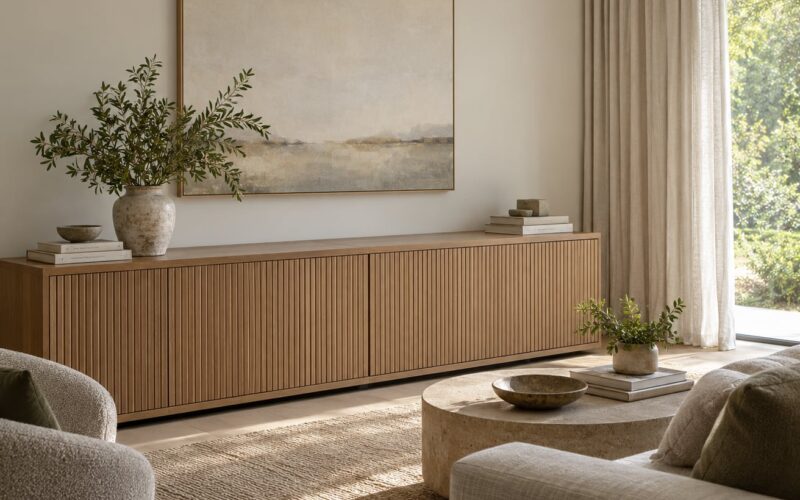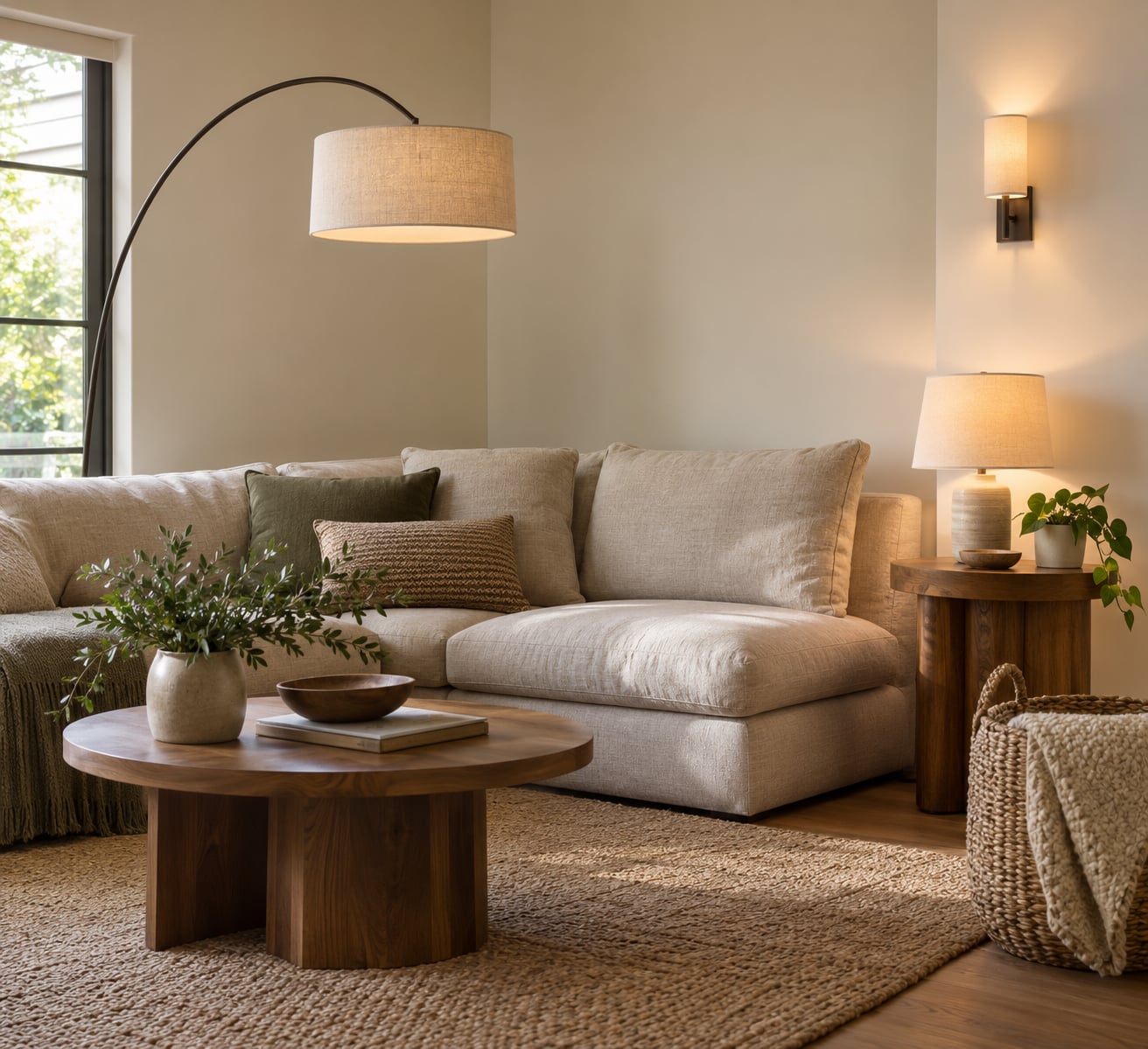
Light a room with no overhead lighting by layering floor lamps, table lamps and wall sconces at three different heights instead of relying on one central source. Add one bright task light where you actually read, cook or work, and put at least one lamp that throws light up at the ceiling.
That last part is the trick most people miss. A ceiling fixture lights the ceiling and the top of the walls. Take it away and those surfaces go dark, so the room reads as gloomy even with three lamps switched on. Bouncing light upward puts back what you lost, and the room feels taller at the same time.
The whole plan takes an afternoon to map out and an hour to place. Nothing here needs a drill, a new circuit or a call to an electrician unless you decide later that you want a real fixture.
Table of Contents
- What You Need
- Light sources
- Placement supplies
- Safety and rules to check first
- Step-by-Step: How to Light a Room With No Overhead Lighting
- Start With the Room’s Main Activity Zones
- Add Ambient Light Without Overhead Lighting
- Layer Task and Accent Lighting
- Choose Bulbs and Control the Mood
- Common Mistakes
- Frequently Asked Questions
- How can I brighten a room that has no ceiling light?
- Do I need to install wiring to light a room without an overhead fixture?
- What type of bulb gives the best light for a room with no ceiling lighting?
- How many lamps does a room need if there is no overhead light?
- Can renters add lighting without drilling into the walls?
- How do I make a room with lamps look brighter and less uneven?
- A Simple Lighting Plan to Start With
What You Need
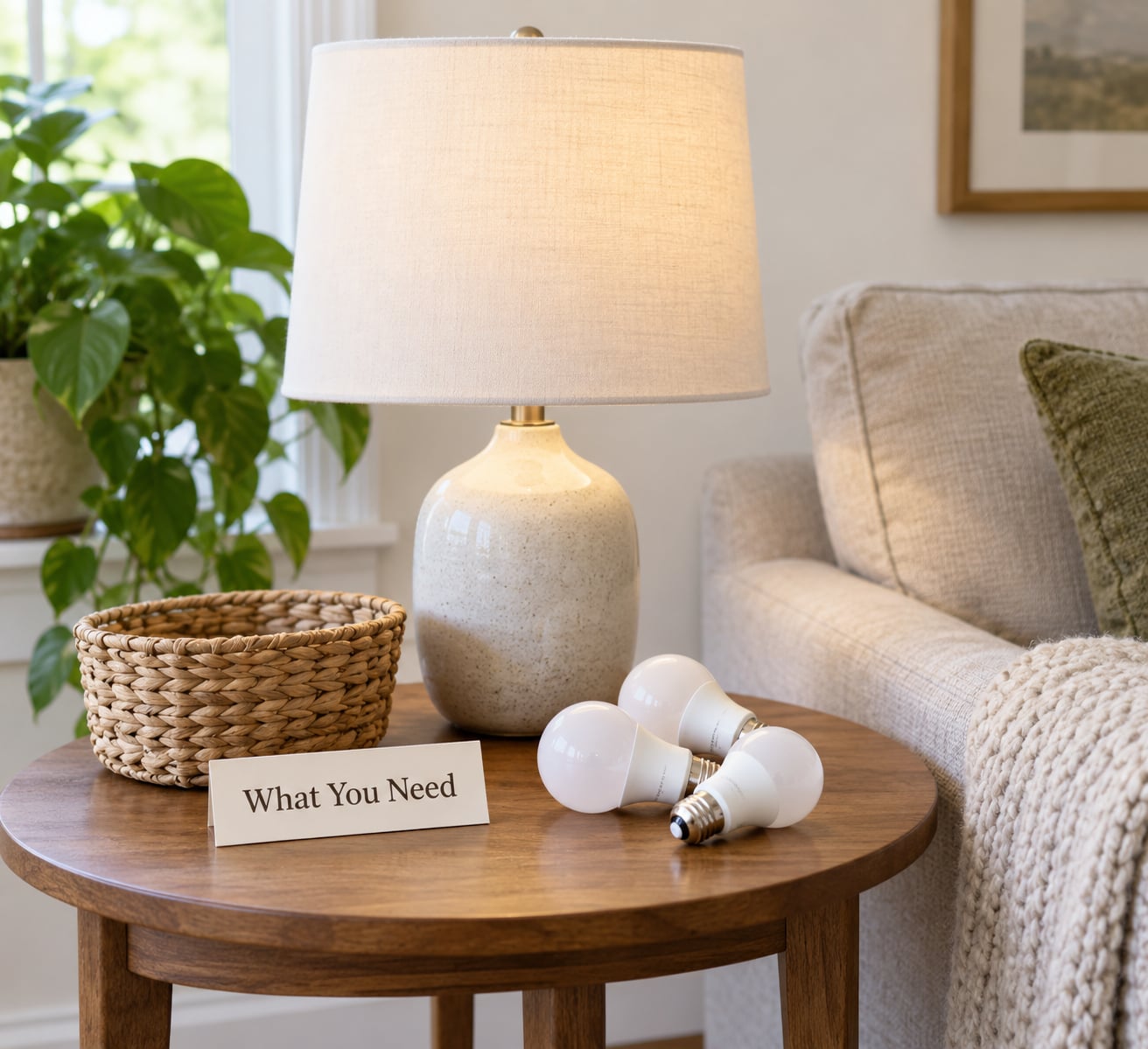
Most of this is gear you can pick up in a home store and set down where it belongs. Gather the light sources first, then the placement supplies, then check what your electrical setup can take.
Light sources
- One floor lamp per seating area: an arc lamp if you want light over a sofa, a torchiere if you want to light the ceiling, a tripod or tree lamp if you want to aim light in specific spots
- Table lamps for surfaces like a console, nightstand or sideboard, plus bulbs that match the fittings
- At least two wall-mounted lights: plug-in or pin-up sconces, flip-up sconces, or battery-operated picture lights for artwork
- A desk lamp, swing-arm reading lamp or clamp light for wherever hands do detailed work
- LED tape strips for under-cabinet, toe-kick or behind-headboard glow
- A plug-in pendant if you want light over a dining table without touching the ceiling
Placement supplies
- Painter’s tape for marking lamp spots on the floor before you move anything
- A tape measure, a step ladder and a phone flashlight for checking how far each outlet reaches
- Cord covers or a cord kit that matches your wall colour, plus a couple of cable clips
- Command strips or removable hooks for cord-free options and temporary fixes
- Paint, a paint pad and a small roller if a scuffed cord cover or an unpainted patch needs touching up
Safety and rules to check first
- Whether you rent. If you do, read your lease before a single hole goes in a wall, and remember that removable adhesive products still need landlord-friendly materials.
- Where your outlets are. Cord length decides which lamps you can place, and a room with one outlet in a corner limits you more than the furniture does.
- What the room is used for. Kitchens, hallways and stairs need brighter, more even coverage than a bedroom.
- When to stop and call a licensed electrician: adding a new ceiling box, running new wire, working on a circuit that trips, or anything in a bathroom or outdoor-rated area.
One safety habit worth building in: run the cord along a wall or under a rug edge rather than across an open walkway, and never daisy-chain extension cords to stretch one outlet across a room.
Step-by-Step: How to Light a Room With No Overhead Lighting
Work through these four steps in order. Each one narrows the next, and the last step is where most of the comfort comes from.
Start With the Room’s Main Activity Zones
Before buying anything, tape three or four squares of floor where life happens: the seat you read in, the counter you prep food on, the desk, the dining table. Those squares are your zones, and every zone deserves its own source.
Then check reach. A lamp only works where a cord can get, so measure from each zone to the nearest outlet. If the nearest one is six feet away and your cord is four, that zone needs a battery light, a floor lamp with a longer cord, or a different plan.
Watch for the awkward cases now rather than later. A bedroom with no nightstand surface needs a headboard clamp or swing-arm wall lamp. A vaulted or sloped ceiling rules out tall torchiere lamps, so wall-mounted options carry more of the load.
Mark the taped squares and step back. If one area gets nothing at all, that is the lamp you buy first.
Add Ambient Light Without Overhead Lighting
Ambient light is the general glow that fills a room, and in a room with no ceiling fixture it comes mostly from floor and table lamps. Aim for three to five sources in an average living or bedroom, spread around the perimeter rather than clustered in one corner.
- Arc lamp: the closest thing to true overhead light without a ceiling. Its arm reaches over a sofa or dining table, so light lands where a ceiling fixture would have put it. The drawback is the footprint: it needs about five feet of clearance and a spot to arc from.
- Torchiere lamp: an uplighter with an open bowl shade. It washes the ceiling and upper walls, which is exactly the light a missing fixture used to supply, so it fixes the dark-ceiling problem faster than anything else you can carry in from a store.
- Tripod or tree lamp: wooden tripod lamps and multi-arm tree lamps let you aim each head at a specific wall, artwork or corner. More adjustability, more visual weight, and they take up more visual real estate than a slim torchiere.
- Table lamps: a lamp on a console or side table creates a pool of light at a comfortable height, which makes a wall look brighter than a bare bulb does. Keep the bottom of the shade near seated eye level, roughly 40 to 42 inches above the floor, so the bulb itself stays hidden.
- Plug-in or pin-up sconces: these read as intentional wall lighting rather than a workaround, and a cord cover along the baseboard makes the plug disappear. Two at sofa height give you the symmetry a ceiling light never had.
- String lights and flameless candles: good for atmosphere, weak for task work. Use them as accent, never as your main source.
- Mirrors: a large mirror opposite a window or opposite a lamp doubles the light you can see without adding a watt. This one costs nothing and changes the room more than most fixtures.
When you are done, turn everything on at the same time and walk from the doorway to the far corner. Any wall that stays dark needs another source, preferably one that uplights.
Layer Task and Accent Lighting
Ambient light sets the mood; task light lets you do things in it. Once the room is generally lit, add a focused source to each zone and a couple of accent lights for depth.
- Desk and reading lamps: an adjustable swing-arm or clamp lamp puts light exactly where your hands are without lighting the whole room. The complaint to expect is glare: pick a shade that hangs below eye level, and aim the arm so the bulb is never in your sightline.
- Under-cabinet and toe-kick LED tape: taped about 8 to 12 inches from the counter or aimed at the backplash, strips give an even wash with no visible fixture. The honest drawback is installation: adhesive on textured paint comes back with the strip, and the plug has to hide somewhere.
- Battery-operated picture lights: the simplest way to light artwork without wire, and renter-friendly. Batteries run out, and they run out on a schedule you do not control, so keep spare cells near the remote or switch to a rechargeable model.
- Plug-in pendants: a swag light hangs from a ceiling hook or a Command-strip anchor, dropping light over a dining table the way a fixture would. Never hang one over a walkway or a stove, and check that the ceiling anchor is rated for the weight.
- Accent uplights: a small shielded lamp behind a plant, a lamp aimed at a textured wall, or a picture light on a shelf. Accent light is about contrast: without it, every wall looks the same flat tone once the room is evenly lit.
Handle cords once you are finished placing lights. Snap-in cord covers that match the wall paint vanish against trim; metal ones on a brick wall look deliberate. Running cords along baseboards keeps them out of walkways, and clips every two or three feet stop them swinging.
Choose Bulbs and Control the Mood
Bulbs decide whether all of this feels cozy or clinical, and the choice is mostly colour temperature and brightness. Warm white at 2700K suits living rooms and bedrooms; 3000K works for kitchens and workspaces. Anything at 4000K or above reads as office lighting, which is rarely what people want at home.
Match brightness to the fixture, not to the room. A single floor lamp with a fabric shade wants roughly 800 to 1,500 lumens. A table lamp usually sits between 400 and 600 lumens, and under-cabinet strips need far less, often 200 to 400 lumens for the whole run. Bulbs that are too dim leave you squinting; bulbs that are too bright inside an opaque metal shade create glare, so let the shade do the diffusing.
Shade material is the second half of the equation. Fabric, paper, rice paper and frosted glass spread light softly and hide the bulb. Plain white or opaque metal shades direct light in a tight beam that is useful for reading and unpleasant everywhere else.
Control is what turns three settings into one room you can change. Dimmable bulbs let you drop to a movie-level glow, and smart bulbs add colour temperature and scheduling control from a phone or a voice assistant. If your switches do not dim, you need a dimmable bulb plus a dimmer switch, which is wiring work for a licensed electrician.
That same rule applies to anything else electrical. Swapping bulbs and repositioning a plug-in pendant are yours to do. Adding a ceiling box where none exists, running new wire or working on a bathroom-rated circuit is not, and it needs a licensed electrician plus whatever permits your area requires.
Common Mistakes
Most disappointing lighting setups share the same handful of causes. Each has a quick fix you can apply in minutes.
- One big lamp in the middle of the room. It creates a hot spot, leaves the corners black and keeps the ceiling dark. Fix: three to five sources at different heights, spread around the perimeter.
- Cool white bulbs everywhere. 4000K and above makes a home feel like a waiting room. Fix: 2700K in living spaces, 3000K where you need to see detail.
- Opaque or dark metal shades on every lamp. You get hard beams and visible bulbs instead of an even wash. Fix: at least one fabric, paper or frosted shade per room to soften the mix.
- All the light at eye level. Lamps at seated height lit only on a sofa leave the upper half of the room black. Fix: one uplighter aimed at the ceiling in every room without a fixture.
- Cords crossing walkways or trailing across the floor. A trip hazard and the fastest way to make a scheme look temporary. Fix: cord covers along the baseboard, cable clips every few feet, and a longer cord or different zone rather than an extension cord.
- Adhesive strips on textured paint, or a lease that forbids it. The strip pulls the paint off and the deposit goes with it. Fix: check the lease first, use removable hooks rated for the weight, and paint-test any adhesive on a hidden corner.
- Bulbs that do not match each other. Mixed brands and colour temperatures in the same room read as sloppy even when nothing is technically wrong. Fix: buy the same Kelvin for every lamp in one room, and dimmable across the board if you plan to dim.
One more worth naming: doing the ambient layer first and stopping. A room can be evenly lit and still feel flat, because nothing gives the eye a place to land. Add two accent sources after the glow feels right.
Frequently Asked Questions
How can I brighten a room that has no ceiling light?
Layer three to five sources at different heights instead of chasing one bright fixture. Put a floor lamp or arc lamp in the darkest corner, a table lamp on a surface, and a wall light where a shade would have hung. Add one uplighter aimed at the ceiling, because the unlit ceiling is what makes the room feel dim. A large mirror opposite a window or lamp doubles the visible light for free.
Do I need to install wiring to light a room without an overhead fixture?
No. Plug-in sconces, plug-in pendants, floor lamps, table lamps and battery-operated lights all run off existing outlets or batteries, so nothing needs to be opened in a wall. The only cases that need a licensed electrician are adding a new ceiling box, running new wire, or installing a dimmer switch on an existing circuit. Check your lease too if you rent.
What type of bulb gives the best light for a room with no ceiling lighting?
Warm white LEDs at 2700K for living rooms and bedrooms, or 3000K for kitchens and workspaces. Dimmable bulbs matter more than brightness here, because you can lower them for evening instead of turning them off. Pair them with fabric, paper or frosted shades, which spread light softly and hide the bulb. Skip 4000K and above unless you want the room to feel like an office.
How many lamps does a room need if there is no overhead light?
Three to five sources in an average living room or bedroom, and that count rises for a large open-plan space or a kitchen. One source per zone works as a starting rule: seating, dining, desk, bedside. Vary the heights, aim at least one upward, and place them around the perimeter. Five identical table lamps at the same height will look worse than three lamps placed well.
Can renters add lighting without drilling into the walls?
Yes. Plug-in sconces with cord covers, battery-operated picture lights, adhesive-mounted cord management, floor lamps and plug-in pendants hung from a rated hook all leave the wall untouched. Read your lease before adhesive mounting, because some ban it, and paint-test any strip on a hidden corner since textured paint can lift. Take the fixtures with you when you move and the landlord has nothing to complain about.
How do I make a room with lamps look brighter and less uneven?
Move lamps toward the walls instead of the middle of the room, so light reaches the surface rather than the floor. Add one uplighter to wash the ceiling, then hang a large mirror opposite your brightest window or lamp to reflect light back into the dark side. Check for blocked shades and dusty bulbs, which cut output without anyone noticing. Finally, add a second floor lamp to the corner that stays dim.
A Simple Lighting Plan to Start With
Do these three things this week, in this order, and you will not need a fourth idea.
First, place one floor lamp or arc lamp where the room is darkest, and add a table lamp on a surface near where you sit. Give both of them warm white 2700K bulbs and put at least one lamp where it throws light up at the ceiling.
Second, add focused light to the zone where hands do the most work: a desk or swing-arm lamp, under-cabinet strip in the kitchen, or a headboard light if there is no nightstand.
Third, come back at night with everything on and walk the room corner to corner. Dim the dark wall with another lamp rather than brighter bulbs, hide the cords along the baseboard, and stop. Layered lighting without overhead lighting works because the light comes from several directions at once, and once those directions are in place, no fixture is missing.