A backyard stops feeling like a leftover patch of grass the moment it has walls, a floor, a light source, and something comfortable to sit on. That is the whole trick. To make a backyard feel like a room, you define zones, put real furniture in them, layer lighting, and give the space an edge so it reads as enclosed rather than open.
The work is mostly arranging and styling, not construction. A weekend and a handful of thrifted or secondhand pieces can turn a bare lot into a place you actually use after dark in 2026.
Table of Contents
- What You Need
- Step-by-Step
- Choose an outdoor-room layout
- Create a clear conversation zone
- Choose furniture that works outdoors
- Add a color and texture plan
- Layer lighting for evening comfort
- Frame the space with shade and greenery
- Style the edges with finishing details
- Common Mistakes
- Frequently Asked Questions
- How can I make my backyard feel like a room on a budget?
- What changes can a renter make to a backyard or patio?
- What outdoor furniture can stay outside all year?
- Is it safe to run string lights and outdoor lighting in the yard?
- What is the rule of three in landscaping, and does it help a small yard?
- Conclusion
What You Need
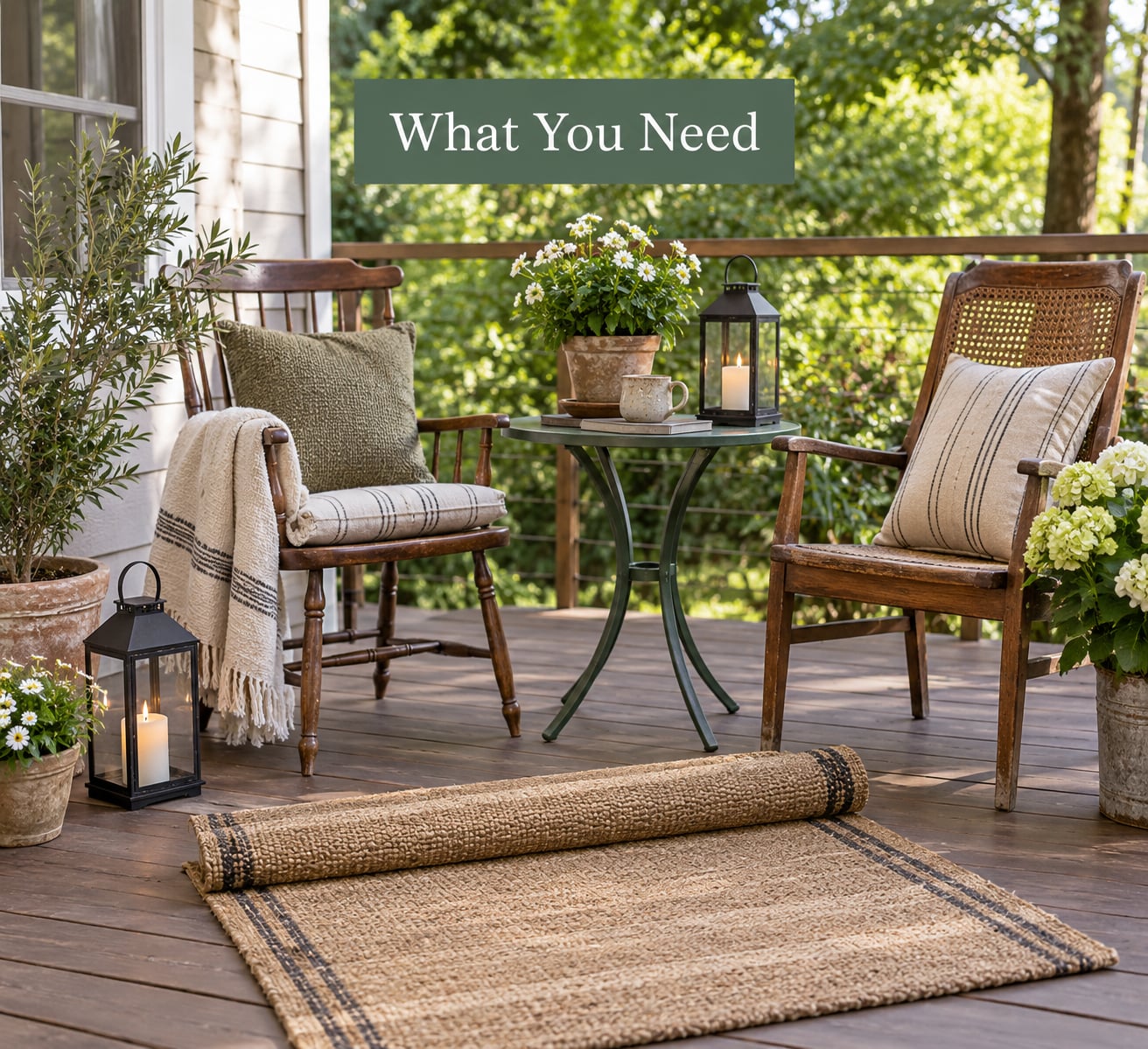
Nobody starts with a full shopping list. Most yards need six things, and you can borrow, thrift, or reuse four of them.
Zone markers. Anything that tells the eye where one area ends and another begins: a row of planters, a change in paving material, a trellis, a couple of large pots, or a low bench. Homeowners with a shovel can add a paver walkway or a raised bed; renters can use planters and movable screens that leave no marks when they move.
Seating. Two to four pieces is usually enough for one zone. Look for wood, powder-coated metal, or resin wicker rather than untreated pine, and check every joint and screw before you commit.
Surface interest. A rug, a pallet deck, or a patch of gravel underfoot does more for the room-feel than most people expect. Outdoor-rated rugs are the easiest swap for people who want the indoor look without dragging the indoor rug outside.
Lighting. Three layers at minimum: something overhead, something at table height, and something along the ground or a wall.
Shade. An umbrella, a shade sail, a canopy, or a pergola with vines. Trees already on the property count, though they take years to do real work.
Finishing details. A few small things that make it feel lived in: outdoor art, a mirror, books, coordinated storage, a hook by the door for the cushions.
Step-by-Step
Choose an outdoor-room layout
Start by deciding how many zones you are actually going to build, then lay them out based on sunlight, traffic, and what you want to do out there. A 500-square-foot yard usually supports two comfortable zones, not four. Trying to cram in a dining area, a lounge, a play corner, and a garden nook is the single most common reason a backyard feels cluttered instead of calm.
Work from the house outward. Note where the sun falls in the morning and late afternoon, mark the paths people already take between the back door and the far fence, and put your main seating where you get shade in the evening. If you only have one solid use, build one excellent zone instead of three mediocre ones.
You will know the layout worked when you can walk through the yard without stepping on furniture and someone always knows where to sit without being told.
Create a clear conversation zone
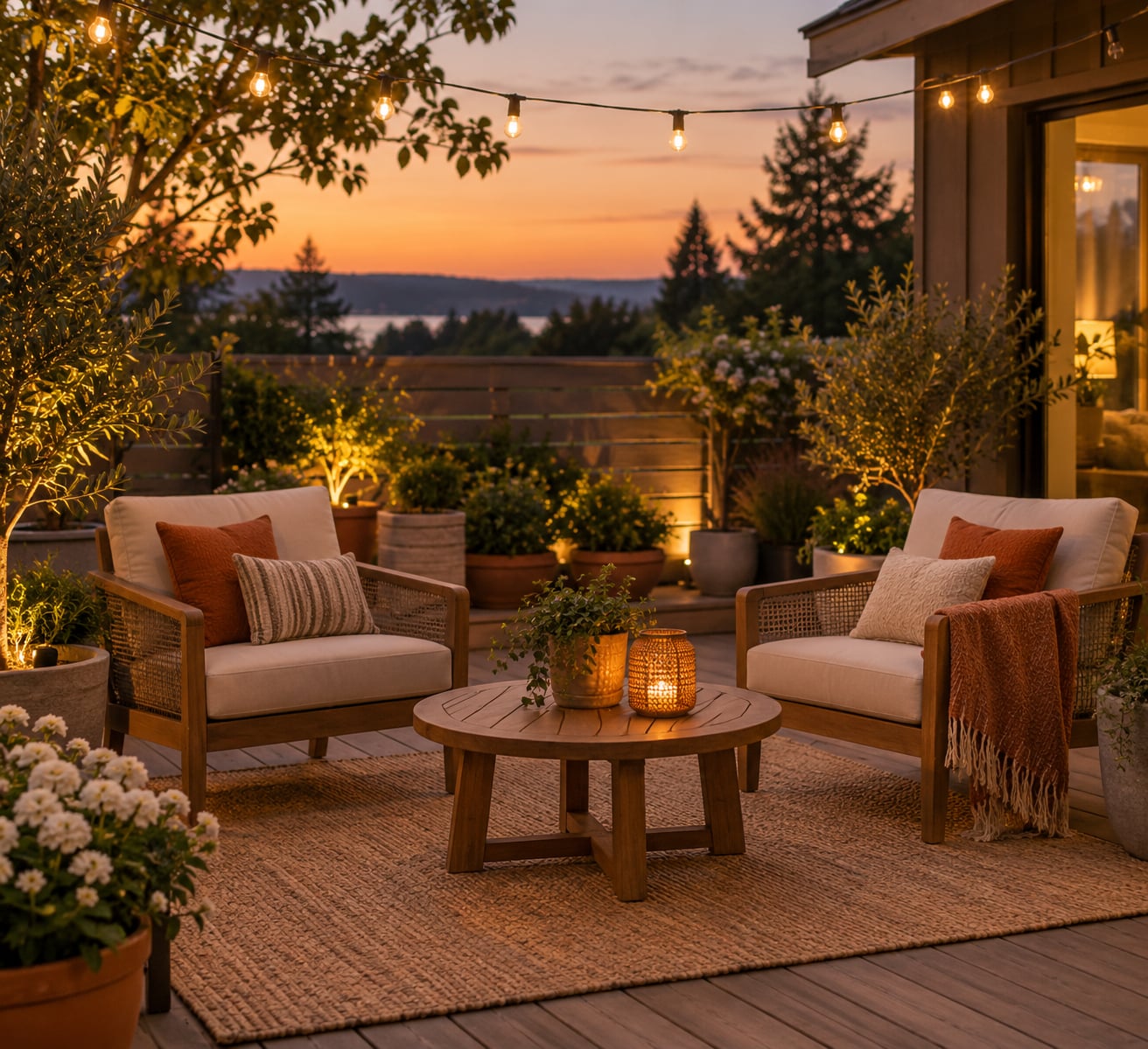
A conversation zone is seating arranged around a center point, not a row of chairs pushed against the fence. Pull everything inward. Chairs should face each other across a low table or a fire pit, with roughly 18 inches of leg room between the seating edge and the table.
Anchor it with a rug that reaches under the front legs of at least two seats. An area rug does the same job indoors: it tells you the floor of the room ends there. Keep a clear path of at least three feet along one side so people can still get to the back of the yard.
If the zone feels wrong, the fix is almost never more furniture. It is a tighter grouping and one thing with height, like a large planter or a lantern on a stand, to break up the eye line.
Choose furniture that works outdoors
Outdoor furniture comes down to three materials worth trusting: teak or other dense hardwood, powder-coated aluminum or steel, and all-weather resin wicker over a metal frame. Anything with solid wood slats is fine as long as you accept a little weathering. Avoid anything built mainly from particleboard or untreated MDF, which swell and crumble within a season or two of moisture.
Secondhand pieces are where I start. Look for rust on the frame, soft or sagging joints, and fabric that has gone brittle. Solid frames are worth restoring with a wire brush, fresh paint, and new outdoor cushions, which you can buy separately and replace rather than replace the whole piece.
Buy one storage box with a tight lid and put the cushion set in it when the weather turns. Most ruined cushions are ruined by rain sitting on them for a month, not by an afternoon shower.
Add a color and texture plan
A room reads as a room when a small palette repeats across different surfaces. Pick two colors and one accent, then repeat them at least three times in the yard: once in a cushion, once in a planter, once in a painted chair or a rug stripe.
Texture is what keeps a repeated palette from going flat. Pair smooth and rough: a glass tabletop on a wood base, metal lanterns against a soft woven rug, stone edging next to feathery grasses. Wood, metal, woven fiber, stone, and live plants in the same view give the eye enough variety that a small yard looks layered.
Repeat the same plant type in groups of three rather than scattering single specimens. It is the oldest rule in the category and it works because it reads as intentional rather than random.
Layer lighting for evening comfort
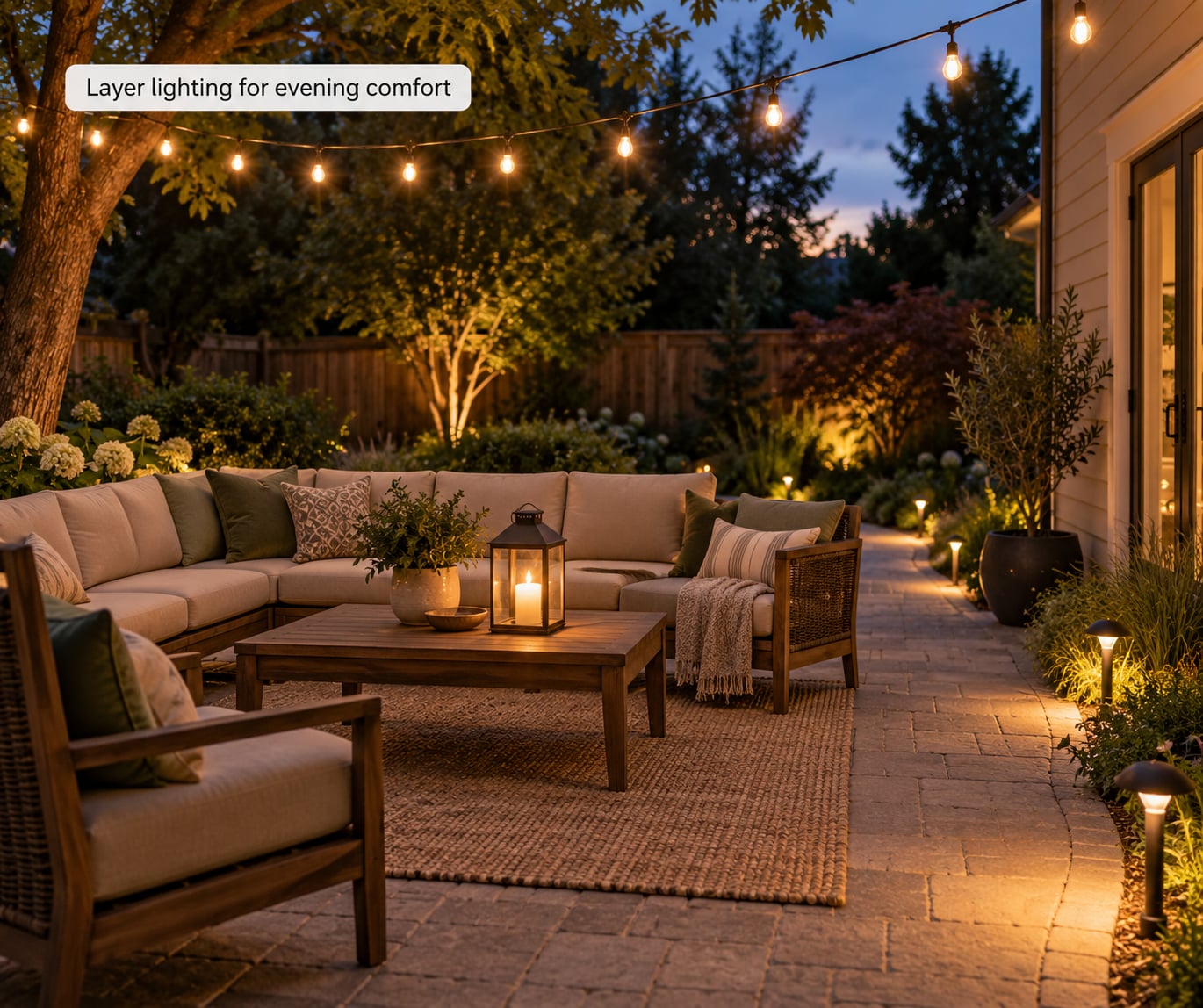
One string of lights will not make a yard usable at night. Lighting works in three layers: ambient light overhead for general brightness, task light at table or counter height for reading and eating, and accent light aimed at a plant, wall, or path edge to give the space depth.
Warm bulbs around 2700K are easier on the eyes than cool white ones outdoors. Low-voltage LED path lighting is the cheapest useful layer because it does the most work for the effort, and solar lanterns cover the spots where running a wire is not worth it.
For anything hardwired, use outdoor-rated fixtures and GFCI-protected outlets, and keep connections above ground where water can reach them. Electrical and structural work belongs to a licensed pro. Solar lights need a full day of direct sun, so place them where the shadow falls on them in winter, not where they look best at noon.
The test is simple: stand in the middle of the zone at nine at night. If you can read, talk comfortably, and see the edges of things without squinting, the layers are doing their job.
Frame the space with shade and greenery
A room has walls, and in a backyard the walls can be living or built. A trellis with climbing vines, a row of tall evergreens, a paneled fence, or a line of planters will block sightlines from the neighbor’s yard and from the street. Screening at roughly eye level does more for privacy than height alone.
Overhead, shade changes how long a zone stays usable. A pergola gives structure and lets you hang lights from it, a shade sail covers a large area with almost no work, and an umbrella moves with the sun. Green shade from a tree is the nicest version and the slowest investment.
Wrap the edge of the zone with plants that spill toward the seating. Soft, trailing growth hides the hard line where hardscaping meets lawn and makes the whole area feel sheltered rather than exposed.
Style the edges with finishing details
Most unfinished-looking backyards are missing their last ten percent. That layer is small and specific: a hook by the door for cushions so they do not live on the ground, a storage bench that matches the seating, one piece of outdoor art or a mirror on a wall or fence, a tray of books on the table, a hook for a towel.
Repeat the same materials rather than adding new ones. Metal lanterns echo metal chair frames; a woven basket repeats the wicker of the sofa. Outdoor art needs weather-rated pieces or a sealed frame, and anything hung on a fence should be fixed with stainless or coated hardware that will not streak rust down the wood.
Then walk the perimeter and remove the things that do not belong. Clutter is what makes a decorated space read as unfinished, not the number of accessories.
Common Mistakes
Buying too much furniture. More seats than people is the fastest way back to a furniture yard. Measure the zone, subtract walking room, and buy for the number of people who actually sit outside.
Ignoring weather ratings. Indoor pillows and untreated fabric outside will fade and hold water within a season. Look for the words outdoor-rated, solution-dyed, or quick-dry on the tag, and skip anything labeled for indoor use only.
Leaving the walkway blocked. When furniture crowds the route to the far end of the yard, people stop going out there. Keep one clear path and design around it.
Overcrowding a small yard. Under 500 square feet, two well-made zones beat four crowded ones. Shrink the dining table, move the lounge to a corner, and let planting carry the rest.
One lonely string of lights. A single run of bulbs creates glare and darkness in equal measure. Add a lower layer so the ground and the edges are visible too.
Mismatched colors with nothing repeated. Every color appearing once looks accidental. Repeat a color on purpose, at least three times, and let the rest stay neutral.
One last tip: decide your two colors and your three light sources before you buy anything else, then shop to that list. A yard assembled around three decisions looks finished, and one assembled around twelve looks collected.
Frequently Asked Questions
How can I make my backyard feel like a room on a budget?
Focus on the four things that do the most work: a defined edge, real seating, layered lighting, and a repeated color palette. Planters, pots, or a line of shrubs create the boundary. Thrifted chairs with new outdoor cushions give you seating. String lights, a lantern, and path lights give you three layers of light. Repeat one or two colors across cushions, pots, and a rug. You can skip the expensive work, like new paving, and still get the room feeling.
What changes can a renter make to a backyard or patio?
Start with things that leave no trace: planters as zone markers, a freestanding trellis or folding screen for privacy, outdoor-rated rugs, string lights clipped to a hook or run along the railing, and a shade sail on poles that drill into pots. Store cushions in a lidded bin indoors when the weather turns. Ask your landlord before anything driven into the ground or attached to the structure.
What outdoor furniture can stay outside all year?
Teak and other dense hardwoods handle weather well and silver over time. Powder-coated aluminum and steel hold up if you clear salt off them near the coast. Resin wicker over a metal frame lasts well in full sun. Expect to replace cushions every few seasons regardless of material, and bring them in during wet weather. Avoid particleboard, untreated MDF, and glue-heavy flat-pack pieces.
Is it safe to run string lights and outdoor lighting in the yard?
Use fixtures and extension cords rated for outdoor use, keep every connection above ground and away from puddles, and plug into a GFCI-protected outlet. Turn the power off before changing a bulb. For hardwired path lighting or anything on your house’s electrical panel, hire a licensed electrician. Solar fixtures need direct sun for a full day, so test them in winter before assuming they will last through a summer evening.
What is the rule of three in landscaping, and does it help a small yard?
It is a grouping rule: plant in odd numbers, most often three, five, or seven, rather than scattering single specimens. Groups read as deliberate and give a small space more rhythm than lone plants do. The same idea works beyond plants: repeat a color three times across a cushion, a pot, and a rug. Use it as a starting point, not a rule, because symmetry often looks stiff in a yard.
Conclusion
To make a backyard feel like a room, you are giving it an edge, a purpose, a place to sit, and a light source. Nothing else is required.
Pick one zone and build it properly. Arrange seating so people face each other, choose your two colors and three light sources, and only then decorate the edges. Once one area feels finished, the yard will follow.