What to put in a guest room besides a bed is really a question about convenience. Guests need somewhere to set a phone, somewhere to hang clothes, a light they can reach from lying down, and enough surface to put a cup of water. Beyond that, it’s personal taste.
The short answer is ten additions: bedside tables, a bench, a reading chair, curtains, a rug, wall hooks, a small desk, a mirror, task lighting and simple wall decor. Keep reading if you want the sizing, the budget-friendly versions and the mistakes to skip.
This list is for homeowners and renters who host overnight guests and would rather spend on five things that work than twenty that look nice in a photo. If your room doubles as an office or a playroom, the notes on each item matter more than usual.
Table of Contents
- What to Put in a Guest Room Besides a Bed at a Glance
- 1. Add a Pair of Bedside Tables
- Where the bedside table actually has to fit
- 2. Use a Bench at the Foot of the Bed
- 3. Add a Reading Chair or Slipper Chair
- 4. Install Curtains for Privacy and Light Control
- 5. Add a Rug to Define the Sleeping Area
- 6. Provide Wall Hooks or a Coat Rack
- 7. Include a Small Desk or Writing Table
- 8. Add a Mirror to Make the Room Feel Larger
- 9. Use Task Lighting in Multiple Places
- 10. Style the Room with Simple Wall Decor
- Frequently Asked Questions
- What is the most important thing to put in a guest room besides a bed?
- How do I make a small guest room feel more spacious?
- Do guest rooms need a chair, or is a bench enough?
- What furniture works well in a guest room on a budget?
- How much storage should a guest room have?
- Should a guest room have a desk?
- Where to Start
What to Put in a Guest Room Besides a Bed at a Glance
| Addition | What it gives guests | Where it works best | Essential or optional |
|---|---|---|---|
| Bedside tables | A surface within arm’s reach of the pillow | Any room with clearance on one or both sides | Essential |
| Bench at the foot of the bed | Luggage seat, dressing spot, extra surface | Rooms with a wall or open foot of bed | Optional |
| Reading or slipper chair | A place to sit that isn’t the bed | Rooms 10×10 ft and larger, or corners | Optional |
| Curtains or shades | Privacy and control over morning light | Every room with a window | Essential |
| Rug | Softens noise, anchors the bed | Hardwood or tile floors | Optional |
| Wall hooks or coat rack | A place for jackets, hats and bags | Near the door or on a blank wall | Essential |
| Small desk or table | A laptop surface for work guests | Larger rooms, long-stay visitors | Optional |
| Mirror | Dressing function, more visual space | Opposite or beside the door | Essential |
| Task lighting | Reading light and a path at bedtime | Every room, bedside first | Essential |
| Wall decor | Finishes the room so it isn’t bare | Any room with an empty wall | Optional |
1. Add a Pair of Bedside Tables
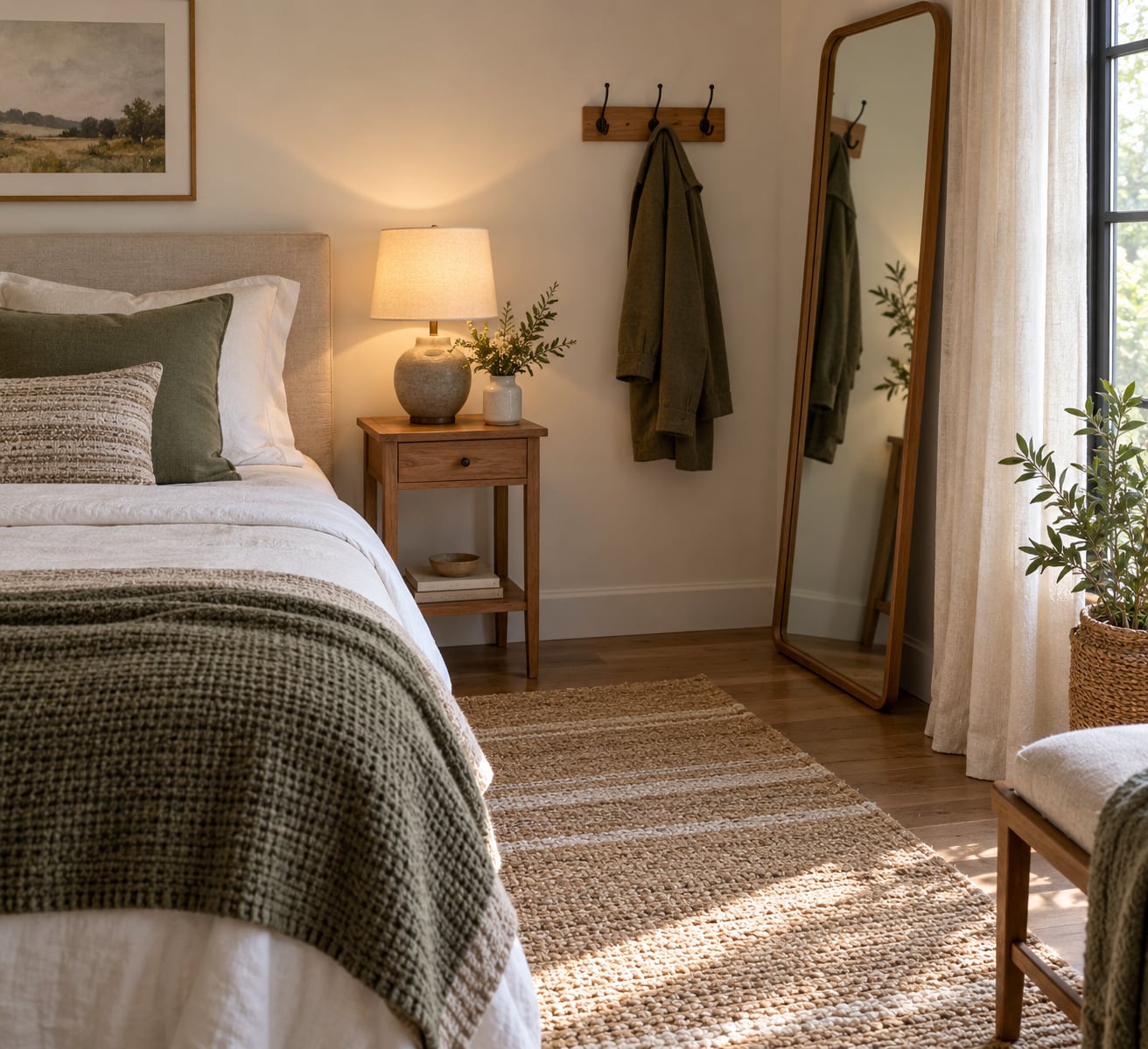
A bedside table is the single most useful non-bed item in the room. It’s where the phone charges at night, where glasses land in the morning, and where a guest puts a glass of water without getting out of bed. It also fixes the visual imbalance of a bed with nothing on either side of it.
Where the bedside table actually has to fit
Measure the gap between the bed frame and the wall before you buy. Most people underestimate it. If you have under about 9 inches of clearance, a slim nightstand or a wall-mounted shelf is a better fit than a traditional table, and it keeps the walkway clear in a small room.
Thrifted tables in a matching pair are the cheapest way to get symmetry. Drawers matter more than style, since guests will use them for a week of small belongings. If you only have space on one side, a narrow shelf mounted at mattress height works fine and costs less than a table.
2. Use a Bench at the Foot of the Bed
A bench solves three problems at once: guests sit to pull off shoes, they lay out clothes the night before, and their suitcase has somewhere to go besides on the bed. That last point matters more than most people expect. Guests arrive with overpacked bags and, without a designated spot, they end up stepping on them all morning.
Leave 18 to 24 inches between the bench and the bed so it reads as seating and not a step. Upholstered benches double as storage if you pick one with a lift top. In a small room, a folding luggage rack does the same job and disappears against the wall between visits.
3. Add a Reading Chair or Slipper Chair
People avoid sitting on a bed that isn’t theirs. A single chair gives a guest somewhere to read, dress or have a conversation that isn’t happening in bed. It also makes the room feel like a real room rather than a storage locker with a mattress in it.
A slipper chair or a small upholstered armchair with a footprint around 24 inches wide is plenty. Pull it into the corner nearest the window or the task lamp, not into the path between the bed and the door. If floor space is tight, a slim wall-mounted chair or a hanging egg chair in the corner clears the floor completely.
4. Install Curtains for Privacy and Light Control
Curtains do two jobs, and only one of them is decoration. Guests close them at night and open them in the morning, which means the window covering is the main control you have over whether someone sleeps until 6 a.m. or 6:30. Hang them wider than the window and higher than you think, close to the ceiling, and the room gets taller and darker at the same time.
For light control on a budget, thrifted black-out panels or a tension rod with lined curtains both work. The blackout layer does the actual work, and it matters most in a basement guest bedroom or a room facing a street lamp.
5. Add a Rug to Define the Sleeping Area
A rug anchors the bed and softens the sound of someone walking across hard flooring at 6 a.m. It is the fastest way to make a spare room stop feeling like a room someone sleeps in occasionally.
Sizing is the whole trick. Ideally the rug is wide enough to extend 18 to 24 inches on both sides of the bed, or at minimum to reach under the front two legs of the bed frame on each side. If nothing that size fits, a smaller rug placed perpendicular to the bed still works better than a tiny one centered under it.
6. Provide Wall Hooks or a Coat Rack
Guests arrive with wet jackets and full bags, and they want to put them somewhere other than the back of a dining chair. Three or four hooks near the door handle more guests than a single hook does.
A slim wall-mounted rail takes up almost no space, a repurposed ladder leaned against the wall looks casual and adds shelf height, and an over-the-door organizer is the answer in a rental where you cannot drill. Put one hook at child or guest height rather than at your own shoulder height, and leave one deliberately low.
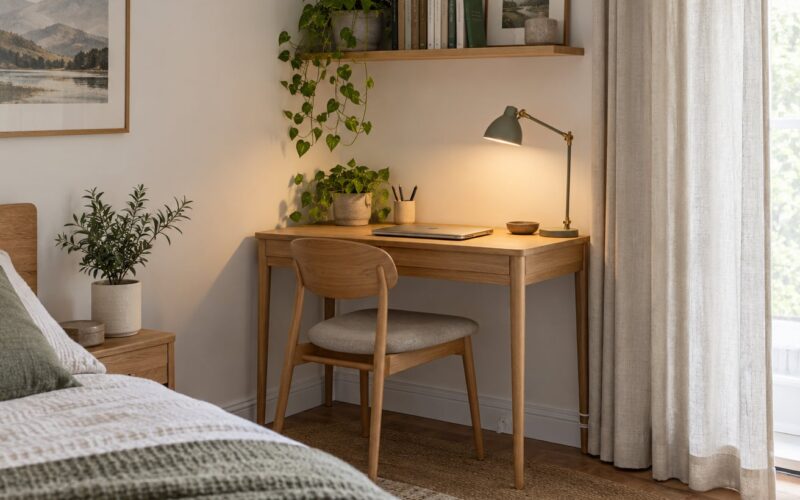
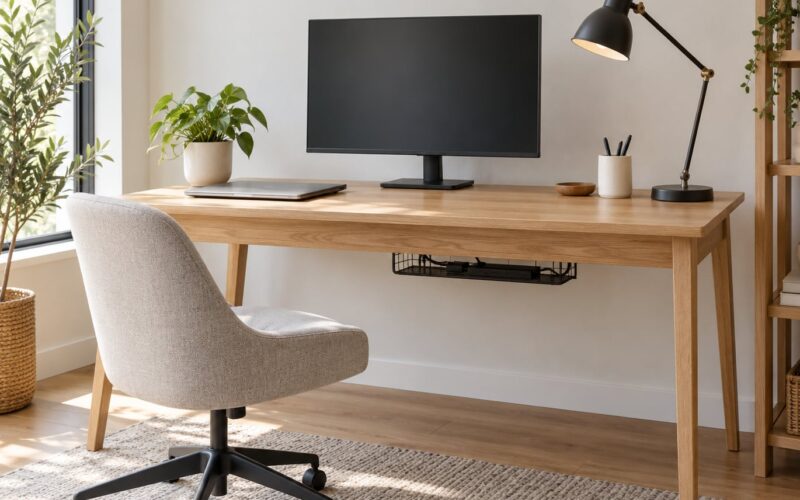
7. Include a Small Desk or Writing Table
A desk earns its place when a guest works remotely, when someone stays for a few weeks, or when the room does double duty as a study. It does not earn its place in a room used purely for weekend visitors, where it will hold laundry and become a clutter magnet.
A 36 to 42 inch wide table is enough for a laptop, a notebook and a coffee cup. A folding desk or a wall-mounted drop-leaf surface keeps the floor clear on days you need it and disappears on days you do not. If you already have a desk elsewhere in the house, this item is the easiest one on the list to skip.
8. Add a Mirror to Make the Room Feel Larger
A mirror is two functions in one object: guests need somewhere to check themselves before leaving, and a mirror bounces light and reflects space, which makes a small room read bigger. Position it opposite or directly beside the door and you catch both your own reflection and more of the room.
A leaning floor mirror is the easiest option, since it needs no mounting and you can angle it later. A thrifted framed mirror with a piece of glass or a discounted pane fitted into it costs less than buying new hardware. Full length is more useful than wide for dressing, so check the height before you commit.
9. Use Task Lighting in Multiple Places
One ceiling light is not enough in a guest room. Guests need a light they can reach from lying down, a path to the door or bathroom that doesn’t mean flipping on the overhead, and something to read by that isn’t the ceiling fixture.
Start with a bedside lamp on a dimmer or with a warm-toned bulb, since a bright overhead at midnight is the thing people remember badly about a guest room. A floor lamp in the chair corner covers the reading seat. A motion sensor night light or a plug-in dimmer takes care of the path. If you use a floor or table lamp, keep the cord along a wall or under a rug runner so nobody catches it in the dark.
10. Style the Room with Simple Wall Decor
Bare walls are what make a guest room look unfinished when nobody’s staying. You don’t need a lot. One large framed print above the bed, a small gallery wall, or a single thrifted piece hung properly does more than a crowded arrangement of small frames.
A plant in the corner and a small shelf of books soften the room too, and they cost nothing if you’re starting from houseplants and books you already own. Keep the palette close to the bedding so the room reads calm. If anyone staying has sensitivities, skip strongly scented flowers and fragranced laundry products, and go with greenery instead.
Frequently Asked Questions
What is the most important thing to put in a guest room besides a bed?
Storage and light. Guests need an empty drawer or two, hangers and somewhere to set a suitcase, plus a light they can reach from bed without getting up. A bedside table with a lamp handles the light and the surface in one piece, and a closet with hangers or an empty dresser drawer covers storage. Add those two first and the rest is comfort and style.
How do I make a small guest room feel more spacious?
Keep the floor mostly clear and push storage up the walls. Use one slim bedside table rather than a pair, a folding luggage rack that leans flat when nobody’s there, and a wall-mounted rail for jackets instead of a standing coat rack. Hang curtains wide and high, add one mirror to reflect light, and skip the rug if floor space is genuinely tight.
Do guest rooms need a chair, or is a bench enough?
A bench is enough for a short visit. Guests will sit on it to pull off shoes and use it to lay out clothes, and a luggage rack or narrow bench handles the suitcase. A chair earns its space when someone reads in the room, stays longer than a weekend, or needs somewhere to sit that isn’t the bed. In a room under about 100 square feet, start with the bench.
What furniture works well in a guest room on a budget?
Thrifted bedside tables, a thrifted bench or luggage rack, and a folding table for a desk all hold up well. Skip anything built in solid hardwood unless you plan to resell it later. Focus your spending on the things guests touch: a decent lamp, bedding, a rug that fits the bed properly, and hardware for hooks that will hold a wet coat.
How much storage should a guest room have?
Enough for a week of clothes for two people. That usually means a closet or hanging space with at least six to eight hangers, two empty drawers, and a spot for a suitcase that isn’t on the floor or the bed. Leave the storage empty between visits rather than filled with your own things, and put a hamper in the room so nobody opens a suitcase to find a sock.
Should a guest room have a desk?
Only if the room hosts working guests or longer stays. A 36 to 42 inch table is enough for a laptop and a cup, and a folding or wall-mounted version keeps the floor clear on days you don’t need it. For weekend visitors, skip the desk and use the space for a reading chair or a bench instead, since a desk with no purpose just collects clutter.
Where to Start
Buy the bedside table with a lamp and the hooks first, then add storage that actually empties out, like a closet with hangers or two cleared drawers. Those four things decide whether a guest can settle in or spends the night improvising.
After that, comfort: the bench, the curtains, the rug sized correctly for the bed. Decor and the desk can wait until the room works, because a guest never notices the art while they’re looking for somewhere to put their phone. Update the list for 2026 and check the room against it once a year.