Guests decide whether they like your home in the first fifteen minutes, and most of that verdict comes from the spare room. If you want to know how to make a guest room comfortable without replacing furniture, start with four layers: a well-supported bed with fresh bedding, warm lighting instead of a bare ceiling fixture, the small essentials already in the room, and a short note that explains how things work.
That is the whole method. Work outward from the mattress, and each layer makes the next one easier. Most hosts spend their budget on the wrong end of the problem — a new throw pillow on a bed that creaks — when the fixes that actually get noticed cost very little.
Here is the room-by-room version, plus what to buy first when you have a normal decor budget and no designer to call.
Table of Contents
- What You Need
- How to Make a Guest Room Comfortable Step by Step
- Start with the bed — it does most of the work
- Add layered lighting for a calm, welcoming atmosphere
- Create practical storage and a clear place for belongings
- Make the room private and easy to use
- Add soft, personal, budget-friendly finishing touches
- Common Mistakes
- Frequently Asked Questions
- What makes a guest room feel comfortable?
- What is the best bedding for a guest room?
- How can I make a guest room comfortable on a budget?
- Should a guest room have a chair?
- What temperature should I keep a guest room at?
- How do I make a multipurpose room work for office and guests?
- Conclusion
What You Need
Comfort upgrades fall into four piles, and you can do this in stages rather than all at once.
The bed: a mattress in decent shape or a mattress topper, a washable mattress protector, two or three sets of sheets, a duvet or coverlet matched to the season, two sleeping pillows plus a spare, and one throw blanket folded at the foot. Bed sheets and duvet covers should be things you can wash at 140°F and put back on the same day.
The light: a bedside lamp on each side of the bed if the room allows, a dimmer switch or a three-way bulb in at least one fixture, warm-toned bulbs in the range of 2700K to 3000K, and a night light for the path to the bathroom.
The essentials: a water carafe and glass, a stack of fresh bath towels plus washcloths, travel-size toiletries and a spare toothbrush, a wastebasket, wall hooks with hangers, a full-length mirror, and somewhere for a suitcase that is not the bed.
The information: an index card or small notepad with the wifi password, how the shower works, how to adjust the heat, quiet hours, and where the snacks are.
You also want your usual cleaning kit, because a room that looks cared for matters as much as one that feels expensive. Wipe down the nightstand, empty the bin, run the sheets, dust the top of the dresser, and open a window for ten minutes.
Thrifted and budget-friendly items fit right in: an older lamp with a new dimmer bulb, a thrifted mirror, a basket from the closet, a piece of art you have had in a garage for years. Guests notice warmth far more than provenance.
How to Make a Guest Room Comfortable Step by Step
Comfort comes from four things working together: a bed that supports an eight-hour sleep, light the guest can control, storage that lets them unpack, and information so nothing has to be guessed at. Matching furniture sets do not enter into it.
Start with the bed — it does most of the work
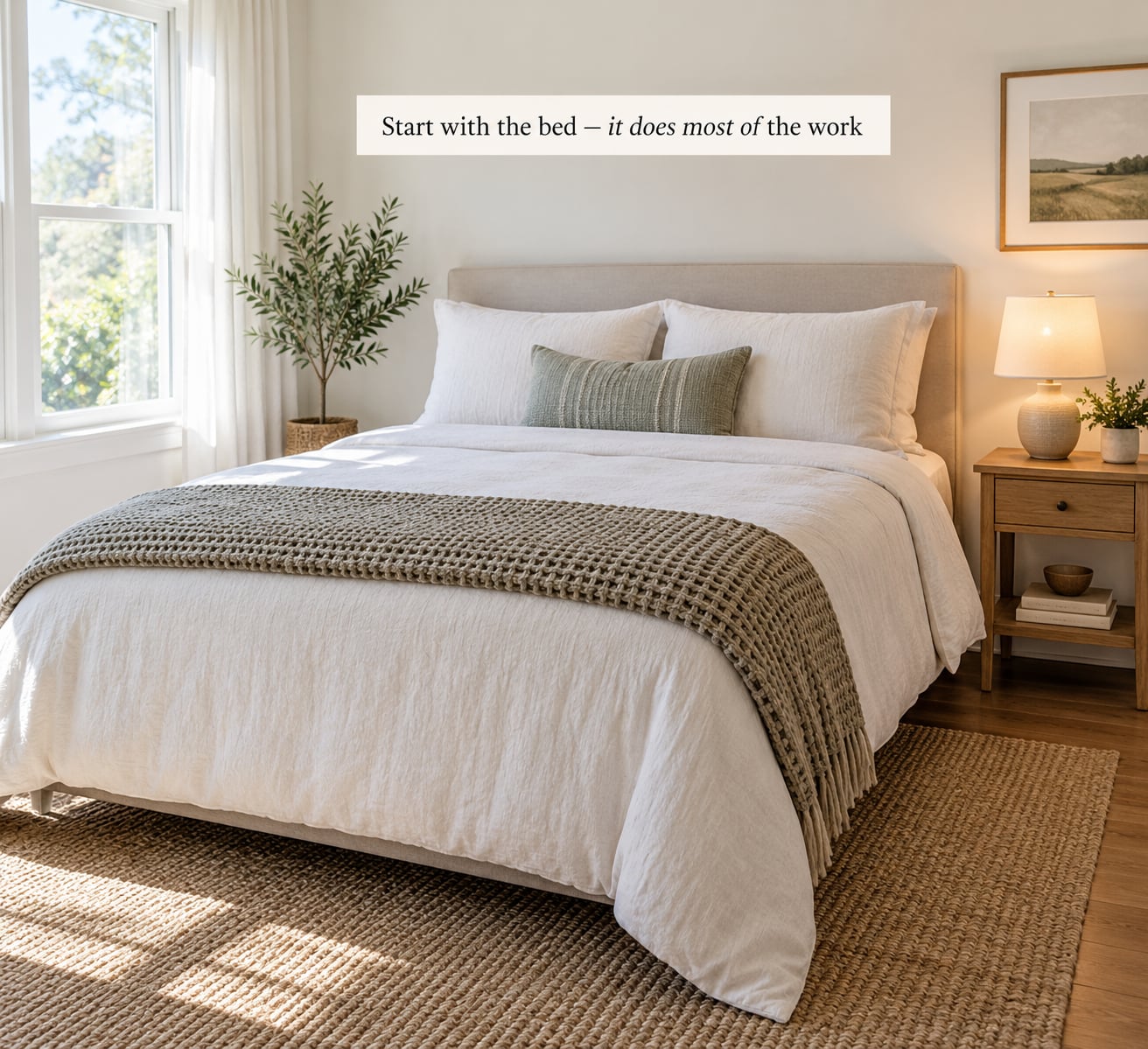
The bed carries most of guest comfort, so spend your first hour there. Hosts on Reddit say the same thing repeatedly: a mediocre mattress on an otherwise nice spare bed is what gets mentioned afterward. If the mattress sags in the middle, a memory foam topper fixes most of it for far less than a new mattress, and an air mattress is the one surface to avoid entirely for overnight guests — a futon or foam mattress is a better temporary upgrade.
Sheets come next. Percale feels crisp and cool and stays that way in summer, sateen feels smoother and warmer and suits cooler months, and flannel is genuinely comfortable in winter but miserable in July. Thread count matters less than people think — anything from 200 to 400 feels good, and what guests notice is that the sheets were washed recently and smell clean, not the number on the box.
Offer a pillow choice rather than guessing. One firm and one soft gives guests a way to solve their own neck, which most beds do not. Two sleeping pillows is right; a decorative stack on top is what makes people quietly move pillows to the floor at midnight. Put the spare pillows and blanket in a basket at the foot of the bed or on a nearby bench instead of on the bed itself.
Match the duvet to the season. A lightweight down-alternative duvet with a washable cover works in summer; add a chunky knit throw for a cooler room. Leave the coverlet or quilt folded across the foot so a guest can pull it up without stripping anything.
Add layered lighting for a calm, welcoming atmosphere
A bare overhead light is the fastest way to make a guest room feel institutional. Layer it: keep something overhead for cleaning, then add a bedside lamp within arm’s reach of the pillow, and a floor lamp or reading sconce in the corner. Warm bulbs in the 2700K to 3000K range do most of the work — cool white overhead light is what makes a room read as a waiting area.
Give the guest control. A dimmer switch or a three-way bulb means they can set the brightness without getting up. If the room is a basement or faces a shaded side, paint the walls a lighter color, hang any curtain high and wide above the window, and put a mirror opposite it. Curtains hung higher and wider than people expect is the cheapest trick decorators use to open up a small or dim room, and it works on a spare bedroom too.
Add a night light along the hall or in the bathroom for anyone who gets up in the dark. A warm bulb in a plug-in fixture, kept low, is enough.
Create practical storage and a clear place for belongings
Guests unpack differently from you. Most of them bring a suitcase, a hanging bag, and a bag of toiletries that end up on the bed. Give each one a home: an empty closet or at least a clear shelf, a luggage rack or bench that is not the bed, a hook on the back of the door for a robe, and a bedside table with one drawer that is not full of your own things.
Storage overflow is the quiet failure. When a spare bedroom doubles as a storage unit, there is nowhere to hang a coat and nowhere to put a bag, and the room reads as unfinished. Moving two boxes to the garage does more for the atmosphere than a new lamp.
A bedside table matters more than most people expect. It holds a glass of water, a phone charger, a book, and the lamp — everything a guest reaches for without wanting to cross the room.
Make the room private and easy to use
Comfort includes being able to close the door. Check that it latches and swings without hitting the bed, and that the privacy lock actually works if the room is near a shared hallway. Guests who cannot lock a door sleep worse, even if they never say so.
Walk the path yourself at night. From the bed to the bathroom there should be nothing on the floor, no luggage, no cord across the walkway, and enough light to see where you are going. Leave a clear side of the bed so someone can get in without crawling over someone else.
Curtains or blinds do more than decoration — blackout curtains are the single best upgrade for a light sleeper, since streetlight and early sun are the most common complaint in guest feedback. A white noise machine or a running fan covers hallway noise and thin walls. For temperature, set the room a little cooler than you like it before you go to bed; people wake up better slightly cool.
Add soft, personal, budget-friendly finishing touches
Comfort is texture before it is color. A chunky knit throw, a soft rug under the bed, curtains instead of blinds, and one warm lamp give a plain room more warmth than a full redesign would.
Then make it feel lived in rather than staged. Hang one piece of art where a person lying in bed can actually see it. Leave two or three books on the shelf — guests reading in bed at midnight will thank you. A small basket with a spare blanket, earplugs, and a phone charger is worth more than any arrangement of throw pillows.
Keep the palette to two or three colors and let one thing in the room be green or wood. Two-color schemes are easy to source from thrifts and read as calm instead of busy.
One thing to skip: fragrance. Candles, reed diffusers, and heavily scented laundry products are a common trigger for allergies, asthma, and migraines, and they linger for days after the guest leaves. Fresh air, a clean towel, and a bar of unscented soap do the same job. If you love a scented product, save it for after the guest leaves.
Leave the room looking cared for, not perfect. A visible laundry pile under the bed or a stack of boxes in the corner undoes all of the above in about two seconds.
Common Mistakes
Most uncomfortable guest rooms fail in the same handful of ways, and every one has a cheap fix.
- The decorative pillow pile. Guests move four pillows to the floor at night and step on them in the morning. Keep two sleeping pillows on the bed and move the decorative ones to a basket or bench.
- Overhead-only lighting. One bright ceiling fixture makes a cozy room feel like a hallway. Add a bedside lamp on a dimmer and warm bulbs.
- Scented candles and diffusers. Pleasant for you, a headache for someone with an allergy. Ventilate instead, and light nothing during the stay.
- No spare blanket. Guests are cold at 2am and will not dig through a closet. Fold a second throw at the foot of the bed.
- No wastebasket. Then the bin goes in the bathroom or the guest carries trash out in the morning. Put a small bin in the room and empty it before arrival.
- Seasonal bedding left in place. Flannel in July or a lightweight duvet in January ruins the bed. Swap the layers before every stay and store the off-season set in a lidded bin.
- No note and no directions. Guests hunt for the wifi password, the thermostat, and how the shower handle works. Write it on an index card and leave it on the bedside table.
- Storage overflow and blocked paths. A room full of boxes leaves nowhere to sit and nowhere to put a bag. Clear one corner and give a suitcase its own spot.
- Stale bedding nobody has washed. Nothing else compensates for this. Wash the sheets and the duvet cover the day before, not a week before.
Frequently Asked Questions
What makes a guest room feel comfortable?
A comfortable guest room lets someone sleep well and get what they need without asking the host for it. That means a supportive bed with freshly washed linens and a choice of pillows, warm bedside lighting instead of a bare ceiling fixture, essentials like water, towels, a wastebasket and hangers already in the room, and a short note with the wifi password and heat instructions.
What is the best bedding for a guest room?
Choose clean, breathable bedding that feels soft without trapping too much heat. A medium-firm mattress, two pillows per bed, a lightweight down-alternative duvet with a washable cover, and an optional washable throw suit most guests year round. Guests are surprised by all three: a topper on a sagging mattress, two pillows to choose from, and a spare blanket within reach.
How can I make a guest room comfortable on a budget?
Start where it counts most: clean linens, a mattress topper if the mattress sags, and warm lighting rather than a furniture set. Thrifted lamps, a thrifted mirror, baskets for spare blankets, and thrifted curtains fill the functional gaps. Warm-toned bulbs, wall hooks, a wastebasket and a written note cost almost nothing and change how the room feels.
Should a guest room have a chair?
A chair helps but is not essential. If the room has space, add one that a guest can use to dress or sit comfortably, ideally near a small table. Just keep it clear of the bed, the closet door and the path to the bathroom. A small stool or a storage bench at the foot of the bed serves most of the same purpose in a smaller room.
What temperature should I keep a guest room at?
Most people sleep best in a room a little cooler than they prefer during the day, around 65 to 68 degrees Fahrenheit. Set it lower than you like before bed, and tell your guest how to adjust the thermostat instead of assuming they will find it. Keep an extra throw on the bed so they can warm up without getting up.
How do I make a multipurpose room work for office and guests?
Keep two things fixed: the desk setup and the bed surface. Store the rest so it disappears in one motion — filing boxes in a closed cabinet, office supplies in a lidded bin, paperwork off the desk. A folding screen or a curtain behind the desk hides the work clutter during a stay, and a daybed with storage or a sleeper sofa gives you a bed without giving up the room entirely.
Conclusion
To make a guest room comfortable, fix things in the order guests notice them: the bed first, then the lighting, then the small essentials, then the note. Wash the linens the day before, add a bedside lamp on a dimmer, put a wastebasket in the corner, fold a spare throw at the foot, and write down the wifi password. That order is not stylish, and it is the difference between a guest who sleeps well and one who quietly rearranges your decorative pillows at midnight.