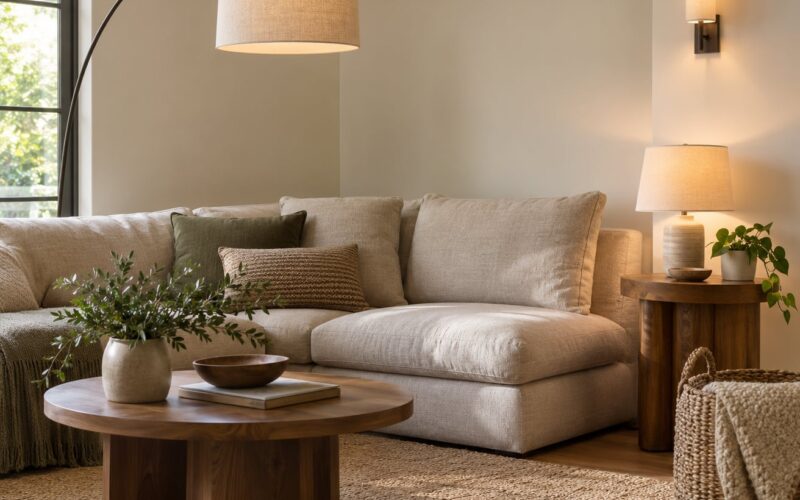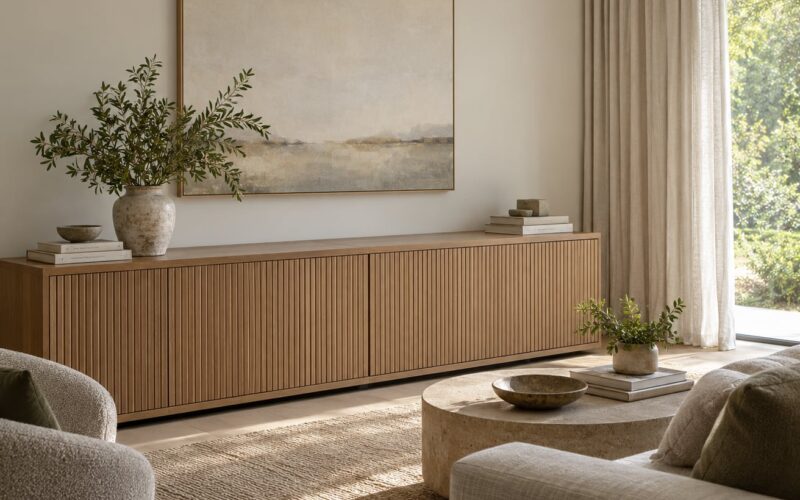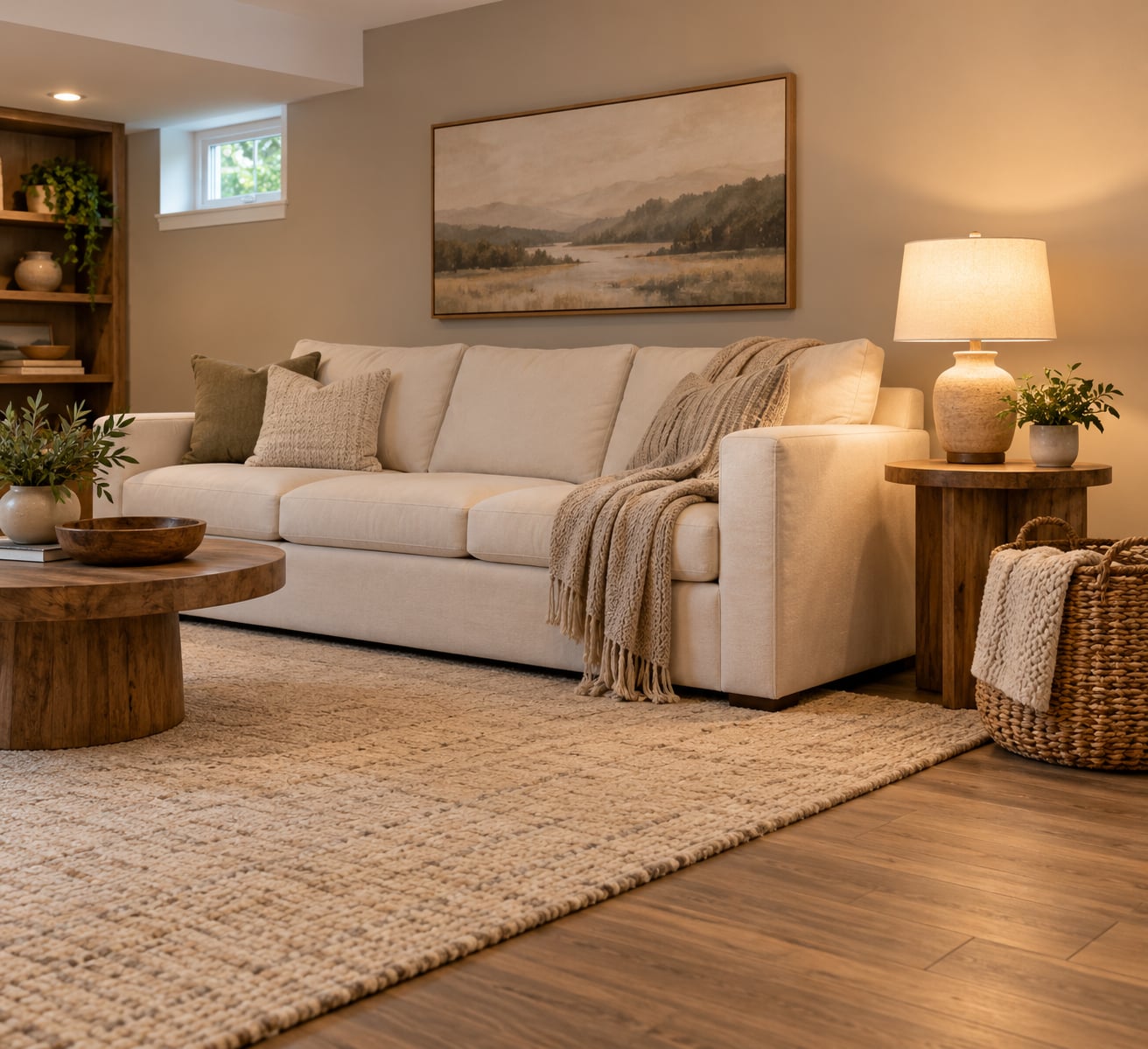
The fastest way to know how to make a basement feel warm and finished is to fix it in a fixed order: solve moisture and temperature first, layer the lighting second, then warm up the walls, floor and textiles last. Three moves do most of the work — warm-white bulbs at more than one height, a warm neutral paint with one textured accent wall, and a large rug with soft fabric. Most rooms look finished after one weekend of those three, not a remodel.
It helps to split what people mean by warm into two problems. Visual warmth is what a room looks like: cold blue-white bulbs, bare block walls, concrete floors and echoing acoustics. Thermal warmth is what the air and surfaces feel like, which comes down to insulation, humidity and the slab under your feet. Decor fixes the first problem almost entirely. The second needs a contractor, and knowing which one you have stops you from spending money on furniture that still feels cold.
Table of Contents
- What You Need
- Step-by-Step: How to Make a Basement Feel Warm and Finished
- Assess the Basement and Set the Layout
- Layer the Lighting to Make a Basement Feel Warm
- Make the Walls and Ceiling Feel Finished
- Define the Floor
- Choose Comfortable, Scaled Furniture
- Add Soft Texture and Color
- Solve Storage Without Making the Room Feel Heavy
- Finish with a Cohesive Focal Point
- Common Mistakes
- Frequently Asked Questions
- What is the best way to make a basement feel warmer?
- Should I paint a basement ceiling white or another color?
- What flooring makes a basement feel warmer and more finished?
- How can I make a basement feel less dark without remodeling?
- What colors work best for a warm and inviting basement?
- How do I decorate a basement on a budget?
- Conclusion
What You Need

Start with tools you probably already own, and buy the rest in one trip so the project does not stall between steps.
- Measuring tape and a notepad for wall runs, window sizes and furniture footprints
- Painter’s tape and plastic sheeting for cutting in trim lines and protecting floors
- Level, screwdrivers, cordless drill and a socket set for mounting sconces, shelves and picture rails
- Paint supplies — a low-VOC interior paint, a roller extension, an angled sash brush and painter’s pads
- Warm-white LED bulbs in a range of color temperatures, plus a couple of dimmable ones
- Floor options — an area rug with a firm pad, peel-and-stick tile, or flooring samples to compare
- Storage bins with lids and labels for the declutter phase
- A budget worksheet dividing spending into the small, mid-range and full-refresh tiers below
Skip anything electrical beyond swapping a bulb until you know what your panel and circuits can carry. New fixtures, added circuits and relocated outlets belong to a licensed electrician, and basement work near a sump pump or a washing machine is the wrong place to improvise.
Step-by-Step: How to Make a Basement Feel Warm and Finished
Work through this in order. Each tier below changes a different set of rooms, so you can stop at the level your budget and weekend allow without leaving the basement half-done.
| Tier | What it changes | Best for |
|---|---|---|
| Small budget | Warm bulbs, a large rug, throw pillows and a blanket, paint on walls and ceiling, labeled bins | A weekend refresh where the walls are already drywall or block |
| Mid-range | Adds sconces or a second lamp layer, peel-and-stick or luxury vinyl plank, window treatments, one textured accent wall | Walls and floor that look dated but are sound |
| Full refresh | Adds new fixtures on new circuits, engineered hardwood or sealed concrete, built-in shelving, and an insulation or dehumidification fix | Rooms where moisture or temperature is the real problem |
Assess the Basement and Set the Layout
Measure first: wall lengths, ceiling height, window and egress locations, door swings, and where the ducts, joists and sump pump intrude. That map decides everything else, because furniture placed before the map ends up facing a pipe.
Then check moisture. Look for efflorescence on the slab, stains below windows, a musty smell that returns within a day of running a dehumidifier, and condensation on cold pipes. Buy a cheap hygrometer and read the room at the wettest point of the day; below-ground rooms generally do best held between 30 and 50 percent relative humidity.
Only after that, place the functions. Seating goes where the ceiling is highest and furthest from ducts. A work zone needs an outlet and ideally a window. Storage tucks under the lowest joists and along the shortest wall. Getting this right means the room functions before it is pretty, which is the opposite of how most basement projects go wrong.
Layer the Lighting to Make a Basement Feel Warm
A single ceiling fixture is why most basements feel like a hallway. Replace the one-source approach with at least three layers: a dimmable overhead layer for general brightness, a task layer where people actually read or work, and an accent layer that grazes walls and artwork.
| Color temperature | How it reads | Where to use it |
|---|---|---|
| 2200 to 2400K | Candle-warm, slightly orange | A single table lamp, a bar cart, a bedside corner |
| 2700 to 3000K | Classic warm white | Living areas, media rooms, seating walls |
| 3000 to 3500K | Warm-neutral, still easy on the eyes | Home office, laundry corner, home gym, playroom |
| 4000K and above | Cool and bluish | Garage and utility spaces only, never the seating area |
Two details decide whether a fixture looks warm. Shade glass matters: tinted or thick glass pulls the light cool, a problem homeowners on decorating forums keep running into when a lamp reads wrong no matter how many warm bulbs they try. And match finishes — mixing a brushed-nickel sconce with a matte black floor lamp looks accidental, not layered.
Add low-level light where none can reach: LED strips under a shelf or along a stair tread, a picture light over the gallery wall, and one table lamp at roughly eye level. Put a mirror on the wall opposite the deepest shadow to bounce light back into the room. Dimmers matter more than fixture count, because they let one room shift from task brightness to evening warmth.
Make the Walls and Ceiling Feel Finished
Basement walls read as unfinished for three reasons: dirt, texture you cannot control, and cold color. Wash block or concrete with a masonry cleaner, let it dry fully, then seal with a penetrating masonry sealer. Paint over that with a low-VOC masonry or eggshell paint in a warm neutral — greige, clay, sand or a soft putty all carry a warm undertone that a plain cool grey never will.
Give one wall something to do. Shiplap over furring strips, brick veneer, grasscloth-style textured wallpaper or a cork panel all add warmth cheaply compared with framing new walls. If you cannot drill, removable wallpaper or a large leaning frame gets most of the effect. On painted cinder block, a filled and sanded surface takes paint far better than raw block, and filling those joints is the whole job.
Do not forget the ceiling, which is the largest surface most people see. Paint it one shade lighter than the walls, or pure white if the room needs every bit of brightness. Painting ducts, joists and pipes the same white makes them disappear into the ceiling instead of cutting it into stripes. If the ceiling is dated popcorn texture, skim-coating it smooth or covering it with flat panels does more for the room than new furniture will.
Define the Floor
Hard floors are correct in a basement for a reason: they tolerate moisture and spills, and wall-to-wall carpet holds dust and allergens in a room that is already humidity-prone. That is why area rugs with a firm pad are the coziness workaround people actually use, and why thick pads over hard floors make a measurable difference underfoot.
- Area rug with a pad — the fastest move, defines zones in an open plan, and softens both temperature and sound
- Painted or polished concrete — inexpensive, durable, and it looks deliberate when sealed with a matte finish
- Peel-and-stick vinyl tile — a weekend install with no adhesive mess, best in dry, stable rooms
- Luxury vinyl plank — water-resistant and quiet, a good match for pets and kids
- Engineered hardwood — warmer underfoot and visually softer, provided the room holds stable humidity
Size the rug so the front legs of the main seating land on it, not beside it. In an open basement, two rugs in different sizes mark two zones far more clearly than moving walls would, which is the trick renters in interior design forums keep circling back to.
Choose Comfortable, Scaled Furniture
Low ceilings punish tall furniture, so favor low silhouettes, shallow depths and legs that lift a piece visually off the floor. Light and mid-tone upholstery bounces light that a dark couch absorbs, and a slim sofa or a pair of lounge chairs leaves walking room where a sectional blocks it.
Buy for the ceiling, not for the wish list. Measure the clearance at the lowest joist, add a few inches for a lamp, and let that number set your budget for the biggest piece in the room.
Add Soft Texture and Color
Warmth is mostly surface. Curtains hung from a rod a few inches beyond the window frame make a small basement window read as intentional, and woven baskets, throws, pillows and a wood coffee table supply the texture that bare block and concrete refuse to give.
Pull two or three colors from the rug and repeat them in cushions, a throw and one piece of wood. Two colors repeated across the room look composed. Nine colors repeated across the room look like leftovers.
Solve Storage Without Making the Room Feel Heavy
Open shelving and open bins are what make a basement read as storage. Closed baskets, labeled lidded bins, and cabinets or ottomans with concealed storage keep the visual field clean while everything still has a home.
Organize vertically with slatwall or pegboard in the playroom and gym, keep daily items within arm’s reach, and move anything used less than twice a year up onto shelves or out of the room entirely. A one-hour purge at the start of this whole sequence is what stops the clutter from returning.
Finish with a Cohesive Focal Point
A finished room has one place the eye lands. Pick a reading corner with a lamp and an armchair, a media wall, a game table, or a bar cart against the longest wall, and give it the best light and the most deliberate styling.
For the gallery wall above a sofa or console, span the art across roughly half to three-quarters of the furniture width and keep consistent gaps between frames. From there, repeat the focal area’s palette, wood tone and one metal finish through the rest of the room. That repetition is the difference between a basement that is decorated and one that looks finished.
Common Mistakes
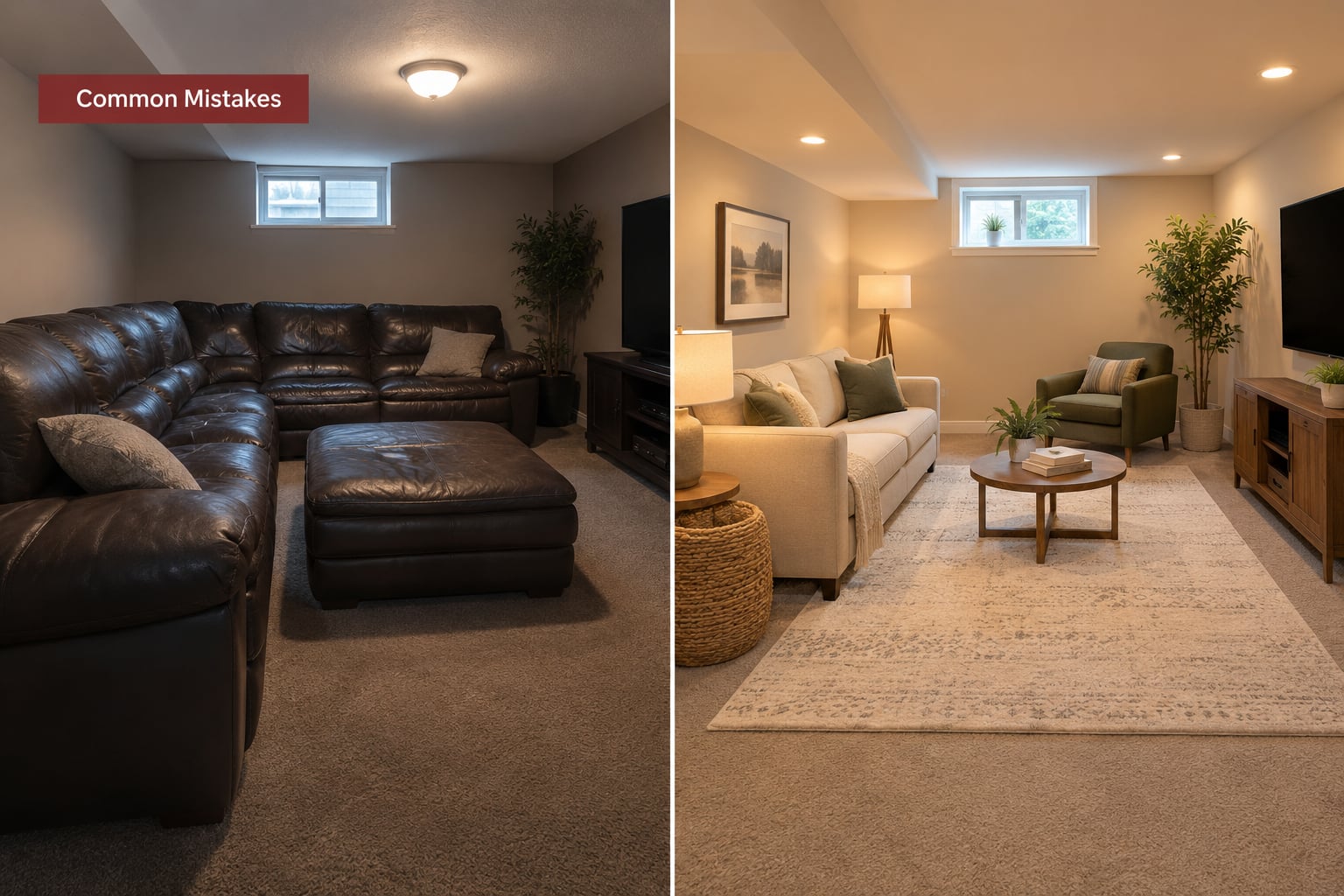
Nearly every disappointing basement room comes down to one of six repeatable errors.
- Cool overhead lighting only. A 4000K bulb in a bare ceiling can light the room perfectly and still make it feel like a corridor. Fix: swap in 2700 to 3000K dimmable bulbs and add one lamp or sconce at eye level.
- Furniture sized for the house above. A tall sofa and a deep sectional swallow a low ceiling. Fix: measure the lowest joist, then buy low and shallow so the floor stays visible.
- Leaving block and concrete untreated. Raw masonry scatters light and looks unfinished no matter what you hang on it. Fix: wash, seal, fill the joints, then paint in a warm neutral.
- Decorating before solving storage. You are styling a surface that will be covered in bins by spring. Fix: one hour of sorting, labeled closed storage, then furniture goes in.
- Mixing too many colors at once. Six accent colors compete and read as noise. Fix: pick two and repeat them in at least four places.
- Ignoring moisture and ventilation. Musty air and condensation will undo paint, paper and fabric. Fix: a hygrometer, a dehumidifier held to a set level, and a working smoke and carbon monoxide alarm before you light anything.
One safety point worth repeating from homeowner discussions: keep fabric, storage boxes and paper well clear of heat sources in a finished basement, and never leave an appliance running down there unattended. A dehumidifier needs clearance on all sides and nothing stacked on its coils.
Frequently Asked Questions
What is the best way to make a basement feel warmer?
Warm white bulbs at multiple heights, warm neutral walls with one textured accent surface, and a large area rug over a firm pad. That trio changes most rooms in a weekend. Physical cold is separate: insulation, humidity control and the slab decide what your skin feels, and those need a contractor.
Should I paint a basement ceiling white or another color?
One shade lighter than the walls is the safest choice, and pure white when the room feels truly dark. Painting ducts, joists and pipes that same white makes them disappear into the ceiling instead of chopping it into stripes. Ceilings painted warm white also soften the cool cast that overhead bulbs throw down.
What flooring makes a basement feel warmer and more finished?
Hard moisture-safe floors with a large area rug over a firm pad give you the coziness of carpet without holding dust and allergens in a humid room. Polished or painted concrete, peel-and-stick vinyl, luxury vinyl plank and engineered hardwood all work. Pick based on how dry and stable that specific room is.
How can I make a basement feel less dark without remodeling?
Layer light instead of adding brightness: dimmable 2700 to 3000K bulbs overhead, plus a lamp or sconce at eye level and LED strips on shelves or stair treads. Light walls and ceiling paint bounce more of it, a mirror opposite the darkest wall doubles what reaches the room, and matching fixture finishes tie the layers together.
What colors work best for a warm and inviting basement?
Warm neutrals with a warm undertone — greige, clay, sand, soft putty — read as inviting and bounce light well. Pair one with wood tones and a muted second color for pillows and rugs. Skip flat cool grey and stark white, which make the room feel clinical, and keep ceiling paint lighter than the walls.
How do I decorate a basement on a budget?
Start with the three cheap moves: warm bulbs, a large rug with a pad, and paint. Paint the ceiling one shade lighter and the same white onto ducts and pipes. Declutter into labeled closed bins, add throws and pillows in two repeated colors, and hang art above a console at about half to three-quarters of the furniture width.
Conclusion
If you only do three things, do these: swap every bulb for dimmable 2700 to 3000K and add one lamp at eye level, repaint the walls in a warm neutral with the ceiling one shade lighter, then drop a large rug with a firm pad and add soft textiles in two repeated colors. Decluttering into closed labeled storage and giving the room one deliberate focal point is what makes it read as finished rather than occupied.
Check humidity before you start, not after. Paint, paper and fabric all fail in a damp room, and a finished basement is usually valued as usable living space rather than as equal square footage — so making it a room people actually use is worth more than making it look expensive.