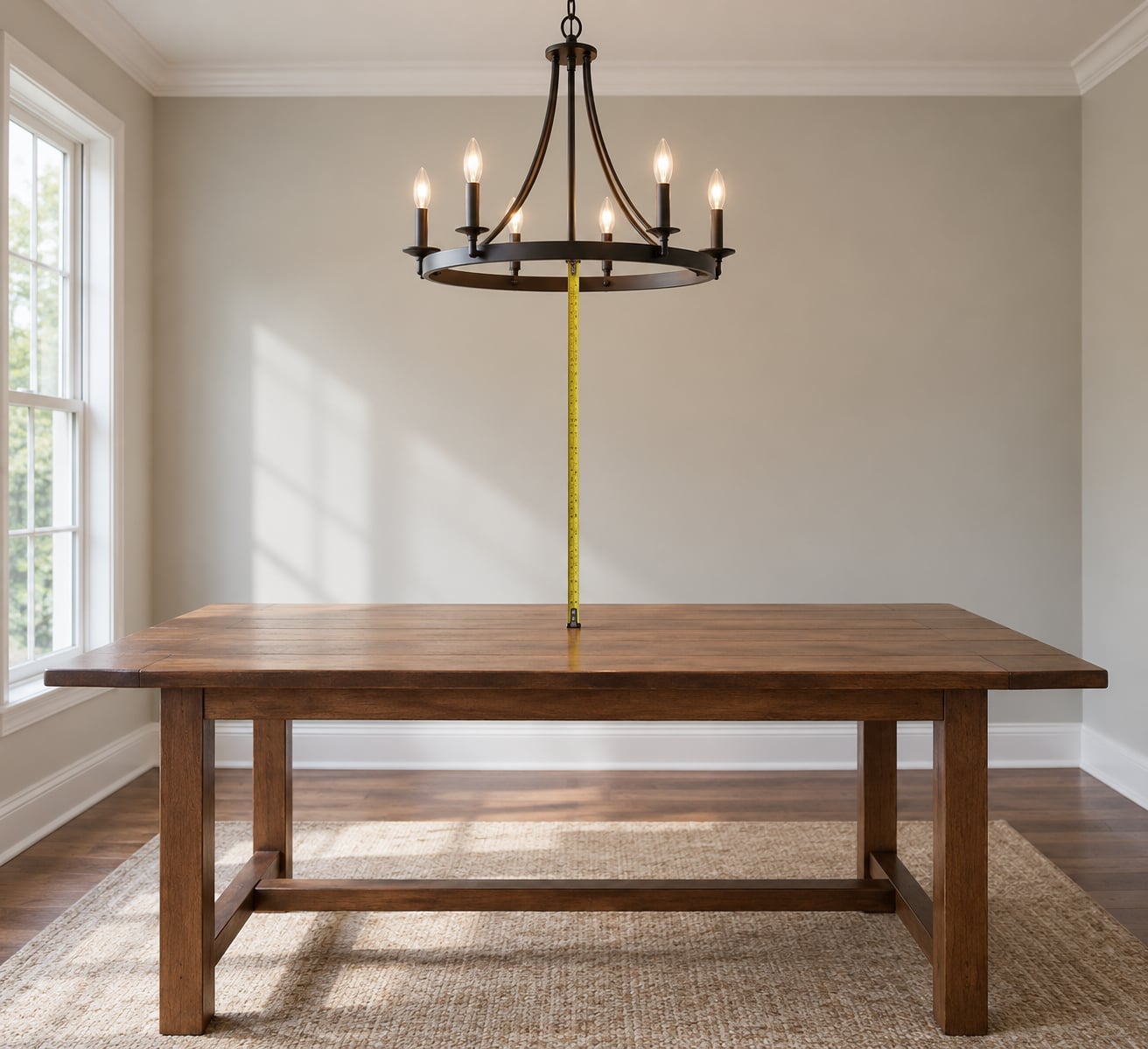
The bottom of a dining room chandelier should hang 30 to 36 inches above the surface of the table if you have a standard 8-foot ceiling. Add 3 inches for every additional foot of ceiling height, so the same fixture wants a longer drop in a 10-foot room than in an 8-foot one.
That single measurement decides whether guests can see each other across the table, whether the light actually lands on the tabletop instead of the ceiling, and whether people can walk past without ducking. Get it wrong and the room feels off in a way most people can’t name. Get it right and the fixture looks like it grew there.
The whole job takes about an hour once the fixture is in hand, and most of that hour is measuring rather than turning screws. Here is the process I use, including the arithmetic people skip when they order a fixture online.
Table of Contents
- What You Need
- Step-by-Step
- How High to Hang a Dining Room Chandelier Above the Table
- Measure the Table and Ceiling First
- Find and Mark the Ceiling Box
- Adjust and Check the Finished Height
- Common Mistakes
- Frequently Asked Questions
- Does the shape of my dining table need to match the chandelier shape?
- What do I do if my dining room ceiling is under 8 feet?
- My ceiling box is not over the dining table. Do I have to move it?
- How high should a chandelier hang with a 16-foot vaulted ceiling?
- Why does my chandelier look too high above the table?
- How far above a table should pendant lights hang instead of a chandelier?
- Conclusion
What You Need
Gather these before you touch anything, because the measuring steps come first:
- A tape measure, ideally 25 feet or longer if you are working over a long table or a two-story entry
- A 6-inch or 8-inch spirit level
- A pencil and a roll of painter’s tape for marking the ceiling
- A sturdy step ladder, and a second person to hold it
- The mounting hardware that came with the fixture, plus the screws that match your ceiling box
- The light bulb or LED bulb the fixture takes
- A helper for the final hang, which is genuinely optional until it is genuinely not
A helper is the one item people skip and then wish they had. Holding a fixture while standing on a ladder is how ceilings get scraped and fingers get pinched.
Step-by-Step
How High to Hang a Dining Room Chandelier Above the Table
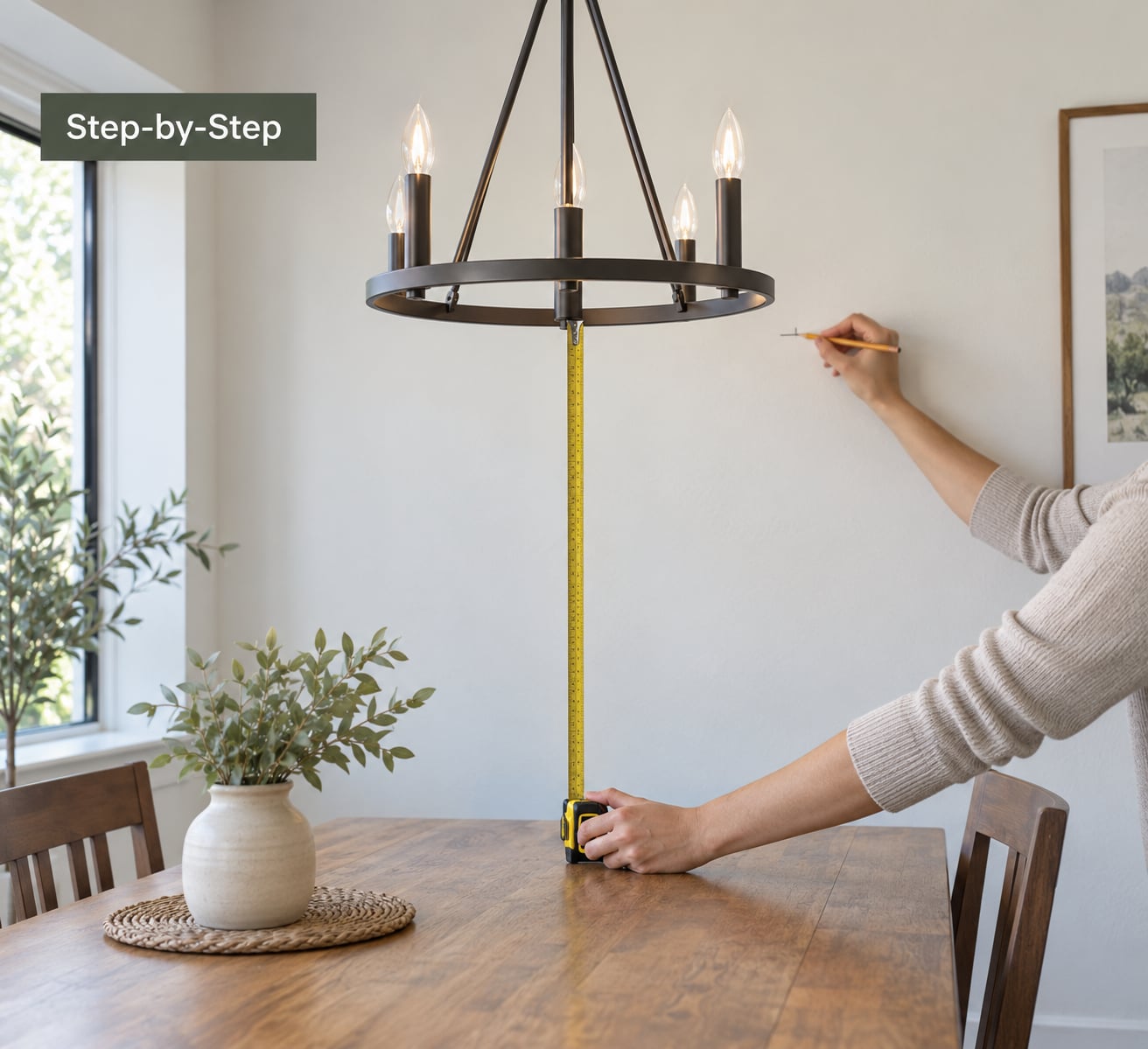
Measure from the top of the table surface to the lowest point of the fixture, and that lowest point means the bottom of the bulbs or shades, not the top of the chain. For an 8-foot ceiling, 30 to 36 inches is the target range. Designers tend to split the difference: Studio McGee is often cited at 32 to 36 inches, while Ballard Designs and HGTV both land on 30 to 36 inches. Treat that disagreement as a feature. You have a 6-inch window, not a single number.
For anything taller than 8 feet, use the adjustment formula: add 3 inches of hang height for every extra foot of ceiling.
| Ceiling height | Hang height above table | Bottom of fixture from floor (30-inch table) |
|---|---|---|
| 7 ft (low) | 24-30 in | 54-60 in |
| 8 ft | 30-36 in | 60-66 in |
| 9 ft | 33-39 in | 63-69 in |
| 10 ft | 36-42 in | 66-72 in |
| 11 ft | 39-45 in | 69-75 in |
| 12 ft | 42-48 in | 72-78 in |
| Vaulted 16 ft | 54-72 in | 84-102 in |
The floor column matters more than people expect. If the bottom of the fixture lands below 84 inches from the floor anywhere someone walks, you have a head-bumping problem, and that is the single most common complaint people have about dining room lighting. On very high ceilings, hang the fixture higher than the table rule suggests but never lower than 7 feet above the floor along any walkway.
Fixture style shifts the number a little within that range. Modern linear and drum-shade fixtures are designed to hang low, usually 30 to 34 inches. Crystal and multi-tier chandeliers sit a touch higher, 34 to 38 inches, because their vertical detail looks cramped when squeezed. Adjust for taste, not past the floor clearance line.
Measure the Table and Ceiling First
Two numbers do all the work: how wide the table is, and how tall it is. Width decides fixture size, height decides the drop. Most rooms go wrong because people measured once and assumed.
For size, aim for a fixture diameter or width between half and two-thirds of the table width. A 60-inch round table wants a fixture roughly 30 to 40 inches across. A 72-inch round table wants about 36 to 48 inches. Keep the edges within about 6 inches of the table edges, so the light pools onto the table rather than past it.
| Table size | Recommended fixture width or diameter | Notes |
|---|---|---|
| 48 in round | 24-30 in | Two pendants or a small drum both work |
| 60 in round | 30-40 in | The most common dining table size |
| 72 in round | 36-48 in | Go larger than feels safe |
| 84-96 in rectangular | Two fixtures, or one linear 48-60 in | Center the pair over the table, not the room |
| Over 96 in | Two or three fixtures spaced evenly | Allow roughly 15 in overhang past each table end |
Table shape should match fixture shape where you can. Round or oval tables take round or oval fixtures. Long rectangular farmhouse tables take linear rectangles or a pair of rounds. Square tables take square frames.
Here is the part that solves the most common ordering mistake. Hang height and drop length are not the same measurement, and mixing them up is why chains arrive too short. The arithmetic:
Drop length = (ceiling height x 12) – table height – hang height
Worked example: a 9-foot ceiling, a 30-inch table, and a 36-inch hang height gives (108) – 30 – 36 = 42 inches of drop. That is the distance from the ceiling to the bottom of the fixture, and it tells you how long a chain or downrod you need.
A second example: a 12-foot ceiling over the same table, hanging at 45 inches, needs 144 – 30 – 45 = 69 inches of drop. Fixture manufacturers sell chains in generous lengths for exactly this reason, but the chain you get is often the reason people think they cannot hit their target height.
Find and Mark the Ceiling Box
Center the fixture over the table, not over the middle of the room. Those are two different points in most homes, and this is where a lot of installs go sideways.
Measure the table’s long axis and find its center. Then hold a tape measure up to the ceiling and mark directly above that point with a pencil, or with a piece of painter’s tape if the ceiling is textured. If the existing electrical box is already there, check whether it lines up with your mark before doing anything else.
When the box is not over the table, you have three options. A surface-mount conduit or hook can bridge the gap, which is the cheapest fix and looks fine with a chain fixture. A longer chain on a canopy offset works in some cases. Or you move the box, which means opening the ceiling, and at that point you want a licensed electrician rather than a weekend. Homeowners who have moved their own boxes report it as a much bigger job than it looks on video.
Before you hang anything, confirm your ceiling box is rated for the fixture weight. Heavier fixtures, especially crystal ones over 50 pounds, need a fan-rated box. An under-rated box is a real safety issue, not a formality.
Adjust and Check the Finished Height
Hang the fixture with a temporary length of chain longer than you think you need, then tighten or remove links until the bottom sits in your target zone. You cannot fine-tune a chandelier once it is wired, and getting it roughly right first saves the whole afternoon.
Tuck or cap any excess chain into the canopy so it does not swing into view. Attach the canopy to the bracket, then hang the fixture. Before installing the bulb, set your level on top of the fixture and adjust the mounting bracket until it reads centered.
Now do the two checks that numbers cannot do for you. Sit down at every seat, including the ends, and look across the table. You should catch someone’s eyes without tilting your head, and nobody’s sightline should be blocked by a shade or a bulb. Then walk the route from the kitchen to wherever people sit, at normal walking height, and confirm nothing overhead is lower than 7 feet.
If the seated view is wrong, the fix is almost always height, not bulb brightness. A dimmer switch gives you a lot of flexibility there.
Common Mistakes
- Measuring from the ceiling instead of the table. Ceiling-to-table distance includes the table height and throws the number off by several inches. Start the tape at the table surface every time.
- Hanging it too low. Under 30 inches over an 8-foot ceiling and you get glare in everyone’s eyes during conversation and a fixture people duck under. Regular head-smuacks are the tell.
- Using one height for every ceiling. The 30 to 36 inch rule assumes 8 feet. Skip the adjustment above that and the fixture floats, disconnected from the table.
- Hanging it too high. The most common regret. The light stops lighting the table and starts lighting the ceiling, and a fixture designed to hang low ends up squished against the plaster.
- Centering on the room instead of the table. It looks wrong immediately, and no amount of bulb swapping fixes it.
- Letting the size and height questions blur together. A too-small fixture hung perfectly still reads as an error. Fix the width first.
- Doing the electrical work yourself past your comfort. Moving a box, running new wire, or adding a dimmer switch is licensed work in most places. Turn the breaker off, and use a fan-rated box for anything heavy.
Frequently Asked Questions
Does the shape of my dining table need to match the chandelier shape?
It helps. Round and oval tables take round or oval fixtures best. Long rectangular tables look right with a linear rectangle or a pair of round fixtures, which also solves the sizing problem on tables over 96 inches. Square tables suit square frames. When the shapes do not match, keep the fixture within the half to two-thirds width range and make sure its edges land within about 6 inches of the table edges.
What do I do if my dining room ceiling is under 8 feet?
Use a shorter hang. On a 7-foot ceiling, 24 to 30 inches above the table keeps the fixture clear of heads while still reading as connected to the table. A semi-flush mount is a better choice than a chain fixture at that height, since it hangs close to the ceiling and frees up the vertical space you are short on.
My ceiling box is not over the dining table. Do I have to move it?
Not always. A surface-mount conduit or hook, or a canopy offset with a longer chain, can bridge the distance for a chain-hung fixture. Moving the box means opening the ceiling and is licensed electrical work in most areas, so it is worth an electrician’s visit rather than a weekend project. Check the offset distance first, because small gaps are easy to hide and large ones are not.
How high should a chandelier hang with a 16-foot vaulted ceiling?
Vaulted ceilings need their own math, since the +3 inches per foot rule runs out well before 16 feet. Work from the center of the room rather than the peak. For most 16-foot vaults, a drop that puts the bottom of the fixture 54 to 72 inches above the table works, and never lower than 84 inches above the floor along a walkway. Test with a temporary chain before you commit.
Why does my chandelier look too high above the table?
Three usual causes. The fixture was hung to the room’s ceiling rule instead of the table rule, which pushes it up too far in tall rooms. The chain supplied was too long for the ceiling. Or the fixture is too small, so even at a correct height it cannot hold the space. Lowering it 6 to 12 inches and sizing up are the two fixes that work most often.
How far above a table should pendant lights hang instead of a chandelier?
Pendants follow the same 30 to 36 inch rule measured from the table surface to the bottom of the shade. They are easier to place off-center and they suit lower ceilings better than a chain-hung fixture. Over a long table, hang them in a row at the same height with roughly 24 to 30 inches between shades for even coverage.
Conclusion
Start with two measurements: the width and height of your table, and the height of your ceiling. From those you get the target hang height, the fixture size, and the drop length you need to buy or adjust. Mark the spot over the table, check whether the ceiling box lines up with it, and confirm the box is rated for the fixture weight before anything gets wired.
If your ceiling and table numbers do not fit a comfortable 30 to 36 inches, tell me your ceiling height and table dimensions and I can work out the drop with you. Most installs take an hour. The measuring takes fifteen.