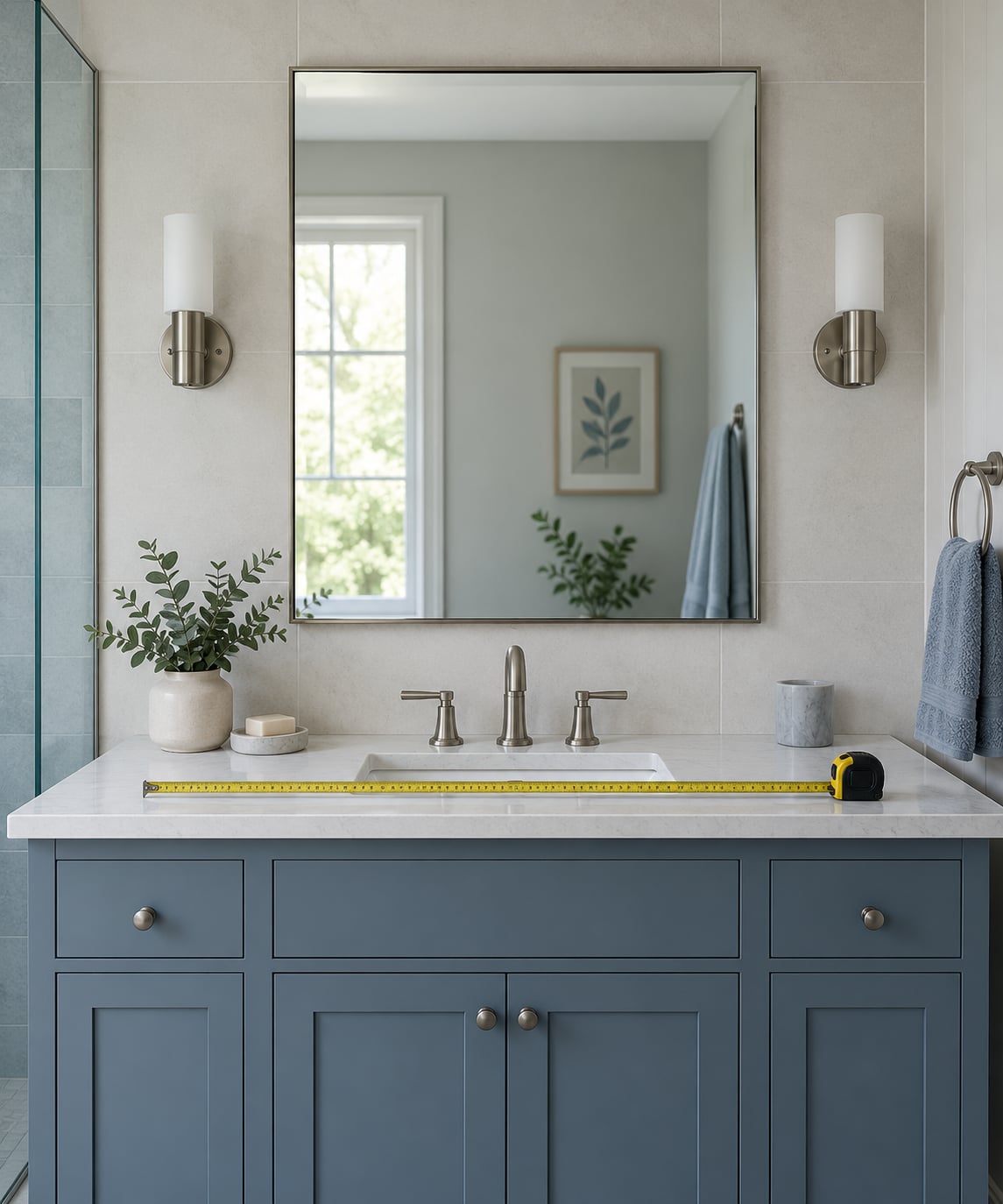
If you want to know how to choose a bathroom mirror size, aim for a mirror that is about 70 to 90 percent as wide as the vanity below it, generally 2 to 4 inches narrower on each side, and never wider than the vanity itself. Get the width roughly right and the height becomes a simple matter of where you hang it.
The whole process takes about fifteen minutes with a tape measure, and it saves the headache of ordering a mirror that collides with a light fixture or floats above the backsplash looking lost. Most sizing mistakes come from eyeballing instead of measuring, not from picking a bad mirror.
Table of Contents
- How to Choose a Bathroom Mirror Size: Quick Guide
- What Size Should a Bathroom Mirror Be?
- The proportion formula: vanity width times 0.75 to 0.95
- Why a mirror should never be wider than the vanity
- How to Measure Your Bathroom for a Mirror
- Measure the vanity at the top, not the counter overhang
- Check the wall on both sides of the vanity
- Measure the vertical space above the backsplash
- Mark the sink center and the fixture clearances
- Find a stud or plan for the anchors
- How Wide Should a Bathroom Mirror Be?
- How Tall Should a Bathroom Mirror Be?
- Set the center, not the bottom edge
- Let height fix an awkward ceiling line
- Where Should You Hang a Bathroom Mirror?
- Check the reflection before you drill
- Two mirrors beat one oversized mirror on a double vanity
- How to Choose a Mirror Shape and Frame for Your Bathroom
- How to Avoid Common Bathroom Mirror Sizing Mistakes
- Frequently Asked Questions
- Is a 24 inch mirror too small for a 36 inch vanity?
- What size mirror is best for a 60 inch vanity?
- What size for 2 mirrors over a 72 inch vanity?
- How high should a bathroom mirror be hung?
- Does a big mirror make a small bathroom look bigger?
- Conclusion
How to Choose a Bathroom Mirror Size: Quick Guide
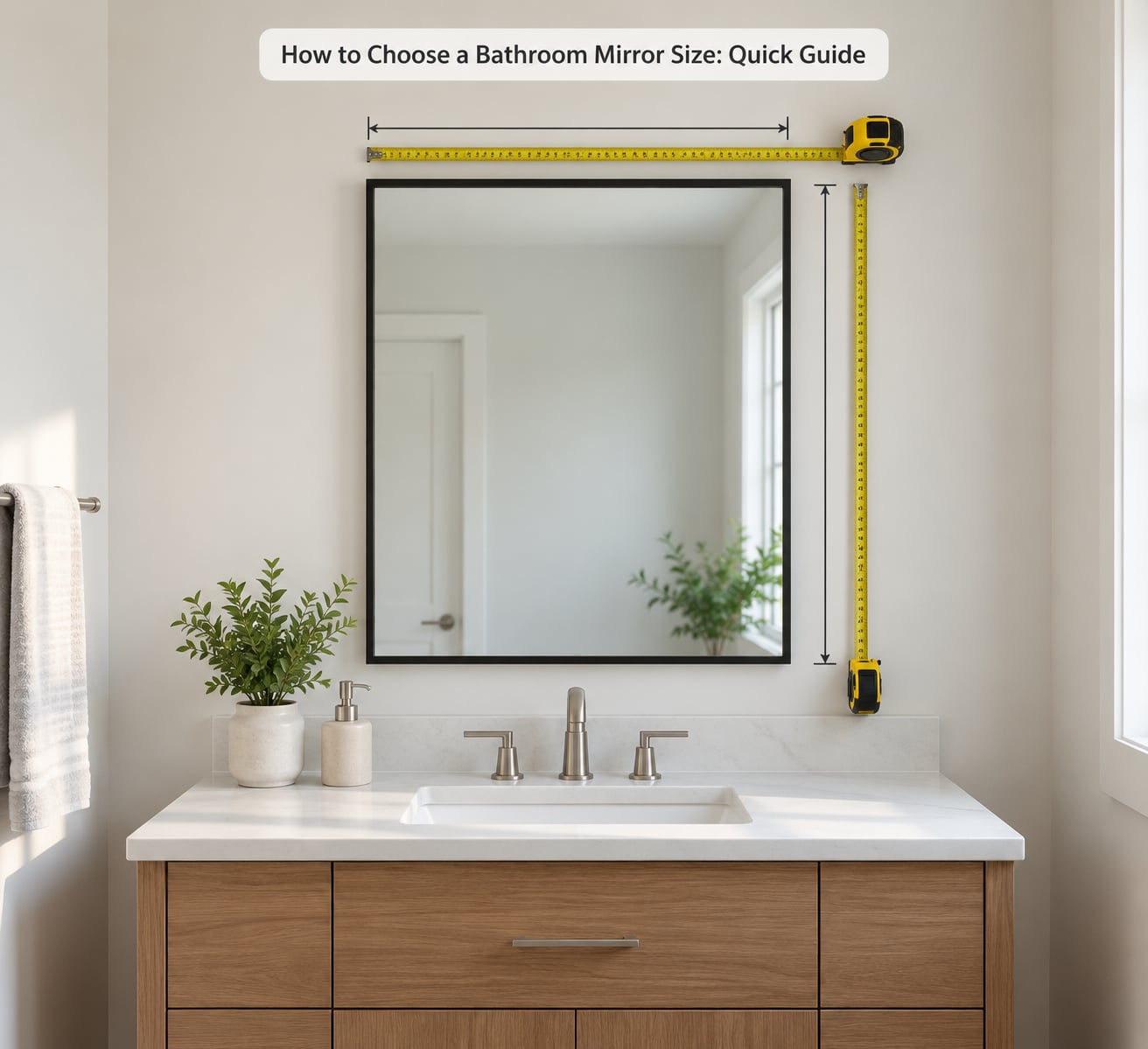
Start with the vanity width and work from there. This chart maps the six most common vanity sizes to a mirror width and height that will look intentional in the room.
| Vanity width | Mirror width | Mirror height | What to know |
|---|---|---|---|
| 24 inch | 18 to 20 inch | 24 to 30 inch | Powder room sizing. A 24 inch mirror reads wall-to-wall here. |
| 30 inch | 24 to 26 inch | 30 to 36 inch | Standard small bath. The 4 inch total tolerance is the ceiling, not the goal. |
| 36 inch | 30 to 32 inch | 36 to 40 inch | The most common single vanity. 24 inch looks undersized in it. |
| 48 inch | 40 to 44 inch | 36 to 40 inch | A 40 inch mirror leaves an uneven 4 inch gap on one side. Skip it. |
| 60 inch | 52 to 56 inch, or two 26 to 30 inch mirrors | 36 to 40 inch | Double sink territory. Decide one mirror or two before ordering. |
| 72 inch | Two 28 to 32 inch mirrors | 36 to 40 inch | A single 72 inch mirror leaves no wall for sconces. Most designers use two. |
Two numbers do most of the work in that chart. First, mirror width should land between 70 and 90 percent of the vanity width. Second, if the total gap between the mirror and the vanity, counted across both sides, comes to more than 4 inches, the mirror is too small.
What Size Should a Bathroom Mirror Be?
A bathroom mirror should be slightly narrower than the vanity underneath it. That margin of a couple of visible inches of countertop on each side is what makes the vanity look like a finished piece of furniture instead of a box with something hung above it.
The proportion formula: vanity width times 0.75 to 0.95
If you would rather not hunt through a chart, multiply your vanity width by 0.75 for the minimum comfortable mirror width and by 0.95 for the maximum. A 48 inch vanity times 0.75 is 36 inches, times 0.95 is 45.6, so somewhere in the 40 to 44 inch range is where you want to land.
Custom mirror shops publish a similar ceiling on the other side: about 4 inches of total width disparity, meaning 2 inches per side. The lower number of the two ranges, 0.75, is the one to trust when your wall is tight or your style leans traditional.
Why a mirror should never be wider than the vanity
Once a mirror extends past the edges of the vanity, it stops reading as a mirror for that vanity and starts reading as a mirror for the wall, and the proportion flips into looking top heavy. Designers surfaced this as the single most consistent rule on the forum discussions I read while putting this guide together.
The one exception is a wall-to-wall vanity that is built into the cabinetry run. There, a mirror spanning the full vanity length can work, provided the surrounding wall reads as built in rather than as blank space you are trying to fill.
How to Measure Your Bathroom for a Mirror
Do these five measurements before you look at a single product page. They take a few minutes and they are the difference between a mirror that fits and one you cannot return.
Measure the vanity at the top, not the counter overhang
Run the tape across the back edge of the vanity at the wall, where the cabinet is actually attached. Most countertops overhang by an inch or more on each side, and measuring the overhang gives you a number that is too generous.
Check the wall on both sides of the vanity
Measure from the vanity edge to whatever stops you: a side wall, a window casing, a door swing, a towel bar, or the edge of a shower surround. This is the number that overrides the chart when they disagree.
Measure the vertical space above the backsplash
Measure from the top of the backsplash or the faucet to the ceiling, and again to the bottom of any light fixture, cabinet or vent. That vertical run caps your mirror height.
Mark the sink center and the fixture clearances
Note whether the sink is centered in the vanity or offset to one side, and note where sconces or a light bar will sit. If the sink is off center, the mirror should be centered on the vanity, not on the bowl.
Find a stud or plan for the anchors
Run a stud finder or tap the wall so you know where the framing is before you commit to a mirror weight. If the studs do not line up with the center of your planned mirror, you are relying on drywall anchors, which is fine for a light mirror but worth avoiding for a thick framed one.
How Wide Should a Bathroom Mirror Be?
Pick the mirror width from your vanity, then adjust for the room. On a tiled wall where the tile pattern continues past the vanity, a mirror that is noticeably narrower than the vanity can look deliberate and clean, because the tile carries the visual weight across the full wall.
A mirror much narrower than the vanity only works when the surrounding wall has something going on, such as a wainscot, a full-height tile field, or a window directly opposite. In a bare room, a 24 inch mirror over a 36 inch vanity reads as a mistake, even though 24 inches is technically inside the 70 percent floor.
Windows and doors change the math more than most guides admit. A mirror hung beside a window needs about 3 inches of breathing room from the casing so the two vertical lines do not fight. A mirror near a door swing needs enough clearance that the door never taps the glass.
How Tall Should a Bathroom Mirror Be?
Set the center of the mirror 60 to 65 inches above the finished floor. That is roughly eye level for an average adult, and it is the single measurement that matters more than any other on this page.
Set the center, not the bottom edge
Once the center is right, the bottom edge falls wherever the height puts it. On a typical vanity with a 4 inch backsplash, that leaves the mirror bottom 5 to 10 inches above the backsplash and clears the faucet spout. If the mirror reaches the backsplash, it is hung too low.
Leave 3 to 6 inches between the top of the mirror and the bottom of the sconces or light bar. That gap is what separates a mirror from the light above it, and without it the two read as one lopsided block.
Let height fix an awkward ceiling line
A taller rectangle pulls the eye upward, which is the cheapest fix I know for a low-ceilinged bathroom. A 30 inch wide by 40 inch tall mirror does more for an 8 foot ceiling than a 30 by 30 square will.
Just check the ceiling first. If the top of the mirror ends up within 6 inches of the ceiling, the proportions have flipped and it will look like the mirror is crowding the room.
Where Should You Hang a Bathroom Mirror?
Above the vanity, centered on the vanity, is the default and it is right most of the time. From there, the placement shifts based on what is on the opposite wall and what the mirror actually reflects.
Opposite a window is the best possible spot for light, since you get daylight from both directions. If a mirror faces a window on an adjacent wall rather than directly across from it, the reflection often lands on the side wall and you lose that benefit.
Beside a shower is where sizing gets tight. Leave at least 3 inches between the mirror edge and the shower curb so water does not land on the glass constantly, and check that the shower head or glass door swing does not come within a few inches of the frame.
Check the reflection before you drill
Tape a piece of cardboard in the size of your candidate mirror to the wall, or hold the actual mirror up with a helper, and stand at the sink to check what you see. The classic mistake is hanging a mirror that reflects a shower stall or an open door right in the center of your view.
Two mirrors beat one oversized mirror on a double vanity
On a 60 to 72 inch double vanity, two mirrors let each one be sized to its own sink, which matters when two people use the room at the same time. Most homeowners landing on two 26 to 30 inch mirrors get the balance right without hitting the light fixture.
A single 72 inch mirror does buy more reflection and a cleaner horizontal line, but it leaves no wall for sconces on either end. If your lighting plan depends on wall sconces, two mirrors is the practical answer.
How to Choose a Mirror Shape and Frame for Your Bathroom
Shape changes the sizing math, not just the look. A round or oval mirror needs a smaller diameter to read as the same visual size as a rectangle, and an arched mirror needs to be narrower than a rectangle of the same width, because the arch tapers the top.
| Shape | Size relative to a rectangular | Visual effect | Best for |
|---|---|---|---|
| Rectangular | The baseline. 30 to 32 inch wide over a 36 inch vanity. | Neutral, balanced, maximum usable reflection. | Most vanities, low ceilings, narrow walls. |
| Square | Same width, shorter height. 30 by 30 over a 36 inch vanity. | Shorter, wider feel that suits low ceilings. | Modern rooms, short walls, powder rooms. |
| Round | Go about 15 to 20 percent narrower in diameter. | Softens hard tile lines, feels less boxy. | Farmhouse, traditional, a sink you want to feature. |
| Oval | Similar to round but a touch taller for the same width. | Elongated, elegant, slightly lighter in feel. | Vanities that are wider than they are tall. |
| Arched | Go 2 to 3 inches narrower than a rectangle. | Tall and drawn out, draws the eye up. | 8 foot ceilings, rustic and farmhouse styles. |
| Frameless | Can run slightly larger, since there is no frame weight. | Light, airy, modern. | Small rooms where you want the mirror to disappear. |
Frame weight works the opposite way. A thick reclaimed wood frame or a deep black frame adds 2 to 4 inches of visual weight, so size those 2 to 4 inches narrower than you would a frameless mirror of the same nominal width. A slim beveled edge or a frameless glass panel can carry a wider mirror without looking heavy.
Match the finish to hardware you already have rather than trying to coordinate everything new. Brushed nickel frames sit well with the same finish on faucets and towel bars, black frames pull the eye and work in a room with matte black fixtures, and wood frames read as casual and warm against tile.
Before you order anything custom, check the standard stock sizes first: 24×36, 30×36, 36×40, 48×36 and 60×40 inches cover most single vanities and can ship in days. If none of them fit, custom glass is commonly available from roughly 12 to 96 inches wide, and the cheaper route is buying an oversized mirror and having it cut and framed at a home improvement store’s trim department.
How to Avoid Common Bathroom Mirror Sizing Mistakes
Most of these come straight from homeowner and designer conversations about mirrors that were already hung, or already ordered.
- Choosing by vanity width alone. The width is the starting point, not the answer. Wall space, tile, windows and doors all cut into what fits, and a mirror that is technically in range but collides with a window casing is still wrong.
- Hanging too high. Hanging to clear a tall backsplash throws the whole room off, because nobody looks at themselves from six feet up. Set the center at 60 to 65 inches and let the bottom land where it lands.
- Centering on the sink when the sink is off center. If the bowl sits left of the vanity center, centering the mirror on the bowl leaves it visibly off the vanity. Center on the vanity instead.
- Buying the mirror before the lighting. Sconce and light bar clearance is the most overlooked constraint there is, and it is a hard one to fix after the mirror is on the wall. Measure to the fixture before you pick the height.
- Ignoring the custom glass return policy. Custom mirrors are frequently non-returnable and are the single most expensive mistake in this whole project. Ten minutes with a tape measure protects money you cannot get back.
- Stretching a small mirror to fill a large vanity. A 40 inch mirror on a 48 inch vanity leaves an 8 inch gap, which reads worse than a 44 inch mirror with a 2 inch gap on each side. Aim for even margins rather than a fill-the-space goal.
Frequently Asked Questions
Is a 24 inch mirror too small for a 36 inch vanity?
Yes, in most cases. A 24 inch mirror leaves a 6 inch gap on each side of a 36 inch vanity, and that is well past the 4 inch total disparity designers consider the limit. For a 36 inch vanity, aim for 30 to 32 inches wide. A 24 inch mirror only reads correctly over a 24 or 30 inch vanity, or on a narrow wall with tile that carries the eye across.
What size mirror is best for a 60 inch vanity?
Either a single 52 to 56 inch mirror or two mirrors at 26 to 30 inches each. Go with one mirror if you want maximum reflection and a clean horizontal line and your lighting comes from above. Go with two if you have sconces to fit on either side or two sinks that need their own reflection. Most people end up with two.
What size for 2 mirrors over a 72 inch vanity?
Most homeowners land on 28 to 32 inches wide per mirror, hung centered over each sink with the pair spaced so the outer edges stay inside the vanity by 2 to 3 inches. Measure the distance between your sink centers first, since that number sets the spacing and your mirror width has to fit within it.
How high should a bathroom mirror be hung?
Set the center of the mirror 60 to 65 inches above the finished floor, which puts it at eye level for an average adult. From there the bottom edge usually lands 5 to 10 inches above the backsplash, and the top sits 3 to 6 inches below sconces or a light bar. If the mirror is being hung high to clear a tall backsplash, it will look wrong from the doorway.
Does a big mirror make a small bathroom look bigger?
Yes, because it reflects more light and more of the room back at you, which reads as space. In a small bathroom, the risk is going too wide rather than too big. For a 24 or 30 inch vanity, choose a mirror at the top of your range and use a taller rectangle to keep the ceiling line from feeling compressed.
Conclusion
Start by measuring, not shopping. Note the vanity width at the wall, the clear space on both sides, the run from backsplash to ceiling or light fixture, and whether your sink is centered. Pick a mirror at 70 to 90 percent of the vanity width from the chart above, adjust down if the frame is thick or the shape is round, and confirm the placement with cardboard taped to the wall before anything is drilled.