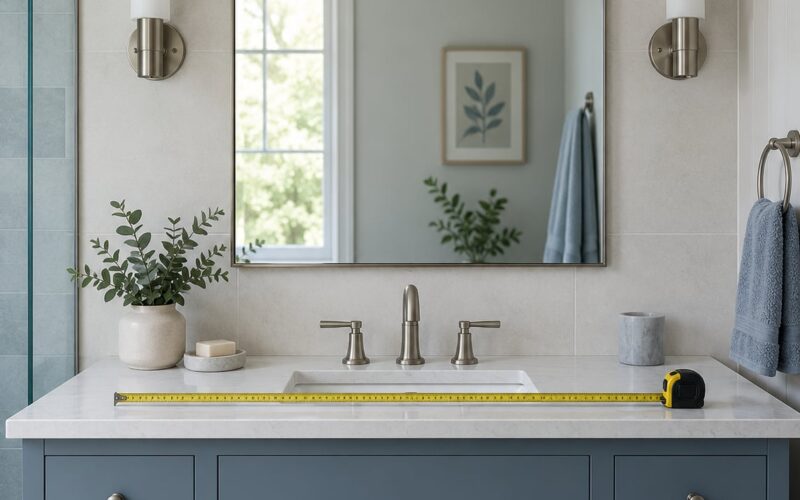
A bathroom with no counter space has a pedestal, wall-mount, or corner sink, a tub with no vanity, or a vanity without drawers, which leaves nowhere to set soap, a toothbrush, or a damp towel. The way out is to take the room’s vertical and hidden volume back before you buy a single piece of furniture: shelves above the toilet, organizers on the back of the door, storage behind the mirror, and one small purpose-built surface so the sink rim stays clear. None of it touches the plumbing, and most of it is a weekend’s work.
Why it matters is simple. Without a landing zone, daily items migrate to the sink rim, the top of the toilet tank, and the floor, and the room starts to read as cramped long before it actually is. People describe this problem constantly on decorating forums, and the complaint is rarely “I need more cabinets.” It’s “I need somewhere to put things down.”
Table of Contents
- What You Need
- How to Decorate a Bathroom With No Counter Space: Step-by-Step
- How to Decorate a Bathroom With No Counter Space by Adding Vertical Storage
- How to Decorate a Bathroom With No Counter Space with Compact Accessories
- How to Decorate a Bathroom With No Counter Space Without Making It Feel Crowded
- Common Mistakes
- Frequently Asked Questions
- Where can I put toiletries in a bathroom with no counter space?
- What storage is best for a small bathroom with no vanity?
- How do I decorate a bathroom without installing permanent storage?
- Can I use wood shelves in a bathroom with no counter space?
- How can I make a bathroom feel larger when there is no counter?
- What should I put above a toilet or beside a sink when there is no counter?
- Conclusion
What You Need
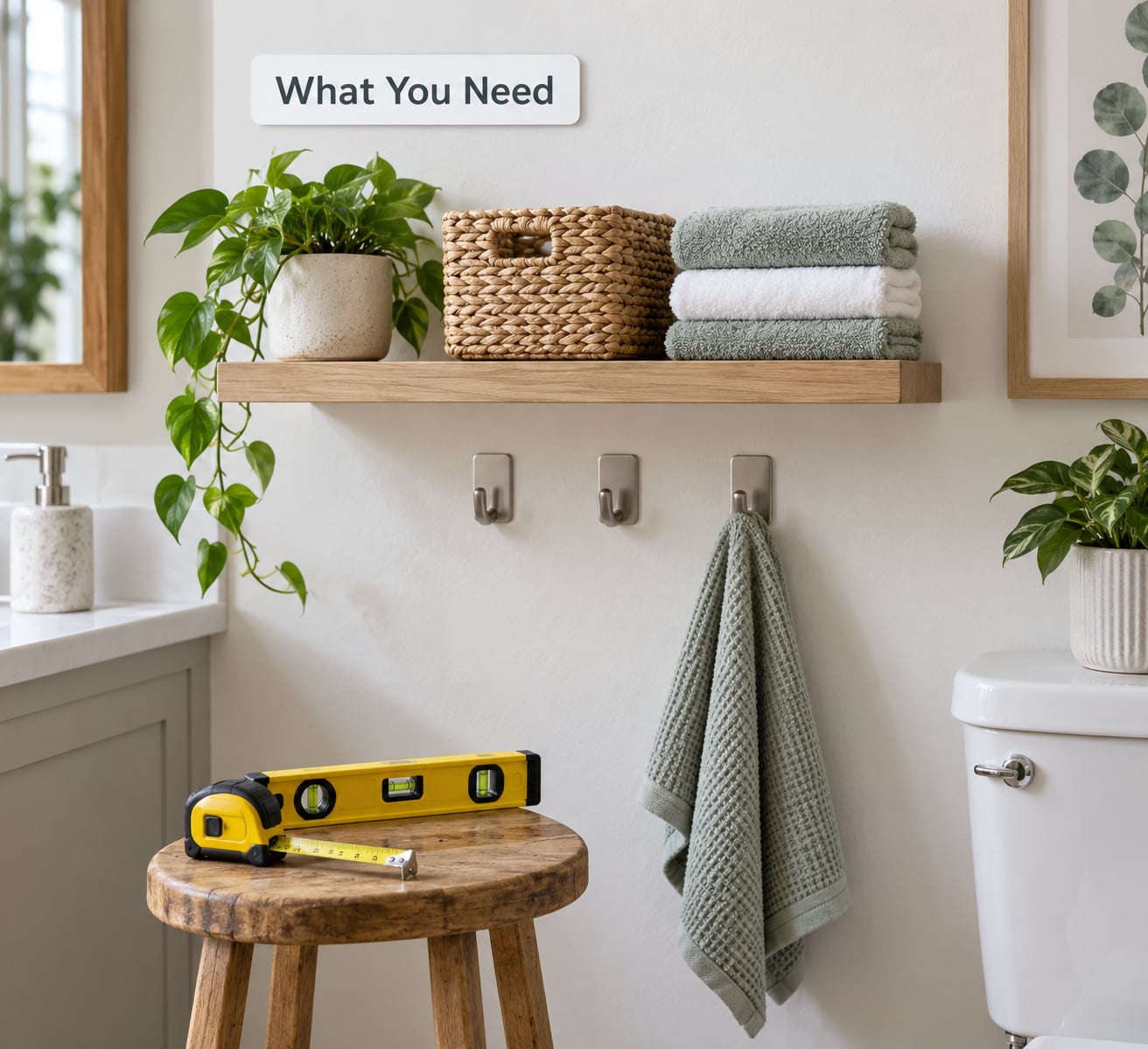
Most of the work here is measuring and mounting, not buying. Gather these first and the room will come together in one or two sessions.
- A tape measure and painter’s tape. Painter’s tape lets you mark shelf footprints on the wall and step back before you drill. This is the single most useful tool in this project.
- A stud finder, or a hammer and a pencil if the walls are drywall. Studs turn a floating shelf from a risky proposition into a fifteen-minute job.
- A small level, because shelves that tilt toward the room read as cheap no matter how nice the wood is.
- A drill with a masonry or tile-safe bit and appropriate anchors for homeowners. On tile, use a diamond bit and drill slowly to avoid cracking.
- Moisture-resistant materials: sealed bamboo, painted or stained pine, powder-coated steel, resin, or woven polypropylene baskets. Skip unfinished oak and MDF, which swell and flake in a humid room.
- Wall-safe adhesive hooks and strips rated above the weight you actually need, plus removable hooks for renters.
- One tray and one small basket to define your landing zone. A shallow tray around 8 by 12 inches does more for a bathroom than any single shelf.
- Edge sealant if you’re mounting raw wood near a splash zone.
If you rent, swap almost all of that. A tension-mounted over-the-door organizer, suction caddies, adhesive hooks on non-porous surfaces, and a slim rolling cart cover most of the same ground without a single hole in the wall. The only thing you give up is deep storage, and a shallow basket hung on the back of a door still beats a pile on the floor.
How to Decorate a Bathroom With No Counter Space: Step-by-Step
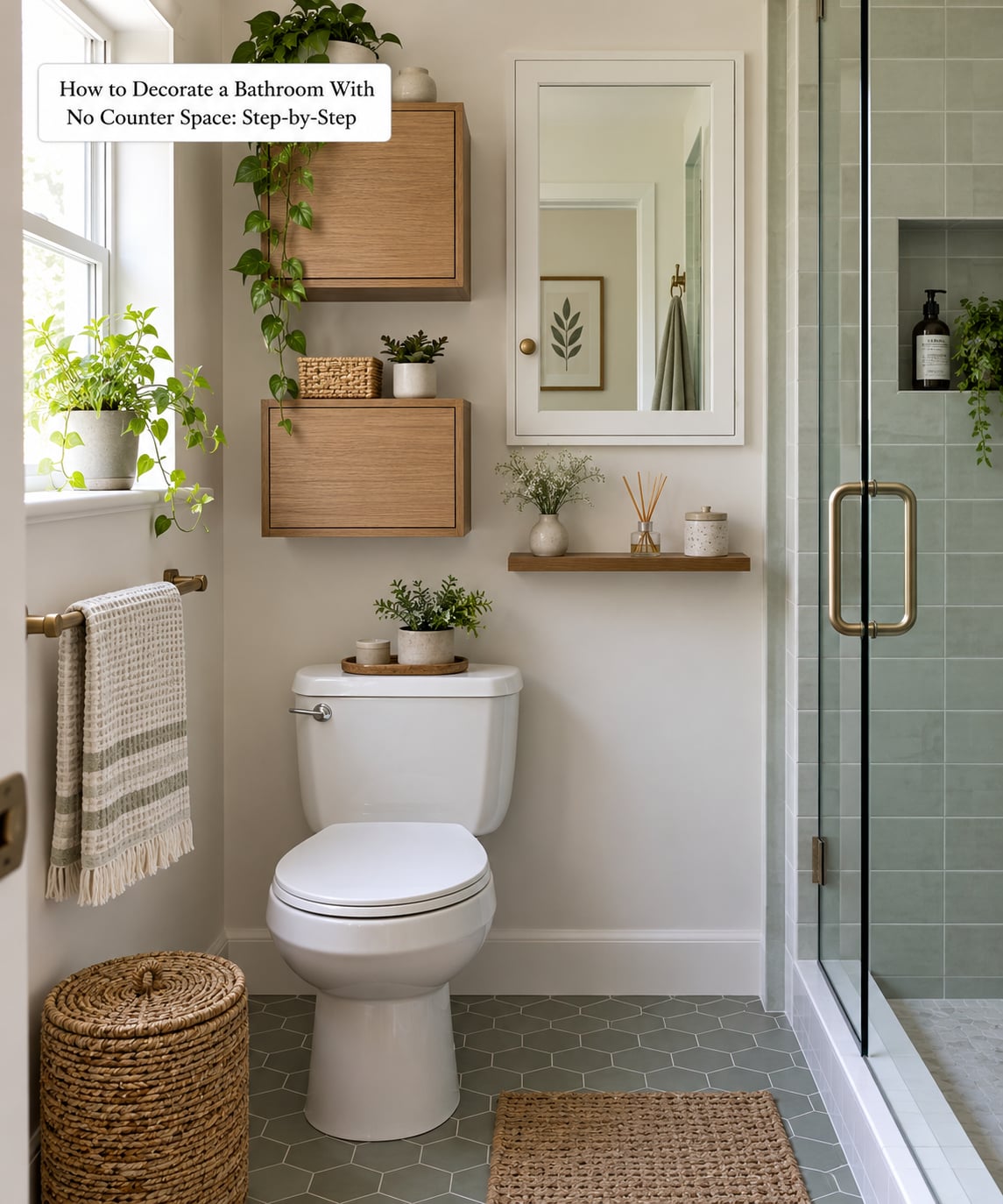
Work in this order and each step makes the next one easier. First find out how much wall you actually have, then choose one focal point, then add storage, then add surface, then style.
- Measure the walls, not the room. Note every vertical run of blank wall from floor to ceiling, the width of the door and how it swings, the clearance above the toilet tank, and where the window and vent are. Write the numbers on masking tape stuck to the wall.
- Pick one focal point. The mirror, the sink wall, or the wall above the toilet. Everything else you add should support it, not compete with it. Rooms with two focal points feel busy even when nothing is cluttered.
- Add vertical storage first. Shelves, a cabinet, or a tall narrow unit go in before any styling objects, so you know exactly what surface you’ll be styling.
- Create one small flat surface. A fold-down ledge, an over-sink board, or a slim side table gives you a place to set a wet toothbrush or a bottle of lotion.
- Style last, and style sparsely. Group items in odd numbers, keep the lower shelves practical, and leave at least a quarter of every shelf empty.
How to Decorate a Bathroom With No Counter Space by Adding Vertical Storage
Floating shelves are the backbone of this job because they add storage without adding visual weight. A shelf 8 to 12 inches deep is the practical sweet spot: deep enough for a soap dish or a stack of hand towels, shallow enough that it doesn’t project into the room.
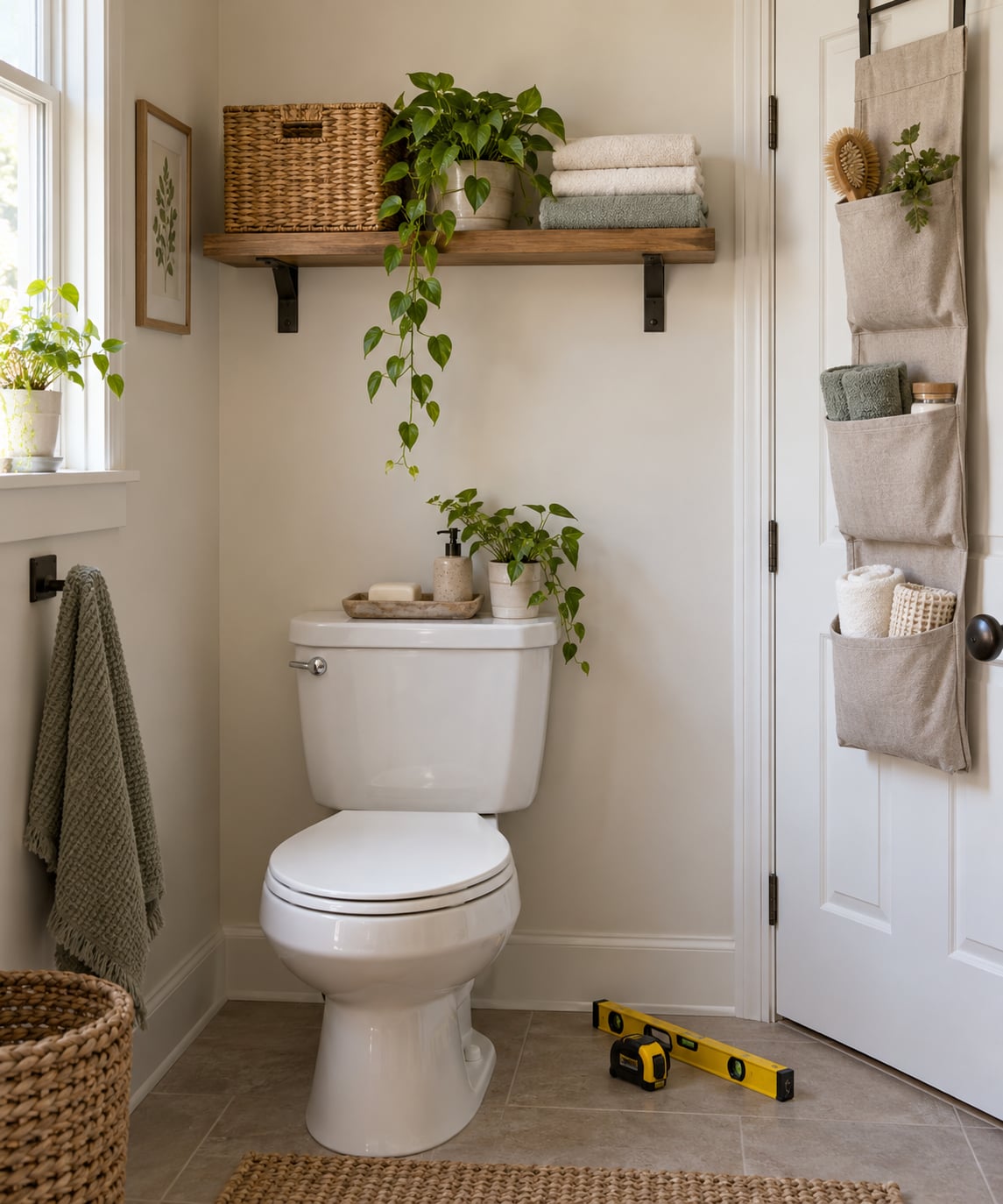
Above the toilet, leave at least 6 inches of clearance over the tank lid so you can lift the lid and reach the flush handle, and mount the lowest shelf high enough that a standing adult will not hit their forehead. In most bathrooms that means the bottom shelf sits at about 6 feet 6 inches from the floor. Above a toilet, keep it to jars, baskets and a small plant; heavier items belong where they sit on a shelf rather than overhead.
Two other vertical moves pay off fast. A shallow wall cabinet or a recessed medicine cabinet stores the same bulk as a shelf while hiding the visual noise, and the back of the bathroom door is an entire surface nobody uses. An over-the-door organizer there can hold toilet paper, a hairdryer, and a full set of cleaning products. Measure the door thickness first; most organizers need 1.5 to 1.75 inches of clearance, and a standard door is right at the limit.
If drilling is not an option, a freestanding ladder shelf leaning into a corner gives you three to five tiers and can be moved with the seasons. It looks less built-in, but it works in rental apartments and in rooms where tile makes holes a bad idea.
How to Decorate a Bathroom With No Counter Space with Compact Accessories
Once the big pieces are up, the compact stuff does the daily work. The goal is that every item you touch in the morning has a defined home, and the sink rim stays empty.
- A wall basket or hanging bin for the overflow: spare toilet paper, clean towels, hair products. Woven baskets look warmer than plastic; ventilated resin ones survive humidity better.
- Adhesive and over-door hooks for robes, hand towels and hair tools. Hang towels on rings rather than draping them, which is what makes a towel wall look cluttered.
- A magnetic strip for razors and small metal items, mounted on the wall or the side of a cabinet.
- Drawer and bin organizers inside whatever cabinet you do have, so a small cabinet behaves like a bigger one.
- Corner shelves for shampoo and soap, especially in a shower where nothing fits on a ledge.
- A narrow rolling cart, ideally under 6 inches wide, parked beside the sink or between the toilet and the tub. Mobility is the feature. Pull it out when you clean and push it back when you don’t.
Style the landing zone as one object, not a collection. A single tray with soap, a small dish for rings, and a folded hand towel reads as intentional. Six loose bottles standing on the sink rim read as storage, which is the opposite of decoration.
How to Decorate a Bathroom With No Counter Space Without Making It Feel Crowded
The whole trick is that storage should mostly be invisible and decor should be sparse. Aim for roughly 60 percent functional, 40 percent decorative on any open shelf, and keep the practical stuff on the shelf at hand level.
Use odd numbers when grouping. Three apothecary jars or a stack of towels beside one small plant looks composed; four objects in a row looks like inventory. Repeat a single material or color across the room so the eye reads it as one scheme. Two wood tones and one metal tone will carry an entire bathroom.
Leave negative space deliberately. If every inch of shelf is filled, the room feels half the size it is, because there’s nowhere for the eye to rest. Keep the shelf above the toilet mostly empty and let one framed print or a plant be the only thing up there.
Finally, keep the floor clear. A basket in a corner is fine; three objects on the floor is not. Most small bathrooms feel larger when the floor is one uninterrupted surface and all the storage has moved to the walls.
Common Mistakes
Covering every inch of wall. Storage everywhere means no visual rest, and the room shrinks. The fix is to pick two storage zones, not six, and let the third wall stay mostly bare.
Adding bulky floor furniture. A wide cabinet or a deep tower in a 5-by-8-foot bathroom can cost you a quarter of the floor. The fix is anything shallower than 8 inches deep, or mounted above eye level instead of standing on the ground.
Using the wrong materials. Unfinished wood, MDF, and paper or fabric baskets absorb steam, swell, and grow mildew at the grout lines. The fix is sealed wood, painted surfaces, powder-coated metal, and resin or polypropylene baskets that can be wiped down.
Installing without checking the wall or the rules. Drilling into tile without a masonry bit cracks it, and drilling at all can end your deposit in a rental. The fix is to find studs with a finder, use anchors rated for the wall type, and ask your landlord before the first hole. When in doubt, tension-mounted and adhesive options will not damage anything.
Underestimating adhesive load in a humid room. Hooks and strips soften and lose holding power when they get wet, and the manufacturer rating assumes a dry wall. The fix is to buy strips rated well above what you are hanging, mount them on tile or glass rather than drywall where you can, and skip anything heavy like a mirror entirely.
Mixing too many styles. Rattan, black metal, glass jars and pine boards in one small room fight each other. The fix is to choose two materials and repeat them.
Mounting too low above the toilet. This is the most common fixable mistake. A shelf that catches the back of someone’s head gets emptied within a week. The fix is 6 inches above the tank lid, tested by standing in front of the toilet and checking your own head height.
Two finishing tips that pay off immediately. Hide the dead space under a pedestal sink with a fabric curtain on a tension rod, which costs almost nothing and removes exposed plumbing from view. And keep one basket of everyday items in one place, labeled, so restocking takes seconds instead of a search.
Frequently Asked Questions
Where can I put toiletries in a bathroom with no counter space?
Wall baskets, a shallow wall cabinet, a recessed medicine cabinet, narrow floating shelves, an over-the-door organizer, or a slim rolling cart under 6 inches wide all work. The best answer for most rooms is one closed option plus one open one: a cabinet for backup stock and a shelf for the three or four things you touch every morning. Keep the sink rim itself empty and let the tray do the holding.
What storage is best for a small bathroom with no vanity?
A combination of vertical wall storage and one closed cabinet works best, because open shelving alone turns into a display of everything you own. Shallow floating shelves at 8 to 12 inches deep, a cabinet above the toilet, and a slim cart or ladder unit for the floor cover storage, display, and overflow in that order. Pick one storage type per zone rather than stacking several in the same spot.
How do I decorate a bathroom without installing permanent storage?
Use removable adhesive hooks, an over-the-door organizer, suction caddies on tile, magnetic strips, tension-mounted curtain rods under a pedestal sink, and a rolling cart you can move. Check door thickness before buying an over-the-door unit, and buy adhesive rated above the weight you need since humidity weakens it. Nothing in that list requires a hole, so all of it comes out cleanly at move-out.
Can I use wood shelves in a bathroom with no counter space?
Yes, but seal it or buy it pre-finished. Unfinished oak, pine, and MDF swell and flake at the edges in a humid room. Painted, stained, or sealed bamboo and pine hold up well, as do powder-coated metal and sealed bamboo. Mount shelves into studs, keep raw edges away from splash zones, and reseal the edges once a year if the bathroom gets steamy.
How can I make a bathroom feel larger when there is no counter?
Keep the floor completely clear and push all storage to the walls, where it costs no floor area. Use a large mirror, or a mirrored medicine cabinet if you can get one, to double what little visual width you have. Choose light wall colors, hang accessories vertically, keep wall storage shallow at 8 inches or less, and leave empty shelf space so the eye has somewhere to rest.
What should I put above a toilet or beside a sink when there is no counter?
Above the toilet, keep items light: a woven basket, two or three jars, a small trailing plant, or one framed print. Leave at least 6 inches over the tank lid and mount high enough to avoid head contact. Beside a sink, use a slim shelf or a shallow cabinet at shoulder height for daily items, and add a tray so anything that needs a surface has a surface that looks deliberate.
Conclusion
Decorating a bathroom with no counter space comes down to two moves: move storage up and out of the floor plan, then give yourself one small flat surface to set things down. Start by measuring every blank run of wall and the clearance above the toilet tank, choose one main storage solution, and add decorative pieces only after the daily items have a home.