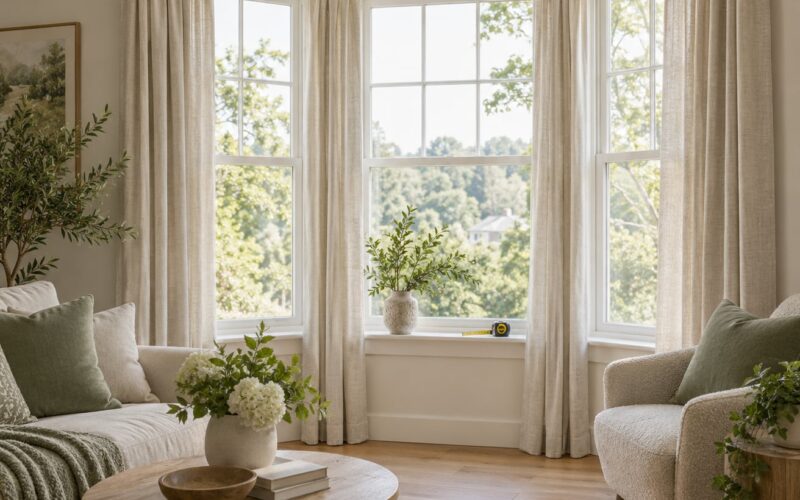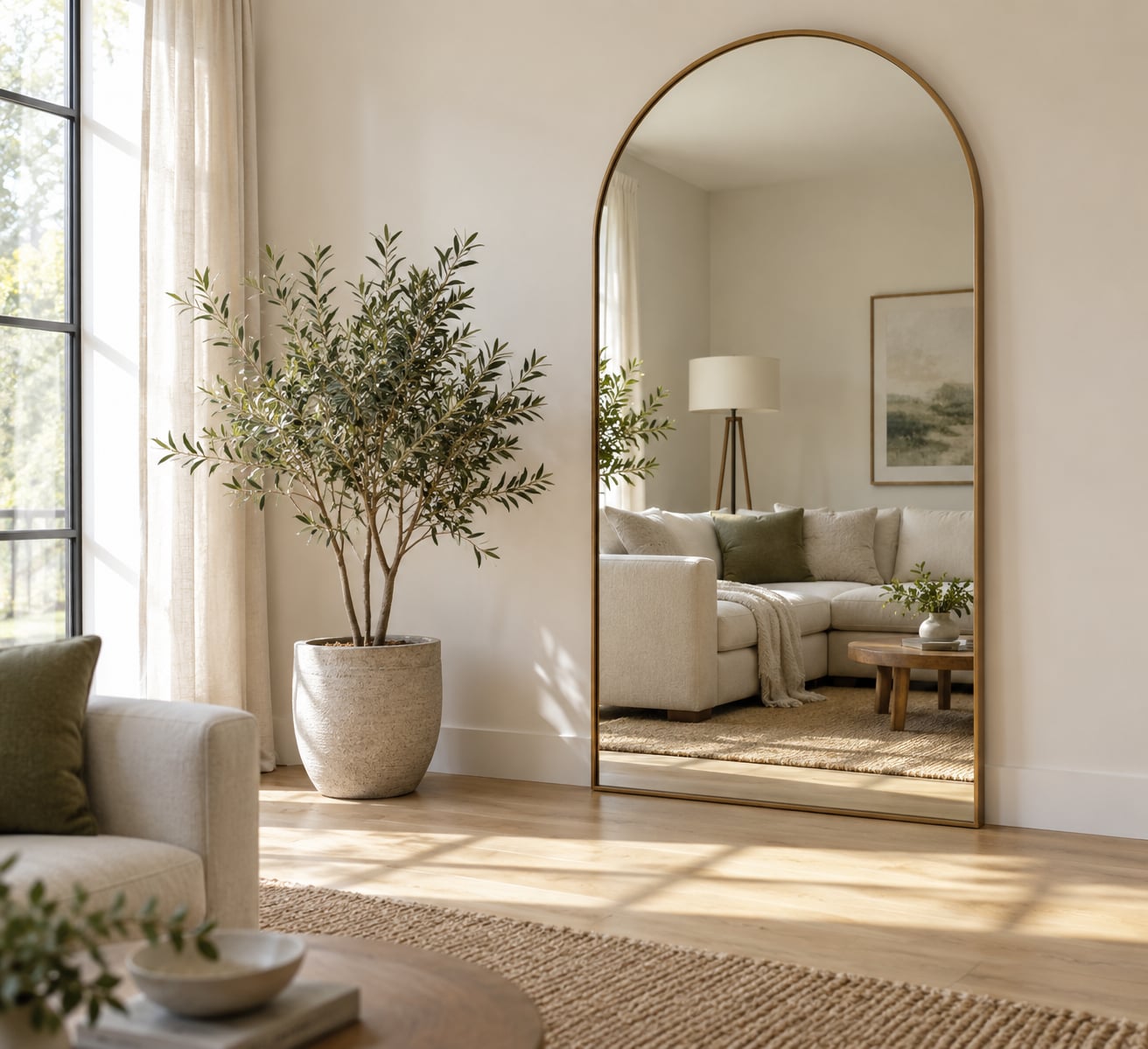
To decorate with mirrors and make a room brighter, hang at least one mirror where it catches daylight from a window and throws it back across the darkest part of the room, then size it so it relates to the furniture beneath it. Most of the job takes an afternoon: measure the wall, stand the mirror up before you commit, and check what it reflects at two different times of day.
That last check is the part people skip, and it decides whether the mirror helps. A mirror does not make light. It returns light that is already in the room to a surface that would otherwise sit in shadow, so a mirror angled toward a blank wall delivers nothing while one angled toward a bright window fills the far corner. Everything below is about getting that angle right before you touch hardware.
Advice here was checked against current lighting practice for 2026, and it assumes you are working with the room you already have. No painting, rewiring, or renovation.
Table of Contents
- What You Need
- Step-by-Step
- How to Decorate With Mirrors to Make a Room Brighter
- Choose the Right Mirror Size and Shape
- Place Mirrors Opposite Windows or Across the Room
- Style the Mirror With the Room
- Use Groups and Layers for a Brighter Look
- Check the Placement in Daylight and at Night
- Common Mistakes
- Frequently Asked Questions
- Do mirrors actually make a room brighter?
- Where should I place a mirror to brighten a dark room?
- How do mirrors make a small room look bigger?
- Will mirrors help in a room with no natural light?
- Should I hang a mirror above the sofa or above the fireplace?
- Conclusion
What You Need
Most rooms need only a tape measure and a wall you have wiped down. The rest is helpful when the mirror is large, heavy, or going somewhere other than a stud.
- Measuring tape for the wall, the sofa or console, and the mirror itself.
- Painter’s tape to mark the outline on the wall so you can judge size without marking the paint.
- A level, or the level tool on your phone, because a mirror that tilts a few degrees reads as crooked from across the room.
- Hooks or mounting hardware rated above the weight of the mirror. Two hooks spread the load better than a single nail.
- Glass cleaner and a microfiber cloth to clear the reflection before you judge it.
- A small step ladder for anything hung above a sofa or a mantel.
Renters can skip the hardware entirely. A full-length mirror leaning against a wall just behind a sofa or a console does the same optical work, moves with you, and leaves no holes.
Step-by-Step
How to Decorate With Mirrors to Make a Room Brighter
Find the darkest wall first, then find where the light comes from. Walk the room around midday and notice which surfaces stay dull: the wall beside the window, the far end of the sofa, the corner the lamp never reaches. That dull area is your target.
Next, work out the direction the light travels. Daylight enters a window on a fairly straight path and then dies out within a few feet. A mirror placed where it can catch that daylight and send it sideways doubles the useful reach of the window without adding a single watt.
- Stand in the room and note the position of every window and lamp.
- Pick the wall that stays darkest for most of the day.
- Ask what that wall is facing: a window, a lamp, a bright doorway, or another wall.
- Choose the surface with light on it and put the mirror opposite or at an angle to it.
- Clean the mirror and check the reflection from where people actually sit.
If the wall you picked faces nothing but wall, the mirror will show you a wall. That is the single most common disappointment people describe online, and it is why the check before hanging matters more than the size of the mirror.
Be honest about the limits here: mirrors amplify light that already exists. In a room with no windows and one dim overhead fixture, a mirror will soften shadows and make the space feel more open, but it cannot manufacture daylight. Rooms that are genuinely dark usually need a brighter bulb or a second lamp before a mirror makes a visible difference.
Choose the Right Mirror Size and Shape
Size a mirror to something already in the room, not to the wall alone. A mirror that matches the width of a sofa or console reads as deliberate; a mirror floating on an empty expanse of paint reads as an afterthought.
- Above a sofa: aim for roughly two-thirds of the sofa’s width, centred, with 6 to 8 inches of space between the frame and the back of the sofa.
- Above a console in an entry: match the console width, or go slightly narrower. A wider mirror crowds a narrow hallway.
- In a large room: one large mirror beats two medium ones. Fewer frames means less visual noise and more reflective surface.
- In a small room: do not go bigger than you can hang safely. A large mirror in a low-ceiling room lowers the ceiling visually, and a very large one can feel like it is tipping into you.
- On a narrow wall: a tall or arched shape uses the vertical run instead of competing with a doorway or window.
- For renters: a leaning floor mirror is the most forgiving option because height is adjustable and the hardware never touches the wall.
| Room | Best placement | Typical mirror width |
|---|---|---|
| Living room | Opposite the main window, above the sofa or console | 30 to 40 inches |
| Bedroom | On the wall beside or behind the nightstand, angled toward the window | 20 to 30 inches |
| Entryway | Above the console, facing the front door | Match the console width |
| Narrow hallway | Long wall, hung high, to bounce light down the corridor | 12 to 18 inches |
| Bathroom | Beside rather than opposite the window, so the glass stays usable | 20 to 30 inches |
| Home office | On the wall behind the desk, opposite or beside the window | 30 to 40 inches |
Shape follows the room’s existing geometry. Rectangular mirrors echo windows, doors, and rectangular furniture. Round and arched shapes soften a room full of straight lines. An organic shape works well when the room already has curves in it, and a frameless panel disappears into a wall better than anything with a border.
Place Mirrors Opposite Windows or Across the Room
Light returns from a mirror at the same angle it arrives. That single fact explains the whole placement rule: a mirror on the window’s own wall reflects the window back at itself and does very little for the rest of the room. A mirror on the wall opposite the window catches the daylight coming in and sends it back across the space to the wall behind you.
A mirror on the perpendicular wall works too, and often better in an L-shaped room. It picks up light coming in from the side and throws it into the part of the room that faces away from the window.
There is a second, separate trick worth knowing. A mirror at the end of a long hallway or a narrow corridor appears to show a space beyond the wall, because your eye reads the reflection as more room. That is the cheapest depth illusion available in a home, and it needs no window at all.
Style the Mirror With the Room
A frame should pick up something already in the room. Look at your hardware, your light fittings, your rug border, the wood tone of your side table, and pick the closest of those finishes. Black metal and brass frames work when the room has black or brass elsewhere; a plain wood frame disappears more calmly and suits most paint colours.
Height matters as much as finish. Hang the centre of the mirror roughly at the average height of the people who will look into it, which for most adults is about 57 inches from the floor. Above a sofa, come down low enough that the gap looks intentional.
Repeat one other element to tie it in: the same metal as a lamp base, a colour pulled from the artwork, or a finish that matches the console it hangs above. One repeated detail reads as a decision. Three repeated details start to look like a rule you wrote down.
Use Groups and Layers for a Brighter Look
On a wall with no furniture, a cluster of mirrors often beats a single one. Three or four smaller mirrors grouped tightly with even gaps between the frames create one larger reflective surface, and the irregular edges add character to plain paint.
Two rules keep a group from turning into clutter. Keep the gaps consistent, and give the whole group one clear relationship: a shared frame finish, a shared shape family, or a shared grid. Three round mirrors in three different finishes is not a grouping.
Leaning mirrors work the same way from the floor. A full-length mirror resting at a slight angle behind a sofa bounces light across the ceiling and adds depth behind the seating. Angle it toward the brightest part of the room rather than straight back at the wall.
Check the Placement in Daylight and at Night
Look at the mirror three times: mid-morning, late afternoon, and after dark with the lamps on. Sun moves across the day, so a placement that works at noon can face a dark neighbour’s wall by four o’clock. Checking at two points on the clock catches that before the hardware goes in.
At each check, look for four things:
- Glare straight into the seat, which makes the mirror a reason to avoid the spot.
- Awkward reflections such as an open door, a television screen, or a bin.
- Blocked furniture once the sofa, bed, or console is in its real position.
- Dark reflections, which tell you the angle is wrong and needs nudging.
At night, switch on the lamps and see what the mirror does with them. A mirror on the wall behind or beside a table lamp roughly doubles the apparent glow, because the light that would have fallen on the wall goes outward instead.
Common Mistakes
Most disappointing mirror results come down to a handful of repeat errors, and each has a straightforward fix.
- Reflecting a blank wall. The mirror shows more paint. Angle it toward a window, a doorway, or a lamp instead, or move it to a wall that faces something lit.
- Hanging it too high. A mirror above eye level looks like it is floating and can feel like it is falling. Drop it so its centre is near the average adult eye height, or fill the gap under a sofa with a leaning mirror.
- Choosing a frame that competes. A high-gloss or heavily moulded frame next to quiet furniture pulls the eye to itself. Match an existing finish and let the mirror sit back.
- Using several mirrors with no balance. Four mismatched thrifted frames in four directions read as clutter. Group them on one wall, unify the finish, or keep only the two that work.
- Expecting a mirror to brighten a room with no light. It redistributes light; it does not create any. Fix the bulb or add a lamp first, then position the mirror to catch it.
- Going oversized in a low-ceiling room. A very tall mirror pulls the ceiling down. Choose a wider, shorter proportion and hang it above furniture rather than alone on a tall wall.
- Skipping the renter option. Leaning mirrors and mirror tiles with removable adhesive need no holes, and they move when you move.
One tradition worth knowing about, since it comes up often: Feng Shui practice generally avoids hanging a mirror where it captures the bed in reflection, and treats a mirror facing the front door as draining rather than welcoming. Those are cultural conventions rather than measurement, but if they matter to you, side-angled mirrors beside the nightstand give you most of the light benefit without the reflection in question.
Frequently Asked Questions
Do mirrors actually make a room brighter?
Yes, but only by moving light that already exists. A mirror returns daylight or lamplight at the angle it arrives, so light that would have hit one dark wall is redirected across the room instead. In a room with real daylight or a working lamp, the effect is obvious within a day. In a windowless room with one dim bulb, you will get softer shadows and more depth, not brightness.
Where should I place a mirror to brighten a dark room?
Put it where it can catch the light, which usually means the wall opposite the main window or the wall perpendicular to it. Hang it high enough to clear furniture, then clean the glass and sit where you normally sit. If the reflection shows a blank wall or an open door, shift the mirror a few inches and check again before drilling.
How do mirrors make a small room look bigger?
A mirror reflects your eye past the wall it is mounted on, so the room reads as continuing behind the reflection. That illusion is strongest when the mirror faces a window or an open doorway, and when it reflects the furthest corner of the room rather than a nearby object. In a small room, one generous surface beats a cluster of small ones that add edges and busy detail.
Will mirrors help in a room with no natural light?
Partly. With no daylight, a mirror can still spread lamp light across a ceiling and walls and make the room feel less enclosed, which is a real improvement. What it cannot do is supply light that the room does not have. Buyers in this situation usually need a brighter bulb, a second lamp, or lighter wall paint first, and then the mirror multiplies that gain across the space.
Should I hang a mirror above the sofa or above the fireplace?
Above the sofa is the safer choice for a smaller room, because the frame relates to something with a known width and keeps the mirror from feeling random. Over a mantel, size the mirror to the opening rather than the wall and check that the reflection shows the room rather than the ceiling. Either works well, as long as the width is tied to the furniture underneath.
Conclusion
Start with a tape measure and ten minutes, not a drill. Measure the wall you want to brighten, stand the mirror near where you would hang it, and walk into the room to see whether it is picking up light or returning paint. If the reflection is worth looking at twice, measure the sofa or console and buy to that width. Most of the difference between a mirror that works and one that gathers dust is decided in that first ten-minute check.