You can clean upholstery fabric at home without a steam machine: read the care code, vacuum the piece, spot test a hidden seam, blot with a cleaner that suits the fabric, then dry it properly with airflow. For a three-seat sofa that is roughly 30 to 60 minutes of work, and the tricky part is never the scrubbing. It is choosing the wrong liquid.
I have cleaned fabric sofas and chairs this way for years, and the one habit that keeps saving me money is the 30-second pause at the care tag. That single letter decides whether water is safe, whether a solvent is required, or whether the piece should never be cleaned by a homeowner at all.
This guide covers how to clean upholstery fabric at home using ordinary tools, plus the warnings that matter, including the situations where a professional is the cheaper option.
Table of Contents
- What You Need
- How to Clean Upholstery Fabric at Home Step by Step
- Identify the Upholstery Fabric and Care Label
- Vacuum the Upholstery Thoroughly
- Pretreat Stains and Test the Cleaner
- Clean with a Damp Cloth or Upholstery Solution
- Dry the Upholstery Properly
- Common Mistakes
- Frequently Asked Questions
- Can I use Dawn dish soap to clean upholstery fabric?
- Is baking soda safe for a fabric couch or suede?
- How do I clean a white couch without leaving yellow marks?
- How can I clean upholstery fabric by hand without a machine?
- Can I wash removable couch covers in a washing machine?
- How do I get a bad smell out of upholstery at home?
What You Need
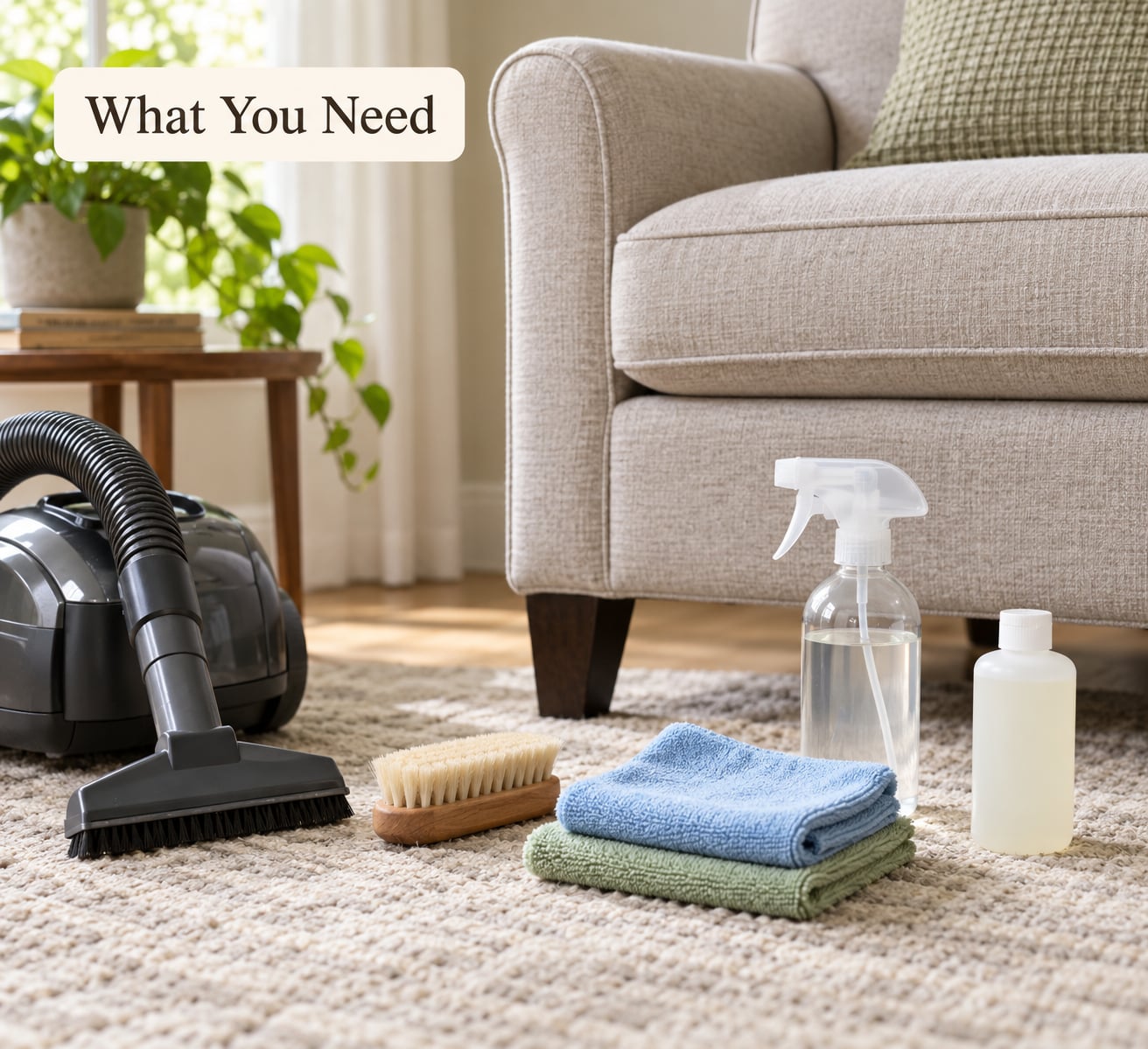
Most upholstery jobs need less than a full shelf of products. Gather these before you start, because interrupting a spot-cleaning job to find a tool usually means the stain spreads while you hunt.
For reading and testing: a flashlight for finding the care tag in the seam, and a white cotton cloth for the spot test.
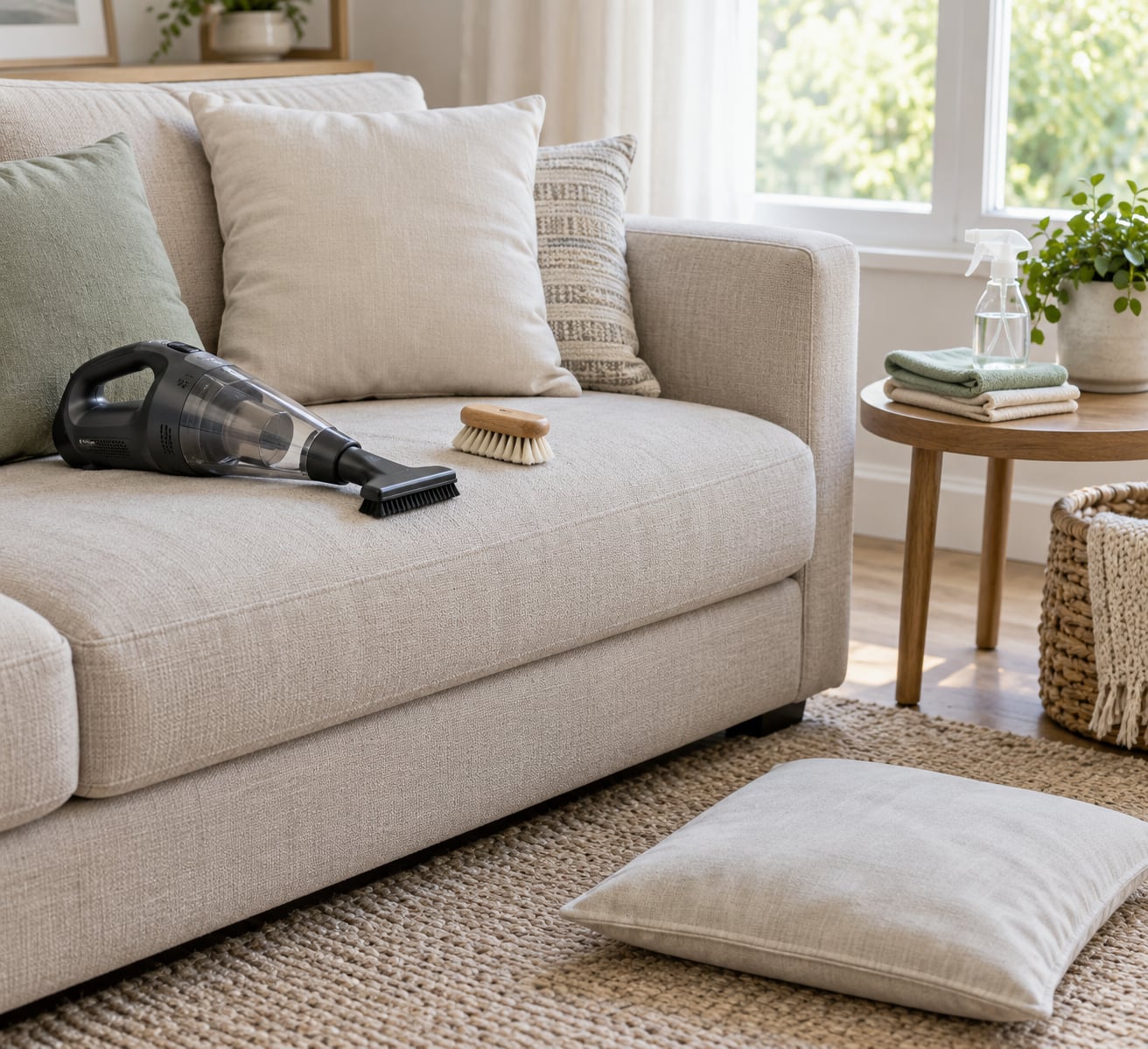
For vacuuming: a vacuum with an upholstery attachment. If you do not have one, use the brush tool on your hose and go slowly, since the plastic edges of a floor head can snag loops in the weave. A lint roller handles pet hair that is sitting loose on the surface.
For cleaning: a spray bottle, two or three clean microfiber cloths, and a soft bristle upholstery brush for agitation along the grain. Clear dish soap, white vinegar and baking soda cover most DIY recipes.
For drying: a box fan, an open window, or a dehumidifier. This step is not optional. Upholstery that stays damp inside the foam will smell within days.
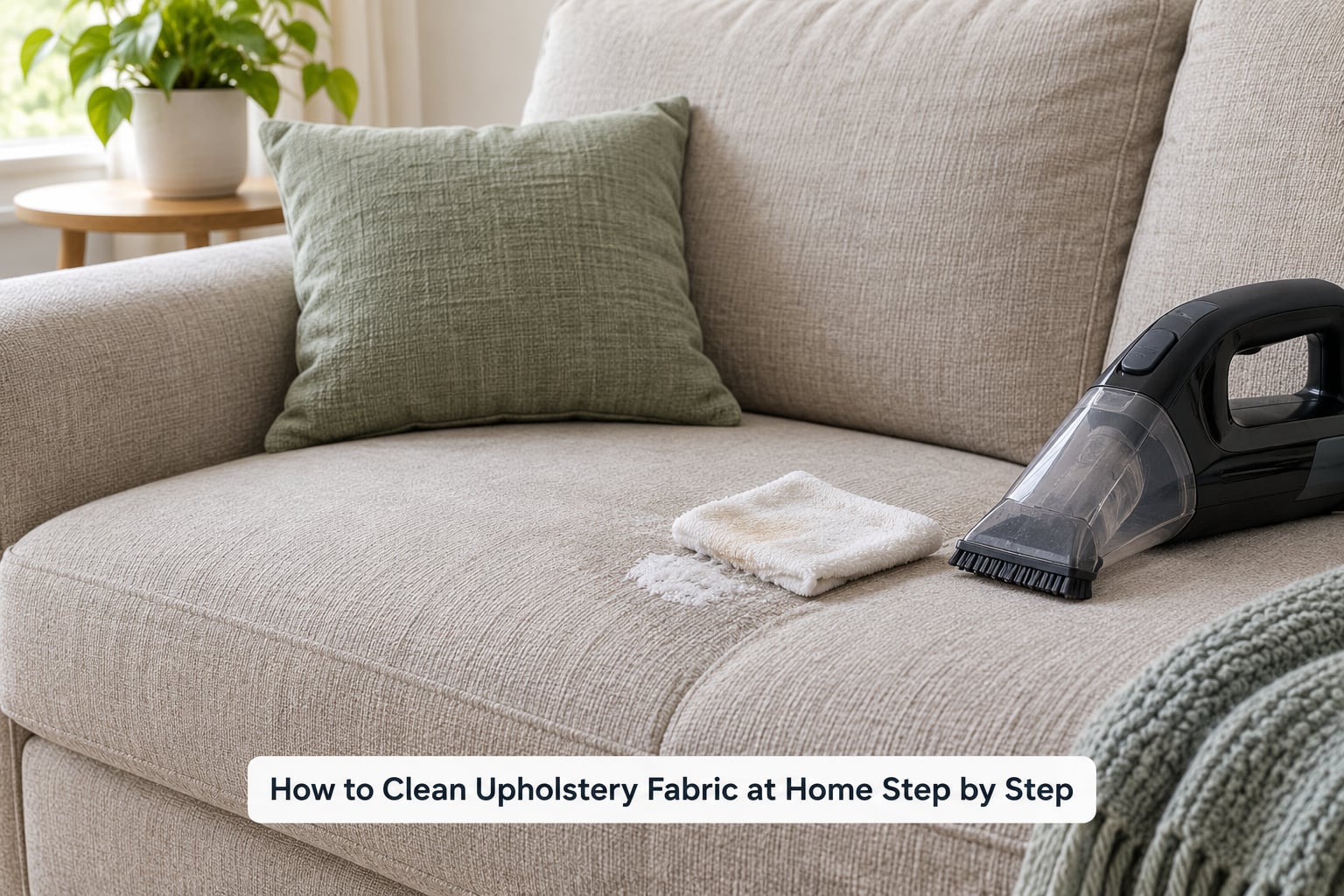
How to Clean Upholstery Fabric at Home Step by Step
Identify the Upholstery Fabric and Care Label
The care code tells you what the manufacturer allows, and it overrides anything you find online. Look under the cushions, along the bottom edge of the back, on the underside of the deck, and inside the zippered covers. On a sofa, the tag is often tucked into the seam where the back meets the arm.
Here is what each letter means in practice:
| Code | What it means | What to use at home |
|---|---|---|
| W | Water-based cleaners only | Water and dish soap solution, water-based upholstery cleaner |
| S | Solvent-based cleaner only | Dry solvent cleaner; no water, no steam, no vinegar |
| WS | Either water or solvent is safe | Most DIY recipes qualify; patch test first |
| X | Vacuum or professional cleaning only | Vacuum and blot, then call a professional |
The letter sits inside or under a circle or a square, and some tags use combinations such as XCS or S, where extra letters mean no water, no chlorine bleach, no solvents or no dry cleaning. If the tag is missing, treat the fabric as X until you test it. Vintage and older pieces often carry codes the current industry does not recognise.
Vacuum the Upholstery Thoroughly
Vacuuming comes first because loose grit acts like sandpaper once you start working a damp cloth over the surface. Every pass over grit rubs that grit into the fibres.
Work in sections and use short strokes so the upholstery attachment stays in contact with the fabric. Lower the suction on delicate or velvet surfaces, and go over seams, welts, the gap between cushion and arm, and the strip of fabric where the deck meets the frame.
If covers come off, vacuum them separately and check the zipper label before you consider a machine wash. Machine-washing a cover that was meant for solvent cleaning can shrink it beyond the zipper’s reach.
Pretreat Stains and Test the Cleaner
Identify the stain before you treat it, because water lifts most food and drink marks but can set protein stains like blood, milk and egg. Ink, grease and oil want a solvent side rather than a water side.
Blot, never scrub. Press a clean dry cloth down, lift it, and repeat with a fresh section of cloth. Scrubbing pushes the stain deeper into the pile and spreads it into a larger halo that is far harder to lift.
Then run the spot test. Put a few drops of your cleaner on an inconspicuous seam, ideally one that is hidden when the piece is in use, and leave it 24 hours if you have time. Look for color bleeding, dye transfer to the cloth, stiffness, or a ring. Any of those means you stop and try a gentler formula.
Forum advice on this point is consistent. Owners recovering cheap couches after a cleaning session that turned white upholstery grey almost always describe the same cause: dye transfer from an untested product.
Clean with a Damp Cloth or Upholstery Solution
For routine overall cleaning, spray the solution lightly on the cloth rather than on the fabric, then work the cloth over the surface. Damp is the goal. You are not wringing a wet towel over the sofa, and if you can squeeze a drop between your fingers you have already gone too far.
For a targeted stain, preload the dry cloth with solution, blot from the outside of the stain toward the center, and change cloths as soon as one becomes dirty. Keep a bowl of clean water nearby to rinse your cloth, and never carry dirty solution back onto the sofa.
Agitate gently with a soft bristle brush along the weave only if the tag allows, and only on W and WS pieces. A light scrub on a tight weave is fine. The same motion on velvet, corduroy or anything with a pile is how you flatten the nap permanently.
These are the recipes that hold up in practice, all measured so you do not have to guess:
| Recipe | Measurements | Use it on |
|---|---|---|
| Dish soap solution | 1 tablespoon clear dish soap, 2 cups lukewarm water | General grime, W and WS fabrics |
| Vinegar solution | Equal parts white vinegar and water | Odors, food and drink marks, W and WS |
| Baking soda paste | 6 tablespoons baking soda, about 1/3 cup water | Set-in odors, paste on, sit 20 to 30 minutes, vacuum off |
| Alcohol solution | 1 part isopropyl alcohol to 1 part water | Ink and oil, microfiber and synthetic only |
| Leather wipe | 1 part vinegar to 2 parts water, then leather conditioner | Finished leather, never suede |
A couple of notes on mixing. Do not combine dish soap, vinegar and baking soda in one bottle. The acid and base neutralise each other and you end up with foamy soapy water, which does less than either ingredient alone. Use baking soda as a paste for odor and soap or vinegar as a spray for grime, one at a time.
Do not use dish soap on suede. Suede is a brushed nap, and soap leaves a pale, stiff mark that can take months to fade. Broom the nap with a suede brush or use a cleaner sold for suede, applied sparingly.
Dry the Upholstery Properly
Blot out what you can with a dry cloth, then put the fan in front of the piece with the cushions propped apart so air can move through the foam. A dehumidifier in the room does more than an open window on a humid day. Expect the fabric to feel dry long before the foam is dry underneath, so press a folded dry towel into the seams to check for dampness.
No heat gun, no hairdryer on high, no radiator underneath. Direct heat dries the outer fibres first, which locks in a water ring and can shrink or scorch the fabric. If the piece is still damp after 12 hours, keep the fan running until it is properly dry rather than rushing it.
Common Mistakes
Almost every ruined upholstery job traces back to one of these.
Scrubbing the stain. It feels like progress, and it is the reason the mark doubles in size. The correction is pressure and patience: press, lift, use a fresh cloth, repeat.
Using hot water. Warm or lukewarm water is safer. Hot water opens the fibers, lifts dye out of them and shrinks fabric. Correction: test your mixed solution on the back of your hand and treat it as too hot if it stings.
Ignoring the cleaning code. Water on an S piece can leave a permanent ring, and steam on velvet flattens the nap for good. Correction: find the tag before anything else, and default to X when the tag is gone.
Soaking the cushions. A soaked cushion takes days to dry and can grow mold inside the foam where you cannot see it. Correction: work with a damp cloth, keep the spray on the cloth, and check the foam every few hours.
Drying with heat or in direct sun. Correction: fan and airflow only, and separate the cushions until they are fully dry.
Overusing baking soda. Powder left in the fibers leaves a white film on dark upholstery and clumps in the seams. Correction: use the paste recipe, keep it to 20 or 30 minutes, and vacuum thoroughly with a crevice tool.
Two habits prevent most repeat problems. Vacuum weekly, since dust and pet hair work into the weave faster than most people notice. And once the piece is clean and completely dry, apply a fabric protectant to W and WS upholstery, following the can directions, then reapply every year or two.
Frequently Asked Questions
Can I use Dawn dish soap to clean upholstery fabric?
Yes, on W and WS coded fabrics, and only in small amounts. Mix one tablespoon of clear dish soap with two cups of lukewarm water, apply it to a damp cloth rather than to the sofa, and blot the stain from the outside inward. Dish soap cuts grease and protein residue well. Avoid it on suede, velvet, and anything marked S or X, and always spot test first.
Is baking soda safe for a fabric couch or suede?
On fabric, yes. Mix six tablespoons of baking soda with about a third of a cup of water to make a paste, spread it over the mark, leave it 20 to 30 minutes, then vacuum it off with a crevice tool. On suede it is not safe, because the powder works into the brushed nap and leaves a pale film. Use a suede brush or a cleaner made for suede instead.
How do I clean a white couch without leaving yellow marks?
Work on it before the stain sets. Vacuum first, test the cleaner on a hidden seam for 24 hours, and blot with a diluted dish soap or vinegar solution using a white cloth so no dye transfers. Skip bleach on most upholstery, since it weakens fibers and yellows over time. Dry with a fan rather than heat, and expect to repeat the treatment on stubborn marks.
How can I clean upholstery fabric by hand without a machine?
You can do the whole job by hand. Vacuum every surface and seam, test your cleaner in a hidden spot, then spray the solution onto a microfiber cloth and blot rather than spray the sofa. Agitate gently with a soft brush only on W and WS fabrics, and keep the cloth damp instead of wet. Press out moisture with dry towels and finish with a fan until the foam is dry.
Can I wash removable couch covers in a washing machine?
Only if the cover label says so. Many covers can be machine washed cold and line dried, but plenty are spot clean only, and a cover meant for solvent cleaning will shrink or distort if it goes near water and heat. Zip the cover fully closed if you do wash it, wash it alone, and air dry it. Covers without a label are best treated like an X code piece.
How do I get a bad smell out of upholstery at home?
Start with an empty room test: press a clean white cloth into the seams and smell it. For pet, milk and smoke odors, apply the baking soda paste or sprinkle baking soda over the surface, leave it 20 to 30 minutes, then vacuum it thoroughly so no powder stays behind. Air the piece with a fan running for several hours. If the odor returns from inside the foam, an enzymatic cleaner made for upholstery is the next step.
Start at the care tag, then vacuum. Everything after those two steps depends on what the letter told you, and most of the disasters people describe come from skipping straight to a spray bottle. Take five minutes with the tag and the rest of the job gets much easier.