Curb hunting is just paying attention to the right streets at the right hours, and most people who try it once end up doing it every week. The good stuff shows up when someone moves out, finishes a renovation, or replaces a sofa, and puts the piece at the curb with a sign on it. Everything below is about the finder’s side: where the pieces actually turn up, when to look, and how to tell a solid hardwood table from a particle-board carcass before you haul it home.
This list is written for first-apartment renters, college-town movers, downsizers, and anyone who needs a dresser this month and would rather not buy one. Municipal rules change often and differ in every city, so treat the legal parts as a starting point to verify with your own sanitation department.
Table of Contents
- Where to Find Free Furniture on the Curb at a Glance
- 1. Check Your Own Street First
- 2. Look Along Busy Neighborhood Streets
- 3. Check Moving-Day Corners
- 4. Explore Apartment and Rental Dumpster Areas
- 5. Watch Neighborhood Facebook Groups
- 6. Ask Local Thrift Stores and Nonprofits
- 7. Check Curbside Pickup Areas on Move-Out Days
- 8. Use Local Marketplace and Free-Stuff Apps
- 9. Scout After Weekends, Holidays, and Renovation Seasons
- 10. Inspect, Clean, and Decide Before You Claim It
- Your Free Furniture on the Curb Inspection Checklist
- Frequently Asked Questions
- Is it legal to take furniture left on the curb?
- When is the best time to look for free furniture on the curb?
- How do I know whether a curbside piece is safe to use?
- Can I take furniture from a dumpster or abandoned building?
- How long can furniture sit on the curb before it is collected?
Where to Find Free Furniture on the Curb at a Glance
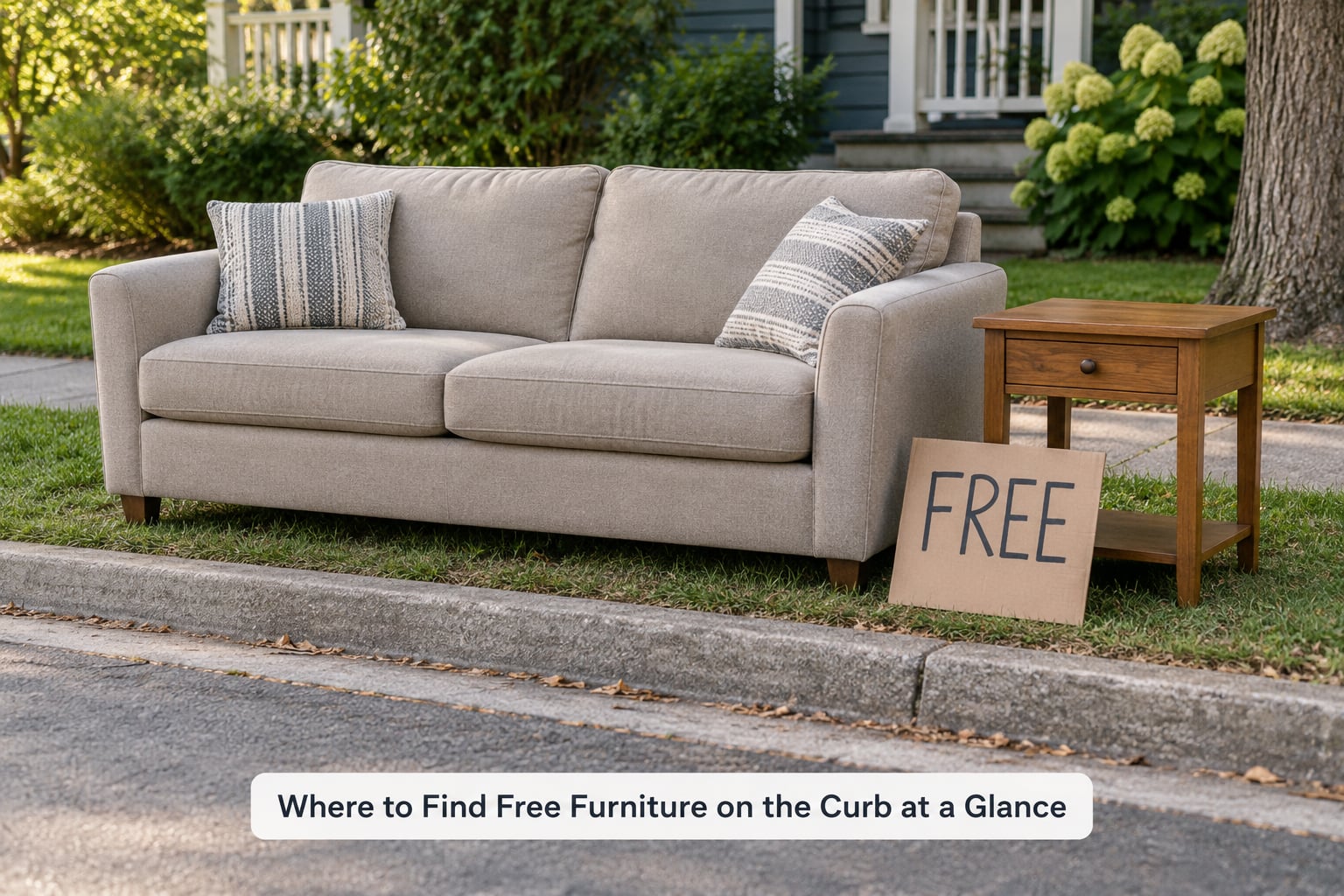
Here is the short version of every source in this guide, with the timing that actually matters for each one.
| Source | Best time to check | What you usually find | The catch |
|---|---|---|---|
| Your own street and immediate block | Early morning, before collection | Sofas, tables, dressers from neighbors | Small volume, but zero travel time |
| Busy residential streets and dead ends | Weekday mornings | Mixed pieces from move-outs and redecorations | You are walking or driving past active traffic |
| Move-out corners at apartment complexes | Last week of the month, lease turnover | Desks, shelving, headboards, microwave stands | Management often requires you to ask first |
| Municipal bulky-item staging areas | The night before collection day | Anything too big for the regular cart | Never reach into an open dumpster |
| Neighborhood Facebook groups | Any time; first alerts go out at night | Already-staged pieces with a pickup window | Fast movers, so turn on notifications |
| Thrift stores and nonprofits | Weekday mornings, by appointment | Dressers, frames, clean donated pieces | Some keep a free waiting list for release days |
| Marketplace and free-stuff apps | Within 30 minutes of a new post | Almost everything, including near-new pieces | Speed decides who gets it |
1. Check Your Own Street First
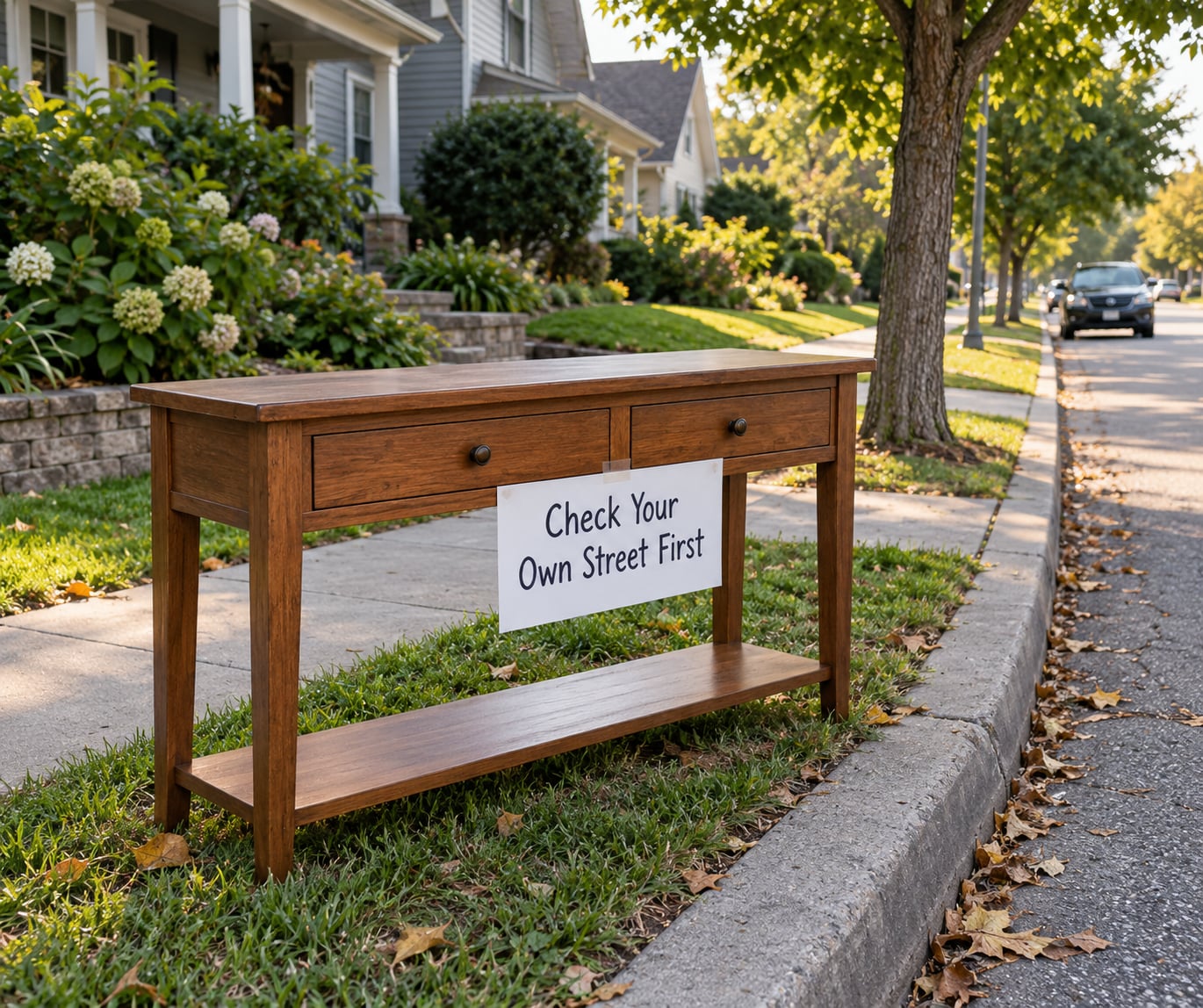
Start where you already are. Neighbors are the most generous and least competitive source, and you will spot their curbside pieces without changing your routine at all.
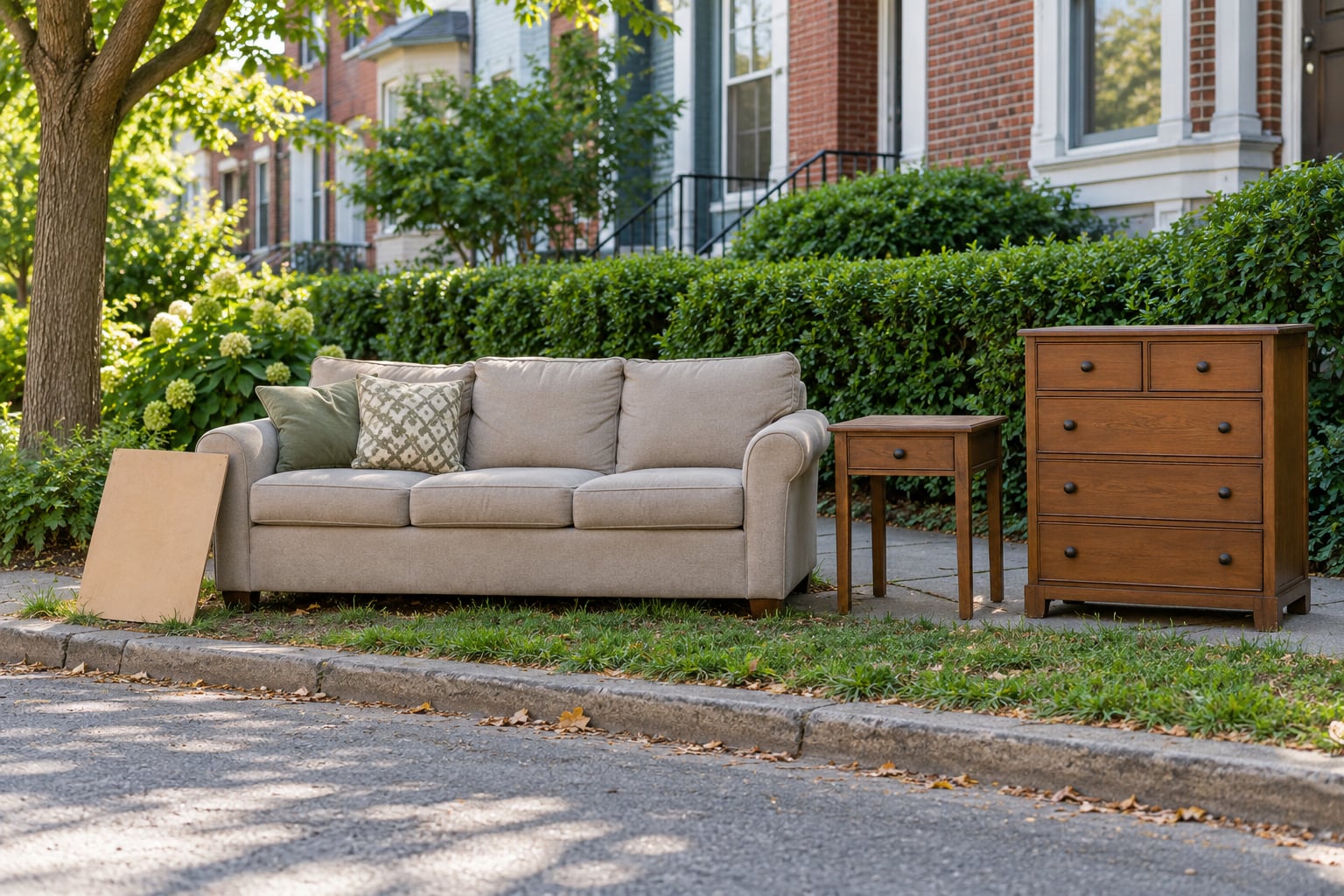
Take the same short walk every morning and look for a few plain signals: a handwritten sign taped to the piece, a sheet or blanket draped over it, or a gap in the lawn where something heavy was dragged. Those all mean a person meant it to go, rather than it being accidental rubbish.
Do not assume a piece is abandoned just because it is sitting there. Knock on the door if someone is home, or wait a day and note the time before you commit. A piece that has sat untouched through two collection days in a neighborhood where you know the residents is probably fair game.
2. Look Along Busy Neighborhood Streets
Main residential arteries, dead ends, and streets lined with older rental houses produce far more than quiet cul-de-sacs. Families with kids cycle furniture out constantly, and they are usually replacing something the previous owner resold or donated.
Pick two or three routes and repeat them until the patterns click. Once you know that one stretch sheds a lot of couches at month end, you can time your drives instead of wandering.
Practical habits matter on these streets: park without blocking a sidewalk or a driveway, stay aware of moving traffic, and carry your phone with a car key on it so you are not standing mid-block wrestling with a heavy piece. Wear closed-toe shoes and gloves; a lot of these items have hardware underneath that nobody saw in twenty years.
3. Check Moving-Day Corners
Apartment complexes, student housing, and any street near a large rental turnover generates the highest concentration of good material. Desks, bookcases, headboards, and dining tables do not survive a move twice, and the person clearing them usually wants them gone within a day.
Approach respectfully. If there is a leasing office on site, ask at the desk first; properties often have a pickup rule for move-out debris, and uninvited haulers can be asked to leave. If a resident is carrying a lamp out to their own car, a simple “Is that going anywhere, or is it up for grabs?” goes a long way.
Watch for pieces staged but still tagged, taped, or wrapped. Those are usually still in play and get taken with the household. The unwrapped, unsignposted ones at the far end of the lot are the ones nobody came back for.
4. Explore Apartment and Rental Dumpster Areas
The legal version of this is the city’s bulky-item staging area: a designated spot where residents set out furniture ahead of scheduled collection. That is public-adjacent and open to anyone once a piece is clearly abandoned, subject to your local rules.
The line you never cross is an open dumpster, an enclosure behind a building, or anything sitting on private property. Items inside a container are still someone else’s property, and cities treat theft from a dumpster as theft. You can also get cited for dumping if you haul out more than you take in.
Instead of digging through containers, watch the staging zone on the evening before collection day. That is where the pieces sit, uncovered and easy to check, and nobody is going to be on the phone about a dresser you carried off.
5. Watch Neighborhood Facebook Groups
Neighborhood and buy-nothing groups are where curb finds get posted before anyone sees them in person. A photo of a mid-century sideboard with a comment reading free, curbside, first to grab it can clear out in under an hour.
Search your city name plus buy nothing, free stuff, and neighborhood name, then request to join and turn on notifications for the group. Search within each group for words like free, must go, and curbside pickup rather than browsing the feed.
When you respond, keep it short, name your pickup window, and confirm before you travel. People listing items at night often post a specific morning window in the replies, and pinning that window is what separates the serious takers from the drive-by curious.
6. Ask Local Thrift Stores and Nonprofits
Not everything is curbside, but plenty of furniture is genuinely free if you ask the right organization. Furniture banks, community thrift stores, and ReStore-style outlets sometimes release donated pieces to the public on a first-come basis, and some keep a short waiting list for a free or reduced-cost piece before it goes on the sales floor.
Call ahead instead of showing up. Ask what they accept, whether furniture goes out on a set day, and whether residents of a particular area get priority. Expect a two-week wait in many places, and expect a flat refusal on stained, pet-damaged, or smoke-saturated pieces, since those often only become apparent after inspection.
The flip side works too. If you are clearing out a piece, donation pickup may be free if the item is in good shape, and a receipt from a nonprofit is something some people actually use. Call first, photograph the piece in daylight, and describe flaws honestly, because that description is exactly what the next taker wants to know.
7. Check Curbside Pickup Areas on Move-Out Days
Senior living facilities, student apartment communities, office move-outs, and commercial relocations all produce furniture in volume, and each has its own permission layer. Some complexes put out a move-out weekend with a contractor hauling to a truck, and the discarded pieces ride along.
Ask the property manager or the moving crew. A quick, polite request at the loading area is often granted, and crews generally prefer the furniture not to go into the dumpster because it costs them disposal fees.
For office and clinic move-outs, ask whether anything is going to auction or donation first. Some release surplus items to whoever shows up with a truck, and it can be the cleanest furniture you will find because it was in an indoor space and stored off the floor.
8. Use Local Marketplace and Free-Stuff Apps
Facebook Marketplace, Craigslist’s free section, OfferUp, and Nextdoor all carry the same breed of listing: a real resident, a real neighborhood, a piece of furniture at zero dollars that you haul yourself. Search by radius rather than city so you cover the towns around you.
Use the curb-pickup or free filter, then save a couple of high-volume searches and check them at least twice a day. Items at zero usually do not last, and the difference between the first message and the third is whether you still have a piece of furniture.
Filter out the commercial resellers. Scroll past the people who post ten identical dressers and instead look for one household, one piece, and honest photos. That listing usually has a real story behind it and a person who will answer a question about the drawer that sticks.
9. Scout After Weekends, Holidays, and Renovation Seasons
Timing beats luck more often than people expect. Most curbside pieces appear in a predictable rhythm: overnight before collection day, right after a weekend when someone finished clearing a garage, and in bursts around month end when leases turn over.
Summer through early autumn is the busiest stretch, driven by student leases and family moves. January and February are quieter but still productive for anyone clearing out holiday gifts, and the weeks after a big renovation or flooring job tend to produce a lot of built-ins, doors, and cabinets.
Build the habit into one route on two mornings a week. Ten focused minutes beats an hour of random driving, and after a few weeks you will be able to tell which blocks produce finds and which are dead weight on your morning.
10. Inspect, Clean, and Decide Before You Claim It
Your Free Furniture on the Curb Inspection Checklist
Run through this before anything crosses your threshold, because a couch with pests can cost you an entire room and a lot of arguing with yourself later.
- Pests: look along seams, piping, and the underside of cushions for rust-colored spotting, shed skins, and pinholes. Skip the piece entirely if you find any.
- Odor: smoke saturation and mildew both soak deep into foam and particle board. A piece that must be aired out for months is usually not worth the effort.
- Structure: wiggle the legs, check the joints, and make sure nothing wobbles. Wobbly is fixable. Cracked or rusted fasteners are a different problem.
- Materials: solid hardwood survives sanding and refinishing. Particle board and MDF swell and crumble the moment water touches them.
- Hardware: run a cloth over every edge. Old nails and exposed screws get filed down or removed before anyone sits on it.
- Dimensions: measure before loading. Know whether it fits your door, your stairwell, and your intended wall.
For wood, wash with warm water and a little dish soap, dry fast, and sand any rough spots. For upholstery, steam clean on the hottest setting the fabric allows, and if the piece came from a home with pets or smokers, treat it as a professional cleaning job or skip it.
Then weigh the honest value. If it needs more than one weekend of work to be usable, it may be cheaper to donate it, list it free yourself, or take it to a scrap route. Solid metal hardware and hardwood frames are worth pulling apart for materials; particle board is worth almost nothing.
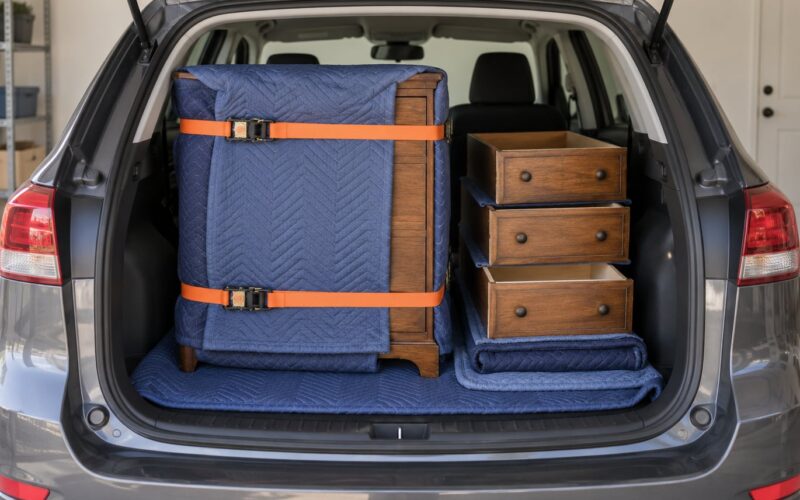
Transport is the last practical hurdle. A furniture dolly and two ratchet straps handle most pieces up to about 150 pounds, and a friend with a pickup beats renting a truck for a single sofa. For anything heavier, an hourly pickup rental or a task service is cheaper than a back injury, and most curbside finds are not worth a long-distance haul.
Frequently Asked Questions
Is it legal to take furniture left on the curb?
Usually, yes, once a piece is clearly abandoned and your local rules allow it. Most cities treat items placed at the curb for collection as available on a first-come, first-served basis, provided you take only what you can carry away yourself. Check your municipality’s bulky-waste and illegal-dumping rules, never take from private property or an open dumpster, and photograph the piece where you found it with a timestamp.
When is the best time to look for free furniture on the curb?
Early morning is best, because most pieces are set out the night before or early that morning and disappear quickly. Check again right after weekends, holidays, and month end, when lease turnovers and cleanouts cluster. Time your route around your own bulky-item collection day too, since neighborhoods tend to put things out on the same schedule.
How do I know whether a curbside piece is safe to use?
Inspect for pests first: rust-colored spots on seams, shed skins, and pinholes along piping and cushion undersides mean you leave it. Smell it too, since smoke and mildew soak into foam and cannot be cleaned out. Skip anything with serious structural damage, unknown contents, sharp or rusted hardware you cannot remove, or upholstery you cannot fully clean.
Can I take furniture from a dumpster or abandoned building?
No. Anything inside a dumpster, inside an enclosure, or on private property is not automatically free, and taking it can count as theft or trespassing under local law. Stick to designated municipal bulky-item staging areas, curbside pieces clearly set out with a sign, and direct permission from a property manager or moving crew.
How long can furniture sit on the curb before it is collected?
Usually until the next scheduled collection day for your area, which is often the day after you put it out. Many neighborhoods and HOAs pass items set out for more than 24 hours as a code violation or fine the household, so givers stage furniture close to pickup time. If a piece has survived two collection days untouched, it is generally fair to take.
Start tomorrow: pick one street within a ten-minute drive, walk it at seven in the morning, and look for a sign taped to a piece. Do that twice a week for a month and you will have three or four routes worth repeating, which is where this actually becomes useful. Follow the inspection checklist before anything comes inside, and check your city’s bulky-waste page once a year, because those rules get rewritten more often than anyone admits.