To paint a metal bed frame, you clean and degrease the metal, scrape and sand off the rust and loose paint, seal it with a rust-inhibiting metal primer, then apply two or three thin coats of paint made for metal. The prep is what separates a finish that lasts years from one that peels off in a month.
Budget a weekend for the whole thing. Moving a frame, sanding it and laying down coats is easy work, but the drying time is what eats the hours, and there is no rushing it. Most of the effort goes into the parts nobody sees, which is exactly why so many paint jobs fail.
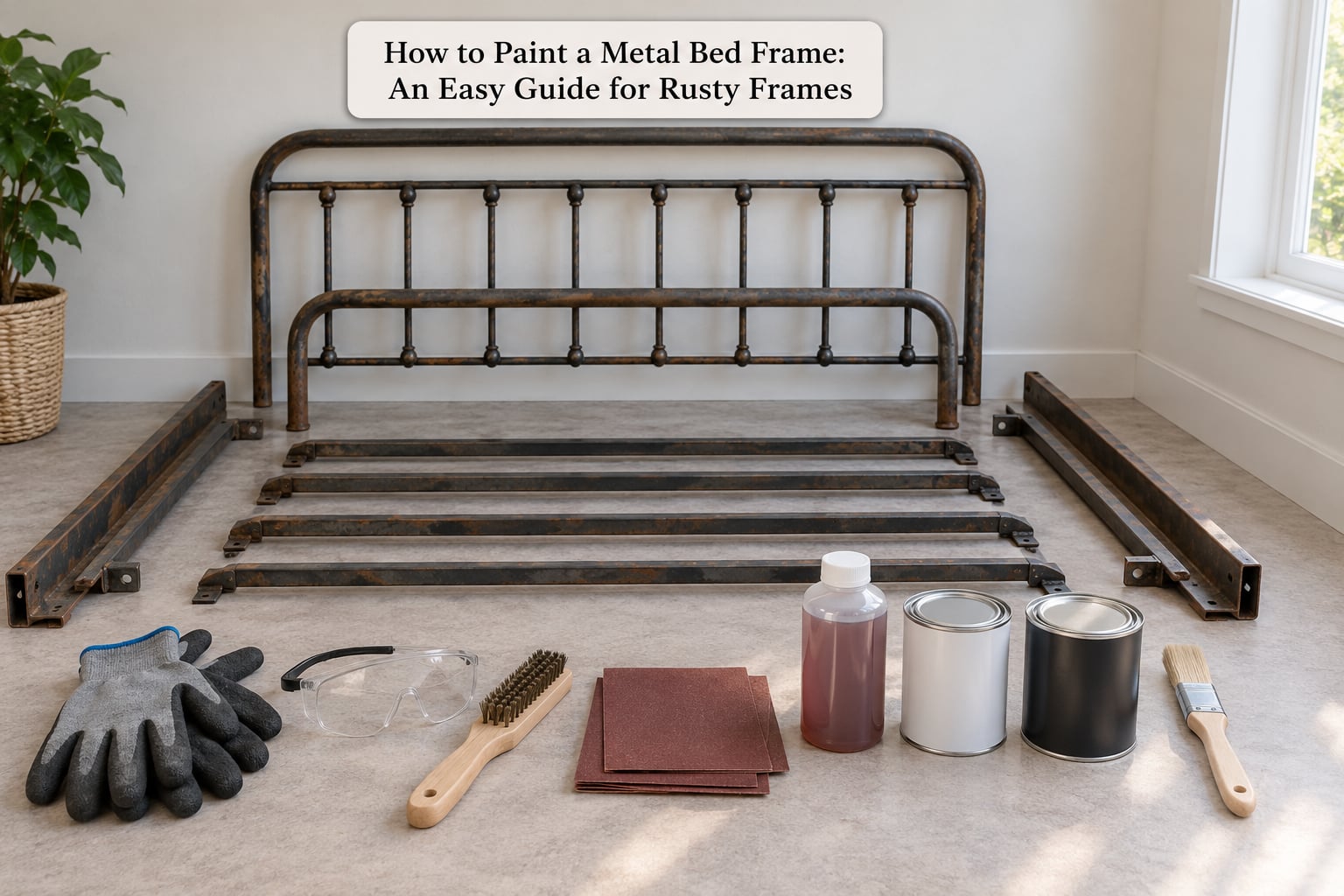
Table of Contents
- What You Need to Paint a Metal Bed Frame
- For removing rust and old paint
- For cleaning
- For painting
- Safety gear for indoor work
- Step-by-Step: Painting a Metal Bed Frame
- Step 1: Inspect and Prepare the Bed Frame
- Step 2: Remove Rust and Old Paint
- Step 3: Clean and Sand the Surface
- Step 4: Apply Primer and Paint
- Step 5: Dry, Seal, and Reassemble
- Common Mistakes That Make Paint Peel
- Frequently Asked Questions
- Can you paint a metal bed frame without removing all the old paint?
- What type of paint is best for a metal bed frame?
- How do you remove rust before painting a bed frame?
- Do I need to use primer on a metal bed frame?
- How long should I wait before using a freshly painted metal bed?
- Can I change a metal bed frame from one color to another?
- What to Do First
What You Need to Paint a Metal Bed Frame
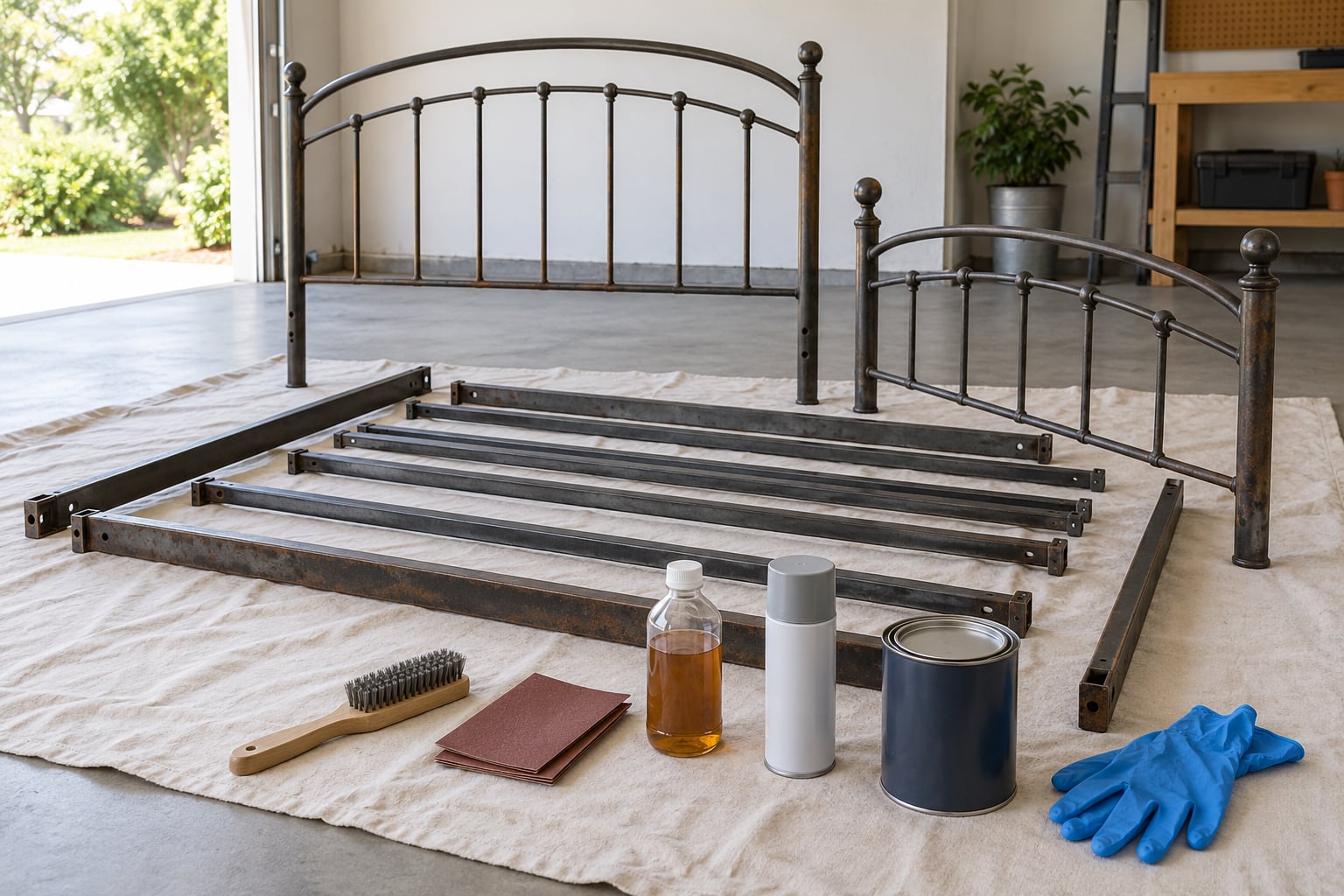
Gather everything before you start. Halfway through a project, hunting for a second brush while wet paint sits on the frame is how people end up with dust in the finish.
For removing rust and old paint
- Wire brush, stiff, for knocking loose surface scale
- Steel wool, medium grade, for stubborn patches on flat rails
- Abrasive sanding block or paper, 80 grit for heavy rust and 120 grit for general scuffing
- Rust remover gel or a rust converter for pitted areas a brush cannot reach
- Plastic scraper or putty knife for lifting flaking paint
For cleaning
- Degreaser such as TSP, or mineral spirits for a lighter clean
- Two clean rags and a bucket of warm water
- Shop towels for wiping the metal dry before sanding
For painting
- Rust-inhibiting metal primer in a spray can or a one-quart can
- Paint formulated for metal, either a spray enamel or a brush acrylic enamel
- Clear coat for a satin topcoat if the frame sees daily handling
- 2-inch angled brush for rails and finials, small foam roller for flat panels
- Drop cloth, painter’s tape for masking off any non-metal fittings, tack cloth
Safety gear for indoor work
- Nitrile gloves and eye protection
- A respirator with an organic vapor cartridge if you spray indoors
- Open windows, a fan pointed out the window, or work in a garage or on a balcony
Over a bed frame, ventilation matters more than it does for a shelf. A spray can in a closed bedroom puts solvent fumes into a space you then sleep in, and the overspray settles on bedding you have not moved. Many DIYers brush the whole frame instead of spraying, which sidesteps the fumes and cuts the cleanup.
Step-by-Step: Painting a Metal Bed Frame
The order below follows the way the job actually has to go. Skipping ahead, most often to get to the painting faster, is what leaves you scraping your own fresh coat off in six weeks.
Step 1: Inspect and Prepare the Bed Frame
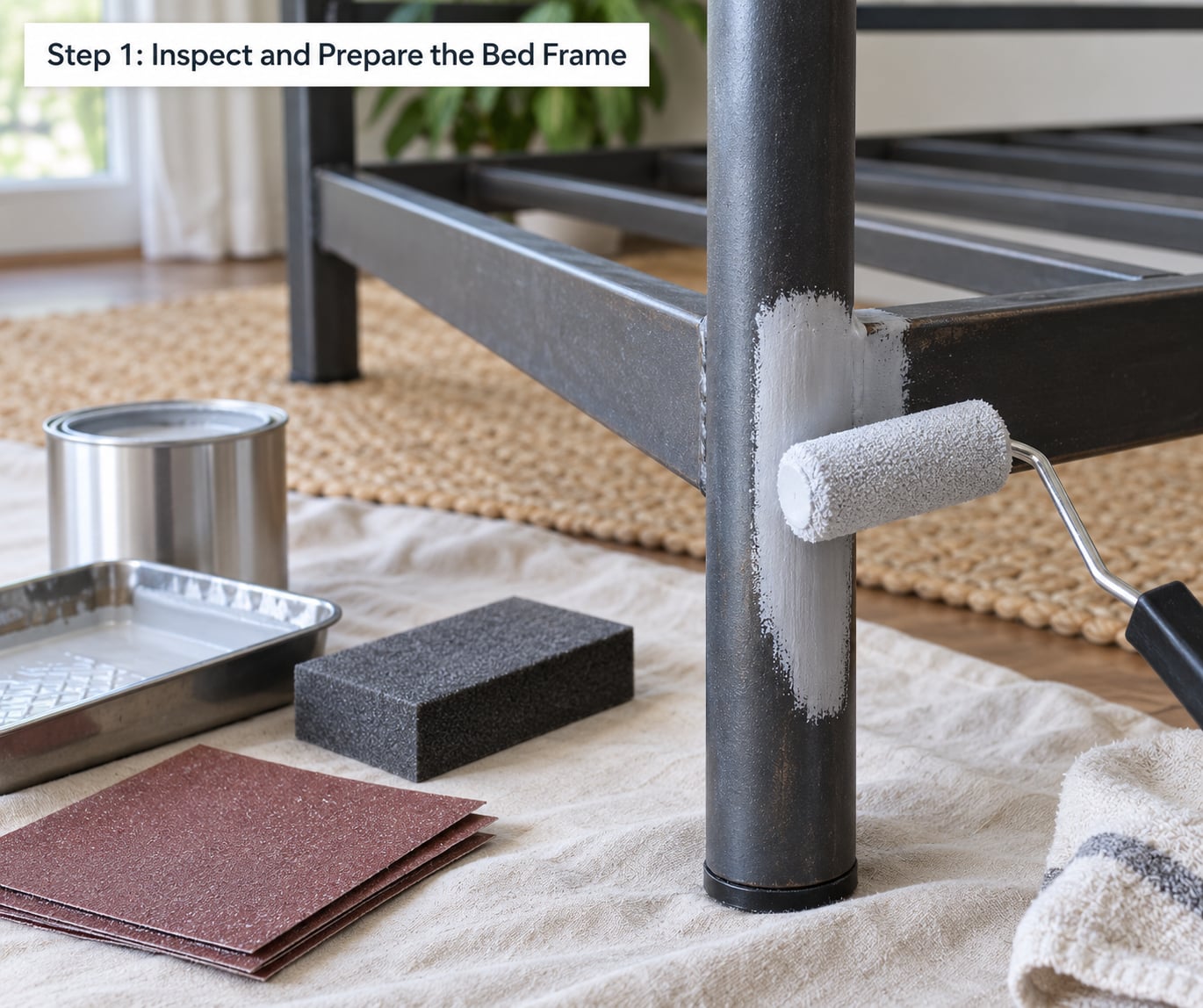
Move the frame to open space before you touch it, and lift rather than drag it. Dragging a steel frame across a floor scars both. Take the mattress, box spring and slats off and set them aside, then photograph each joint and any hardware before you remove a single screw.
Bag every bolt, washer and dowel separately with a bit of tape on the bag marking which corner it came from. If you remove the frame to separate headboard from footboard, note where the bolts went through, because the top hole and the bottom hole are usually not interchangeable.
Push on the frame. A wobble, a cracked weld or a hole eaten through the metal at a joint is a repair job, not a paint job. Weld it or swap the section before you spend a weekend on a cosmetic finish that will split later.
Step 2: Remove Rust and Old Paint
Paint over rust and the rust comes back, pushes the paint off from underneath, and leaves you doing the job twice. Match the treatment to how bad the metal actually is.
- Light surface rust: orange staining that rubs off on a rag. Scrub with a wire brush and follow with a pass of 80 grit paper until the metal reads grey or silver.
- Moderate rust: flaky brown scale in patches. Wire brush first to knock the scale loose, then apply a rust remover gel and let it sit for the time printed on the label. Rinse and dry fully.
- Heavy rust with pitting: deep orange pits, especially at welds and inside joints. A rust converter turns remaining corrosion into a stable coating, or you grind it out with an angle grinder fitted with a flap disc if you own one.
On cast iron and wrought iron, keep the wire brushing light. Those surfaces carry decorative scrolls, medallions and end caps, and aggressive sanding takes that detail off faster than you can put it back.
Old paint only comes off where it is loose. Flatten peeling areas with the scraper, feather the edge of bare metal with 120 grit so paint has something to blend into, and leave sound paint alone. A frame that will not hold paint at the welds will not hold it on a side rail either, so a full strip rarely buys you anything extra.
Step 3: Clean and Sand the Surface
Dip a rag in TSP solution and wipe the frame down, working section by section so the solution does not sit and dry on the metal. Follow with a clean damp rag to remove the film, then dry it properly with a shop towel.
This step is not optional. Oil from the factory finish, skin oils from handling and years of bedroom dust all sit on the surface and paint will not grip them. Mineral spirits work if TSP is too harsh for the finish you are dealing with.
Now scuff with 120 grit for the whole frame, moving to 220 grit on the areas that need a smoother topcoat. You are not trying to remove metal, you are scratching the surface so paint has something mechanical to hold onto. Feather the edge of every bare patch you exposed in the last step.
Never leave a bare spot ringed with shiny metal. That ring of exposed steel rusts from underneath and blooms through the new paint within a year. Wipe the frame with a tack cloth right before you prime.
Step 4: Apply Primer and Paint
Choose by the metal, not by the color. Powder-coated steel from a mass-market frame is smooth and non-porous, so it needs a primer rated for that coating or nothing will adhere for long. Galvanized steel needs a primer formulated for it. Cast iron and wrought iron take conventional rust-inhibiting primer well.
Apply primer first, in thin coats. Sand it lightly when it is dry to the touch, wipe the dust off, and move to your color. Chalk-style paint and matte topcoats give a soft, low-sheen look, while semi-gloss enamel holds up better to bumps and scrubbing.
Two or three thin coats beat one thick one every time. A thick coat skins over while the middle stays soft, and that is how you get drips that cure into hardened runs. Keep a wet edge and work section by section so nothing overlaps half-dry.
With a brush, load a third of the bristle length and brush along the rail. With a roller on flat panels, roll out and then come back with a dry pass to even out the stipple. If you spray, hold the can about 10 to 12 inches away, move it steadily rather than sweeping it back and forth, and wait the label’s flash time before the next coat.
Step 5: Dry, Seal, and Reassemble
Dry to the touch is not cured. Touch is roughly an hour for most metal paint, full cure is generally 24 to 72 hours depending on the product, humidity and how many coats went on. Handle the frame gently during that window.
Look for missed spots under good light and touch up while the last coat is still slightly workable. Add a clear coat only if the frame takes daily knocks or you want extra scratch resistance on a semi-gloss finish.
Reassemble with the hardware you bagged in Step 1, then push the bed around and check for wobble, sticking bolts or scraping on the floor. New felt pads or rubber feet on every contact point protect both the frame and the floor.
Common Mistakes That Make Paint Peel
Almost every peeling metal paint job comes back to one of the same nine problems. Each has a straightforward fix, and all of them are avoidable before you open a can.
- Painting over rust. The rust returns and lifts the coating. Fix: wire brush every orange patch and treat what remains before priming.
- Skipping the primer. Paint sits on a smooth surface with nothing to grip and peels in sheets. Fix: always prime bare metal, and always prime factory powder coat.
- Applying one heavy coat. Runs, sagging and a soft skin that chips. Fix: three thin coats, with flash time between each.
- Priming damp metal. Trapped moisture bubbles the paint. Fix: dry the frame fully and give it an hour indoors after wiping it down.
- Missing crevices and welds. Rust starts in the joints nobody painted. Fix: use a small angled brush and walk the welds, finials and the underside of every rail by hand.
- Sanding away the decoration. Cast iron loses its scrollwork under heavy sanding. Fix: light scuffing is enough for adhesion.
- Reassembling too soon. Bumping a curing frame leaves dents and fingerprints that stay. Fix: full cure before hardware goes back in.
- Wrong paint for the metal. Household acrylic over galvanized steel slides off in sheets. Fix: use paint labeled for metal and primer for the specific coating.
- Painting in a closed room. Poor ventilation leaves odor in the bedroom and settles dust into the wet finish. Fix: work outside or brush indoors with the windows open and a fan moving air out.
One more, and it is the popular one: skipping the whole project because the factory finish feels permanent. Users repainting IKEA-style powder-coated steel frames report it is paintable with the right primer, though the coating fights adhesion for the first pass. Scuff it, prime it, and expect the new finish to outlast the old one.
Frequently Asked Questions
Can you paint a metal bed frame without removing all the old paint?
Yes, if the existing paint is sound. Scrape off anything that is peeling or flaking, feather those edges with 120 grit paper, and scuff the rest of the surface so the new coat has something to grip. Paint over topcoat is fine; loose paint is not. Where bare metal is exposed, treat it for rust and prime it, because bare steel inside an otherwise painted frame is where rust starts.
What type of paint is best for a metal bed frame?
Any paint labeled for metal works, and the primer matters more than the topcoat. A rust-inhibiting metal primer underneath a spray enamel gives the most durable result on cast iron, wrought iron and steel. Chalk-style paint gives a soft matte finish popular on antique iron beds. Match the primer to the metal first: galvanized and powder-coated frames need their own formulations or nothing grips long-term.
How do you remove rust before painting a bed frame?
Match the tool to the severity. Orange surface rust that wipes away comes off with a stiff wire brush and a pass of 80 grit paper. Flaky scale needs a rust remover gel, left on for the label’s stated time, then rinsed and dried. Deep pitting at welds and joints responds to a rust converter or a grinder with a flap disc. On decorative iron, keep brushing light so you do not take the detail off.
Do I need to use primer on a metal bed frame?
Yes, on any frame that has been stripped to bare metal or where old paint came off. Primer seals the metal against corrosion and gives the topcoat a stable surface to hold. On a factory powder-coated frame it matters even more, because that coating is smooth and non-porous. The only case where you might skip it is painting over a fully intact, already primed surface with a compatible topcoat.
How long should I wait before using a freshly painted metal bed?
Leave it until the paint is cured, not merely dry. Most metal paints feel dry to the touch in about an hour but need 24 to 72 hours to harden fully, and humid rooms stretch that. Reassembling early is the common mistake: bumping a soft frame leaves dents and fingerprints that stay permanently. Sleep on it once it feels firm, not tacky, and treat it gently for the first few days.
Can I change a metal bed frame from one color to another?
Any color will work, since you are painting over what is already there rather than stripping it back. For the biggest change, going light to dark or dark to light, expect two coats to cover the old color, and pick the primer shade that matches your new color so the frame does not need a third coat. Finish choice changes the mood: semi-gloss is crisp and modern, matte is softer and hides scuffs.
What to Do First
Start with the rust, not the color. Take the frame apart, wire brush every orange patch you can find, and let the metal tell you whether you need a rust remover gel or just a scuff.
Then degrease, scuff with 120 grit and prime. Most failed paint jobs trace back to one of those three steps being rushed. Do them properly and the painting part takes a couple of hours on a quiet weekend.