To clean a thrift store couch, work in this order: read the cleaning code tag, vacuum every surface and seam, then treat the fabric with only what that code allows. Most secondhand upholstery handles a diluted dish soap and vinegar mix applied by cloth, followed by a slow dry with fans running. Add an inspection for pests, odors and stains first, because scrubbing cannot rescue an infested frame or a soaked foam core.
Budget about two hours of hands-on work plus a full day of drying. If you only do three things, do these: identify the fabric, test the cleaner in a hidden seam, and vacuum thoroughly.
Table of Contents
- What You Need
- Step-by-Step: How to Clean a Thrift Store Couch
- Identify the Upholstery Before You Clean
- Vacuum and Treat the Couch Before Washing
- Clean Fabric Upholstery
- Clean Microfiber, Velvet, Leather, and Faux Leather
- Remove Odors and Kill Germs Without Soaking
- Let the Couch Dry and Restore Its Shape
- Common Mistakes
- Frequently Asked Questions
- Can I use a washing machine to clean a thrift store couch?
- What cleaning code is safe for my couch upholstery?
- How do I remove a musty smell from a secondhand couch?
- Is baking soda safe for all types of couch fabric?
- Can I use vinegar or bleach to disinfect a couch?
- How long does it take for a cleaned couch to dry?
- Conclusion
What You Need
Nothing here is exotic. The difference between a couch that comes back looking refreshed and one that ends up with a bleach halo is mostly knowing which supplies to skip.
For any fabric upholstery marked W or S/W:
- A vacuum with an upholstery attachment and a crevice tool
- A soft-bristle brush for seams and tight fabric
- Plain dish soap, white vinegar and distilled water
- Two or three lint-free microfiber cloths you can spoil
- Baking soda for dry deodorizing
- A spray bottle and a small mixing bowl
For velvet, microfiber, linen or anything tagged S:
- A soft-bristle clothes brush to lift the nap
- A water-free solvent or dry foam upholstery cleaner
- Paper towels for blotting, never scrubbing
For leather or faux leather:
- A damp microfiber cloth only, to start
- Saddle soap or a leather conditioner, matched to the finish
Optional but useful: an enzymatic pet urine cleaner, a portable spot cleaner or small upholstery shampoo machine, a box fan, and a dehumidifier if your rooms stay humid.
One rule before anything else: find the care label. It usually sits under one of the cushions or on the underside of the deck, sewn into a tag with the manufacturer’s cleaning code. No tag usually means vintage or unlabelled, and then you treat the couch as its most delicate material until a spot test proves otherwise.
Step-by-Step: How to Clean a Thrift Store Couch
Identify the Upholstery Before You Clean
The care tag tells you which cleaners the maker permits. If the tag says W, water-based cleaners are fine. S means solvent or water-free only. S/W allows either. X means vacuum or brush only, no cleaning product at all.
Here is how the codes translate into an actual method:
| Code | What it allows | Safe DIY method |
|---|---|---|
| W | Water-based cleaners | Diluted dish soap and vinegar mix, or upholstery shampoo |
| S | Solvent or water-free cleaners | Dry foam or solvent cleaner sprayed on the cloth, blot only |
| S/W | Either type | Spot test first, then choose the gentler option |
| X | Vacuum or brush only | No wet cleaning. Professional cleaning only |
Feel the fabric too. Cotton and linen weaves take water well. Microfiber and velvet have a pile that mats and flattens if you soak it. Leather and faux leather wipe clean but stain and crack if you soak them. When there is no tag at all, start with the gentlest method that could work, usually blotting rather than saturating, and keep the first test spot in a back corner where nobody sits.
Vacuum and Treat the Couch Before Washing
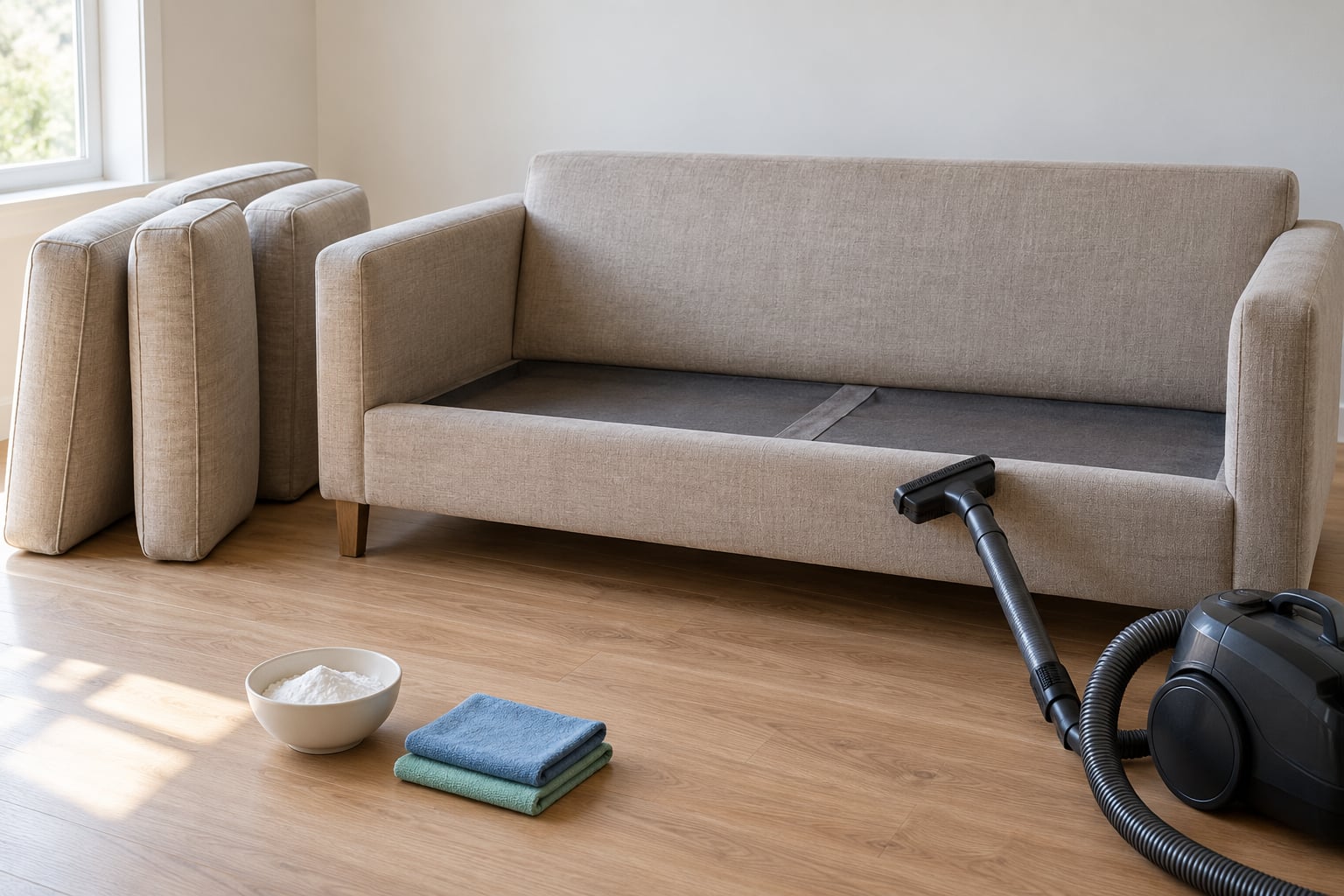
Vacuum first, always, because dirt left behind turns into mud the moment water arrives. Pull every cushion off, vacuum the deck and the gap between the back and the arms, and run the crevice tool along every seam. Pet hair comes up faster if you use a rubber brush or a fabric attachment at low suction.
Then blot what is there. For a fresh stain, press a clean white cloth down and lift straight up. Do not rub; rubbing drives the stain deeper into the pile.
Before you vacuum anything, take sixty seconds to check for pests. Pull the cushions out and look along the seams, the deck and the underside of every pillow for rusty or dark spotting, webbing in the corners, shed, or tiny live bugs. That is the point to walk away, not to start cleaning.
Match pretreatment to the stain and the code. Pet urine gets an enzymatic cleaner and a long dwell time, not a soak. Ink gets a blotting cloth dampened with rubbing alcohol on solvent-safe fabrics. Oil gets a dry absorbent powder like baking soda or cornstarch left on for fifteen minutes, then vacuumed. Anything unidentified, leave alone and test a cleaner on a hidden seam first.
Clean Fabric Upholstery
For W and S/W fabric, mix two cups of distilled water with two tablespoons of plain dish soap and two tablespoons of white vinegar in a spray bottle. Distilled water matters on darker colors because hard tap water leaves a dull ring. Shake, and test it on the hidden spot for ten minutes to check for colorfastness before going anywhere near the visible surface.
Spray the cloth, not the couch. Dampen a microfiber cloth with the mix and wipe the section in small circles, working one cushion at a time so you do not outrun your drying time. Follow with a second cloth dampened with plain water to lift the soap, then a dry cloth to pull the moisture up.
Agitation stays light. On a flat-woven fabric you can scrub a soft brush across the weave. On a corduroy or a deep texture, stay on the surface. When a section is soaked, blot it dry rather than squeezing, because squeezing pushes water into the foam core where it turns musty.
Washing the removable parts is the easiest win in the whole job. Slipcovers and zip-off cushion covers usually survive a cold gentle cycle with a small amount of detergent, and hanging them to dry damp takes most of the wrinkles out without shrinking anything. Line dry, never tumble dry on heat.
Wipe the bare frame where the covers sat. Foam cores cannot be washed, so they get vacuumed, deodorized and, if you have a portable spot cleaner, treated one section at a time. A stiff brush pushes cleaner into the foam without drowning it.
If you rent or buy an upholstery shampoo machine, the technique is the same on a bigger scale: apply solution, let it dwell a few minutes, then run the vacuum hose slowly back over the section to pull both cleaner and dirt out of the foam. Go over each pass twice so you do not leave a sticky residue behind.
Clean Microfiber, Velvet, Leather, and Faux Leather
These four need low moisture, a soft brush and a lot of restraint. On velvet, mist the fabric lightly with water, let it sit a few minutes, brush the nap with a soft-bristle brush in one direction, and vacuum the pile upright with the nozzle just off the surface. Never steam a velvet couch up close and never saturate it; the pile mats and the mark never comes out.
Microfiber responds well to a nearly dry cloth with a drop of detergent, and to dry foam if the tag allows solvent. Velvet and microfiber covers should never go into a washing machine, even when they unzip, because the pile mats permanently in the spin cycle. Lay them flat with airflow over them instead.
Leather and faux leather start damp, never wet. Wipe with a barely damp microfiber cloth, follow with a dry one, then treat the whole surface with saddle soap or a leather conditioner. Skip household sprays entirely; they leave a sticky film and leather eventually cracks. Sunlight and heat are the real leather enemy, so keep the couch off a south-facing window if you can.
Remove Odors and Kill Germs Without Soaking
Deodorizing is dry work. Sprinkle baking soda generously over the fabric, work it in with a soft brush, leave it four to eight hours or overnight, then vacuum it all off. A few drops of eucalyptus oil shaken into the baking soda helps with musty storage smell. For a couch that has sat in a damp closet, sun and air beat another round of spray every time.
Sunlight is genuinely useful here, with one caution: it fades dyes over repeated sessions, so move the couch if the afternoon sun hits the same panel every day. A single day of airing does more good than a week of spraying in a closed room.
For pet urine, baking soda alone will not do it. Urine smell lives in the foam core, so use an enzymatic cleaner designed for pet odor, saturate the affected area, and give it the dwell time printed on the label. Blot from the outside of the patch inward so you do not spread it. If the smell is still there after two full treatments, the cushion core is saturated and the honest answer is to replace the cushion.
Cleaning and disinfecting are different jobs. A soap mix lifts dirt; it does not reliably kill germs. For a couch someone else slept on, especially with allergies, kids or pets, clean first and dry fully, then apply a fabric-safe disinfectant according to its label and leave it wet for the contact time the label specifies. Use the product only where the cleaning code permits, and never mix bleach with vinegar or any other cleaner.
Know the limits of household work. A couch that has been somewhere with known cockroach or bed bug activity is a professional job or a trip to the dump. Nobody wants to be the person who brings an infestation home to a kid’s bedroom.
A professional upholstery cleaner charges a few hundred dollars for a standard three-seat sofa, more for stairs or heavy pet contamination, and it buys you extraction from the foam plus equipment you would otherwise have to rent. Fumigation for pests is a separate job and priced separately. Worth it when the piece is vintage, velvet, tagged X, or worth more cleaned than replaced.
Let the Couch Dry and Restore Its Shape
Drying is where most people fail, and it is why a clean couch smells bad two days later. Remove every cushion, stand them on edge, and get air moving across the whole frame. A box fan pointed at the couch and a dehumidifier in a closed room shorten the job considerably. Open windows on a dry day help more than people expect.
Check for dampness with the back of your hand, not just the surface. The deck and the inside of the back panel hold water long after the outside feels dry. Until the whole frame is dry to the touch and there is no cool or musty patch, keep the fan running.
When everything is dry, flip the cushions over and rotate them so the previously compressed sides face up. Plump them, redistribute the fill by hand, and put them back in their usual spots. A couch that got a full vacuum, a deodorizing pass and its covers washed usually needs a slipcover more than it needs new cushions.
Common Mistakes
Skipping the care label is the expensive one. Half the thrift haul has no tag at all, and guessing wrong can bleach a panel or set a stain permanently.
Soaking the couch is the second big one. Water that reaches the foam core takes days to leave, and it comes back as a sour smell that is harder to fix than the smell you started with.
Other mistakes that come up again and again:
- Hot water. It shrinks fabric, sets protein stains like blood and milk, and dulls colors. Cold water and gentle heat in the dryer or none at all is safer.
- Scrubbing hard. Agitation on velvet, microfiber and bouclé crushes the pile. Blot, then brush gently.
- All-purpose spray straight from the bottle. Most leave a sticky residue that attracts dirt and can bleach. Always dilute.
- Bleach on fabric upholstery. It destroys color and weakens fibers. For dingy white covers, an oxygen brightener on a cold wash works better.
- Water on exposed wood legs. It swells and warps the grain. Wipe those with a barely damp cloth and dry them right away.
- Assuming every odor will go. Smoke, cat urine in the foam and long-term dampness sometimes outlast any home method. Know when to stop.
- Cleaning with no airflow. A closed room plus trapped moisture is how musty comes back within days.
If you only fix one habit, start vacuuming more and testing more. Both prevent more damage than any product you can buy.
Frequently Asked Questions
Can I use a washing machine to clean a thrift store couch?
Only the removable parts. Slipcovers and zip-off cushion covers can usually go in on a cold gentle cycle, and an oxygen brightener works well on dingy white covers. Never put the couch frame or a foam cushion core in a machine. Foam can hold water for weeks and the whole thing will smell worse than before.
What cleaning code is safe for my couch upholstery?
W means water-based cleaners are fine. S means solvent or water-free products only, no water. S/W allows either. X means vacuum or brush only, with no cleaning product at all. If the tag is missing, assume the most delicate option, test in a hidden seam and keep moisture low.
How do I remove a musty smell from a secondhand couch?
Dry deodorizing works best. Sprinkle baking soda over the whole surface, work it in with a soft brush, leave it overnight and vacuum it off, then air the couch in sunlight for a day. For pet urine, use an enzymatic cleaner and give it the full label dwell time. If the smell returns after drying, it is in the foam.
Is baking soda safe for all types of couch fabric?
Yes, on almost everything. Baking soda is dry, so it will not bleed dye, shrink fabric or flatten a velvet pile. It works best on fabric and upholstery. Skip it on unfinished wood, where alkaline powder can dull the finish, and on leather, where you want a conditioner instead of a deodorizer.
Can I use vinegar or bleach to disinfect a couch?
Diluted white vinegar is a safe fabric-safe option on W and S/W upholstery, used after cleaning, never before. Bleach is not a good idea on colored fabric because it bleaches and weakens fibers. For real disinfection, clean first, dry, then apply a fabric-safe product and keep the surface wet for the label contact time. Never mix bleach with vinegar.
How long does it take for a cleaned couch to dry?
Plan on a full day and often overnight, especially if you used a wet method on the cushions. Cushions should be stood on edge, and a box fan plus a dehumidifier will cut the time considerably. Only put covers back on when the frame feels dry to the touch everywhere, not just on top.
Conclusion
Start with the fabric, not the sponge. Identify the upholstery from the care tag, test whatever cleaner you plan to use in a hidden seam, and vacuum every surface and crevice before anything wet goes on. From there, work in layers: dry deodorizing first, then wet cleaning only where the code allows, then a slow dry with airflow.
Go gradually. Small, tested sections are reversible; a soaked couch is not. And if the piece is valuable, velvet or heavily contaminated, or came from somewhere with a known pest problem, pay a professional. It is cheaper than replacing what you just rescued.