To learn how to spot good quality furniture at a thrift store, watch five things: whether it sits square, stays still when you push it, feels heavy for its size, is built from solid wood or hardwood veneer rather than particleboard, and has joints that were cut to carry weight. Look at the underside first, open every drawer, smell the fabric, and measure before you pay. Five minutes of that tells a solid vintage dresser from a glue-and-particleboard cabinet.
That routine matters because a thrift store prices a mid-century walnut dresser and a glue-and-particleboard cabinet almost the same way. The tag tells you nothing about which one is about to shed a drawer or split a leg.
Table of Contents
- What You Need Before You Start
- Green Flags and Red Flags at a Glance
- Step-by-Step: How to Spot Good Quality Furniture
- 1. Measure It and Check the Fit
- 2. Test the Stability and Movement
- 3. Inspect the Wood or Main Material
- 4. Examine Joints, Drawers, and Hardware
- 5. Check the Finish and Surface Condition
- 6. Estimate the Repair and Restoration Cost
- 7. Make a Final Buy-or-Skip Decision
- Common Mistakes That Cost Buyers Money
- Frequently Asked Questions
- How can I tell if furniture is good quality?
- How do I tell solid wood from veneer or particleboard?
- How do I check upholstered furniture for bed bugs before buying?
- Is a wobbly thrift store chair worth buying?
- What furniture should I never buy at a thrift store?
- Conclusion
What You Need Before You Start
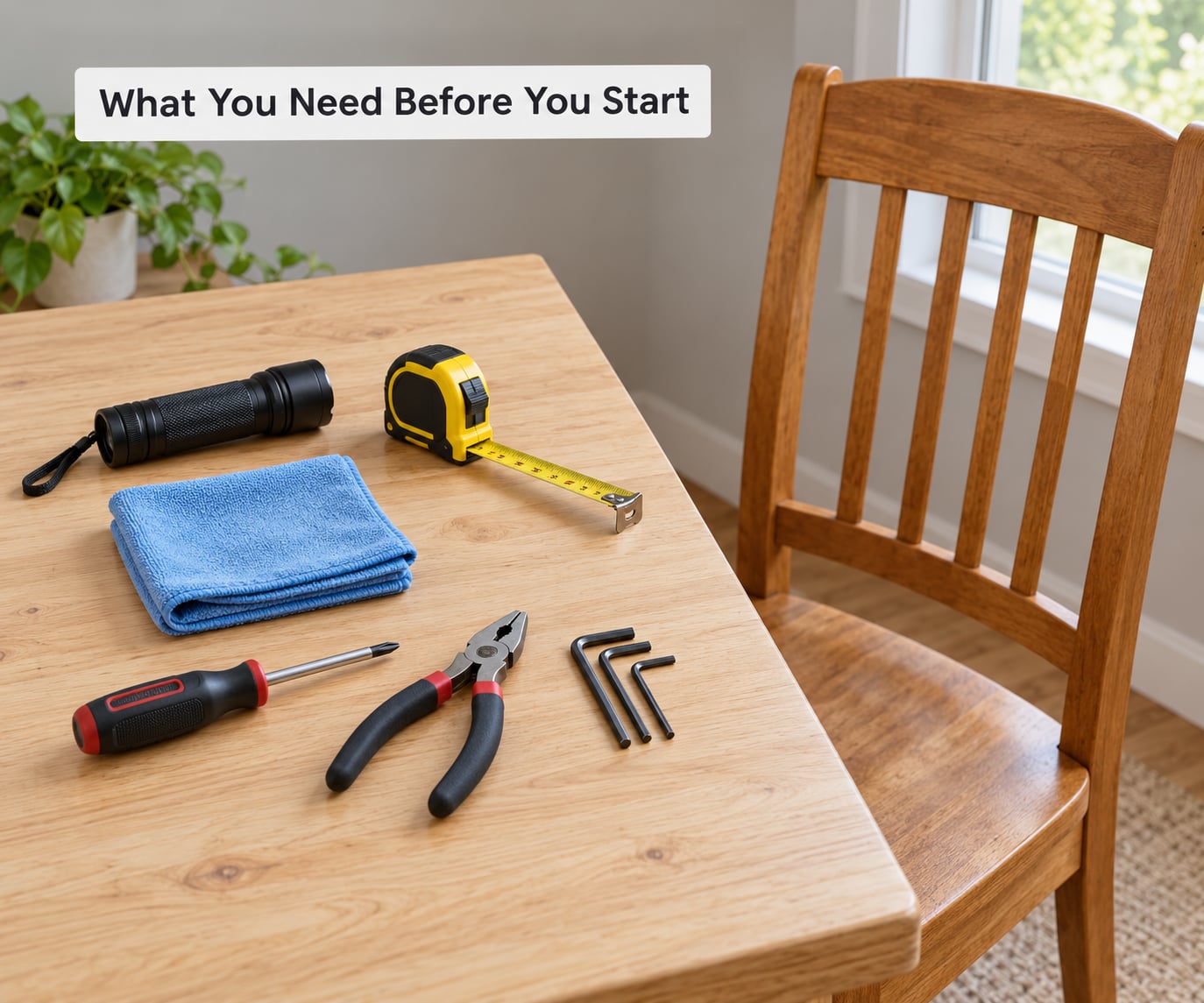
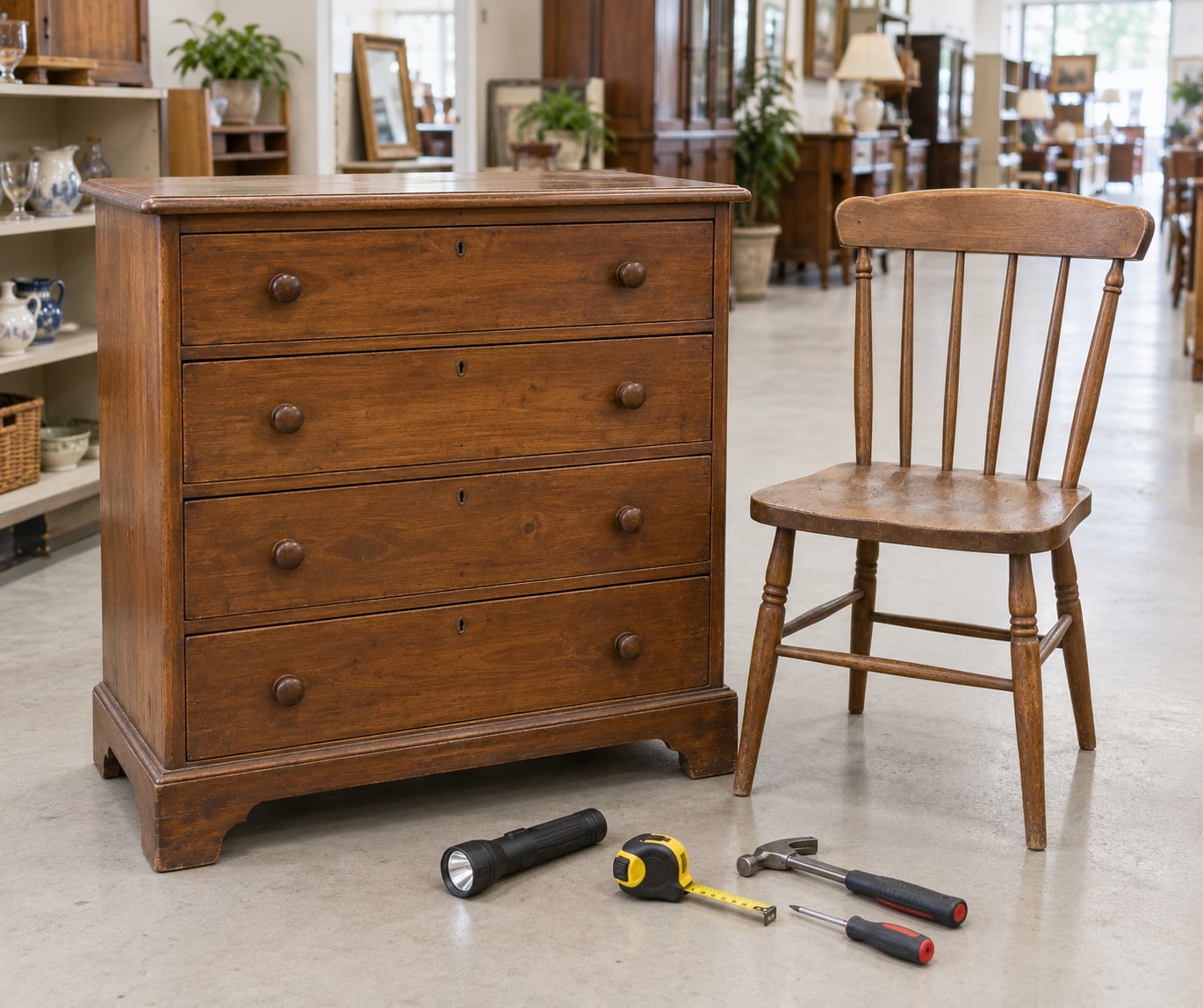
A phone flashlight is the single most useful tool you own, and it gets skipped more than any other. A tape measure matters more than people expect, because the piece that will not fit through the door is not a bargain no matter what you paid for it.
Bring these five things and you can judge any piece on the floor:
- A phone with a flashlight for the underside, the back panel and the inside of drawers.
- A tape measure, plus the room dimensions and your doorway width written down before you go.
- Your phone notes app for measurements, brand names and price-check screenshots.
- A cleaning cloth and a small lint roller to wipe a surface before you touch the joints.
- A coin or key to tap glass, crystal and finished surfaces and listen.
Optional but useful: a small flat-head screwdriver for loosening a back panel, and a phone camera to photograph the maker’s mark before it gets scratched out of your memory.
Green Flags and Red Flags at a Glance
| Check | Good sign | Walk-away sign |
|---|---|---|
| Stability | Sits square on the floor, no rock or wobble | Rocking, racking, legs that move at the floor |
| Weight | Noticeably heavy for its size | Light enough to carry with one hand under one end |
| Material | Solid wood or hardwood veneer over a sound carcass | Particleboard or MDF with swollen, furry edges |
| Joinery | Dovetails or mortise-and-tenon, tight glue lines | Visible staples, brad nails, glue squeeze-out |
| Drawers | Run smoothly, sides stay square, bottoms solid | Sagging bottoms, grooves worn through, one stuck drawer |
| Finish | Even wear, minor scuffs, intact veneer | Peeling veneer, alligator cracking, water rings that spread |
| Upholstery | Clean smell, springs firm, no stains | Urine odor, dark specks, rust-colored streaks, live bugs |
| Marks | Maker’s stamp in a drawer, on the back or under the seat | Nothing identifiable anywhere |
Step-by-Step: How to Spot Good Quality Furniture
1. Measure It and Check the Fit
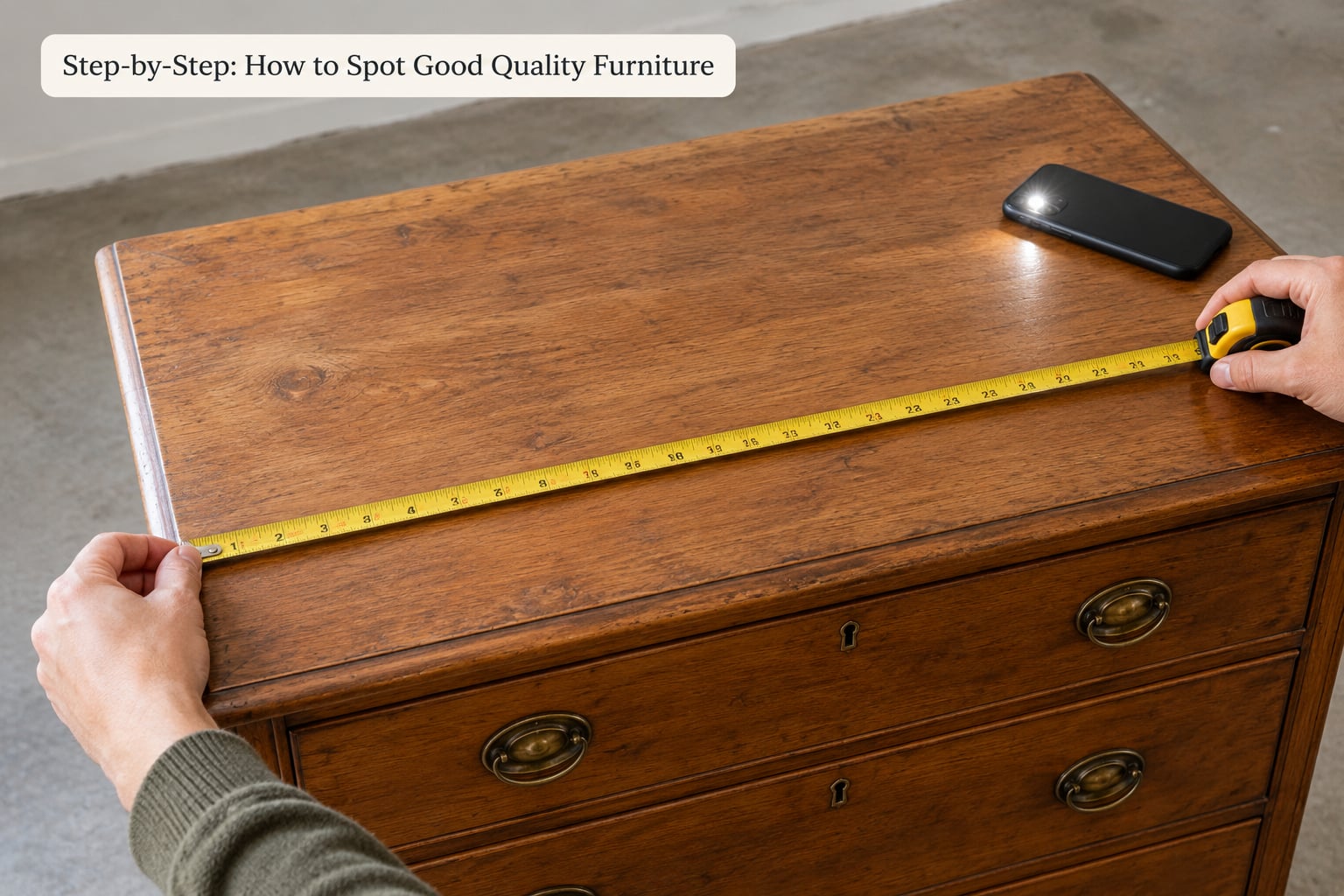
Measure first, because a wrong measurement kills the whole trip later rather than right now.
Check three numbers: the piece’s height, width and depth, plus the diagonal of anything that has to turn a corner. Then confirm your narrowest doorway and the tightest spot on your stairwell or elevator. A 34-inch tall dresser that is 20 inches wide still has to clear the turn at the top of the stairs, and that is where a good find ends up in a hallway.
Many stores keep a tape measure behind the register and will let you measure before you commit. If staff will not bring one out, use your own and expect it to be busy at the register on a Saturday.
2. Test the Stability and Movement
Stand the piece on a flat floor, level with all four feet touching, then push the top corner gently with your palm. If it racks side to side, the joints or the floor contact points are gone. Rocking under weight is different from rocking when you push, and rocking when you push is the more serious one.
Then load it the way it will be used. Sit in a chair and lean back, press down on the arms of a sofa, open a dresser drawer and push your full weight into it, swing a door open as hard as it will go. Good structure resists all of it without creaking, shifting or letting go.
Lift one end and set it down. Genuinely solid hardwood feels like a chore to lift; particleboard feels like carrying a hollow box. Weight is not proof, but a very light piece holding a very heavy load usually means an engineered core.
3. Inspect the Wood or Main Material
Flip the piece over. Most people inspect the top and never look at the bottom, which is where the answer is written.
Solid wood is lighter in color underneath and unfinished, since nobody bothers to sand and stain the underside of a dresser. Grain runs continuously across the face of the wood, and on a hardwood such as oak or walnut you will see open pores you can feel with a fingertip. End grain looks darker and more porous than face grain.
Veneer is a thin layer of real wood glued to a cheaper core, and it is not a bad thing when it is well made. You will see a thin seam at the edge of a top or a drawer front where the veneer meets the substrate. If that edge is chipped, cracked or lifting, the piece is done. Peeling veneer cannot be glued back reliably.
Particleboard and MDF are the warning signs. Look for swollen, furry or crumbling edges, especially at corners and around screw holes, and for a hollow knock when you rap the panel. Pine and other softwood are perfectly legitimate, especially in older and country-style pieces, and pine is stronger than its reputation suggests; the giveaway is that cheap pine is unstained underneath, while good pine is finished on all sides.
For metal, check for rust bloom at the joints and under the feet, and for rust pitting on the surface. On glass tops, run your fingernail along any scratch: a surface scratch catches the nail, a crack through the glass runs all the way to the edge.
4. Examine Joints, Drawers, and Hardware
This is where cheap construction announces itself, and where good construction shows off.
A dovetail joint is a series of interlocking trapezoids cut at the corner of a drawer. On a hand-cut piece the pins vary slightly in width and spacing, which is a good sign of age and hand work. On a machine-made piece the tails are identical. Machine dovetails are still solid joinery; mismatched, loose or gapped ones are not.
Mortise-and-tenon joints show as a thick shoulder where a leg or rail plugs into a mortise, usually pegged with a visible dowel. Staples, brad nails and a thick line of dried glue squeezing out of a joint mean a piece built for price rather than for load.
Work every drawer through its full travel. The sides should stay square and the back should not bulge. The bottom should not sag under a light press from your thumb, and grooves worn through the sides mean the slide is done and needs wood runners. On a nightstand, make sure the drawer clears the leg.
Hardware is a surprisingly honest signal. Solid brass or cast iron original hardware that still moves freely suggests a piece built to last. Lightweight plated hardware, mismatched screws and stripped screw holes do not. Check that every screw is the same type; a mix of Phillips and flathead usually means someone replaced a part, which is fine, but a stripped hole means the fastener will not hold again.
5. Check the Finish and Surface Condition
Separate cosmetic damage from structural damage, because only one of them decides the price you should pay.
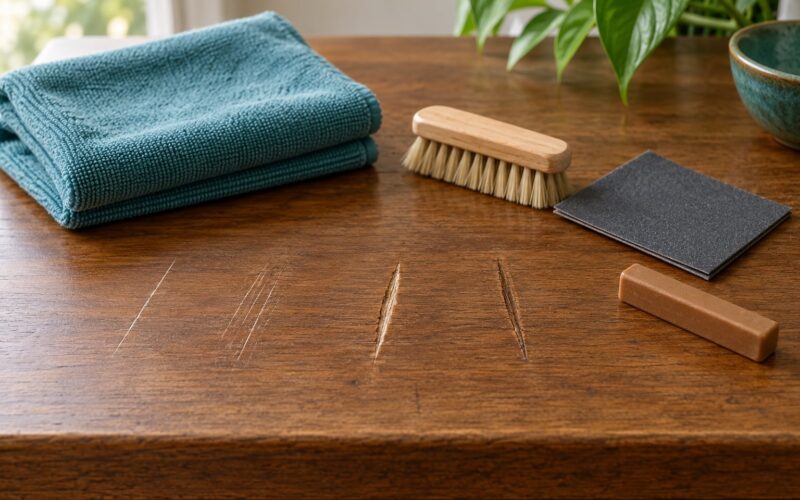
Cosmetic: scratches, scuffs, dents, worn edges, a dull finish, a dated color, missing hardware. Almost all of it is fixable, and worn edges on an old walnut desk are a sign of use, not a defect.
Structural: water staining that has spread or darkened, alligator cracking in old paint, veneer lifting, soft spots in panels, mold, and anything soft when you press it. Press suspicious spots firmly with your knuckle. Solid wood resists; a hollow or swollen core does not.
For paint, run a fingernail or a coin edge across it. If it flakes off in sheets, the bond has failed and the whole surface needs stripping before anything else can be done to it. Check corners and edges, where paint fails first.
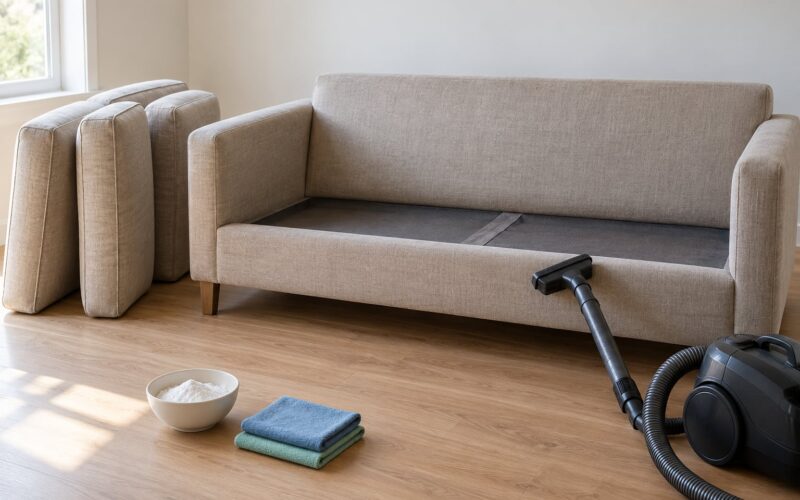
For upholstery, smell it before you look at it. Any sharp ammonia or urine smell means the foam underneath is saturated and cannot be cleaned out of the piece; the smell will follow you into the room. Check the seat cushions, the underside of the cushions, the seams and any dark speckling on the fabric near the piping. Lift the cushions and look for rust-colored streaks from old springs, live or dead insects, and webbing that has snapped or stretched. The frame matters too: a kiln-dried hardwood frame under loose springs is restorable, and a plywood frame with crushed foam is not.
6. Estimate the Repair and Restoration Cost
Decide what you are willing to do yourself before you price the piece, because the repair cost is the real price.
Add up the obvious jobs before you commit: new drawer glides, a stripped screw hole filled and re-drilled, a leg re-glued and a shim added, a full refinish, or reupholstery with fabric and foam. A solid wood dresser that needs a day of sanding and a can of finish is usually a good buy. A piece with an engineered core needs the same sanding and has a higher chance of splitting when you start.
Then apply the break-even rule honestly. Estimate what the finished piece would sell for, subtract the repair cost, and compare that to what similar pieces sell for in local listings or sold-completion listings for the same brand. If the repair eats more than a third of the finished value, pass. If you cannot do the work and would have to pay someone else, add their labor at full rate before doing the math, because labor is usually the biggest line item.
7. Make a Final Buy-or-Skip Decision
Run the checks in a few seconds and decide.
Stable, real material, sound joints, intact hardware, damage that is cosmetic, and a size you have already confirmed is a yes. A piece that fails on two or more of structure, material and joinery is a no, no matter how cheap the tag.
One ambiguity is fine. Many good pieces are cosmetically tired and structurally perfect, which is exactly what you want when you plan to paint them. Two ambiguities usually means you are rationalizing, and that is how a heavy piece ends up at the curb a week later.
Common Mistakes That Cost Buyers Money
Judging by appearance alone. A freshly painted dresser with new hardware on Saturday can be glued particleboard with a sagging shelf. Judge structure first and finish last, or you will fall in love with a paint job.
Skipping the underside. The back panel and the bottom of the piece hold the joinery, the maker’s mark and most of the water damage. Flip it over before you make any kind of decision.
Ignoring smells. Urine odor does not come out of foam. If you smell it in the store, it will still be there in a month, and it often comes out of an upholstered piece into the whole room.
Buying without measuring. This is the most common and least forgivable mistake. Write your room dimensions down before you go and measure every candidate.
Paying for style you are borrowing. A piece that looks mid-century but is a 1990s laminate reproduction will not gain value, and the veneer on the top will chip at the first coffee ring. Look for solid wood on the underside and the mark, not the silhouette.
Overvaluing a brand name with no condition behind it. A Drexel Heritage stamp matters, but a Drexel Heritage frame with chewed joints and a stripped drawer is still a project with a much higher repair cost than the name suggests.
Two habits fix most of these. Go early in the week, because the good solid wood pieces are picked over fastest and the furniture floor restocks through the week. And keep a running note of every piece you pass on, so you learn what your own eye is missing.
Frequently Asked Questions
How can I tell if furniture is good quality?
Check four layers in order: it sits square with no wobble, the material is solid wood or hardwood veneer rather than particleboard or MDF, the joints are dovetail or mortise-and-tenon instead of staples and glue, and the original hardware still moves freely. Weight is a useful secondary signal, since a solid wood piece feels noticeably heavy for its size.
How do I tell solid wood from veneer or particleboard?
Flip the piece over. Solid wood is unfinished on the bottom and shows grain running continuously across the face, with open pores you can feel. Veneer is a thin wood layer over a cheaper core, visible as a fine seam at the edge of a top; chipping or lifting there is a deal breaker. Particleboard and MDF crumble or swell at edges and knock hollow when tapped.
How do I check upholstered furniture for bed bugs before buying?
Look for live or dead insects in the seams and piping, dark rust-colored spotting on the fabric or mattress pad, and shed skins in the frame. Lift every cushion and check inside and underneath. Smell it too: bed bugs leave a sweet musty odor, and any strong urine smell means saturated foam that cannot be cleaned out of the piece.
Is a wobbly thrift store chair worth buying?
Often yes, but only if the wobble comes from a loose joint or an uneven leg rather than cracked wood or a broken frame. Tighten every fastener, check the leg-to-seat joint for glue failure, and shim the short leg. If the wood is cracked, splinters, or a rear leg has separated at the mortise, the repair will not hold and you should pass.
What furniture should I never buy at a thrift store?
Skip mattresses and box springs, since they are hard to sanitize and hold odors and pests. Pass on anything with structural damage: racking frames, sagging shelves, rotted panels, mold, or peeling veneer that has lifted at the edge. Avoid upholstered pieces with urine odor or pest evidence, and any item you cannot get through your own doorway.
Conclusion
Start at the bottom of the piece and work up: stand it square, push and load it, read the underside for material and joinery, work every drawer and door, then check the finish, the upholstery and the maker’s mark. That is how to spot good quality furniture at a thrift store faster than the person restocking the aisle beside you.
Structure, joinery and repairability decide the buy; everything cosmetic is your problem to solve, and often it is the fun part. Then buy only when the condition and the work involved match the room you are putting it in. Most thrifted furniture that disappoints people was not a bad find at all, it was a piece they loved before they checked.