To move heavy furniture alone, take the weight off your body instead of trying to carry it. Furniture sliders, a flat dolly, a moving blanket, and a planned route turn a two-person job into a controlled one-person glide. Budget about 20 minutes of prep for every piece, and expect stairs to be the hard part, not the hallway.
I have moved a sectional, two dressers and a wardrobe up a walk-up on my own. What I learned is that strength is almost never the limiting factor. Friction and shape are. A 90-pound dresser will sail across a protected floor on sliders once you get them under all four feet, and it will be nearly impossible to move a few inches if one corner catches.
There is a real limit to solo moving, and this guide will tell you where it is. Pianos, safes, slate pool tables and oversized appliances belong with professionals no matter what equipment you own.
Table of Contents
- What You Need
- The essentials
- When you should stop and get help
- Step-by-Step: How to Move Heavy Furniture Alone
- Step 1: Check the weight and plan the route
- Step 2: Remove loose parts and protect the furniture
- Step 3: Protect the floor, walls, and doorways
- Step 4: Use the safest solo lifting method
- Step 5: Slide, pivot, and move through tight spaces
- Step 6: Handle stairs only when the risk is manageable
- Step 7: Set the furniture down and inspect the result
- Common Mistakes
- Frequently Asked Questions
- How heavy is too heavy to move furniture alone?
- What is the safest way to move a heavy sofa alone?
- Can I move a dresser alone with furniture sliders?
- Is it safe to move heavy furniture down stairs alone?
- Do furniture sliders really work?
- How do I move a heavy desk by myself?
- Conclusion
What You Need
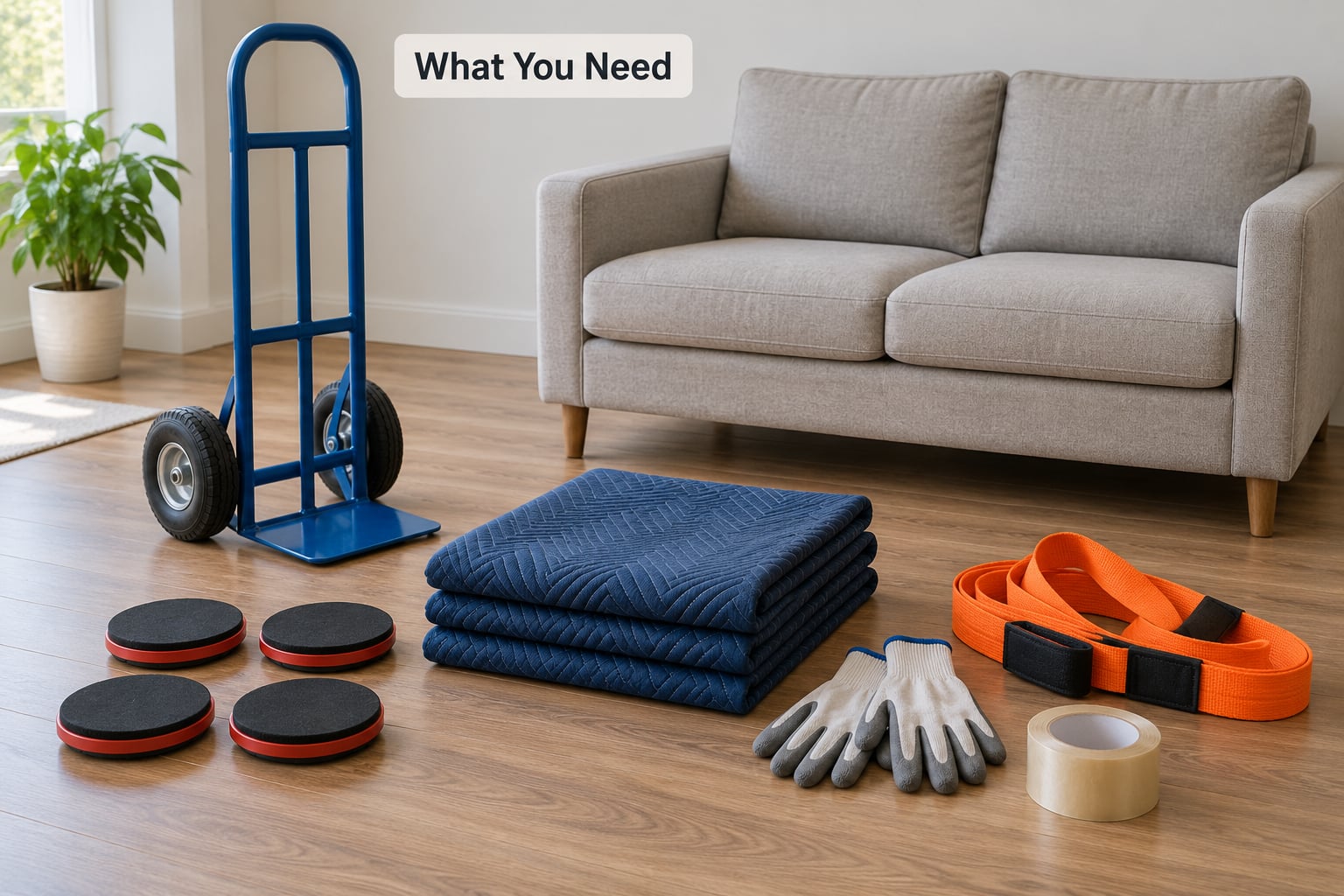
You do not need a full moving kit. You need friction control, something to lift with, and something to protect the floor with. Most of it you already own or can borrow; a few items are worth buying outright because you will use them again the next time a chair needs to cross a room.
The essentials
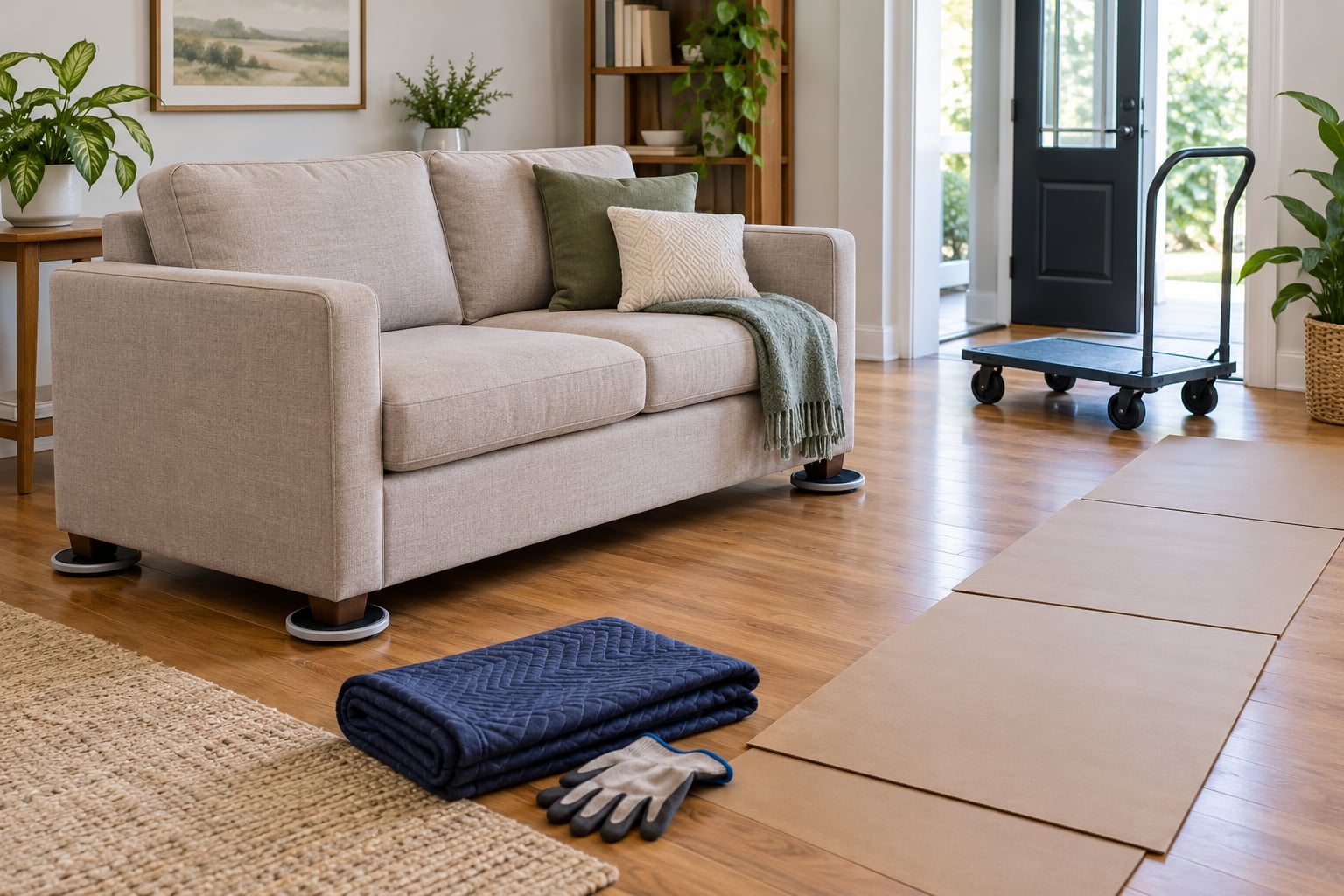
- Furniture sliders — hard plastic or felt-faced pads that go under each leg or corner. These do the most work in any solo move.
- A flat four-wheel furniture dolly — converts a heavy piece into something you push rather than lift.
- Lifting straps or a shoulder dolly — a canvas loop that lets your legs and hips take the load instead of your lower back.
- Moving blankets — for wrapping corners, padding door frames, and sliding across bare floors as a last resort.
- Painter’s tape — for marking a piece’s original position, taping loose seams, and protecting a wall corner you are going to brush.
- Cardboard runners — flattened boxes that glide surprisingly well on hardwood and grip far better on carpet.
- Work gloves with grip palms — cotton for grabbing edges, nitrile-coated for sliding and dolly work.
- Closed-toe shoes and knee pads — a dresser foot landing on a sandal is how people break toes.
- Basic tools — a screwdriver or hex key set, a hammer, and a tape measure.
- A small bag of hardware — a plastic bag taped inside a drawer or cabinet keeps screws with the piece instead of in the carpet.
Buy the sliders and gloves. Rent the dolly and stair climber, because most people move furniture a handful of times in a lifetime and a rented flat dolly costs a fraction of owning one. Borrowing is better still.
When you should stop and get help
Get a second person or a professional mover when any of these are true: the piece blocks your view of your own feet, the route includes stairs, the item weighs more than you can lift with one hand’s worth of control, the piece is a piano, safe, slate-topped table or large appliance, or the furniture is antique or glued together in a way that disassembly would break it.
Two people and a set of straps is a genuinely cheap insurance policy, and most people would rather spend an hour with a neighbor than three weeks nursing a back strain. If nobody is available, that is a reason to rent equipment, not a reason to try harder.
Step-by-Step: How to Move Heavy Furniture Alone
Step 1: Check the weight and plan the route
Before you touch the piece, work out roughly what you are dealing with. Lift one end a few inches with a straight back and see how it feels; if your arms shake or you cannot hold it for five seconds, that end is over your solo limit.
Roughly 50 pounds is the commonly cited guideline for one person, and it is a guideline rather than a rule. Your strength, the item’s shape, the distance, and the surface all change what 50 pounds means in practice.
Next, walk the route and look for the things that end moves. Standard interior doorways run about 28 to 30 inches wide, which is narrower than most people assume. Note thresholds, tight turns, floor outlets, light switches, wall corners, and any uneven spot in the flooring.
You will know the route is workable when you can say which side of the piece goes through the door first without re-planning mid-carry.
Step 2: Remove loose parts and protect the furniture
Take everything out that can fall out. Remove drawers, shelves, doors, cushions, detachable legs, and any glass or mirror panels. A loaded dresser is several times heavier than an empty one, and drawers that shift mid-move will either jam or dump their contents.
Tape a bag of screws to the inside of the piece rather than setting hardware on the floor. If the top lifts off, that is usually the single biggest weight reduction available and it takes two minutes.
Wrap the corners and any finished or lacquered surface with a moving blanket, then tape the blanket to the piece. You are finished when you can tip the piece onto its side without anything sliding, rattling, or straining at a joint.
Step 3: Protect the floor, walls, and doorways
Put down protection along the whole route before the piece moves, not halfway through. On hardwood, use sliders or a blanket, and never drag bare furniture legs across the finish. On carpet, plastic sliders can chew the fibers and felt pads lose grip, so switch to cardboard runners or a folded blanket. On tile, hard plastic sliders glide well once the surface is clean and dry.
Tuck moving blankets or cardboard at the base of any wall corner within the piece’s swing. Measure the narrowest doorway on the route and check the piece’s widest point, including arms, cushions, and feet, not just the cabinet box.
If the piece misses by an inch or two, removing the door hinges usually buys 3 to 4 inches of clearance. Do that before you start lifting anything.
Step 4: Use the safest solo lifting method
The tilt-and-slide is the technique that makes solo moving possible. Tip the piece onto one long edge, feed a slider under each corner, and lower it onto the pads. Your arms are only guiding at that point; the levers are doing the work. Once it is down, glide it.
For a flat surface, a four-wheel dolly is even better. Tip the piece back onto its rear legs, roll the dolly under, lower it onto the platform, and push from behind with your body behind the load.
Whatever the tool, your form matters. Put your feet shoulder-width apart, bend at the knees rather than the waist, keep the load close to your body, push instead of pull, and turn by moving your whole body rather than twisting at the waist. Stop the moment you feel strain, numbness, or a loss of balance. It is a small cost compared to weeks of pain.
Step 5: Slide, pivot, and move through tight spaces
Most tight spots are solved by orientation, not force. A sofa on its side is often shorter than it is tall, and a wardrobe turned 90 degrees will clear a doorway that defeated it head-on. Work out the math on the floor with a tape measure before you commit.
To pivot, stop, set both feet, push with your legs, and let the piece sweep around the corner slowly. Keep one hand guiding and never reach underneath or behind a moving piece to grab a corner that is drifting.
At a doorway, go at the slowest speed the whole way through. Halfway moments, where the piece is straddling the frame, are where most wall and finger injuries happen. If you need to tilt a tall piece through a door, blanket the frame edges first.
Step 6: Handle stairs only when the risk is manageable
Stairs are where a solo move most often goes wrong, and the reason is asymmetry. When one person carries both ends, the end nearest their body takes a disproportionate share of the weight, and if the grip fails there is no second pair of hands on the other end.
A stair-climbing dolly helps, but it only works if the piece sits at the correct angle, the stair pitch allows it, and you can control the load on the steps. Many people rent one and discover the stair geometry is the problem, not the tool.
For a wide, straight, carpeted run and a light item you can keep a hand on at the top, you can manage it. For anything heavy, anything on a spiral or tight turn, or anything where you cannot see the treads, use a second person or a professional. Watch for wet or icy steps too; a load sliding on a damp tread is unrecoverable.
Step 7: Set the furniture down and inspect the result
Lower the piece, do not drop it. Slide the dolly out from under, or tip the piece gently off its sliders and set it down from a controlled height with your legs doing the work.
Once it is in position, check four things: that the legs all touch the floor and the piece sits level, that no drawers or doors hang or bind, that the floor shows no fresh scuffs or dents, and that the door frames and walls are unmarked. Reinstall drawers and doors only after the piece is stable where it stands.
Then take the protectors off slowly, and vacuum up any grit that travelled with the sliders. You will know the move worked when the piece is level, the route is clear, and there is no new mark anywhere.
Common Mistakes
Almost every injury I have seen in solo furniture moves traces back to one of a handful of avoidable errors. The fixes are simple; the point is catching them before the piece is in your hands.
- Lifting with the back. The load drifts away from your body and your lower back takes the load. Keep it close, hinge at the hips, and let sliders or a dolly carry the weight instead.
- Moving before emptying. A dresser with drawers still in it is far heavier than it looks, and a shifting drawer ruins your balance. Empty it, always, even if you plan to move it across the room.
- Using a flat dolly on stairs. A flat four-wheel dolly on a stair run is a tipping hazard. Either use a stair-climbing model or bring in a person who can manage the load with you.
- Not testing the weight first. Lift one end for five seconds before committing. If you cannot hold it, the piece is a two-person job or a smaller-piece job.
- Pulling instead of pushing. Pulling compresses your spine and removes your view of the path. Push whenever the layout allows, and keep your sightline to the floor ahead.
- Forgetting your own sightline. A bulky piece that hides your feet is one of the most self-reported causes of solo moving injuries. Wrap the piece, but if you still cannot see the floor in front of you, use a dolly instead of carrying it.
- Leaving the route half-cleared. Rugs, cords, baseboards and pets turn a smooth glide into a tip. Clear and re-check the whole path, not just the doorway.
- Overloading one dolly. Stacking a second piece on a loaded dolly is how solo movers lose control. One item per dolly, always.
- Ignoring weak joints. Secondhand dressers and cabinets often have loose joints that fail mid-carry. Wiggle the piece before you commit, and if something gives, disassemble it instead.
- Rushing. Every injury on this list shares one cause. The piece will wait five minutes while you tape something down.
Two final safety notes. This is general information, not medical or professional moving advice, and if you feel a sharp back twinge mid-move, stop, set the piece down, and let it stay down; seek medical care for pain that travels down a leg, numbness, or weakness. And if a piece is genuinely too heavy for one person, that is a fact about the furniture, not a failure on your part.
Frequently Asked Questions
How heavy is too heavy to move furniture alone?
There is no universal safe weight limit because strength, balance, stair design, and the item’s shape all matter. Roughly 50 pounds is the common guideline for one person, but treat any item that blocks your view of your feet, pulls off the floor, or cannot be held for five seconds as too heavy. Shape decides more than weight: a wide sofa can be harder than a compact cabinet twice its weight.
What is the safest way to move a heavy sofa alone?
Remove the cushions and any loose parts, measure the route, then tip the sofa onto one long edge and slide a slider under each corner. Push rather than pull whenever the layout allows, keep your body behind the load, and never twist at the waist to turn it. If you cannot see the floor in front of you, put it on a flat dolly instead of carrying it.
Can I move a dresser alone with furniture sliders?
Furniture sliders make a medium-weight dresser far easier across a hard floor, but they do not make an unstable or very heavy piece safe. Empty and remove the drawers, secure the doors, check the joints for wobble, protect the floor, and use sliders under all four corners so nothing catches. If one end lifts off the floor when you tilt it, recruit a second person.
Is it safe to move heavy furniture down stairs alone?
Usually not. Stairs cut your balance and control, and the end nearest your body takes more of the weight, with no second pair of hands if the grip fails. A stair-climbing dolly helps only when the stair geometry suits it and you can keep control. For anything heavy, on a spiral turn, or with wet or icy treads, use a second person or a professional mover.
Do furniture sliders really work?
They work very well on hardwood and tile, where they cut friction and let you guide rather than carry the weight. On carpet, plastic sliders can tear fibers and felt pads lose grip, so switch to cardboard runners or a folded moving blanket. Always put a slider under every corner that touches the floor, or the piece will tip as you cross the threshold.
How do I move a heavy desk by myself?
Desks are often easier than they look. Remove the drawers, take off the top if it lifts out, and empty any cable tray. With the weight gone, tip the desk onto a long edge, feed sliders under the legs, and push it in short bursts. Take the back panel off first if it is heavy, and reattach it once the desk is in place and level.
Conclusion
Start with the honest part: lift one end of the piece and hold it for five seconds. If that end comes up easily, you can move it yourself once friction is out of the picture. If it does not, the answer is a second person or a mover, and that is a reasonable place to stop.
When you do take it on, the order is always the same. Clear and measure the route, protect the floor and the door frames, empty and disassemble the piece, get a slider or a dolly under every corner, push instead of pull, and set it down slowly. Add help whenever the piece, the stairs, or the distance exceeds what you can control alone.