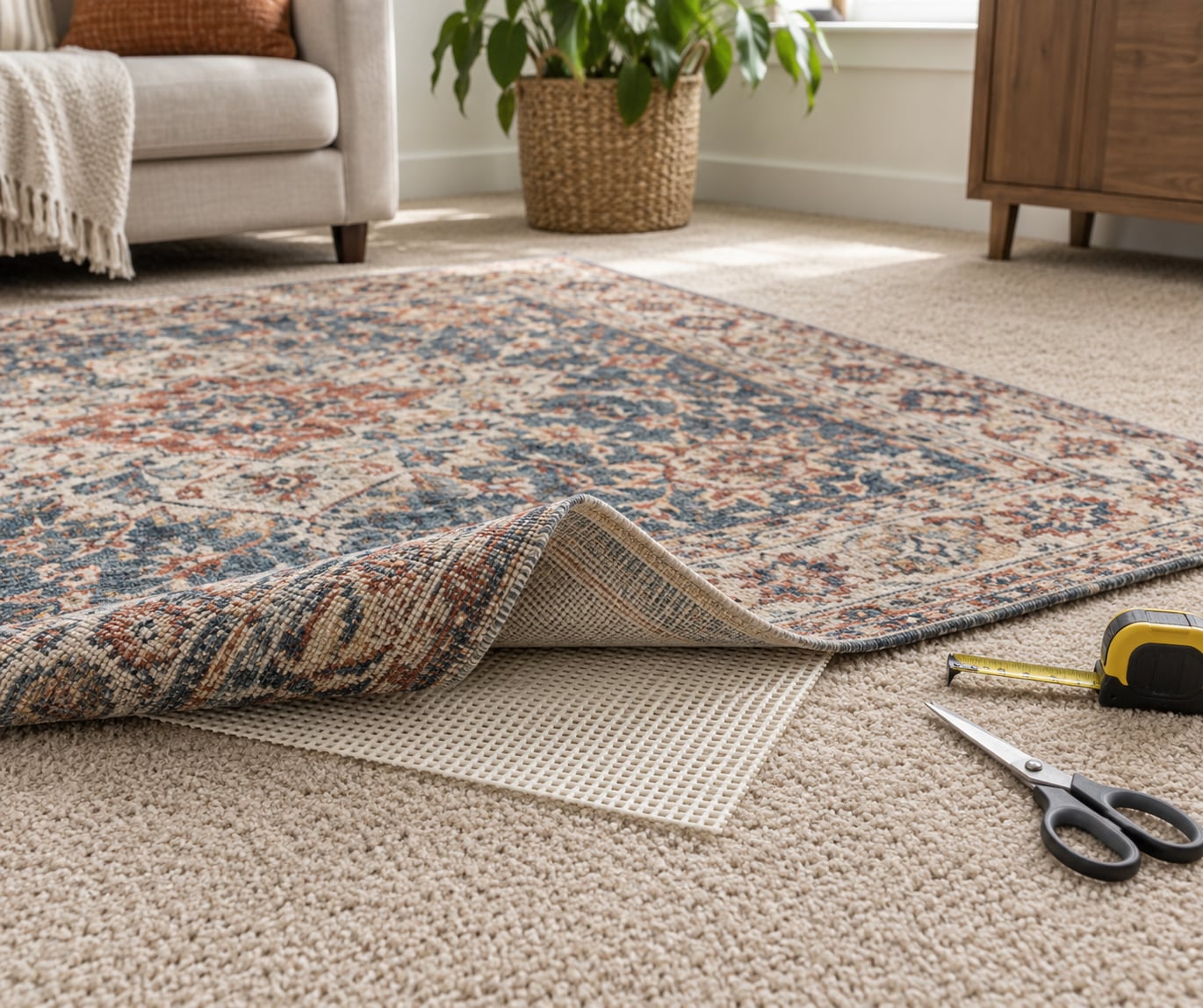
Rugs slide on carpet because a woven rug backing and a carpet pile have almost no friction between them, so the fix is a carpet-to-carpet rug pad: a thin underlay with a textured felt bottom that grips the carpet fibres and a rubberized top that grips the rug. Start there, then work down to tape or anchors only if the pad alone is not enough.
The method you pick depends on three things. How to keep a rug from sliding on carpet in a rental is a different problem than doing it in a house you own, because adhesive is off the table when a deposit is at stake. A heavy wool rug with a natural rubber backing already grips and needs less help than a flat-backed polypropylene rug in a hallway.
Pick your situation and jump to the matching step:
- Renting, or you cannot risk residue: use a non-adhesive pad or suction-style corner anchors.
- Heavy traffic from kids, pets, or a vacuum route: a denser high-grip pad, full rug coverage.
- A small rug or a runner in a hallway: sized felt pad plus corner anchors if the edges still creep.
- Corners lifting but the rest is fine: skip the pad and reset the curl first, then add a thin pad.
Table of Contents
- What You Need
- Step-by-Step: How to Keep a Rug from Sliding on Carpet
- 1. How to Keep a Rug from Sliding on Carpet With the Right Rug Pad
- 2. Use a High-Grip Rug Pad for Rubber-Backed or Heavy Rugs
- 3. Use Rug or Carpet Tape for a Temporary Hold
- 4. Try a DIY Grip Treatment Only When the Rug and Carpet Allows It
- 5. Keep the Rug and Carpet Clean, Flat, and Properly Positioned
- How the Five Fixes Compare
- Common Mistakes
- Frequently Asked Questions
- What is the best way to keep a rug from sliding on carpet?
- Will a rug pad damage carpet?
- How do I remove rug tape from carpet?
- Does a rubber-backed rug need a special pad?
- Why does my rug slide even though it has a rug pad?
- Can I use double-sided tape under a rug?
- Conclusion
What You Need
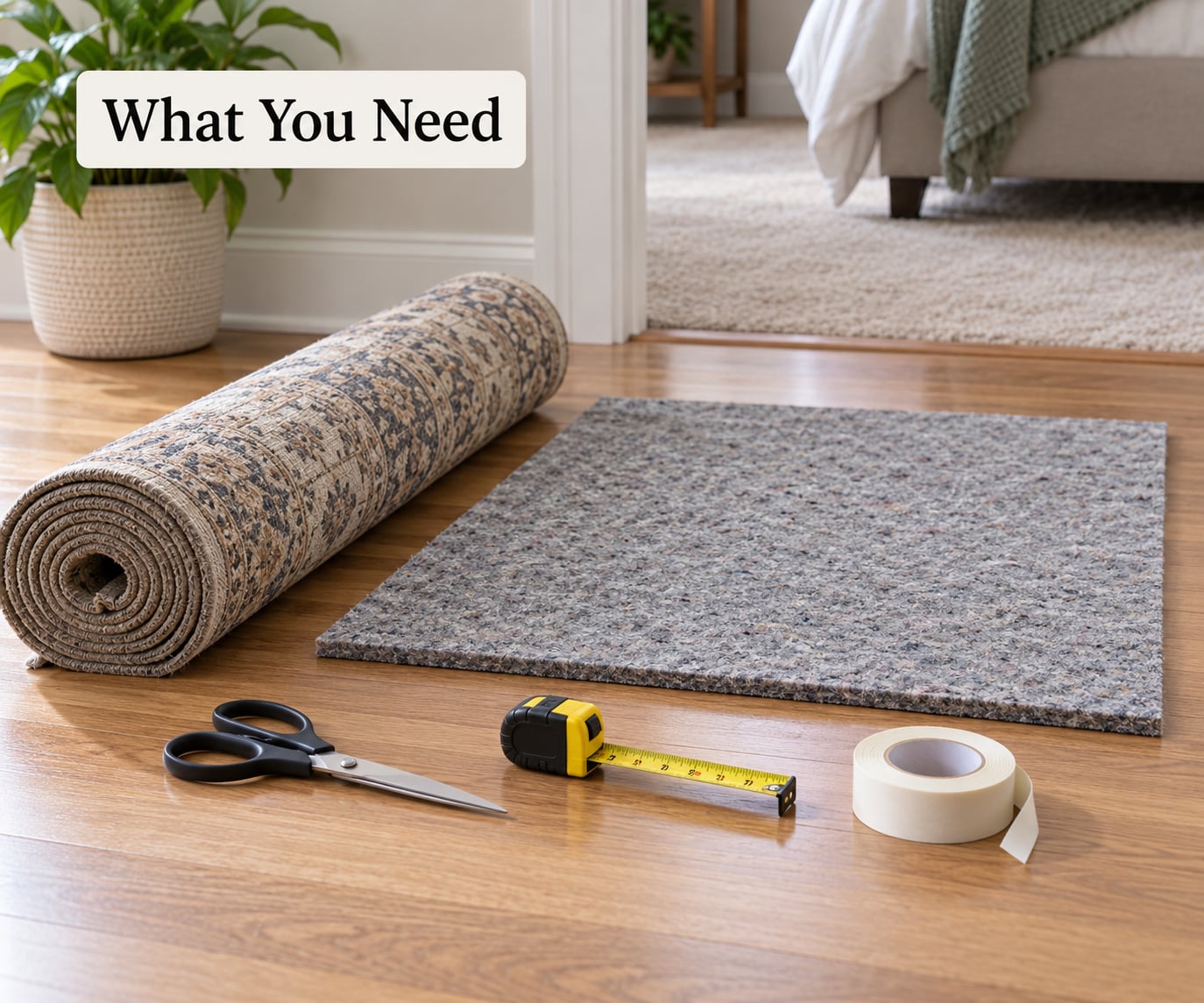
The core item is a rug pad sized slightly smaller than your rug, one inch shorter on each side so no edge peeks out and becomes its own trip hazard.
Beyond that, most people only need a measuring tape, sharp scissors for trimming the pad, and a clean cloth for wiping the carpet before laying anything down. Painter’s tape helps mark the rug’s position so you can put it back in the same spot.
Optional items depend on the method. Carpet-safe double-sided tape for a temporary hold, low-residue carpet tape if you are willing to risk a mark, corner grippers or rug anchors for extra edge control, and a hair dryer plus flat weights for resetting curled corners.
Two things decide which of these you actually need: the rug’s backing and your carpet pile. Flat-woven and polypropylene-backed rugs slide badly on nearly any surface, so they need the most grip. Low-pile loop or berber carpet grabs a needle-punched felt pad better than plush cut pile, which compresses and lets the pad skate.
Step-by-Step: How to Keep a Rug from Sliding on Carpet
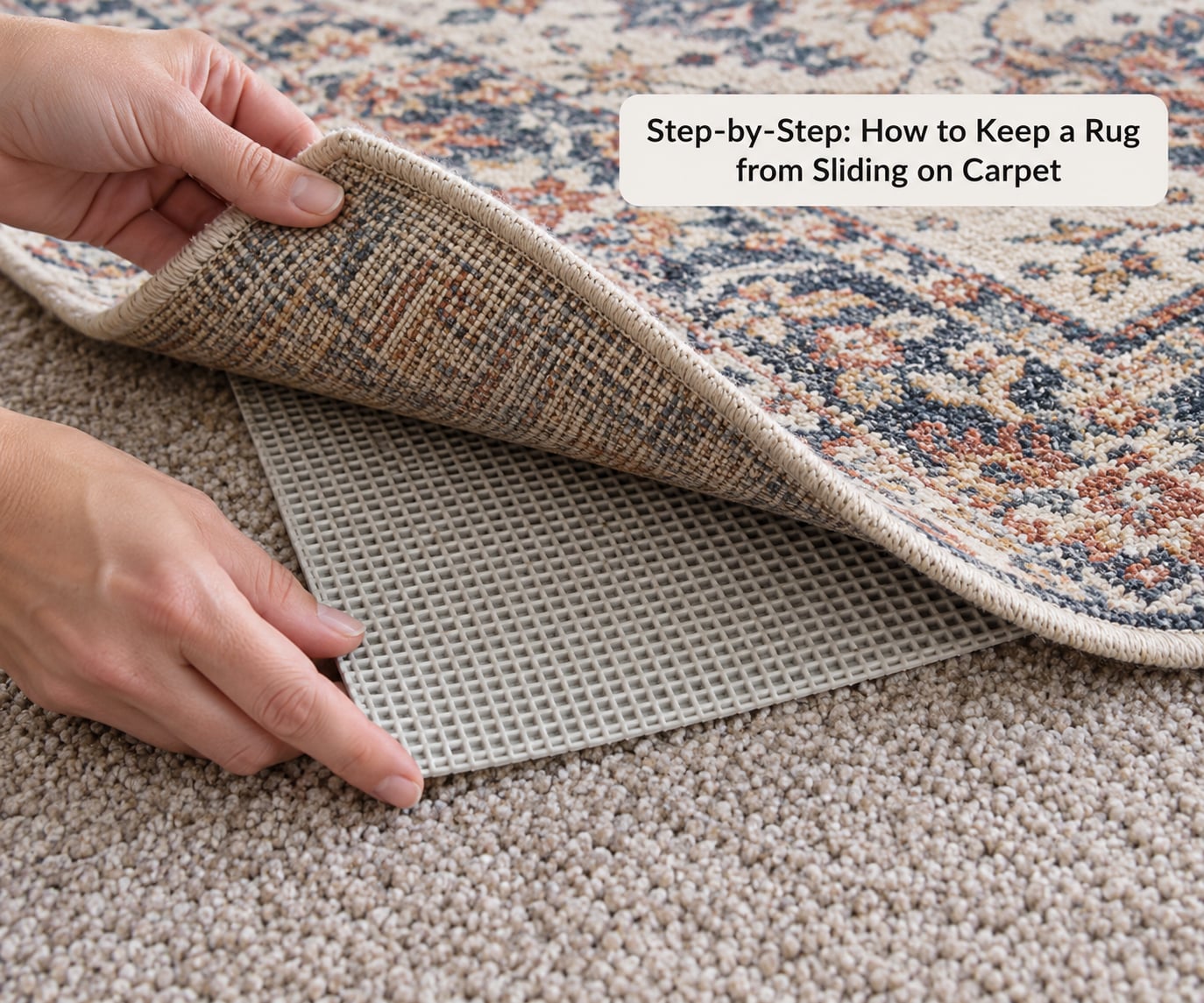
Work through these in order, from least to most involved. Stop as soon as the rug stays put for a week of normal use.
1. How to Keep a Rug from Sliding on Carpet With the Right Rug Pad
This is the fix that works for most people. Vacuum the carpet and the underside of the rug first, then lay the pad with its textured felt side down against the carpet and the smoother rubberized side up toward the rug.
Center the rug on the pad and smooth from the middle outward with your palms. Bunches under the rug will not flatten on their own, and every wrinkle is a starting point for rippling later.
How to tell it worked: push the rug firmly with your foot in the traffic path. If it moves less than about an inch and comes back, the grip is enough.
2. Use a High-Grip Rug Pad for Rubber-Backed or Heavy Rugs
When a thin felt pad gets walked out of position, the problem is usually pad density or coverage rather than the rug itself. A denser pad with more natural rubber per square yard holds better under a vacuum or a rolling chair.
Two traps here. A pad thicker than about a quarter inch creates a visible step at the rug edge that trips people walking barefoot, and a pad cut exactly to the rug size will show its own corner the moment the rug shifts at all.
Keep coverage near the full footprint of the rug but stay about an inch inside each edge. Most pads trim cleanly with scissors, so cutting to size is normal rather than a sign of a cheap pad.
3. Use Rug or Carpet Tape for a Temporary Hold
Tape works, and it is the right answer for a rented room you will leave in a few months. Use double-sided rug tape intended for carpet, applied in short strips at each corner and along two opposite edges.
Keep every strip inside the rug’s border so no adhesive is ever visible from above. Always test one small strip first, press it down, wait a day, then peel it and look at the carpet pile.
Be honest about the tradeoff. Adhesive can leave residue, and residue can leave a bald spot that does not come out. On low-pile carpet the risk is lower than on plush. If there is any chance of losing a deposit, use a pad or anchors instead.
4. Try a DIY Grip Treatment Only When the Rug and Carpet Allows It
This one is close to irreversible, so it suits a rug you intend to keep in the same spot for years and a synthetic-backed rug that will tolerate it. It does not suit wool, jute, or latex-backed rugs, where adhesive can be difficult to remove later.
Apply lines of silicone caulk across the rug backing in a grid, let it cure for a full 24 hours, then lay the rug down and press it into place. Hot-melt glue works similarly but leaves a harder, less reversible bond, and it can bleed through light-colored backings.
Follow the manufacturer’s directions on the product you use, and test for colorfastness and residue in a hidden corner before you commit the whole rug. Once the rug is stuck down, lifting it will likely stretch or tear the backing.
5. Keep the Rug and Carpet Clean, Flat, and Properly Positioned
A rug that slides usually has a cause you can remove. Grit and dust under the rug act like ball bearings, so lift the rug or roll it back, vacuum the carpet underneath, and vacuum the rug itself before repositioning it.
If the backing is curling upward at the corners, reverse-roll the rug tightly with the backing facing out, leave it for a few hours, then lay it face down under a couple of flat weights for a day. Gentle warmth from a hair dryer along a stubborn curl helps the synthetic backing relax.
Finally, watch the traffic path for a week. If the rug keeps migrating in the same direction, the floor under that stretch may be uneven or the carpet pile there is worn flat. A replacement pad usually solves it; if not, that is a flooring question rather than a rug question.
How the Five Fixes Compare
- Carpet-to-carpet rug pad. Strong hold, fully reversible, carpet-safe. The best general answer, and the right pick for most rooms and especially rentals.
- High-grip dense pad. The strongest non-adhesive option, still reversible and carpet-safe. Suits heavy rugs, vacuum routes, and homes with kids or pets.
- Carpet tape at the corners. Medium hold, usually reversible, but risky for the carpet pile. Fine for a short-term hold in a rental you are about to leave.
- DIY silicone or glue grid. Strong and permanent, with carpet safety depending on your carpet. Only for a rug that is staying in one spot for good.
- Corner anchors and grippers. Light to medium hold, reversible, carpet-safe. Good for edge control on small rugs and runners.
Common Mistakes
Pad smaller than the rug. A pad that stops short of the edges gives the rug room to ride up. Cut the pad about one inch inside the rug footprint, all the way around.
Buying a hard-floor gripper pad. A hardwood pad grips a smooth hard floor, not a carpet pile. On carpet it just adds a slick rubber sheet between two soft surfaces.
Too much tape. Long strips of double-sided tape across the middle of a rug pull the backing off the pile when you lift it, and every strip is another chance to leave residue. Corners and two edges are enough.
Ignoring curled edges. A corner that will not lie flat drags the rest of the rug with it. Reset the curl before anything else, because a pad under a curled rug is a thicker trip edge.
Testing adhesives on a good day. Press the test strip, then walk on it for a full day in socks or bare feet before committing. Adhesive that looks fine under a heel can pull pile fibres after a day of traffic.
Using products the rug or carpet was not tested for. Silicone caulk and hot glue belong only on synthetic backings, and thick jute or wool felt pads add height without adding useful grip on carpet.
Frequently Asked Questions
What is the best way to keep a rug from sliding on carpet?
A carpet-to-carpet rug pad is the best answer for most rooms: a textured felt or natural rubber bottom grips the carpet pile, and a rubberized top grips the rug backing. Size it about one inch smaller than the rug on each side. Add corner anchors if the rug is small or in a hallway. Avoid adhesive unless you own the carpet and can accept possible residue.
Will a rug pad damage carpet?
A quality carpet-to-carpet pad will not. Pads made from needle-punched felt and natural rubber let air move and do not trap grit that can abrade fibres. Avoid waffle-cut vinyl-style pads, which are designed for hard floors and can scratch underfoot. Rotate the rug every few months so wear spreads evenly, and lift it occasionally to vacuum the carpet underneath.
How do I remove rug tape from carpet?
Lift the rug slowly, peeling the tape rather than pulling it straight off. For residue, press a clean cloth dampened with a little carpet-safe adhesive remover over the tacky area, then blot, never scrub. Repeat once. If residue remains, it often lifts with a plastic scraper held at a shallow angle. Test any remover in a hidden spot first, especially on low-pile carpet.
Does a rubber-backed rug need a special pad?
A rug with natural rubber or latex backing grips most smooth floors on its own, but it grips bare carpet far less reliably. A thin felt-faced pad still helps, because it stops the backing from locking into the carpet pile. Skip thick cushioned pads under a rubber-backed rug: they add height without much grip and make the rug harder to reposition.
Why does my rug slide even though it has a rug pad?
Usually the pad is the wrong type or the wrong size. A hard-floor gripper pad has a smooth rubber face that skates across carpet pile, and a pad cut to the rug’s exact size lets corners climb out. Check that the felt side faces the carpet, that the pad sits about an inch inside the rug on every side, and that dust and grit have not built up between the two.
Can I use double-sided tape under a rug?
You can, and it holds well for a few months, but it is the riskiest option on wall-to-wall carpet. Adhesive can leave residue that shows as a dark or bald patch, and lifting the rug later can pull carpet fibres. Test one strip for a full day first. In a rental, choose a non-adhesive pad or corner anchors instead.
Conclusion
Measure the rug, cut a carpet-to-carpet pad about an inch smaller on each side, and lay it down felt side to the carpet. That single change solves most sliding rugs and leaves nothing behind when you move out.
If corners still lift, reset the curl by reverse-rolling the rug and weighting it flat, then add anchors at the edges. Anyone trying to work out how to keep a rug from sliding on carpet should start with the least permanent option and work up only if the pad fails. Save tape and silicone for situations where you truly cannot move the rug, and always match the method to your carpet pile and whether the home is rented.