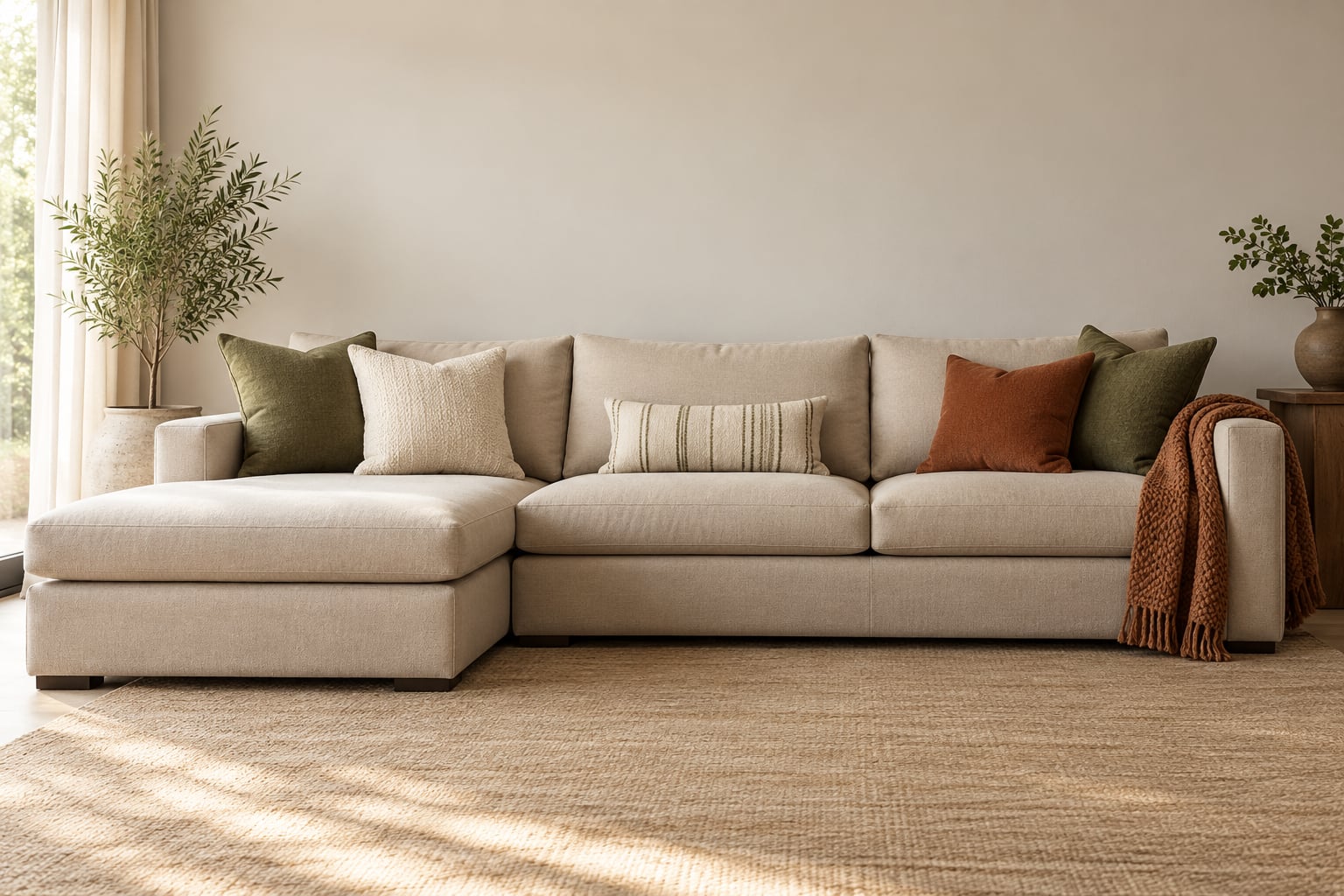
Arranging pillows on a sectional is mostly about scale and spacing: anchor the two outer corners with your largest pillows, layer smaller ones toward the middle, and finish with one accent piece. A standard sectional usually takes seven to nine pillows, and the whole job takes about fifteen minutes once you know the order to work in.
The reason most arrangements look off is skipping the measuring step. People buy a matching set of identical pillows, stand them all up in a row, and wonder why the sofa looks shorter than it is. Swap the matching set for two or three sizes and the same sectional reads completely different.
What follows is the method I use: start at the corners, work toward the center, keep the middle seats clear enough to sit on, and hold the palette to three colors and three textures. If you follow the steps in order, the balance takes care of itself.
Table of Contents
- What You Need
- Step-by-Step: How to Arrange Pillows on a Sectional
- Measure the Sectional and Choose the Main Pillows
- Place the Largest Pillows First
- Layer Medium Pillows Through the Center
- Add One or Two Accent Pillows
- Check the Balance from Across the Room
- How Many Pillows and What Size: Quick Reference
- Common Mistakes
- Frequently Asked Questions
- How many pillows should I put on a sectional?
- What is the 2-2-1 pillow rule?
- What size pillows are best for a sectional sofa?
- Should sectional pillows match or mix?
- How do you arrange pillows on a chaise sectional?
- How do I keep pillows from sliding off a leather sectional?
- Conclusion
What You Need
You do not need much, but the right pillow sizes make the difference between a styled sofa and a pile. Before you start, gather these:
- Two large back pillows, 22×22 or 24×24 inches. These are your anchors. Euro shams at 26×26 inches work well here too, and they are easy to find secondhand.
- Two to three medium pillows, 18×20 to 20×20 inches. These sit in front of the back pillows and carry most of your pattern.
- One accent pillow, 16×16 to 18×18 inches. Optional, but this is the piece that makes the arrangement feel deliberate rather than stocked.
- One lumbar or bolster, 12×20 or 14×36 inches. Skip it if the sectional has no corner to fill. Do not skip it if it does.
- A measuring tape or a strip of painter’s tape. Tape on the floor marks your zones so you can keep them even without eyeballing it.
- A pillow insert you can reshape. A slightly overfilled insert holds its corner shape instead of slumping flat within a week.
Rough budget: most people assemble a full arrangement from four or five pillows they already own plus one or two new pieces. Thrift stores, estate sales, and clearance racks are full of 22×22 shams in decent condition, and mixing a thrifted neutral with two newer patterned pillows is a normal way to build a palette.
Step-by-Step: How to Arrange Pillows on a Sectional
Measure the Sectional and Choose the Main Pillows
Measure the seat width, not the whole sectional, then divide it into zones. Most pieces break into two or three zones: the outer arms, the center seats, and the inside corner where the two arms meet.
A useful shortcut is the 2/3 rule: your pillows should cover roughly two-thirds of the seating width. Cover the full width and the sofa disappears under fabric. Cover less than half and it looks like you ran out of pillows before you ran out of sofa.
Choose your two largest pillows to be equal or near-equal. If you only own one big pillow, borrow the other from a chair elsewhere in the room until you can replace it.
Place the Largest Pillows First
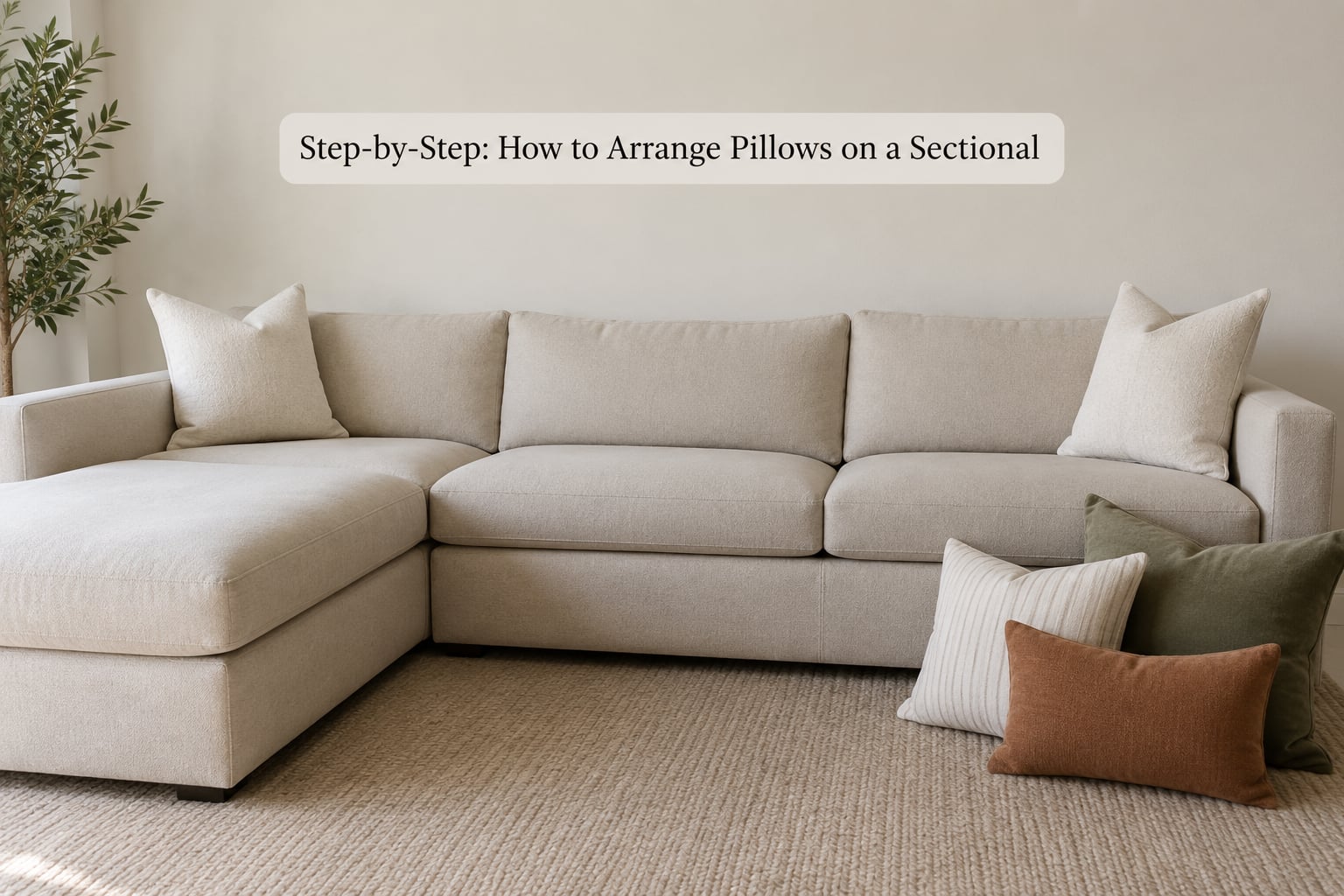
Put one large pillow in each outer corner, tucked into the junction of the seat back and the arm. Push it down into the seam so it leans into the corner rather than standing straight up like a fence post.
Angle each one about 10 to 15 degrees toward the center of the sofa. That slight lean is what makes a sectional look relaxed. Straight upright pillows read stiff, and leaning them too far reads sloppy.
Check the spacing from where you would stand. The two large pillows should sit at the same height and the same distance from their arms. On a three-seat sectional, add a second large pillow on the far side so the outer arms match.
Layer Medium Pillows Through the Center
Place the medium pillows in front of the large ones, resting on the seat, not floating against the back. Each one should overlap the large pillow by about a third so the back pillow still reads as a separate layer.
Work in pairs from the outside in. On a three-seat sectional, that usually means one pair at the arms and a single pillow or a lumbar in the middle, which keeps the count odd and the seating open.
If your sectional has an inside corner, put the lumbar there. It fills the gap where the two sections meet, and it gives someone sitting in the corner something to lean against. This single pillow fixes more awkward corners than any other move.
Add One or Two Accent Pillows
The accent pillow goes last and it should be the only pillow with a bold pattern or an unexpected texture. One focal point per arrangement is plenty. Two accent pillows work if they sit at opposite ends of a large U-shaped sectional.
Keep the middle seat cushions usable. If you have to shove three pillows onto a seat to fit them all, you have too many. Decorative pillows on a sectional still need to leave room for two adults and a blanket.
Check the Balance from Across the Room
Sit on the sofa, then stand and walk to the opposite side of the room. That is the view that matters, and it is the view that catches mistakes. Look for three things: one end that looks heavier than the other, a gap where the sofa back shows through in the middle, and a color that appears on one side only.
Fixes are small. Shift a pillow three inches. Swap two accent pillows between corners. Add one lumbar to the empty end. Most arrangements need one adjustment pass, not a restart.
For a chaise sectional, treat the chaise as a separate, shorter sofa rather than an extension. Two or three pillows on the chaise, and one lumbar at the junction, reads cleaner than trying to run a row along the whole piece.
Same idea for U-shaped layouts: repeat the same pillow pairing at each corner and keep the middle of each run nearly bare. Repetition at the corners is what holds the shape together.
How Many Pillows and What Size: Quick Reference
Here is the count that suits most living rooms, with the sizes that go with each layout. Odd numbers generally look better than even ones because the eye registers them as intentional.
| Sectional size | Large (22-24 inch) | Medium (18-20 inch) | Accent or lumbar | Total |
|---|---|---|---|---|
| Loveseat or small two-seater | 2 | 1 | 1 | 4 |
| Standard three-seat | 2 to 3 | 2 to 3 | 1 | 7 to 9 |
| L-shaped with chaise | 3 | 3 | 2 | 7 to 8 |
| Large U-shaped | 4 | 4 | 2 | 9 to 10 |
| Modular reconfigured | 2 per module | 1 per module | 1 overall | 4 to 6 |
On color and pattern, use the rule of three: one solid, one subtle pattern, one bold pattern. Three textures work too, and velvet, linen, and bouclé in the same neutral family give depth without another color.
Decide between symmetry and asymmetry on purpose. Symmetry suits a formal room or a sectional pushed against a wall with clear space on both sides. Asymmetry suits a lived-in room, a chaise on one side, or a sectional in an open plan where one corner needs extra weight to hold the shape.
Common Mistakes
Using a matching set of identical pillows. Five pillows in one print and one size flatten the whole sofa. Keep one or two of the matching pieces and replace the rest with different sizes.
Overcrowding the chaise. People treat the chaise like extra seating and fill it. Cap it at two or three pillows, or it stops reading as a lounging spot.
Blocking the seats. If a guest has to move three decorative pillows to sit down, you have too many. Keep one or two full seat cushions clear.
Leaving the inside corner empty. That gap on an L-shaped sectional is the first thing your eye catches. One lumbar pillow closes it.
Matching colors too closely. A palette of five near-identical beiges looks like a mistake. Pull one pillow from another part of the room and put it in the mix.
Pillows sliding off leather or smooth upholstery. Common on slick fabrics. Rub a bar of dry soap over the back of each pillow, or place a small non-slip pad between the pillow and the seat.
Forgetting function. Decide what the pillows are for. Back pillows go at the corners, lumbar pillows go where someone sits, and anything smaller is decoration only.
Buying inserts that flatten in a month. If you can, overfill the insert by a small amount. A pillow that holds a crisp corner when you arrange it will still look right a year later.
Frequently Asked Questions
How many pillows should I put on a sectional?
Most three-seat sectionals take seven to nine pillows: two or three large back pillows at the outer corners, two or three medium pillows layered in front, and one accent or lumbar piece near the inside corner. A loveseat needs closer to four. The count matters less than keeping it odd and leaving at least one or two seats completely clear.
What is the 2-2-1 pillow rule?
It is a simple starting formula for a single sofa or one run of a sectional: two large pillows, two medium pillows, and one small accent pillow. On a sectional, apply the formula to each zone, so a three-seat piece usually runs two large at the corners, two to three medium through the middle, and one lumbar or accent near the corner.
What size pillows are best for a sectional sofa?
Anchor the outer corners with 22×22 or 24×24 inch pillows, layer 18×20 or 20×20 inch pillows in front, then add one 16×16 to 18×18 inch accent or a 12×20 inch lumbar. Match the size to the sectional: a deep sectional takes 24 inch pillows well, while a small loveseat looks better with 20 inch pillows and one accent.
Should sectional pillows match or mix?
Mix them. A full matching set is the most common arranging mistake because identical size and print cancel out the depth that layering creates. Keep a palette of three colors and three textures, then repeat one pillow or one color in two places so the arrangement still reads connected.
How do you arrange pillows on a chaise sectional?
Treat the chaise as its own short sofa rather than an extension of the main run. Put two or three pillows on the chaise, angled into its outer arm, and place one lumbar pillow where the chaise meets the main seat to close the gap. Trying to continue a single row along the whole piece usually looks unbalanced.
How do I keep pillows from sliding off a leather sectional?
Slick upholstery is the usual culprit. Rub a bar of dry soap across the back of each pillow to add grip, or tuck a small non-slip shelf liner between the pillow and the seat back. Positioning pillows into the seam where the seat meets the back also helps, because the corner does the holding for you.
Conclusion
Start with two large pillows in the outer corners, angled inward, then layer medium pillows toward the middle and finish with a single lumbar at the inside corner. Hold the palette to three colors and three textures, leave a seat or two clear, and walk to the other side of the room to check the balance. That sequence takes about fifteen minutes and it holds up whether your sectional is a loveseat or a full U-shape.