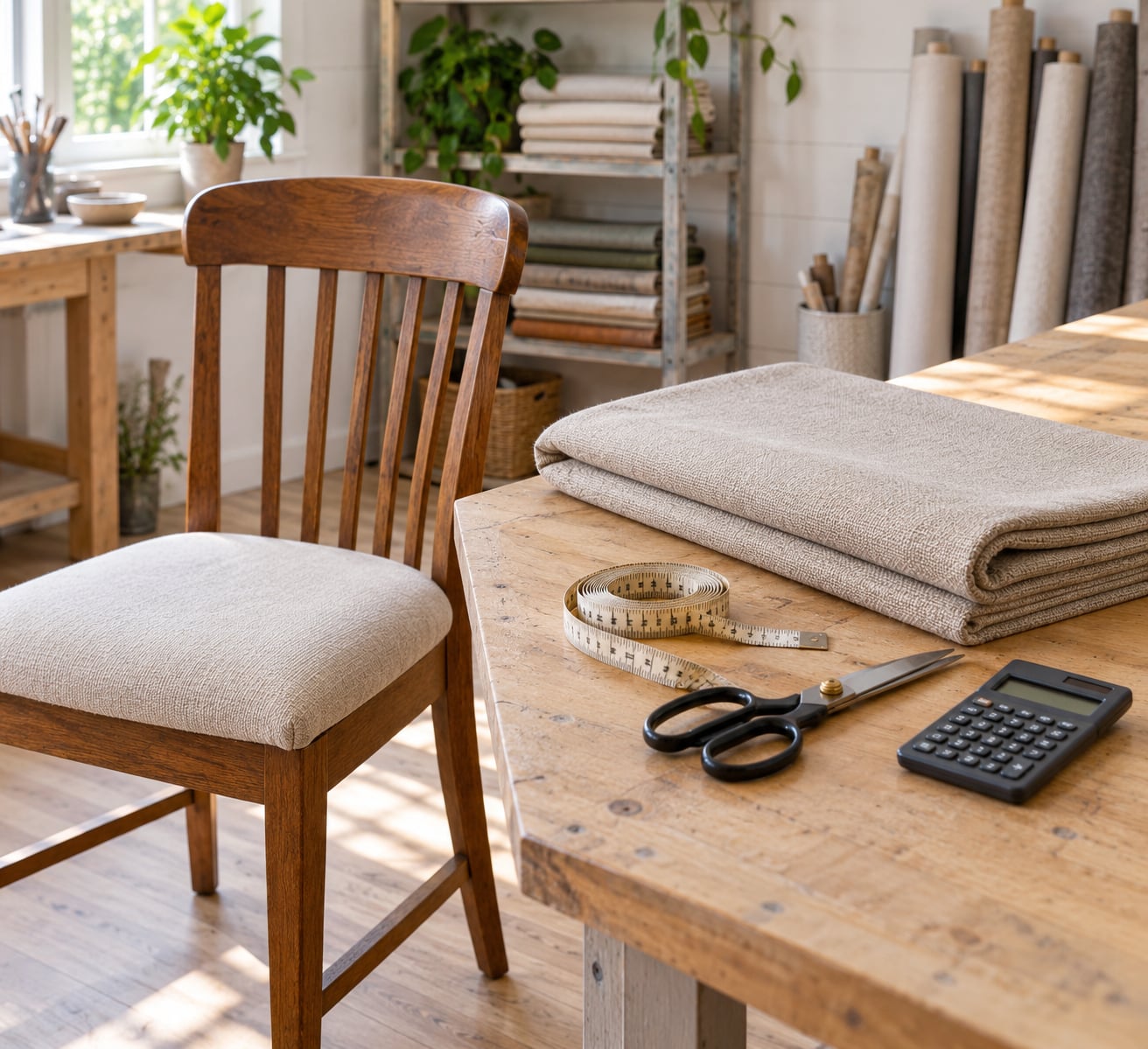
A standard dining chair seat needs 0.5 to 0.75 yards of 54-inch-wide upholstery fabric, and a chair with an upholstered seat and back needs roughly 1.25 to 2 yards. That single number covers most drop-in seat pads, which are the easiest first reupholstery project there is.
If you have never stapled fabric to anything, a chair seat is a good place to start: it is small, flat, and needs no sewing. Most of the work is measuring and pulling fabric tight.
Quick vocabulary, since people ask this constantly. Removing the old cover and stapling new fabric on is called reupholstering, or more accurately recovering a chair. Re-covering or re-skinning mean the same thing. A slipcover goes over the chair and comes off, which is a different job entirely.
All the yardage figures below assume 54-inch-wide upholstery fabric sold by the yard. If your fabric is sold by the metre, 1 yard is about 0.91 metres, and most online fabric sellers will convert for you at checkout.
Table of Contents
- How Much Fabric to Reupholster a Dining Chair?
- Yardage by chair coverage
- Fabric Needed by Chair Type
- Yardage for a whole set
- How to Calculate Fabric for Your Chair
- Step 1: measure the seat
- Step 2: add the depth of the pad
- Step 3: work out how many pieces fit across
- Use the old cover as your template
- What Affects the Amount of Fabric
- Fabric width
- Pattern repeat and directional fabric
- Shaping and technique
- Fabric to skip
- Fabric that holds up
- Ways to Save on Fabric
- Frequently Asked Questions
- How many yards are needed to reupholster a dining chair?
- How much fabric do I need for four or six dining chairs?
- What type of fabric is best for reupholstering dining chairs?
- Can I use curtain or dress fabric to reupholster a chair?
- Do I need to replace the foam when reupholstering a chair?
- Is it cheaper to reupholster dining chairs or buy a new set?
- Conclusion
How Much Fabric to Reupholster a Dining Chair?
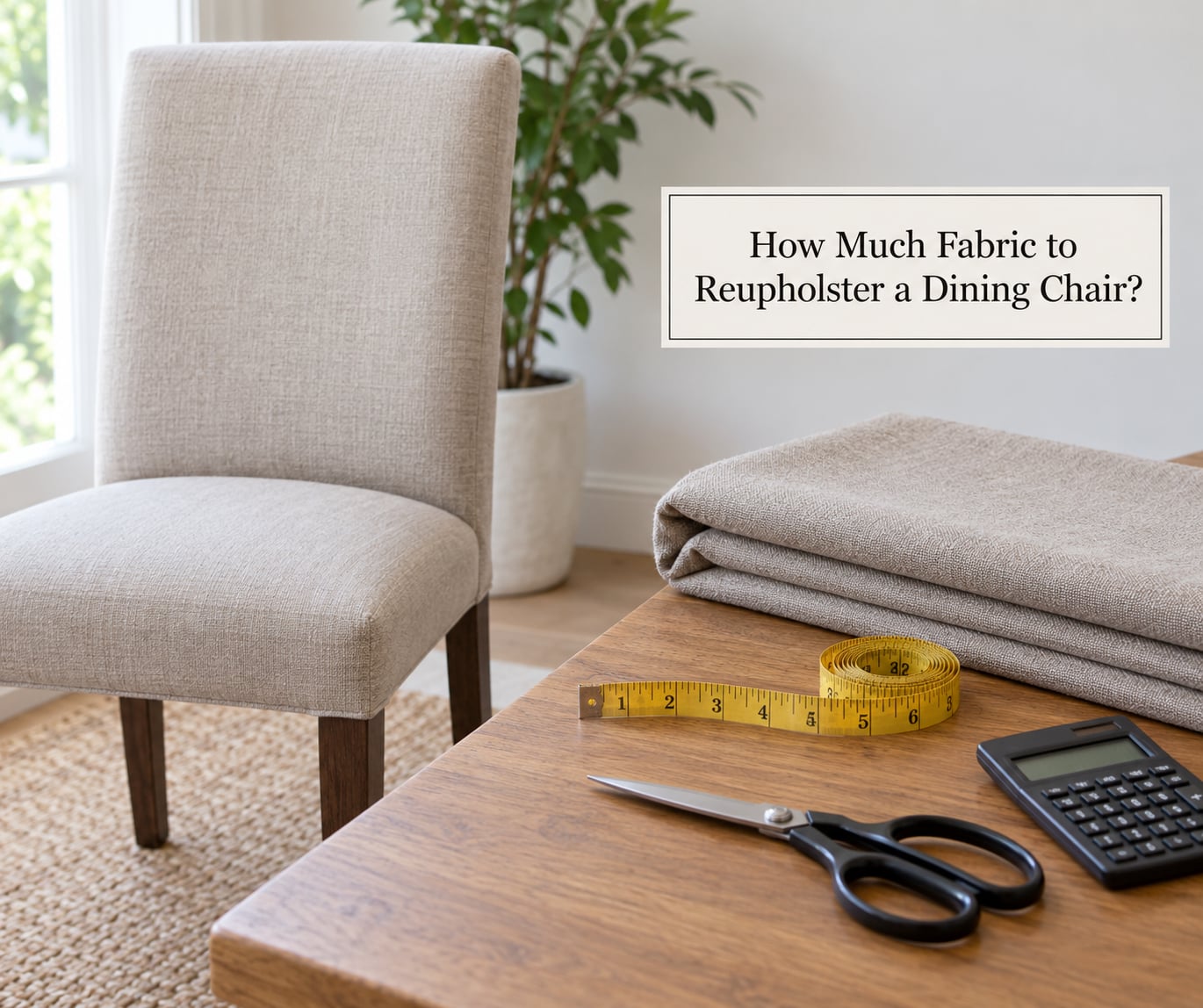
Yardage depends almost entirely on how much of the chair you are covering. A seat pad only, a seat with an upholstered back, and a fully upholstered chair with arms are three very different amounts of cloth.
Yardage by chair coverage
| What you are covering | Yards of 54-inch fabric, per chair | Extra to buy | Four chairs, plain fabric |
|---|---|---|---|
| Drop-in seat pad only | 0.5 to 0.75 yd | 0.25 yd | 2 to 2.75 yd |
| Seat plus inside back panel | 1 to 1.5 yd | 0.25 yd | 4 to 6 yd |
| Seat plus inside and outside back | 1.25 to 2 yd | 0.5 yd | 6 to 9 yd |
| Fully upholstered chair with arms | 3 to 4 yd | 0.75 yd | 13 to 18 yd |
The third column matters more than people expect. Cutting waste on a small pad is generous, because you leave slack for turning the fabric under underneath and stapling the edge. Add a quarter yard for a single pad and half a yard or more for anything with a shaped back.
You will also hear much higher numbers than these. Some charts quote three to four yards for a group of seat pads and eight to twelve yards for six chairs with backs. Those figures are not wrong, they just assume a large cutting waste per chair and no clever nesting of cuts. Measure and lay out before you buy.
Fabric Needed by Chair Type
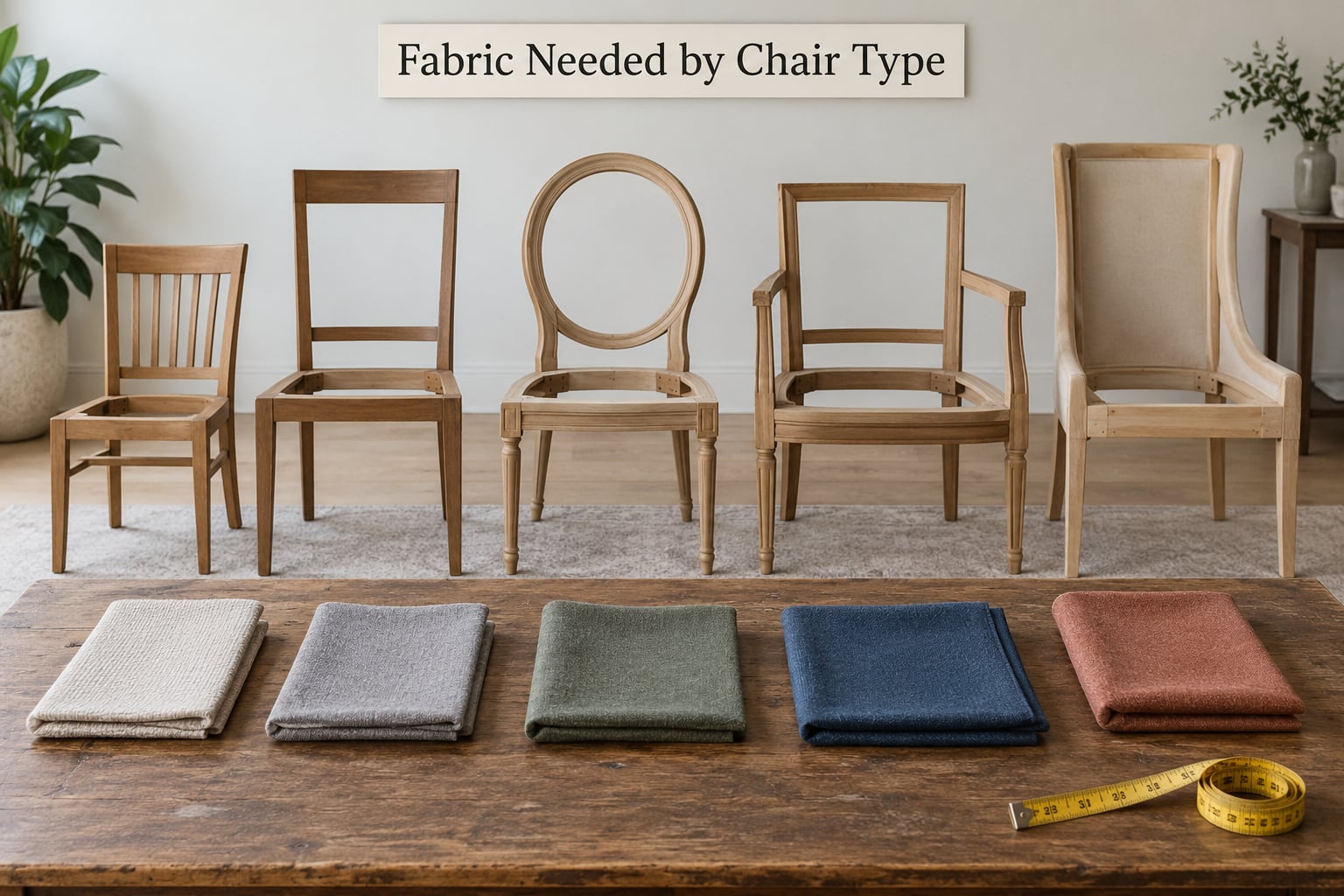
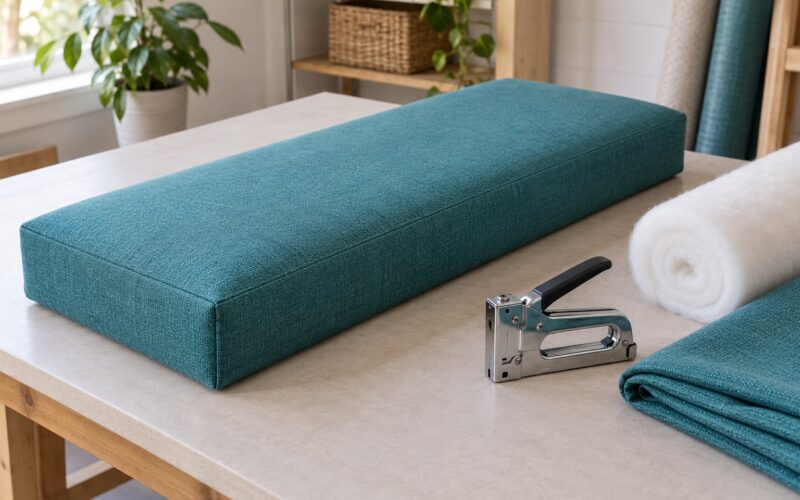
A drop-in seat pad on a standard dining chair is usually about 18 by 18 inches. To cover it you need a piece roughly 28 by 28 inches once you add depth for turning under and stapling. Two of those pieces fit side by side across a 54-inch roll, which is where the savings come from.
Yardage for a whole set
| Number of chairs | Seat pads only | Seat plus inside back | Seat plus inside and outside back |
|---|---|---|---|
| 2 chairs | 1 to 1.5 yd | 2.5 to 3.5 yd | 3.5 to 5 yd |
| 4 chairs | 2 to 2.75 yd | 4.5 to 6 yd | 6 to 9 yd |
| 6 chairs | 2.5 to 3 yd | 6.5 to 9 yd | 9 to 13 yd |
| 8 chairs | 3.5 to 4.5 yd | 9 to 12 yd | 12 to 18 yd |
Notice how much less a set costs per chair than a single chair does. Four plain seat pads need barely more than two individual pad estimates, because the pads nest across the width of the roll. If a search result told you to multiply one chair by four, that number assumes you cut wastefully one at a time.
Oversized and oddly shaped seats break these rules. A wide bench seat, a deep tufted chair, or a rounded back that wraps around the frame can double the yardage. Measure those two or three times.
How to Calculate Fabric for Your Chair
You do not need a calculator app. You need a tape measure, a pencil, and about ten minutes.
Step 1: measure the seat
Measure the seat pad at its widest point and front to back. Ignore the screws. Write both numbers down, then add 4 inches to each measurement: roughly 2 inches of slack on each side for the fabric to turn under and reach your staple line.
Step 2: add the depth of the pad
If the pad is 3 inches thick, that thickness is consumed as you wrap down the front and staple underneath. Add it to both your width and depth figures. An 18 by 18 inch pad that is 3 inches thick becomes a 28 by 28 inch piece.
Step 3: work out how many pieces fit across
Here is the arithmetic for six standard pads. Each pad needs 28 by 28 inches. Across a 54-inch width, two fit side by side, so six pads take three rows. Three rows of 28 inches is 84 inches of roll length, which is 2 and one third yards. Add ten percent for cutting error and you want about 2.5 to 2.75 yards.
That ten percent allowance is not optional. It covers a slip of the scissors, a piece you cut on the grain line backwards, and one chair that gets redone because the first attempt bunched at a corner.
Use the old cover as your template
Beginners on upholstery forums consistently recommend the same trick: take the old cover off, lay it out flat, and copy it. It is more accurate than any chart because it already accounts for the shape of your chair.
If the pattern matters to you, do not cut it all apart. Find the centre of the back panel, snip the seam down the middle only, then flatten each half. You keep the full width and matching placement while still getting the fabric apart. Take a photo of the flattened cover before you staple anything, so you can compare the new one against it later.
What Affects the Amount of Fabric
Fabric width
Width is the single biggest factor. Wider fabric means fewer rows of cutting and fewer seams.
| Fabric width | 28 inch pad pieces per row | Effect on yardage |
|---|---|---|
| 45 inch | 1 | About 20 percent more yardage than 54 inch |
| 54 inch | 2 | The standard, and the cheapest way to buy |
| 60 inch | 2 | Same as 54 inch for pads, better for wide backs |
For scale, one yard of 54-inch fabric gives you 54 by 36 inches, or 1.5 square yards of surface. Every pad you cut takes a bite out of that, plus the strip you lose at the selvedge.
Pattern repeat and directional fabric
Pattern repeat is the vertical distance before the design starts again, printed on the fabric listing. Add one full repeat per chair so the pattern lands in the same place on every seat. A 12-inch repeat across six chairs is 72 inches, which is two extra yards. Solid colours and small prints cost you nothing extra.
Directional fabric is the trap underneath that. Velvet pile, corduroy, and most printed stripes have a top and a bottom, and so do some plain weaves with a visible grain. Mark the top of the first piece with a chalk mark and match every piece to it. Velvet also shades differently depending on which way the pile is brushed, so keep every chair running the same direction or the set will look mismatched under dining room light.
Shaping and technique
- Piping or welt cord around the pad edge adds a few inches per chair plus cord itself. It is the neatest looking finish and the most expensive in yardage.
- Gathers, skirts, or a waterfall front use far more fabric than a tight stapled cover, sometimes double.
- Stretch fabric pulls tighter but eats more material. Buying non-stretch upholstery weight makes stapling predictable.
- Tight curves and inside corners eat the extra allowance you gave yourself. This is why shaped backs carry a bigger extra column in the tables above.
- Leather comes on narrower hides, usually around 54 inches for upholstery weight, and the yield per yard is lower. Budget the same yardage but check the hide width first.
Fabric to skip
Some fabrics fail predictably on a dining chair, and it is worth knowing which ones before you buy.
- Silk and rayon snag and stretch, and they tear when you staple them.
- Synthetic velvet crushes and shows every mark from a person’s leg.
- Tweed and lightweight wool pill at the sitter’s hip within months.
- Chenille is soft but wears through at the front edge first.
- Faux leather and vinyl peel and crease, and the surface coating cracks with age.
- Embroidered and loosely woven fabric pulls out of shape when stapled and does not lie flat.
Fabric that holds up
Tightly woven polyester or poly-cotton blends in a performance finish are the workhorses. Look for a Martindale rub count, which is a wear rating measured in double rubs. For daily family dining, aim for 25,000 or higher. Around 15,000 suits occasional use, like a breakfast room that sees light traffic.
Boucle is durable but has a loose loop texture that snags on staple guns and hooks on jewelry. Linen looks wonderful but creases and slacks over time. Cotton canvas is the traditional choice when the chair gets hard use. Kids and pets push you toward something wipe-clean and dark enough to hide a spilled drink.
Ways to Save on Fabric
Most of the savings come from decisions made before you cut anything.
Measure every chair, not just one. Sets are rarely identical. If the pads vary by even an inch, the widest one sets the yardage and the narrower ones waste the difference. Sizing everything from the largest pad takes ten minutes.
Buy the width that fits. If a 45-inch fabric is the only one you love, calculate again. One pad per row roughly doubles the length you cut.
Use a second fabric where nobody sees it. The underside of the seat, the bottom rail, and the back of the seat pad can be a cheaper solid colour while the visible faces get the good stuff. It is a normal design choice, not a compromise.
Staple over the existing cover. If the foam underneath is still firm, pull the old staples and tacks, pull the old fabric taut over the foam, and staple straight onto it. That approach needs only enough fabric for the top and sides, roughly 0.75 yard per pad, and it is the cheapest refresh there is.
Skip reupholstery when the frame is the problem. Wobbly joints, cracked rails, or missing screws are frame repairs, not upholstery problems. Fixing them first is the only way the new fabric stays looking good.
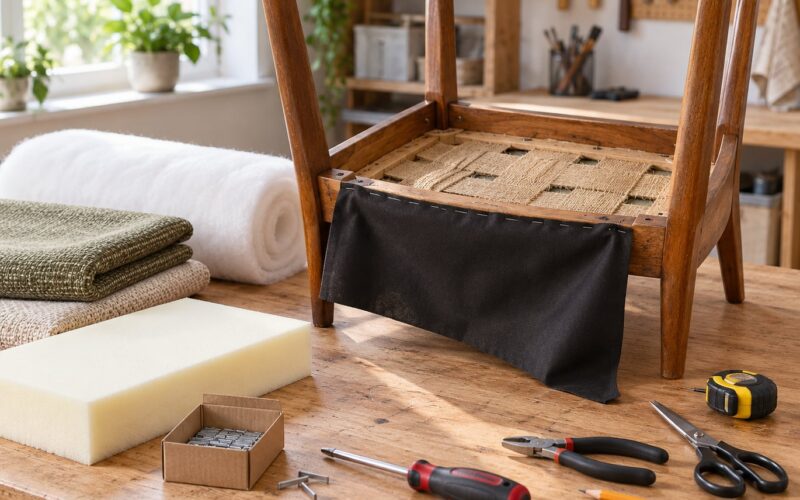
Decide DIY or professional before you buy fabric. Professional help on dining chairs runs far enough that on a matched set it can reach or pass the cost of new chairs, and the forum consensus is consistent on that. Getting two or three written quotes is the only sensible way to compare. If you do the work yourself, the real outlay is the fabric, a sheet of high density foam around 3 inches thick cut half an inch larger than the pad on every side, polyester wadding over the foam, a staple gun, staples, and optionally calico interlining or a cambric dust cover on the underside.
Buy from one roll and keep the offcuts. A second length pulled from a different roll can be a shade off, and on a matched set that difference reads immediately. Buy everything at once and save the leftovers, which cover the first chair you ruin.
One safety note. If you are only working with a staple gun, you are not sewing and not dealing with springs, so chairs are genuinely a beginner project. Once you add springs, webbing, and frame work, you have moved on to sofas, which is a different weekend.
Frequently Asked Questions
How many yards are needed to reupholster a dining chair?
A drop-in seat pad takes about 0.5 to 0.75 yards of 54-inch-wide upholstery fabric. Add a seat with an inside back panel and you need 1 to 1.5 yards, and a chair with both sides of the back covered takes 1.25 to 2 yards. Add another quarter yard per chair for cutting waste.
How much fabric do I need for four or six dining chairs?
For plain drop-in pads, four chairs need roughly 2 to 2.75 yards and six need about 2.5 to 3 yards of 54-inch fabric, because two pads fit side by side across the roll. Once you add a back panel, four chairs jump to 4.5 to 6 yards and six to 6.5 to 9 yards.
What type of fabric is best for reupholstering dining chairs?
A tightly woven polyester or poly-cotton blend in a performance finish is the safest pick for daily family dining. Check the Martindale rub count and aim for 25,000 or more for everyday use, or around 15,000 for occasional meals. Skip silk, rayon, velvet, tweed and faux leather, which snag, pill or crack.
Can I use curtain or dress fabric to reupholster a chair?
Only if it is upholstery weight. Dress fabric is usually too light and slippery to staple, and curtain fabric is often wider than the chair needs and may not hold a staple without tearing. If the Martindale rating is missing and the weave looks open, treat it as decorative fabric only.
Do I need to replace the foam when reupholstering a chair?
You only need new foam if the old pad feels crushed or uneven. If the foam still springs back, leave it, cover it with fresh polyester wadding, and staple the new fabric over it. Sagging foam under new fabric looks bad within months, so test the pad by pressing down firmly before you decide.
Is it cheaper to reupholster dining chairs or buy a new set?
Doing it yourself usually wins on cost, since the main outlay is a couple of yards of fabric plus foam, wadding and staples. Paying a professional can reach or exceed the cost of new chairs on a matched set, so get two or three written quotes before committing. Reupholstery also makes more sense when the frame is solid.
Conclusion
A standard dining chair seat needs 0.5 to 0.75 yards of 54-inch-wide fabric, and a four-chair set of plain pads usually comes in under 3 yards. Once you add back panels, yardage climbs quickly, so measure before you buy rather than trusting a single number.
Start by measuring the widest pad in the set, add 4 inches to each dimension for turning under, work out how many pieces fit across your fabric width, then add ten percent for cutting error. If the fabric is patterned or has a pile, add one full repeat per chair and mark the direction on the first piece before you cut anything.
Those three steps, measuring, choosing the coverage level, and buying with a small margin, are what keep a reupholstery project a weekend job instead of a trip back to the fabric store.