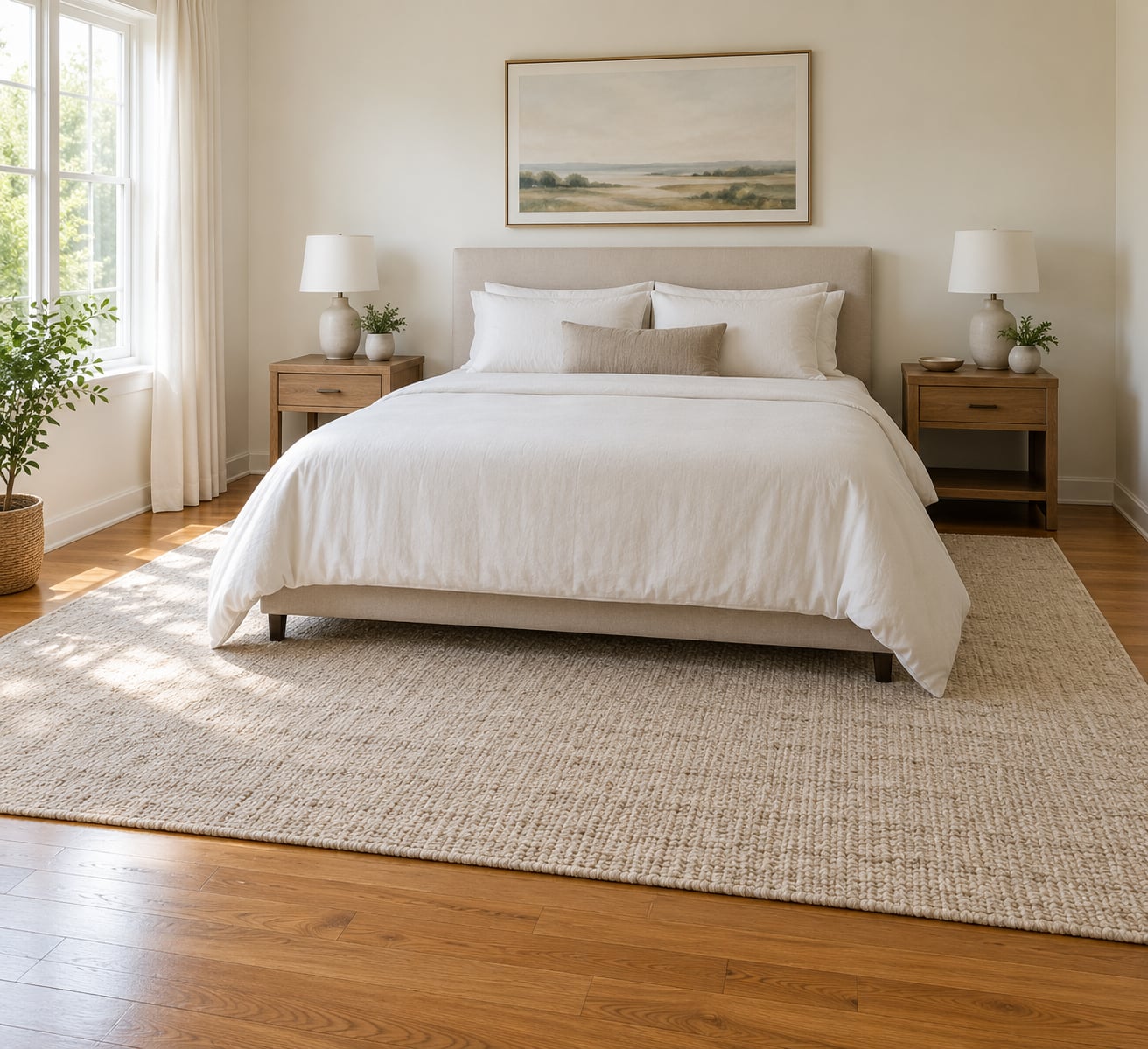
An 8×10 foot rug is the best all-around size for a queen bed, and a 9×12 foot rug is the right upgrade when you have a larger room and want the rug to run past both nightstands and the foot of the bed. A 6×9 works in tighter rooms, and 5×7 is the practical floor. The rule behind all of it is simple: the rug should extend 18 to 24 inches past each side of the mattress, and 24 to 36 inches past the foot.
Most sizing mistakes come down to measuring the mattress instead of the frame. A queen mattress is 60 by 80 inches, but the bed you actually own, with its frame and headboard, is usually wider and longer than that. Get the frame number first and the rug size basically picks itself.
Table of Contents
- What Size Rug for a Queen Bed? Sizes at a Glance
- What Size Rug for a Queen Bed? Standard Dimensions
- 8×10 vs 9×12: Why Sizing Guides Disagree
- How to Measure Your Bed and the Available Floor Space
- Where Should the Rug Go Under a Queen Bed?
- How Much Rug Should Extend Beyond the Bed?
- Round, Oval, or Rectangular Rugs for a Queen Bed
- How to Choose a Rug Size in a Small Bedroom
- Frequently Asked Questions
- What is the best rug size for a queen bed?
- Should the rug be wider than the queen bed?
- How far should the rug extend past the foot of the bed?
- What if my queen bed has an oversized frame?
- Is a small rug okay in a bedroom with a queen bed?
- Do round rugs work with queen beds?
- Conclusion
What Size Rug for a Queen Bed? Sizes at a Glance
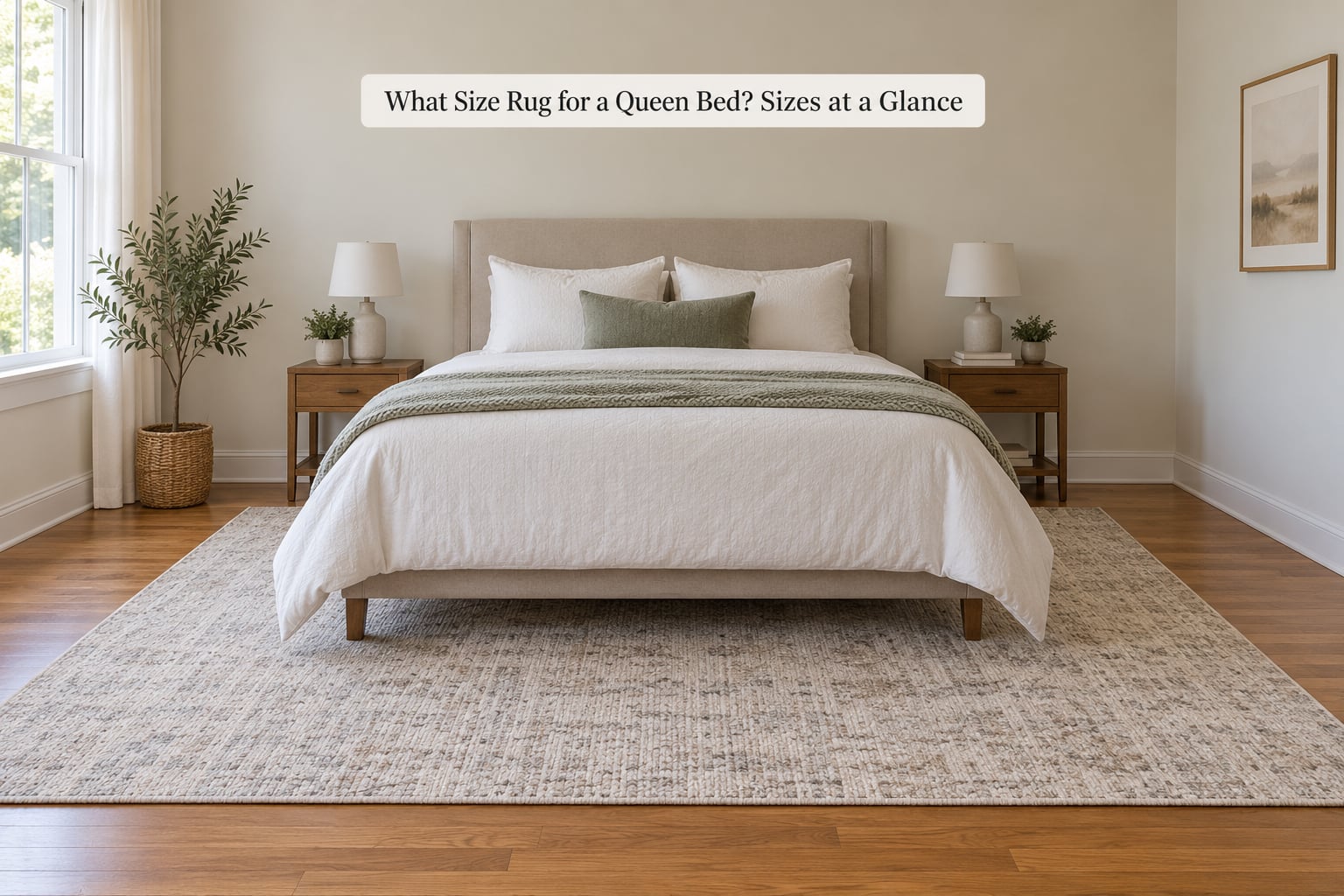
Here is the short version. The table below goes from the smallest rug that technically works to the largest, with what each one looks like next to a queen bed and the room size it actually fits.
| Rug size | How it sits with a queen bed | Nightstands | Minimum room size | Verdict |
|---|---|---|---|---|
| 5×7 ft | Stops well short of both sides and the foot | Off the rug | 8×10 ft | Barely a bedroom rug |
| 5×8 ft | Clears the sides, stops short at the foot | Off the rug | 9×10 ft | Minimum viable option |
| 6×9 ft | Roughly 6 inches each side, 12 inches at the foot | Mostly off | 10×12 ft | Good for small bedrooms |
| 7×10 ft | Roughly 12 inches each side, 20 inches at the foot | Front legs on the rug | 11×13 ft | Workable compromise |
| 8×10 ft | Roughly 18 inches each side, 20 inches at the foot | Fully on the rug | 12×14 ft | Best overall |
| 9×12 ft | 24 inches each side, 32 inches at the foot | Fully on with clearance | 12×16 ft | Best for large rooms |
| 10×14 ft | Room for a bench or chair at the foot | Plus a sitting area | 14×16 ft | Luxury primary bedrooms |
Those extension numbers assume a standard frame footprint of about 90 to 96 inches wide including the headboard. If your bed measures wider, subtract the difference from the rug before you buy.
What Size Rug for a Queen Bed? Standard Dimensions
A standard queen mattress is 60 by 80 inches. The frame around it is a different story, and this is where the sizing math usually goes wrong.
- Mattress: 60 inches wide by 80 inches long.
- Frame with headboard: commonly 62 to 66 inches wide and 84 to 88 inches long.
- Bed plus both nightstands: about 90 to 96 inches across, which is the number most people forget.
- Olympic queen: 66 inches wide, so it behaves more like a king for sizing purposes. Go up one rug size.
- California queen: 60 by 84 inches, longer rather than wider. A 9×12 handles it better than an 8×10.
Headboard width matters more than most people expect. A tall upholstered headboard that spans 66 inches pushes the whole bed wider, and an 8×10 that looked generous suddenly looks tight.
| Rug size | Inches | Centimeters (approx.) |
|---|---|---|
| 5×7 | 60 x 84 | 152 x 213 |
| 5×8 | 60 x 96 | 152 x 244 |
| 6×9 | 72 x 108 | 183 x 274 |
| 7×10 | 84 x 120 | 213 x 305 |
| 8×10 | 96 x 120 | 244 x 305 |
| 9×12 | 108 x 144 | 274 x 366 |
| 10×14 | 120 x 168 | 305 x 427 |
8×10 vs 9×12: Why Sizing Guides Disagree
Search results split cleanly into two camps. Most general guides say 8×10, while rug retailers who sell large inventory argue for 9×12. Both are correct, and the difference is what you want the rug to do.
An 8×10 leaves about 18 inches of rug on each side of the bed and roughly 20 inches past the foot. Both nightstands sit fully on the rug. In a standard bedroom that is exactly enough rug to stop the bed from floating on bare floor.
A 9×12 gives you about 24 inches per side and 32 inches at the foot, with clear floor visible around the nightstands. That is the version where the rug anchors the whole room rather than just the bed.
Here is the test that tells you which camp you are in. Measure your room wall to wall and subtract 24 inches on each side. If what is left is 96 inches or more, you have room for a 9×12. If it comes out between 84 and 96 inches, the 9×12 will touch or nearly touch both walls, and an 8×10 is the honest answer. A rug running wall to wall reads as carpet, and the border of visible floor is what keeps it looking like a rug.
Go to 10×14 only when something else is happening in the room: a bench or ottoman at the foot, a chair in the corner, or a sitting area by a window. A queen bed in a room that size looks lost on an 8×10.
How to Measure Your Bed and the Available Floor Space
Five minutes with a tape measure answers this completely, and it takes less effort than returning a rug.
- Measure the bed across the headboard. Not the mattress, the headboard. This is your true width and every later number starts here.
- Measure the length of the frame from the headboard to the outer edge of the foot rail, including any overhang.
- Measure the room wall to wall in both directions, and write both numbers down.
- Subtract 12 to 24 inches from each side of the room measurement. That gap is your floor border, and you want the rug to fit inside it.
- Check the door swing. An inward-swinging bedroom door will hit a thick rug, so you need clearance or a low-pile choice.
Then do the arithmetic. Take your bed width and add 36 to 48 inches for the two sides. A 66 inch headboard plus 48 inches lands at 114 inches, which no standard rug in the 8×10 or 9×12 range reaches. That is a real result, and it means either a smaller rug with partial coverage or a room scale that limits your options.
Before you commit, mock the size on the floor. Painter’s tape is the cheapest tool for this, and it is better than anything else at showing you how much bare floor will sit between the bed and the wall. Lay out the tape rectangle, walk on it barefoot, and see whether your feet land on rug when you get up. If they do not, the rug is too small.
Cardboard boxes cut down to the right size work just as well if you have a few flattened boxes around. The point is to see the border, which is impossible to judge from a photo on a screen.
Where Should the Rug Go Under a Queen Bed?
Three placements work in practice, and which one you use is mostly a function of rug size.
Fully under. The head end of the rug runs under the headboard or the head of the mattress, and the bed covers the middle. Both nightstands land on the rug. This is the cleanest look and it needs at least an 8×10 to work properly.
Two-thirds under. The rug starts about a third of the way down the bed instead of at the head, so most of the visible rug sits at the foot and along the sides. This is the standard answer for a 6×9 or a 7×10, where pushing the rug to the headboard would leave too little showing. Plenty of people in home design communities treat this as the correct choice rather than a compromise, and they are not wrong.
Foot of the bed only. The rug sits entirely in front of or under the foot of the bed, perpendicular to it. This works when the room is narrow or the bed nearly fills the wall-to-wall space, and the rug turns into a soft zone for a bench rather than a bed anchor.
Runners on each side of the bed are a fourth option worth knowing. Two matching runners running lengthwise down either side look deliberate, and they solve the problem in a room where one large rug simply will not fit.
Whatever the size, the rug runs square to the bed, not at an angle, and it lines up with the bed’s center line rather than shifting a few inches off to one side.
How Much Rug Should Extend Beyond the Bed?
Leave 18 to 24 inches of rug showing on each side of the bed, and 24 to 36 inches past the foot. Those three numbers are the whole rule.
The side measurement has a functional purpose, not just a visual one. If you sit on the edge of the bed to put your shoes on, your feet need to land on rug rather than hardwood. Eighteen inches covers most people getting out of bed in a hurry. Twenty-four covers people who like to sit there with coffee.
The foot measurement is usually the one people get wrong by going too small. A rug that extends generously past the foot makes the bed look anchored and the room look longer. One that stops at the frame makes the bed look like it is sliding off the edge of the rug.
When a rug is too small, the room itself looks smaller. A 5×7 under a queen bed leaves a wide band of bare floor on both sides, and the eye reads that band as unfinished rather than intentional. This is the most common complaint in bedroom rug discussions, and it is nearly always a size problem rather than a color or pattern problem.
One exception: a rug that covers roughly two-thirds of the bed, set deliberately and centered, reads as intentional. A rug that is almost entirely swallowed by the bed reads as an accident. There is a wide gap between those two things.
Round, Oval, or Rectangular Rugs for a Queen Bed
Rectangular rugs are the default for a reason. They match the bed’s proportions, they take up floor efficiently in a rectangular room, and every sizing calculation on this page assumes one.
Round rugs work well when the bed has a floating frame with open space beneath and no headboard touching the wall. The curve softens the corners of a very rectangular object. A 10 foot round rug gives roughly 15 inches of coverage past each side of a queen mattress, so it reads similar to a 7×10 in practice, even though the diameter sounds much bigger.
Oval rugs sit in the same family, with one practical edge: a slightly narrower footprint for a given length. In a room that is long but tight, an oval can reach the foot of the bed where a rectangle would hit the wall.
Shape changes clearance more than people expect. A round rug leaves hard triangular gaps in the corners of a small room, and those gaps can look worse than a rectangle that fills the space evenly. In a room under 11 by 12 feet, stick with a rectangle.
Three problems come up repeatedly, and each has a straightforward fix.
- The rug floats in the middle of the floor. The room is too large for the rug, or the bed is too small. Either size up or shift the rug so the head end tucks further under the bed.
- Corners curl or the rug slides. It needs a rug pad cut to the same size, plus a gripper-type pad if the floor is hard wood or tile. Cushion also protects the rug from bed frame movement.
- The bedroom door catches on the pile. Either go low pile, under half an inch, or trim the door bottom by a quarter inch. A door trimmer is a few dollars and takes five minutes.
How to Choose a Rug Size in a Small Bedroom
Below about 11 by 12 feet, a 9×12 will hit the walls and the choice narrows fast.
A 6×9 in a 10 by 12 room is the sweet spot. It gives you 6 inches on each side and 12 inches at the foot, which is thin, so the placement matters: run it two-thirds under the bed rather than to the headboard, and the exposed foot section becomes the visual anchor.
In a 9 by 11 room, 6×9 is tight and you have three options. Use it anyway and accept the narrower border. Use two 4×6 rugs side by side, which together give the same footprint but let you shift one at a time. Or use two runners down either side of the bed, which is the cleanest look in a genuinely narrow room.
Two rugs solve more problems than people expect. A pet that shelters under the bed can be cleaned around without hauling one large rug, and a rental where you might move next year does not need one expensive piece. The two rugs should match exactly in color and pile height, or the seam down the middle of the bed becomes obvious.
Two things help more in a tight room than the size of the rug itself. Low pile under half an inch keeps the bed visually higher and solves door clearance. A rug pad in a light or neutral tone stops the bare floor from pulling attention to the edges.
If the room is under 9 feet in either direction, stop trying to fit a rug under the bed. A round rug or a single runner in the open floor near the door reads as a deliberate choice, and it keeps the bed from looking like it is standing on nothing.
Frequently Asked Questions
What is the best rug size for a queen bed?
An 8×10 foot rug suits most standard bedrooms. It extends about 18 inches past each side of a queen bed and 20 inches past the foot, with both nightstands sitting fully on it. Step up to a 9×12 if your room is 12 by 16 feet or larger, or if you want clear floor visible around the nightstands on all three sides.
Should the rug be wider than the queen bed?
Considerably wider, yes. A rug the same width as the bed disappears under the frame, and the bed then looks like it is standing on bare floor. Aim for a rug 36 to 48 inches wider than the bed itself, which leaves 18 to 24 inches showing on each side. That is also enough room for your feet to land on rug when you get out of bed.
How far should the rug extend past the foot of the bed?
Between 24 and 36 inches. This is the part people undershoot most, and it is the part that makes a bed look anchored instead of sliding off the edge of a rug. On an 8×10 you will land closer to 20 inches at the foot, which is why a 9×12 is worth the extra size if the room allows it.
What if my queen bed has an oversized frame?
Measure the frame and headboard, not the mattress, then add 36 to 48 inches for the sides. A frame that is 66 inches wide instead of 60 can push you past what an 8×10 covers. In that case go up a size, place the rug two-thirds under the bed so the exposed section is larger, or accept a smaller border and center everything carefully.
Is a small rug okay in a bedroom with a queen bed?
A 5×7 works as a bedside accent rug, and 6×9 is a reasonable full rug in a room of 10 by 12 feet or smaller, especially placed two-thirds under the bed. A 5×7 placed as the only rug under a queen bed usually leaves too much bare floor and makes the room look unfinished.
Do round rugs work with queen beds?
They do, especially with a floating frame and no headboard against the wall. A 10 foot round rug gives roughly 15 inches of coverage past each side of a queen mattress, which reads like a 7×10. Round rugs leave triangular gaps in the corners, so in a small room under 11 by 12 feet a rectangle is the better choice.
Conclusion
Measure the bed first, and measure the frame and headboard rather than the mattress. That single number, plus the wall-to-wall room measurement, tells you which size to buy.
Start with an 8×10 foot rug unless your room gives you at least 12 by 16 feet, in which case a 9×12 foot rug gives you the balanced, three-sided coverage most people are aiming for. Either way, leave 18 to 24 inches showing on each side and clear floor at the edges, then mark the size out in painter’s tape before you spend anything. If nothing standard fits, a 6×9 placed two-thirds under the bed, or two matching rugs, will look deliberate rather than short.