Short answer: add at least 24 inches (about 60 cm) to your table’s length and at least 24 inches to its width, which means adding 48 inches to each dimension. A 60 by 36 inch table wants an 8 by 10 foot rug at minimum, and a 9 by 12 foot rug if the chairs need room to move.
That number comes from one stubborn practical fact: people pull their chairs out to sit down. If the rug stops at the table edge, every chair leg hangs in the air, the chairs wobble, and the rug border wears out in a year.
The rest of this guide covers how to measure, how much overhang different rooms can afford, which shape to pick, and what to do when no standard rug size fits your table.
Table of Contents
- What Size Rug Under a Dining Table Should You Choose?
- How Do You Measure a Dining Table for a Rug?
- How Much Rug Should Extend Beyond the Table?
- Which Rug Shape and Size Fit Your Dining Table?
- What Size Rug Fits a Small Dining Room?
- What Size Rug Works in a Large or Open-Plan Room?
- What Rug Size and Placement Look Best?
- Frequently Asked Questions
- Will a 5×7 rug fit under a dining room table?
- Is an 8×10 rug big enough for a dining room?
- What is the 18 inch rule for rugs?
- Is it a good idea to have a rug under a dining table?
- Do I need a rug pad under a dining table rug?
- Should I put a round rug under a rectangular dining table?
- Conclusion
What Size Rug Under a Dining Table Should You Choose?
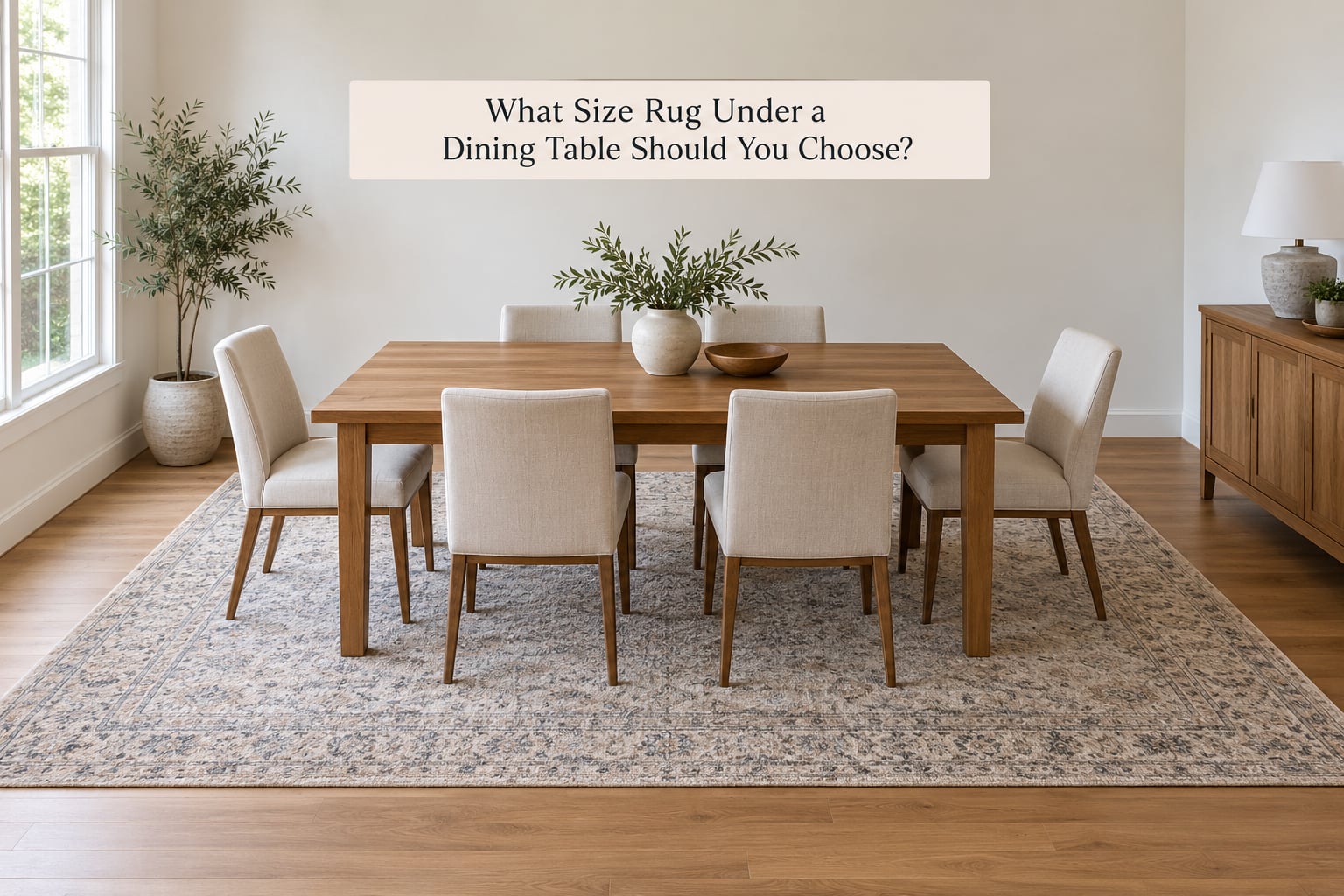
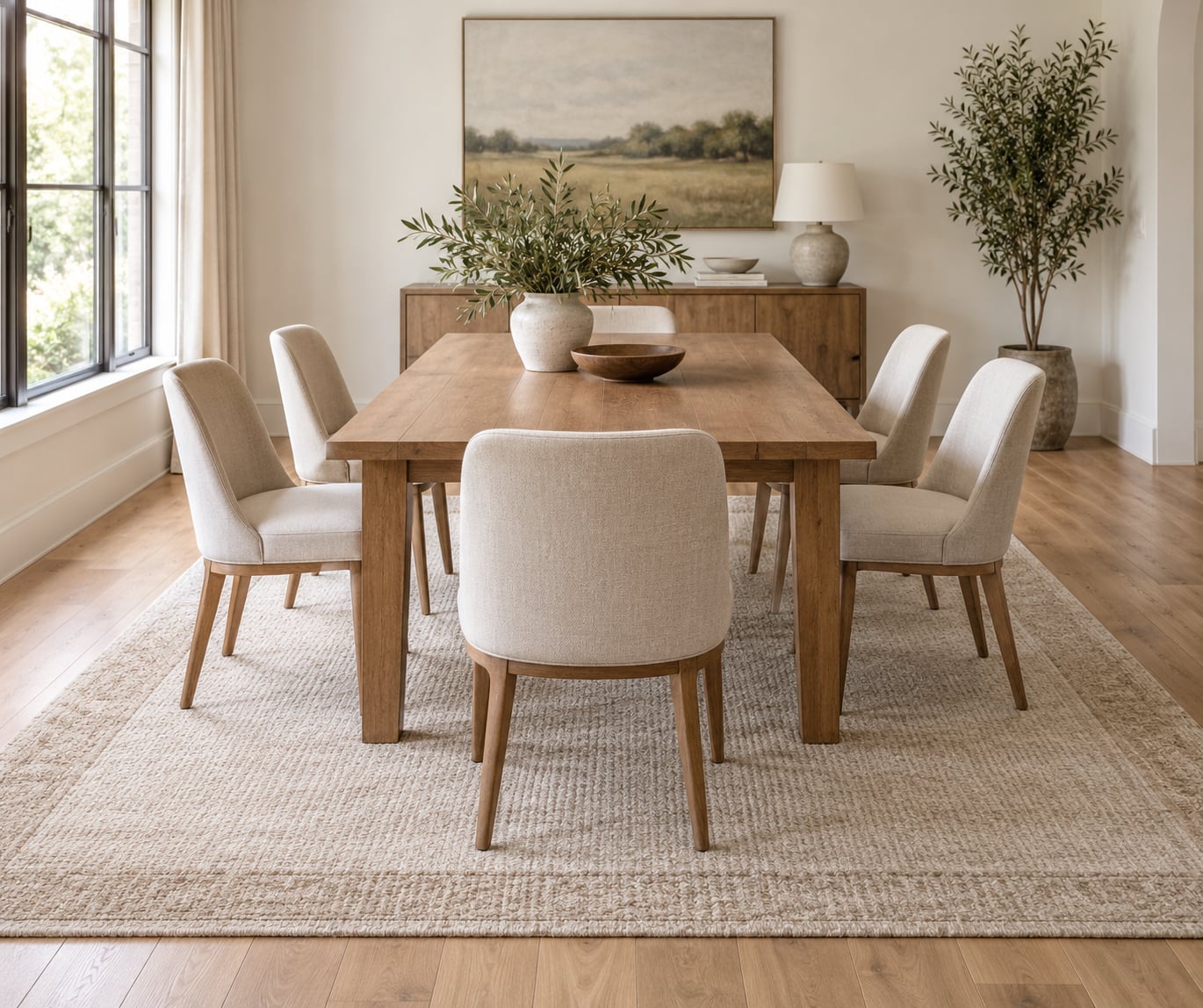
Choose a rug that measures 24 inches longer and 24 inches wider than your table, then round up to the next available rug size. That is the floor, not the ceiling: 30 to 36 inches of overhang per side looks better and gives chairs more room, but 24 inches is where a rug stops looking undersized.
There are two jobs a dining rug can do, and people mix them up. A rug that anchors the table is the one sized to the table plus clearance, and that is the useful default. A rug that fits the dining zone reaches the other pieces in the room and defines the whole area. Both look intentional, but they need different numbers.
| Goal | What you size to | Example with a 60 x 36 inch table |
|---|---|---|
| Anchor the table | Table plus 48 inches on both dimensions | 8 x 10 ft minimum |
| Anchor it generously | Table plus 60 to 72 inches on both dimensions | 9 x 12 ft |
| Fit the dining zone | The nearest other furniture, minus about 24 inches | Sideboard 3 ft away means a 10 x 14 ft rug |
Size to the table first. Fitting the whole zone only works when the table sits in a room with clear floor on all four sides, and plenty of dining rooms do not.
How Do You Measure a Dining Table for a Rug?
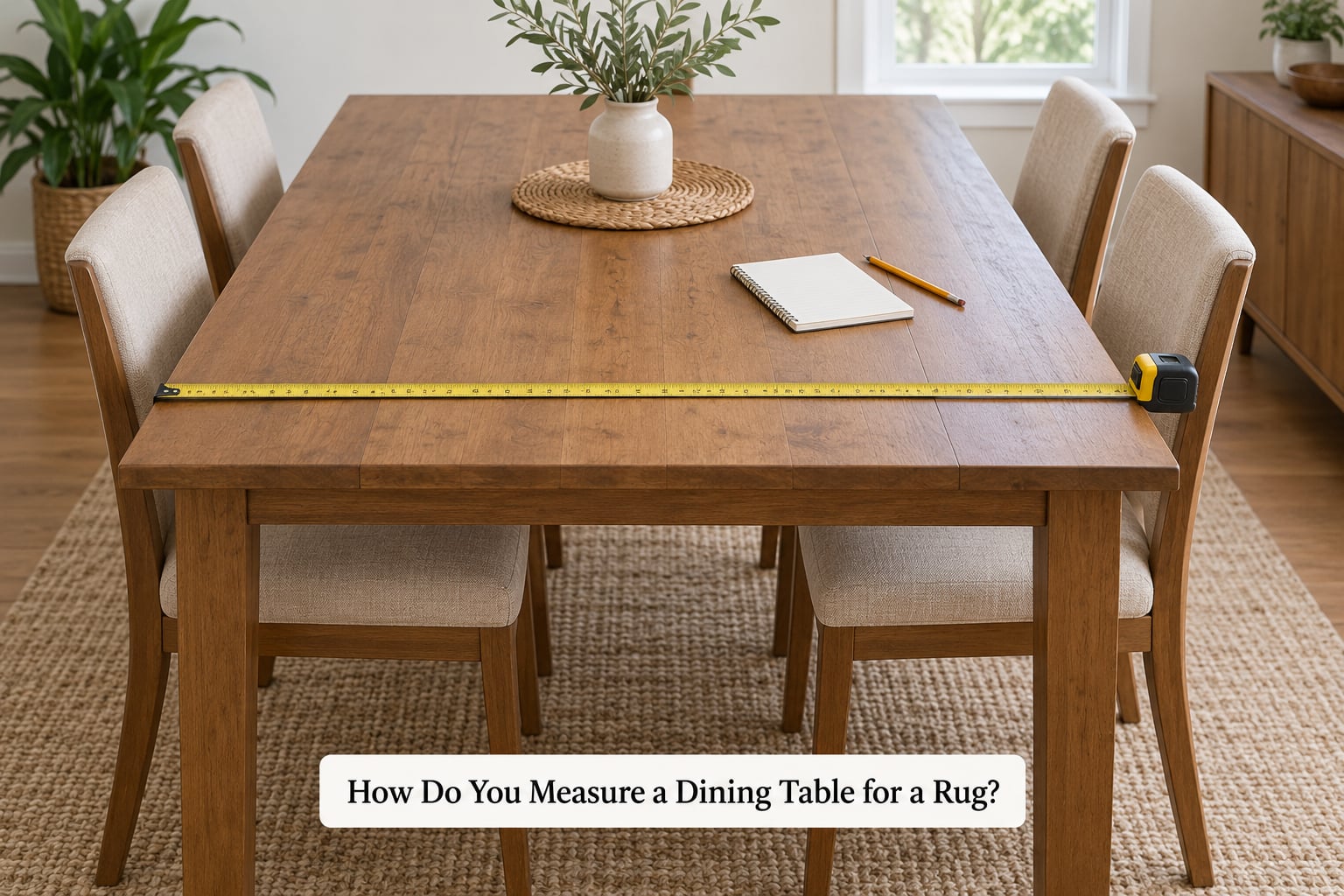
Measure the table top to top, widest point to widest point, including any pedestal or thick trestle that sticks out past the edge. Most mistakes come from measuring the tabletop and ignoring the base.
- Measure length. Push a chair in and measure the widest point along the table’s long axis, front edge to front edge.
- Measure width. Measure across the narrowest part a diner has to squeeze past. A pedestal base can be wider than the top, and that width is what chairs hit.
- Check the chair footprint. Pull one chair out fully, as if someone were sitting down. The floor it covers is the area the rug must hold.
- Measure the room. Wall to wall, both directions. Subtract 24 inches from each number and you have the largest rug your floor can take.
- Tape out the footprint. Mark the rug rectangle on the floor with painter’s tape, walk around it, and pull a chair out at each seat. This is the fastest way to catch a bad number before you spend anything.
The tape step matters more than it sounds. A rug can measure perfectly and still crowd a doorway or pinch a walkway, and a tape outline shows that in two minutes rather than after the rug is unrolled.
Write down two numbers before you shop: your table dimensions, and your room dimensions minus 24 inches on each side. The rug you want is the standard size that is at or above the first number and at or below the second.
How Much Rug Should Extend Beyond the Table?
Plan for 24 inches of rug past every edge of the table, and 30 to 36 inches if the room can take it. Every chair should sit fully on the rug when pulled out, with all four legs on it. If a back leg hangs off, the rug is too small.
The 18 inch rule you will read everywhere is real, but it belongs to living rooms, where the goal is furniture legs landing on the rug rather than people pulling chairs out. Dining needs more because chairs travel. Catching is the failure point, not a hard number: if a chair edge never snags the rug when it is pulled back, a slightly smaller rug still works.
Two adjustments are worth knowing:
- Big tables, long sides. A 90 inch table needs more than 24 inches at the ends, because the host seat travels the longest distance. Add 36 inches on the long axis if you can.
- Tight rooms. 18 to 24 inches per side still works when a chair leg lands just off the edge, provided the border does not wobble when someone sits. Keep the rug centered and the overhang even, or the unevenness reads as a mistake.
Round and oval tables use the same rule, measured from the tabletop edge to the rug edge in every direction.
Which Rug Shape and Size Fit Your Dining Table?
Match the rug shape to the table shape and the room’s traffic flow. The table should sit centered on the rug, with equal overhang on every side.
| Rug shape | Best for | Sizing note |
|---|---|---|
| Rectangular | Rectangular and oval tables, most rooms | Table plus 48 inches on length and width |
| Round | Round tables, curved floor plans | Diameter plus 48 inches |
| Square | Square tables, small breakfast nooks | Use the larger table dimension for both sides |
| Oval | Long oval tables in wide rooms | Add 48 inches to length and to width |
| Runner | Sideboards, narrow galley kitchens | Table width plus 24 inches on each long side |
A round rug under a rectangular table is not wrong, but the eye reads the mismatch. The same goes for a rectangle under a round pedestal table, where the corners end up empty while chairs sit at the edge. When shapes cannot match, go two sizes up rather than forcing the match.
What Size Rug Fits a Small Dining Room?
Take your room dimensions and subtract 24 inches from each one. That is your maximum rug size, and it leaves a walkway around the rug instead of running it wall to wall. A 10 by 12 foot room gives you an 8 by 10 foot rug at most.
Standard sizes make small rooms awkward because the steps are large: 5×7, 6×9, 8×10, 9×12, 10×14. If your calculation lands between two sizes, round up only as far as the room allows and accept a slightly tighter border. Never round down. A rug two sizes short reads as an accident.
Breakfast nooks and galley kitchens are the usual exceptions. A round 6 or 8 foot rug under a 42 inch round table fits the space beautifully, and leaving the bare floor around it reads as intentional tile or wood rather than a cramped room.
If the clearance numbers do not work at all, a rug tucked fully under the tabletop is a legitimate choice. Chairs sit off it, so nothing catches, and the rug works as a floor protector rather than a seating surface. It is a deliberate look, not a compromise, as long as you keep it centered.
What Size Rug Works in a Large or Open-Plan Room?
Scale the same 24 inch rule up, and let the rug do more work. In an open plan living and dining area, the rug is often what separates the two zones, so size it to reach toward the living seating rather than stopping at the table.
For a 72 by 40 inch table, a 9 by 12 foot rug is the minimum and a 10 by 14 foot rug is the comfortable choice. Anything seating eight or more needs the 9 by 12 or larger. If a large pendant hangs low over the table, size for clearance as well as for looks, because a low-hanging light with tight clearance is exactly where chairs start catching the rug edge.
Leave at least 24 inches between the rug edge and any sofa, sideboard or console. A rug that touches other furniture reads as one continuous surface, which is a good look in an open room and a poor one in a small one.
What Rug Size and Placement Look Best?
Center the rug on the table, not on the room. The table should be equidistant from every rug edge, and the rug centered on the room as well when the room allows. Those two centers line up in most dining rooms and cannot both be satisfied in an awkward one, so prioritize the table.
Other details that decide whether it looks right:
- Visible floor. Leave 12 to 24 inches between the rug edge and each wall. A rug touching every wall looks cramped.
- Table legs. Front legs on the rug is enough if rear legs are off; all four on the rug is better if the size allows.
- Doors. Check that a dining chair pulled back does not catch a door or cabinet. This is where the tape outline earns its keep.
- Color and pattern. Contrast anchors the table and defines the zone in an open plan. A pattern hides crumbs and spills better than a solid. Tonal rugs work in small rooms where contrast would fragment the space.
- Pile. Low-pile and flatweave let chairs glide and clean up easily. High-pile traps crumbs and dust under the table, so skip anything shaggy beneath a dining table.
- Pad. A rug pad is worth adding under heavy furniture. It grips the floor, cushions the chairs, and protects hardwood from dye and grit transfer.
Frequently Asked Questions
Will a 5×7 rug fit under a dining room table?
Only under a very small table. A 42 by 30 inch table plus 48 inches needs a 90 by 78 inch rug, and the closest standard size is 8 by 10 feet. A 5 by 7 rug works under a 24 by 36 inch bistro table with minimal overhang, or as a deliberate tabletop-only placement where the chairs stay off it.
Is an 8×10 rug big enough for a dining room?
For a standard four to six person table, yes. An 8 by 10 foot rug covers a 60 by 36 inch table with 22 to 24 inches of overhang on each side, which is the accepted minimum. Once you move to a 72 inch table or seat eight people, step up to 9 by 12 feet.
What is the 18 inch rule for rugs?
It is a living room rule: furniture front legs should land on the rug, and roughly 18 inches of rug beyond the furniture keeps things balanced. Dining tables need more, usually 24 inches, because chairs pull back when people sit. Both numbers appear in good guides because they answer different rooms.
Is it a good idea to have a rug under a dining table?
Usually yes. A properly sized rug softens sound, protects the floor from chair traffic, defines the dining zone in an open room, and makes a small space feel more finished. The trade-offs are real, though: crumbs and dust collect under the table, and a thick pile traps both. A low-pile flatweave addresses most of that.
Do I need a rug pad under a dining table rug?
It is not strictly necessary, since the table’s weight keeps the rug in place. A pad still helps because it grips the floor so chairs do not slide the rug, adds cushion under chair legs, and blocks dye or grit transfer onto hardwood. Skip the pad if your rug is a washable all-in-one with a non-slip backing.
Should I put a round rug under a rectangular dining table?
It works if the round rug is large enough to hold every chair, which usually means a 10 foot or 12 foot diameter under a standard rectangular table. Below that, the corners sit empty and chairs hang off the edge. A rectangular rug under a round pedestal table has the same problem in reverse, and matching shapes is the safer choice.
Conclusion
Measure the table first, add 48 inches to its length and 48 inches to its width, then buy the smallest standard rug that reaches that number and still leaves room to walk around it. Before you order, tape the footprint on the floor and pull a chair out at every seat. If every chair leg stays on the rug, you have the right size.