If you have ever wondered how to make a fireplace a focal point, the fix is rarely a bigger fireplace. It is concentration: put the visual weight in three places, the surround or chimney breast, the mantel shelf, and the firebox opening. Work those zones top-down, then let lighting and furniture aim the eye back at them, and the room reads intentional within a weekend. Most of the moves below cost nothing but an afternoon and a trip to a thrift shop.
The one thing to fix first is almost never the fireplace itself. Homeowners on decorating forums usually describe the same symptom: something is off and they cannot name it. Nine times out of ten it is clutter competing for attention, a blank wall above the mantel with nothing to anchor it, or a television that has quietly become the room’s real centerpiece.
Table of Contents
- What You Need
- Step-by-Step: How to Make a Fireplace a Focal Point
- Start by Defining the Focal Point
- Prepare and Refine the Fireplace Surround
- Style the Mantel as a Display Area
- Make the Wall Above the Fireplace Matter
- Connect the Hearth to the Room
- Finish with Lighting and Nearby Furniture
- Common Mistakes
- Frequently Asked Questions
- How do I create a focal point without a fireplace?
- What are some ways to create a focal point in my home?
- How do I make an unusable fireplace look nice?
- How high should art hang above a fireplace mantel?
- Can I hang a TV above a fireplace?
- Should I paint a brick fireplace or leave it exposed?
- Conclusion
What You Need
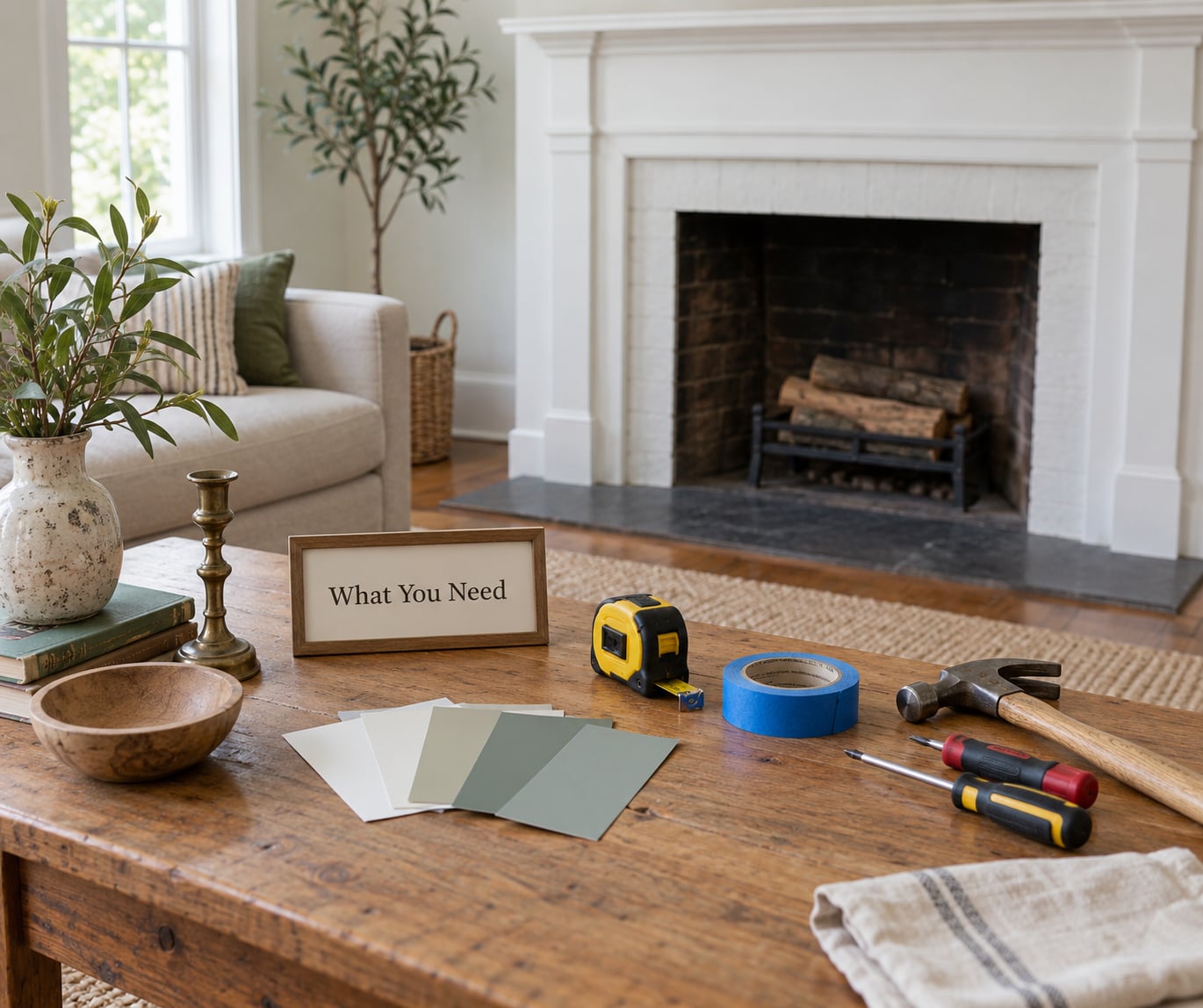
Start by knowing what you are working with. The tool list is short, but the decisions matter more than the equipment.
You will need a tape measure and a pencil, painter’s tape and drop cloth, a level, a paint roller with an extension pole, a brush for edges, sandpaper or a scraper, a caulk gun, and basic cleaning supplies. Add a sponge, a bucket, and a brush stiff enough for brick.
Before shopping for anything, take four measurements and write them down:
- The width and height of the wall or chimney breast, from the floor to the ceiling.
- The mantel shelf width, its depth from the wall, and the height of the wall directly above it.
- The firebox opening, measured across and up.
- The distance from the room’s main walkway to the front of the hearth.
Those numbers tell you what scale your objects need to be, and most decorating mistakes are just objects at the wrong size for the space.
Next, decide how the fireplace actually works. Find out whether it burns real wood, runs on a gas insert, is electric, or has been disconnected and bricked up. That answer controls what can sit on the mantel, what can lean in the firebox opening, and whether you need a licensed technician before anything gets moved. If you are not sure, read the rating plate inside the firebox or ask a chimney professional rather than guessing.
Finally, check two safety facts and note them on your list: which vents and flues you must not cover, and how hot the surface actually gets when the fireplace is in use. Many people only discover the second point after a candle melts onto a shelf.
Step-by-Step: How to Make a Fireplace a Focal Point
Start by Defining the Focal Point
A focal point is simply the place the eye lands first and returns to. A living room usually needs exactly one, and if two elements are competing, neither wins. Decide which single element will carry the room: a finished surround wall, a large mirror, one oversized art piece, or the firebox itself with a dramatic fill.
Diagnose the wall honestly. Ask four questions: is the mantel crowded, is there anything on the wall above it, does the fireplace sit in the center of the wall, and does a television or large window pull focus away from it? Each failing one tells you which stage below matters most.
The awkward geometry cases are worth naming. If the fireplace sits off-center, stop trying to make it symmetric. Lean into it instead, shift seating to balance the room, and let the asymmetry read as deliberate. If the chimney breast runs wide and tall, treat the whole breast as one surface rather than three separate spots to decorate.
Prepare and Refine the Fireplace Surround
The surround is the largest zone, so it carries the most weight. Give it a clean, even surface first. Wash brick or stone with a soft brush and a gentle cleaner, scrape loose paint, fill nail holes and cracks with filler, and run a bead of paintable caulk along the edges where the mantel meets the brick.
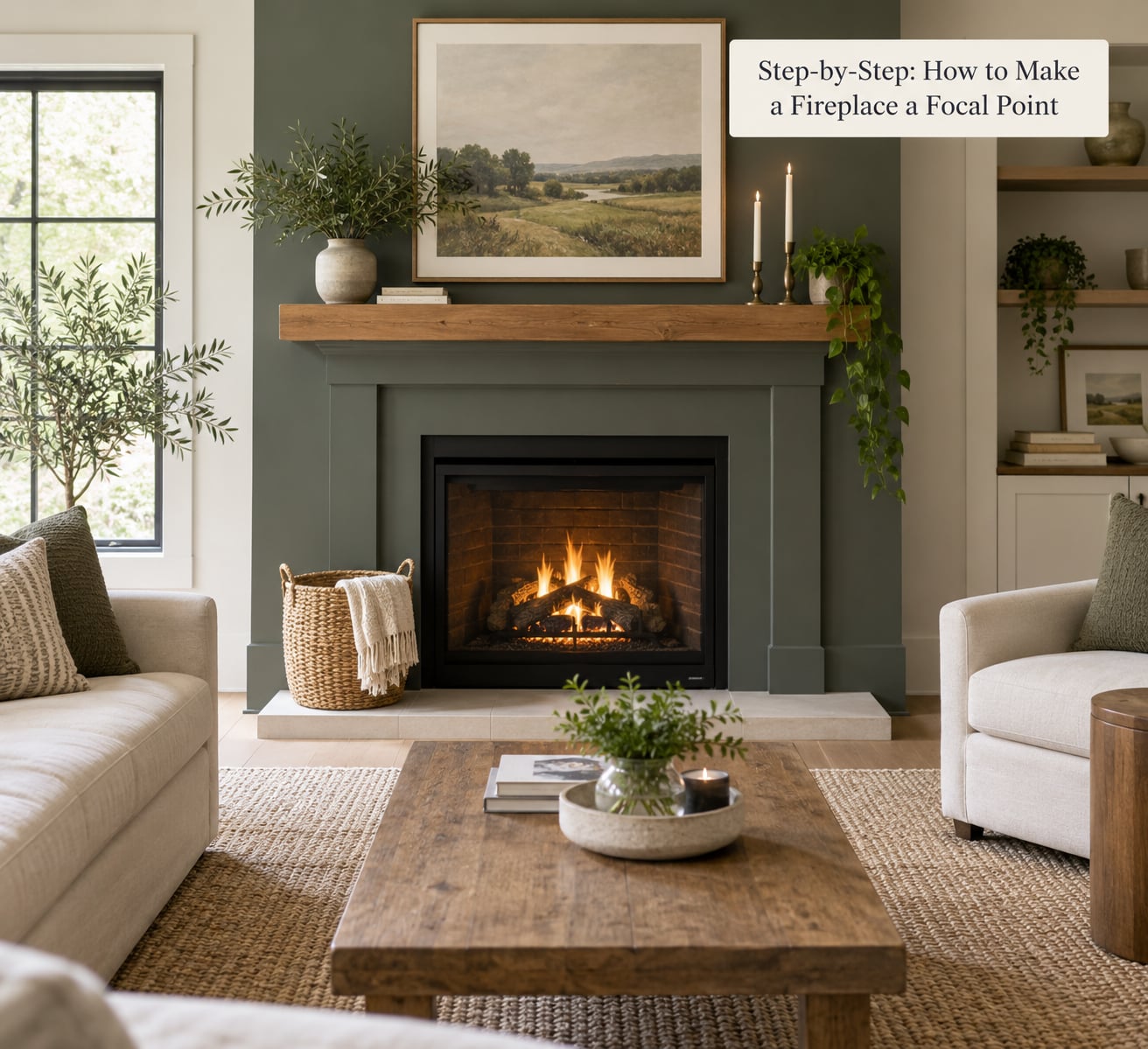
Then pick one of two directions. Paint the chimney breast the same color as the surrounding wall so the bulk visually disappears, and let the mantel and firebox become the focal point. This is the cheapest fix there is and the one forum readers recommend most often for bulky white brick.
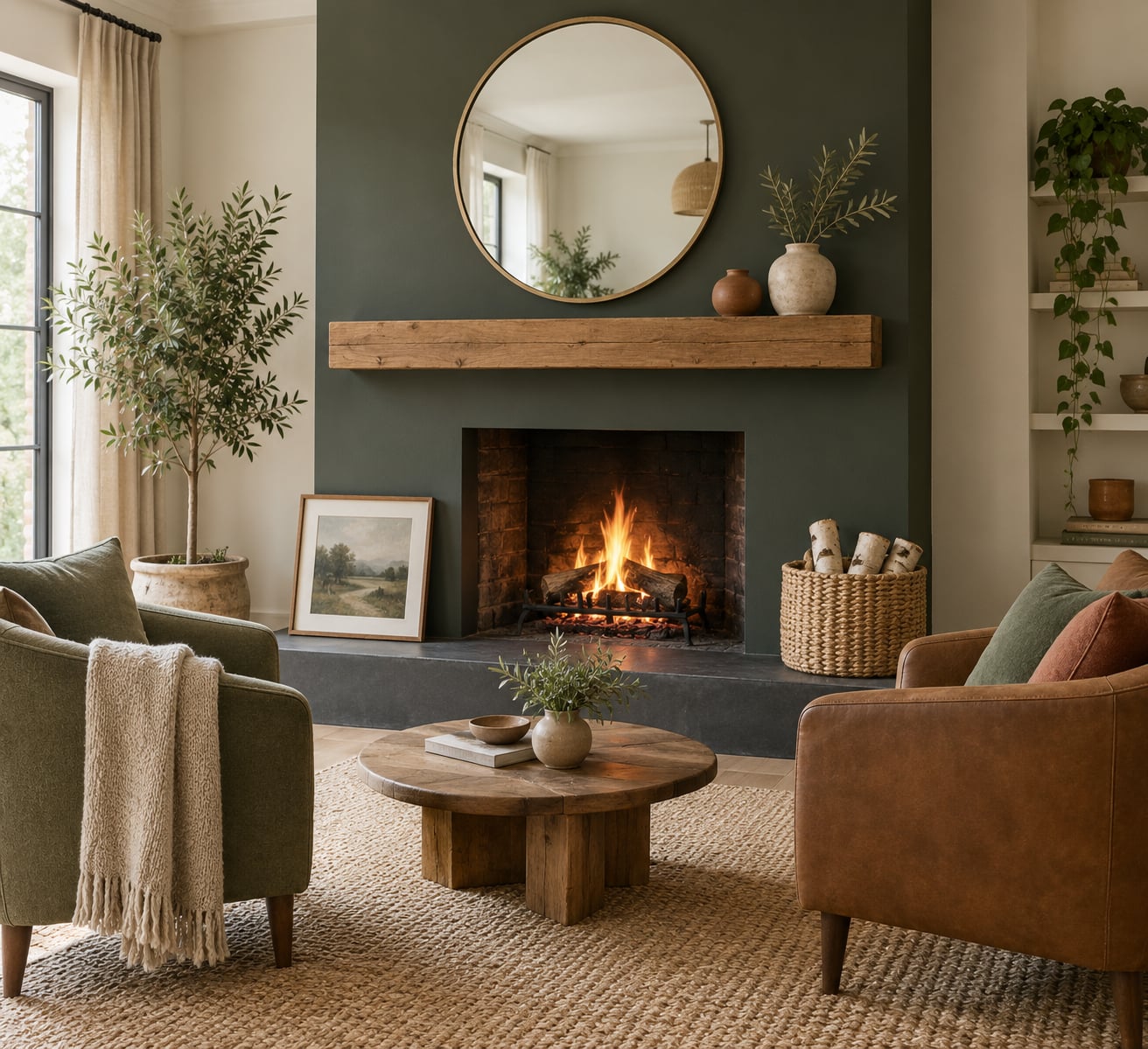
The other direction is to make the surround the statement: a dark matte accent wall, a warm clay or olive tone, a vertical tile field, or lightweight stone veneer. Dark paint on a white brick surround is the single biggest visual change most homeowners can make in a day, and it makes everything above and beside it read brighter.
Two practical notes. On a working fireplace, use a paint formulated for high-heat surfaces on the firebox itself, and follow the manufacturer’s stated clearance over anything decorative. Never block a vent or a flue, and never seal a required vent. If the surface is real brick, plaster, or historic stone, a pro should assess it before you drill, because masonry that gets punctured wrong can compromise the chimney or your insurance.
Renters can get most of the same effect without paint. Large peel-and-stick panels in tile or subway patterns, a fabric wall hanging on a tension rod, or leaning oversized frames against the surround all create a backdrop you can remove in an afternoon.
Style the Mantel as a Display Area
The mantel is where most people overdo it. The fix is usually subtraction: clear everything off, then bring back fewer and larger objects. A mantel that holds one dominant piece and two or three supporting objects reads as styled, while a mantel holding nine small vases reads as cluttered.
Group in odd numbers, and vary height so objects are not all in a line. A good starting rule is to place the tallest object at or just off the center, put the medium-height piece beside it, and use a small low object to close the group. Leave roughly a third of the mantel surface empty; that empty space is part of the composition, not an oversight.
Scale to the shelf, not to your house. A mantel over six feet wide needs a piece that is genuinely large, otherwise everything on it looks like a doll’s collection. Leave a few inches of clearance at each end of the shelf so the arrangement looks composed rather than squeezed.
If you want a test that travels well, clear the mantel and put one large rectangular mirror on it. It is the most repeated suggestion in homeowner threads for good reason: it adds light, doubles the room’s apparent depth, and gives the whole wall a center of gravity.
Make the Wall Above the Fireplace Matter
The blank space above the mantel is where most focal-point attempts fail. That wall needs one vertical anchor: art, a mirror, a shelf with a single object, paneling, or a television.
For artwork, hang the bottom edge six to eight inches above the mantel shelf, and let the piece be two-thirds to three-quarters of the mantel width for a single frame, or span the full mantel width with a pair or a triptych. Center it over the mantel, not over the room, because the room’s center is often nowhere near the fireplace.
If the wall is very tall, consider a tall narrow piece, a vertical stack of frames, or two staggered frames. If it is short, a single wide horizontal piece works better than anything tall. For oversized walls, a wall gallery with consistent matting and one dominant frame among smaller ones gives the eye somewhere to land.
On the television question, be honest. Hanging a large screen above a fire means living with glare, heat, and a neck angle, and a working fireplace may need its vent path kept clear. Follow the insert manufacturer’s clearance requirements, confirm the wall can carry the weight, and use heat management such as a raised mount and a properly engineered mantel detail if your setup allows it. If your fireplace is used often, a side-mounted or adjacent screen is often the better room.
Built-in shelving flanking the mantel solves two problems at once, giving the blank wall structure and storage. It is a carpentry job, so measure the chimney breast carefully and use a stud finder before you commit.
Connect the Hearth to the Room
The hearth is often styled as an afterthought, which is why it looks stranded. Tie it to the room by treating it as furniture. A woven basket of birch logs, a stack of split firewood in a metal cradle, or a shallow tray of decorative logs all fill the opening and give it weight.
For a non-working fireplace, the opening is an asset, not a hole. A large mirror leaning inside reflects light and doubles the depth of the room. Leaning artwork against the back wall works, as does one statement object such as an oversized vase, a lantern, or a sculptural branch in a tall vessel. Support anything you lean with a hidden bracket or a level wedge so it cannot slide.
Nearby, let the floor do some of the work. A rug whose front edge runs under the front legs of the seating anchors the seating to the fireplace, and a slim bench or pair of stools flanking the hearth turns dead space into seating. A small round table on one side, close enough that a seated person can reach it, helps the fireplace feel like a destination rather than a wall feature.
Finish with Lighting and Nearby Furniture
Light is what makes a focal point work in the evening. A pair of sconces on either side of the mantel, or one fixture per side of the chimney breast, frames the fireplace and washes the surround. Battery-operated sconces are a good renter option and require no wiring.
Add a table lamp beside the nearest chair, and use a directional floor lamp angled at the wall if the room still feels flat after dark. Candles in clusters of three on the hearth or mantel add movement, but keep them on a stable surface and well away from any flame or vent.
Finally, aim the room at the fireplace. Place the main seating so people sit facing it, use two chairs angled in rather than a straight line of sofas parallel to the wall, and leave a clear path so nobody walks across the front of the hearth to reach the rest of the room. Off-center fireplaces are usually balanced by furniture on the opposite wall, which makes the asymmetry look like a choice rather than a flaw.
Common Mistakes
Crowding the mantel. Nine small objects compete with each other and none wins. The fix is the one people resist most: remove everything, then place one dominant piece and no more than three supporting objects.
Using objects at the wrong scale. Tiny vases on a wide mantel, or a narrow mirror over a broad chimney breast, make the whole wall look unfinished. Match the largest object to about two-thirds of the mantel width and check it from across the room.
Ignoring the wall above the mantel. A beautifully styled shelf with a bare wall above it still reads as unfinished. Add one vertical anchor sized to the space.
Fighting the room’s style. A sleek black metal surround in a cottagey room, or rustic timber in a flat modern space, will always look borrowed. Match the finish to the furniture you already have, or pick a neutral that sits between both.
Putting décor too close to heat or over a vent. Follow the clearance figures printed on your insert or listed for your appliance, and never cover a vent or flue. A mantel full of paper, wax, and fabric is fine on a non-working fireplace and questionable near a working flame.
Making it too symmetrical or too perfect. Forced symmetry can look harder than a slightly relaxed arrangement. Height variation and a little asymmetry read as human.
DIY-ing masonry that needs a pro. Repointing brick, adding structural weight above a mantel, or changing a gas appliance line is trade work. Get a qualified professional involved; the savings from doing it yourself are small next to the risk.
Frequently Asked Questions
How do I create a focal point without a fireplace?
A focal point is any element the eye returns to, and the same principles apply elsewhere. Use a large piece of art, a mirror, or a wall of color on one wall, then aim your seating at it. A heavy piece of furniture, a bright drape, a gallery wall, or an oversized pendant light in an empty corner all work. The rule is one clear anchor per room, sized larger than you expect, with nothing brighter competing beside it.
What are some ways to create a focal point in my home?
The reliable options are: paint one wall a contrasting color, hang one oversized artwork or a mirror, build in shelving or benches around a fireplace or window, run vertical paneling or tile to add texture, place a large rug to define a seating zone, or light a wall deliberately with sconces or a floor lamp. Whichever you pick, point the furniture at it and keep the competing surfaces quiet.
How do I make an unusable fireplace look nice?
Treat the opening as a display niche rather than a hole. Lean a large mirror inside it to reflect light, or rest oversized artwork against the back wall on a hidden support. One sculptural object, a lantern, or a tall vase works too. Close off the flue properly, keep the firebox clean, and add a woven basket beside the hearth so the whole area reads as deliberate.
How high should art hang above a fireplace mantel?
Hang the bottom edge six to eight inches above the mantel shelf, which leaves the art breathing room without letting the gap look empty. Center the piece over the mantel rather than over the room. A single frame should measure roughly two-thirds to three-quarters of the mantel width, or use a pair that together span the full width.
Can I hang a TV above a fireplace?
It is possible, but check two things first: the clearance required by your fireplace or insert manual, and whether your wall can carry the weight of the screen. A large screen over a fire usually means glare, heat, and an awkward neck angle. If you use the fireplace often, a screen placed on an adjacent wall or on a swivel mount usually serves the room better.
Should I paint a brick fireplace or leave it exposed?
Both work, and the right choice depends on the room. Painting brick the same color as the wall makes bulky masonry recede so the mantel leads. Painting it a dark matte tone turns the whole chimney breast into the feature and brightens everything nearby. Leaving it exposed suits a room that already has strong wood and stone texture. Whichever you pick, use a paint formulated for the surface and follow the heat clearance the appliance requires.
Conclusion
Start by choosing one element to carry the room, then measure the fireplace wall, the mantel, and the firebox before you buy a single object. Pull everything off the mantel, put back one large piece plus a few smaller ones, give the wall above it a single vertical anchor, and turn the seating so people face the fire.
That sequence is all it takes for most rooms. Paint, tile, and built-ins come later, and only once the styling already looks right.