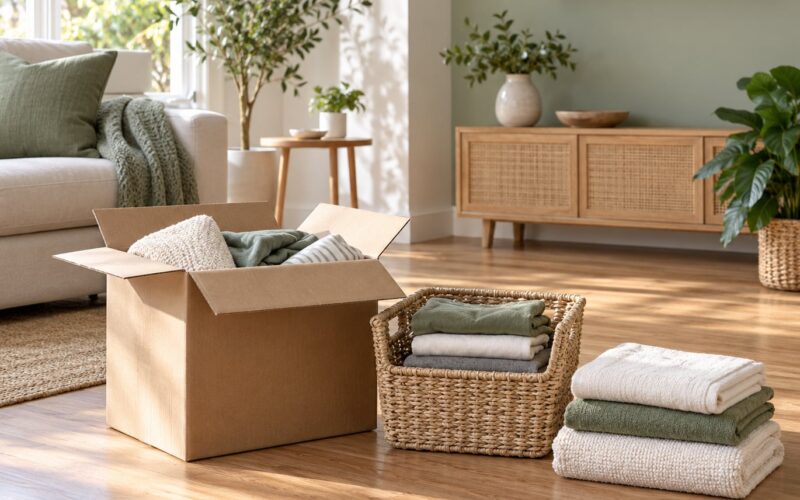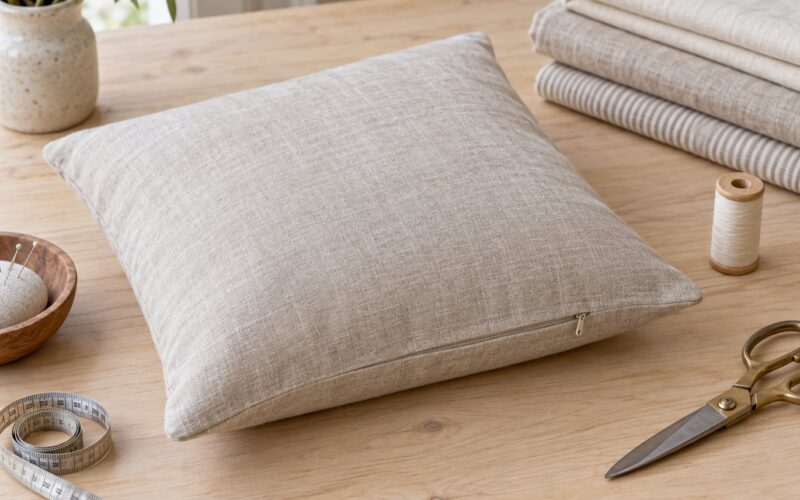
The standard throw pillow for a three-seat sofa is 22×22 inches, filled with a 24×24 inch insert. Step down to 20×20 on a loveseat and up to 24×24 on a wide or deep sectional. Match the pillow to your seat width, not to the sofa’s overall length.
Get the size wrong and a sofa looks half-dressed. Too small and the pillows vanish against a wide seat; too tall and they poke above the backrest like a barricade. Most of the work is a tape measure and ten minutes.
I have rearranged the same three-seat sofa more times than I care to admit, and the pattern is consistent: the arrangements that look expensive are the ones where nobody can explain why. The pillows are simply the right size for the space they sit in, stepped down in size, and left some breathing room around them.
Here is how to work that out for your sofa, whether it is a loveseat in a studio apartment or a deep L-shaped sectional that eats an entire wall.
Table of Contents
- What Size Throw Pillows for a Sofa? Quick Sizing Guide
- Which Throw Pillow Size Works Best for Each Sofa?
- Loveseats and two-seat sofas
- Standard three-seat sofas
- Sectionals and oversized seating
- Low-back modern sofas
- Deep-seat sofas
- The 2/3 rule of thumb
- How Do You Measure a Sofa Before Buying Pillows?
- What Size Throw Pillows for a Sofa Look Balanced?
- Three sizing mistakes that flatten a sofa
- How Many Throw Pillows Should You Put on a Sofa?
- How Do You Arrange Different Pillow Shapes and Sizes?
- Should Throw Pillows Match the Sofa or Add Contrast?
- Frequently Asked Questions
- What is the difference between throw pillow and pillow insert size?
- Are 22-by-22-inch pillows too small for a sofa?
- What shape throw pillows are most comfortable on a sofa?
- Should throw pillows be the same color as the sofa?
- How do you keep throw pillows looking neat on a sofa?
- How often should throw pillows be washed or replaced?
- Conclusion
What Size Throw Pillows for a Sofa? Quick Sizing Guide
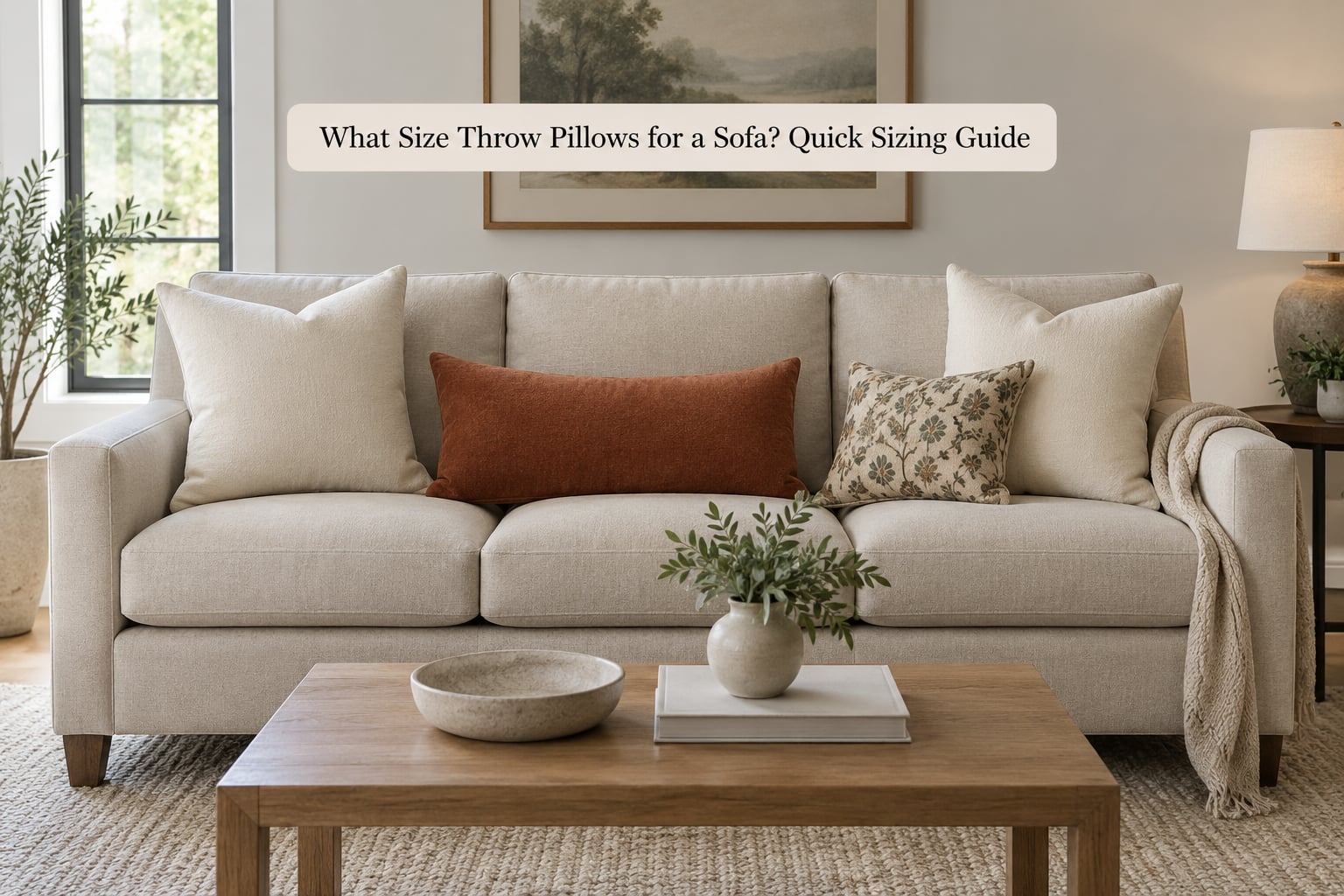
Start with the width of one seat, not the sofa. Divide the total seating width by the number of seats, and the number you get tells you which row of the table below to read.
| Sofa type | Typical width | Back pillow size | Best match |
|---|---|---|---|
| Loveseat or apartment two-seater | Under 60 in (152 cm) | 18×18 in (46 cm) | 20×20 in (51 cm) insert |
| Two-seat sofa | 60-70 in (152-178 cm) | 20×20 in (51 cm) | 22×22 in (56 cm) insert |
| Standard three-seater | 72-89 in (183-226 cm) | 20×20 to 22×22 in (51-56 cm) | 22×22 in (56 cm) insert |
| Large three-seater or shallow sectional | 90-100 in (229-254 cm) | 22×22 to 24×24 in (56-61 cm) | 24×24 in (61 cm) insert |
| L-shaped or deep sectional | Over 100 in (254 cm) | 24×24 in (61 cm) | 26×26 in (66 cm) insert |
| Low-back modern sofa | Varies | 18×18 in (46 cm) | 20×20 in (51 cm) insert |
| Deep-seat sofa (over 40 in / 102 cm) | Any | 22×22 in (56 cm) | 24×24 in (61 cm) insert |
Decorators on r/HomeDecorating describe 22 to 24 inch squares with down filling as the most common look on a standard sofa, which matches the middle of this range. If you want one number to walk into a shop with, buy a 22×22 inch cover.
Here are the standard sizes you will see in stores, with the insert that fills each one properly.
| Cover size | Metric | Insert to use | Feels like |
|---|---|---|---|
| 18×18 in | 46×46 cm | 20×20 in (51 cm) | Firm, tidy, good for small seats |
| 20×20 in | 51×51 cm | 22×22 in (56 cm) | The everyday standard |
| 22×22 in | 56×56 cm | 24×24 in (61 cm) | Full and soft, designer look |
| 24×24 in | 61×61 cm | 26×26 in (66 cm) | Statement scale |
| 26×26 in Euro sham | 66×66 cm | 28×28 in (71 cm) | Thin, oversized, usually two per sofa |
| 14×18 in | 36×46 cm | 16×20 in (41 cm) | Small accent, front row only |
| 12×20 in lumbar | 30×51 cm | 14×22 in (36 cm) | Low back support |
| 14×22 in lumbar | 36×56 cm | 16×24 in (41 cm) | Fuller lumbar for deep seats |
The insert rule explains most of the disappointment people report. Buy the insert 2 inches larger than the cover and the corners fill out, seams stay relaxed, and the pillow holds its shape after a day of leaning. Going one size up works fine. Matching sizes gives you a flat, slightly sad pillow that looks half empty.
Which Throw Pillow Size Works Best for Each Sofa?
Loveseats and two-seat sofas
A loveseat gives each person about 30 inches of seat width, which is the whole story. One 18×18 pillow on each end leaves the center open for sitting, which is what you want in a room where the sofa gets used daily.
Avoid stacking two pillows on a two-seater. The pair of them takes up most of the usable seat and the arrangement reads as furniture you are not allowed to sit on.
Standard three-seat sofas
Split a 72 to 89 inch sofa and each seat lands near 24 to 30 inches wide. That range is why 20×20 and 22×22 both work here, and why the choice comes down to how tall your back cushions are.
If your back cushions measure 14 inches or less from seat to top of the back, use 20×20 pillows. They will sit without rising above the back line, which is the neat look most people are going for.
Sectionals and oversized seating
Large sectionals are wide enough that a single pair of 20×20 pillows looks lost at either end. Step up to 22×22 or 24×24 and let each corner carry a pair, one square and one lumbar.
On a deep L-shaped sectional, the chaise end usually needs its own pillow grouping. A single accent there looks like an oversight rather than a decision.
Low-back modern sofas
Slim-arm, low-back sofas are the one case where bigger is wrong. A 24 inch pillow on a 12 inch back looks like it is sliding off, because visually it is.
Stay at 18×18, or even 16×16, and sit them slightly forward against the arm. The proportion that matters most on a low-back sofa is the pillow height against the back height, not the pillow against the sofa.
Deep-seat sofas
Seat depth past 40 inches is where 20×20 pillows start to look wrong, and forum decorators mention this constantly. The pillow sits at the back, you sit forward, and there is a gap between you and it.
Fix the gap with depth rather than width: a 24×24 pillow, a lumbar tucked in front of it, or a small accent resting against the seat back. Deep seats also like loose throws better than heavily arranged pillows, since most of the surface is sitting space.
The 2/3 rule of thumb
The 2/3 rule answers a question people search for constantly and almost no decorating site explains. Take the width of a single seat cushion and choose a pillow roughly two-thirds of it. A 24 inch seat gets a 16 inch pillow; a 30 inch seat gets a 20 inch pillow; a 36 inch seat gets a 24 inch pillow.
Use it when the seat is unusually wide or unusually narrow. Everywhere else, the standard table is more reliable than a formula.
How Do You Measure a Sofa Before Buying Pillows?
Ten minutes with a tape measure removes most of the guesswork. Work through these in order.
- Measure the total width from the outside of one arm to the outside of the other. This tells you which row of the sizing table applies.
- Count the actual seats and divide the width by that number. This is your per-seat width and the single most useful number in the whole process.
- Measure seat depth from the front edge of the seat cushion to where it meets the back cushion. Anything over 40 inches calls for a larger pillow or a lumbar in front.
- Measure the back height from the top of the seat cushion to the top of the backrest. Pillows taller than this number will crest the sofa line.
- Measure an existing pillow if you are replacing covers rather than starting over. Lay it flat, measure corner to corner across the face, and buy covers 1 inch larger so seams are not under strain.
- Photograph the empty sofa from across the room before you buy. It makes the pile-on obvious later, when you are three pillows deep and emotionally committed.
If your sofa has unusual proportions, the measurement matters more than any chart. A 90 inch sofa with narrow 22 inch seats behaves like a loveseat twice over, and the tape measure is the only thing that will tell you so.
What Size Throw Pillows for a Sofa Look Balanced?
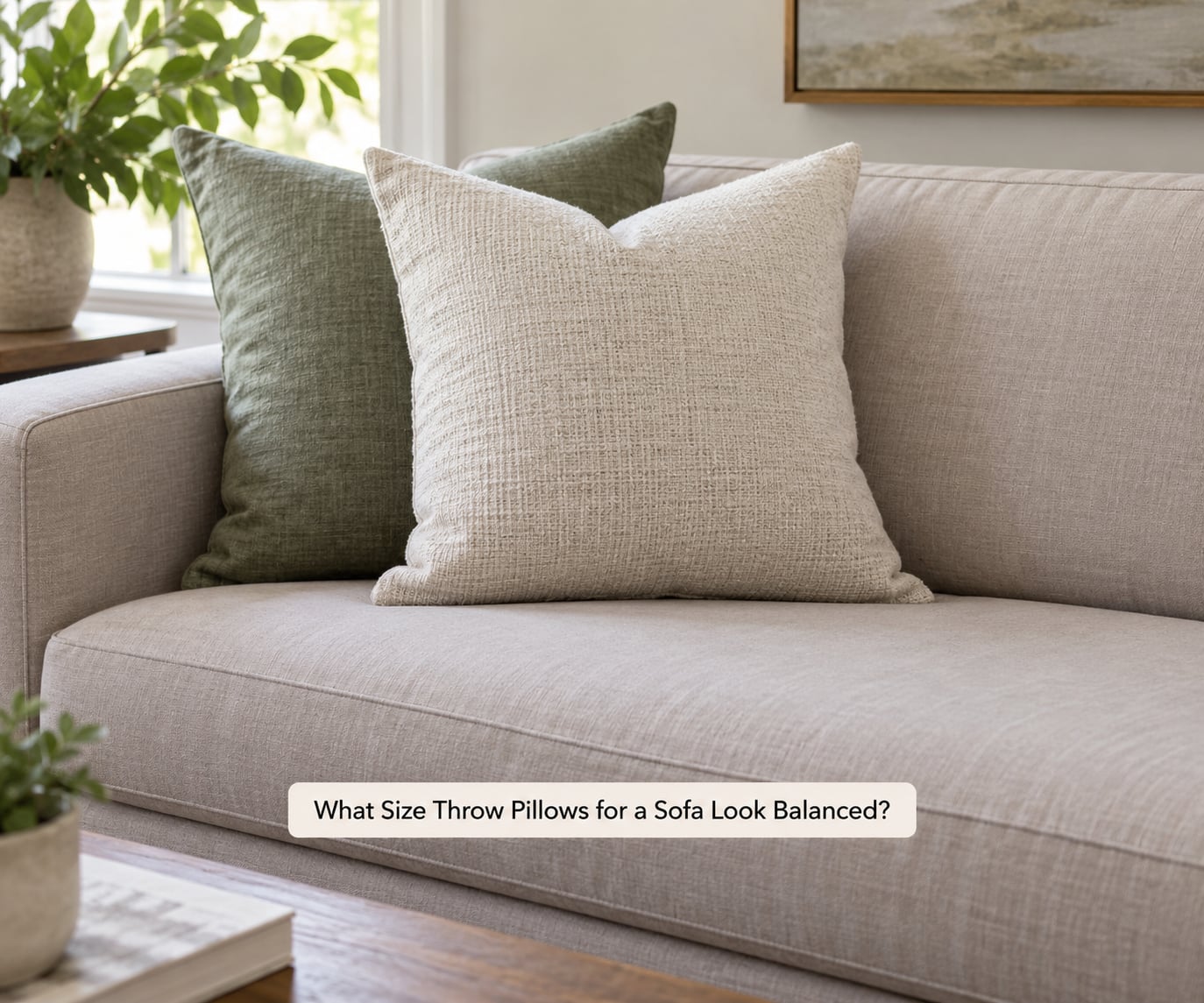
A balanced sofa has three things going on: pillows that fill the space they occupy without touching, a visible stretch of bare cushion somewhere in the mix, and nothing rising above the back line. Remove any one of those and the arrangement stops working.
That is where the 22 to 24 inch guideline for standard sofas comes from. At that scale a pillow is wide enough to feel intentional against a seat and short enough to stay below the backrest.
Overlap is fine and usually better than gaps. Set two pillows at the same corner with about a third of one covering the other, slightly angled, and they read as a layered pair instead of two separate objects.
Negative space is the part people skip. If every square inch of the sofa back has fabric touching fabric, the sofa looks packed rather than arranged. On a three-seater, leaving one corner bare or one whole seat clear gives the eye somewhere to rest.
Three sizing mistakes that flatten a sofa
- Pillows that look lost against a wide sofa. Four 18×18 pillows on a 96 inch sectional is the most common version of this. Each seat needs roughly 24 to 30 inches of pillow, so scale up rather than adding more pieces.
- Pillows taller than the backrest. A 24 inch pillow on a 13 inch back crests the sofa and blocks the line of sight across the room. Drop to 20×20 or move the pillow forward and lean it.
- Too many pillows at one size. Five matching 22×22 squares is clutter with a matching theme. Vary the sizes instead: one large square, one lumbar, one small accent.
Overstuffed inserts create the fourth problem, which is a filling issue rather than a sizing one. Corners poking through seams usually mean the insert is too big or the cover is too small, not that the insert needs fluffing harder.
How Many Throw Pillows Should You Put on a Sofa?
Most sofas look best with one to three pillows per corner grouping, and the number depends more on how often people sit on it than on the sofa’s size.
| Furniture | How many | What that looks like |
|---|---|---|
| Loveseat | 2 | One per end, nothing in the middle |
| Two-seat sofa | 2 to 3 | One per end plus a lumbar if you like |
| Three-seater | 3 to 5 | A pair at each end, center left clear |
| Large sectional | 6 to 8 | A grouping on each section, chaise included |
| Sofa that gets sat on daily | 2 to 3 | One per end, plus a throw for comfort |
The 2/2/1 rule is the shorthand most people run into on social posts, and it is worth understanding even if you do not use it strictly. Two pillows in the back row, two smaller ones in the middle, one accent in front. It produces a stepped arrangement that works on almost any sofa and gives you a repeatable starting point.
Zero pillows is a legitimate answer too. Designer roundups on this topic keep pointing it out: a clean, well-proportioned sofa with a folded throw needs no pillows at all. That is the right call in a formal room, a small space, or anywhere the sofa is primarily seating.
How Do You Arrange Different Pillow Shapes and Sizes?
Shape does the work that size alone cannot. Three identical squares in a row read as repetition; the same three pillows in square, lumbar and small accent read as a composition.
Build the arrangement back to front, stepping sizes down by 2 inches as you come forward. A 24×24 square leans against the back, a 22×22 square overlaps its lower corner, and a 14×18 accent finishes the front. Each layer is visibly smaller, and the eye reads depth instead of a wall.
Lumbar pillows earn their place at the front of the group. A 12×20 or 14×22 lumbar lying across the bottom two squares fills the empty space in front, supports the small of your back when you actually sit down, and breaks up a row of squares.
Euro shams at 26×26 inches are thin by design, which makes them work as back-row pillows where a thick square would sit too tall. Use two per sectional end rather than one, so the pair fills the width instead of floating in the middle.
A few things keep mixed arrangements from tipping into uneven. Odd numbers read as intentional, so three or five pillows settle better than four or six. Alternate rather than group when shapes repeat. And keep one pillow touching the other at an angle, since a gap between every pillow makes the sofa look like a showroom display rather than a lived-in room.
Should Throw Pillows Match the Sofa or Add Contrast?
Contrast, with discipline. A pillow the same color as the sofa disappears into it, which is the fastest way to make an arrangement look accidental.
A workable formula: pick one color from your rug, one from your walls, and one accent you already own somewhere else in the room. Pull those three into the pillows and repeat at least one of them somewhere else in the space, so the sofa does not look like it was decorated on its own.
Pattern behaves the same way. Two patterns of similar scale compete, so either keep the print scale close and vary the color, or use one print with plain pillows around it. A single buffalo check pillow beside plain linen squares works; three different prints rarely do.
Texture is easier to get right than color. Mixing one smooth material with one textured one, such as velvet against boucle or linen against a woven wool, adds depth without adding another color decision. Keep the count of materials at three or fewer.
When sizes differ, match scale across the room rather than repeating one size everywhere. Two 20×20 pillows on the sofa and one 24×24 on an adjacent chair looks like a rule you follow, not a size you happened to buy.
Frequently Asked Questions
What is the difference between throw pillow and pillow insert size?
The size printed on a throw pillow cover is the finished size. The insert is the filling inside it, and it should be 2 inches larger than the cover so the corners fill out and the seams stay relaxed. A 20×20 cover takes a 22×22 insert. Matching sizes work but produce a flatter pillow that looks half empty after a day of use.
Are 22-by-22-inch pillows too small for a sofa?
Not on most sofas. On a standard three-seater between 72 and 89 inches wide, 22×22 pillows are a designer standard and often the best-looking choice, especially when the back cushions are low. They look too small on a wide sectional over 100 inches or on a deep sectional over 40 inches deep, where 24×24 reads better.
What shape throw pillows are most comfortable on a sofa?
Squares work best for lounging because they fill a corner and give you something to hold. Lumbar pillows at 12×20 or 14×22 inches are the most comfortable shape for actual back support, since they sit at the height of the small of your back. Many arrangements use both, with a lumbar resting in front of two squares.
Should throw pillows be the same color as the sofa?
No. A pillow in the same color as the sofa disappears into the upholstery, which makes the arrangement look accidental rather than styled. Pull two or three colors from elsewhere in the room, such as the rug and the walls, and contrast against the sofa fabric. Repeating one of those colors elsewhere keeps the room feeling connected.
How do you keep throw pillows looking neat on a sofa?
Overlap pairs slightly at each corner instead of leaving gaps, and step sizes down by 2 inches from back to front so the layers read as depth. Use down or feather-blend inserts that you can chop and fluff, since they hold their shape after being leaned on. Leave one seat or one corner of bare cushion so the sofa does not look packed.
How often should throw pillows be washed or replaced?
Wash covers every few months, or whenever they start to smell, and check the care label for fiber content before you do. Down inserts can go years between washings if you rotate and fluff them, and reusing an insert with a new cover is the cheapest way to refresh a room. Replace an insert when it no longer holds its shape after fluffing.
Conclusion
Measure first: total width, seat count, seat depth and back height. That takes ten minutes and tells you whether you are shopping for 18×18 pillows or 24×24 ones.
Then start with one or two correctly scaled pillows rather than the full arrangement. Check how they look from across the room, adjust the size once if needed, and build outward from there. For most sofas, that means a 20×20 or 22×22 cover with an insert 2 inches larger, one pillow per end, and room left over to sit down.