If you are working out where to put a bed in a room with windows, the answer is usually not the wall you first picture. Put the headboard against a solid wall with the window beside the bed, not behind it, and leave the window doing its job. When no solid wall exists, put the bed under a single window or turn it sideways against the window wall, then use a headboard and layered curtains to make it look deliberate. Rooms with two windows, a bay, or an awkward shape have their own best position, and the difference is mostly about light, privacy, and clear walking space.
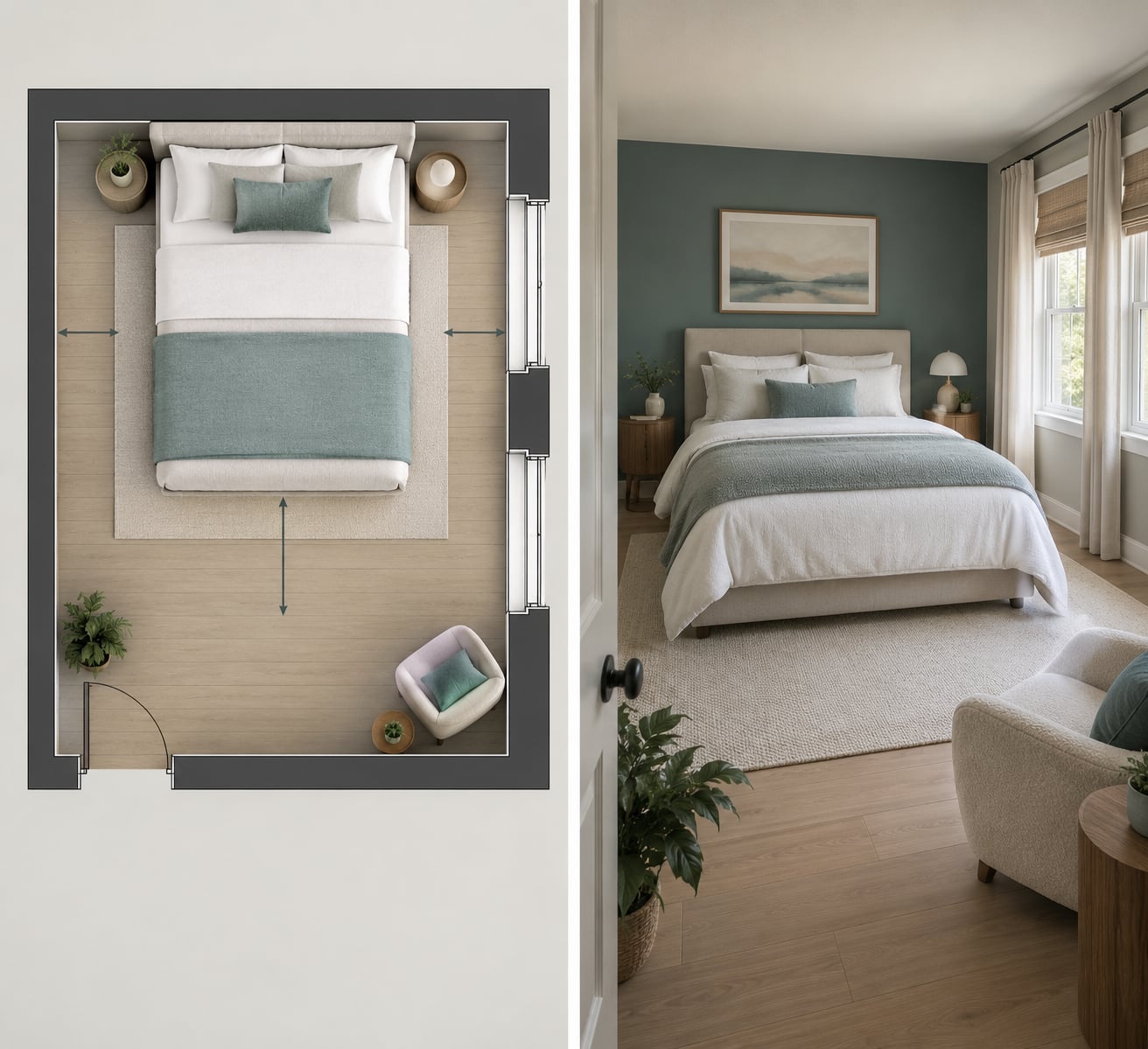
The default that works in nine rooms out of ten: headboard on the wall opposite the door, window on one side. Everything below is a variation on that, for the rooms where it does not fit.
Last updated October 2026.
Table of Contents
- Where to Put a Bed in a Room with Windows: Quick Placement Guide
- Should the Bed Go Directly in Front of a Window?
- When bed-under-window wins anyway
- Which Bed Placement Works Best With One Window?
- The renter version
- How to Position a Bed With Two Windows
- Where to Put a Bed in a Corner With Windows
- Bed size in a corner
- How to Keep Windows Usable After Placing the Bed
- How to Choose Bed Placement Based on Room Shape
- Narrow and long rooms
- Square rooms
- L-shaped rooms
- Irregular rooms with sloped ceilings
- Bed Placement Ideas for Light, Privacy, and Small Rooms
- How to Test a Bed Layout Before Moving Furniture
- Frequently Asked Questions
- Can I put a bed in front of a window?
- What is the best bed position in a room with one window?
- Should a bed be centered between two windows?
- How far should a bed be from a window?
- How do I place a bed in a small bedroom with windows?
- Conclusion
Where to Put a Bed in a Room with Windows: Quick Placement Guide
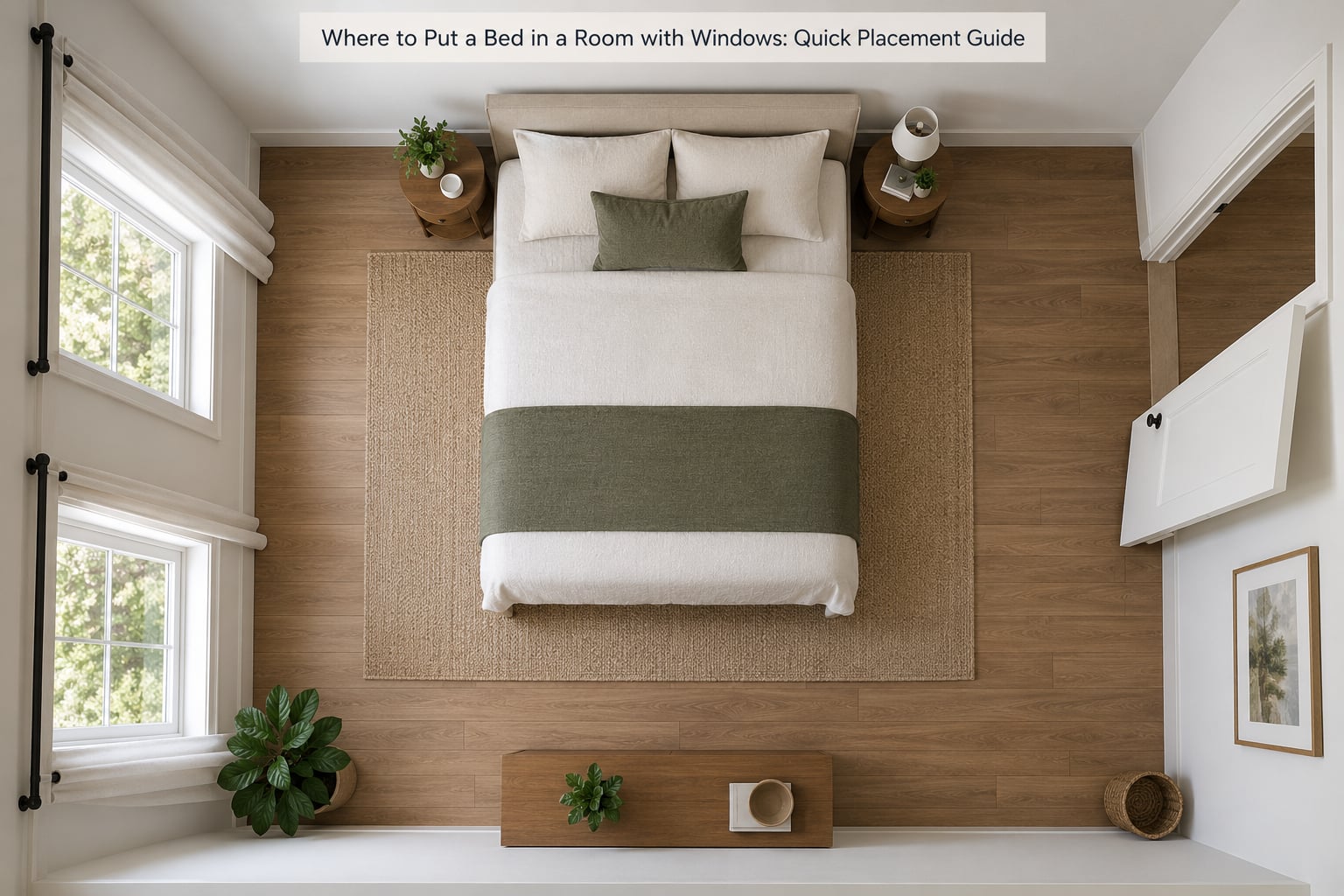
A bed wants three things: a wall behind it, 24 inches of walking room on each side, and a window it does not block. Windows are a light source first and a backdrop second. When the two goals conflict, the window wins the argument and the bed turns sideways.
| Window situation | Bed orientation | Best placement | Main caution |
|---|---|---|---|
| One window | Headboard on a solid wall | Window to one side of the bed | Do not let the headboard block the opening |
| Two windows on one wall | Headboard between them | Centered on the solid pier between windows | Piers are often too narrow for a queen |
| Windows on adjacent walls | Headboard on the third wall | Foot of the bed toward the corner | Corner curtains trap heat when closed |
| Off-center windows | Headboard centered on one window | Center under the larger window | Centering on the small window looks off-balance |
| High window | Headboard below the sill | Bed under the window with a low frame | A radiator under the sill pushes the bed out |
| Bay window | Headboard on the solid wall | Bed facing into the bay nook | Only works if the nook fits a nightstand |
Two rules cover the awkward cases faster than any rule of thumb. If you can walk behind the bed to reach the window, the placement works. If you cannot, the window becomes decorative and you will regret it every time you want air.
Should the Bed Go Directly in Front of a Window?
Yes, when there is no other wall and the window is not the room’s best feature. It is a solvable compromise, not a mistake. Plenty of people sleep under windows every night without problems, especially with a headboard and a window treatment that closes.
Four conditions tell you the placement will hold up. The sill has to sit above mattress height or you will bang your shins. The window has to open with the bed in place, which usually means a tilt-and-turn sash or a window that slides upward. There should be space to reach the sash without climbing onto the mattress. And the bed should not sit in the path between the door and the window if feng shui matters to you.
Three things argue against it. Curtains behind the bed get kicked, crushed, and never fully closed, which means no blackout and a streetlight in your eyes at 2 a.m. A cold window behind your head is a real draft source in winter, and condensation on the inside of the glass can leave the wall damp. If the radiator or a baseboard heater lives under that window, the bed has to move anyway.
A high or clerestory window changes the answer entirely. Nobody puts their head under a window at chest height, so a bed below it is just a bed below a window. Hang the rod above the frame, treat the wall as the feature.
One safety note worth stating plainly: do not place a child’s bed under an operable window. It is a fall risk and it can block the required escape opening in a bedroom. Use a guard rail on a different wall instead.
When bed-under-window wins anyway
It wins in a small room where the solid wall is a closet door or a radiator. It wins in a rental where drilling for a headboard is not allowed. And it wins when the window is the only source of morning light and you want it working for the rest of the room. In those cases, plan the window treatment before the frame, not after.
Which Bed Placement Works Best With One Window?
Beside the window is the best answer in the widest range of rooms. You get the light, you keep a real wall behind the headboard, and the curtains still open all the way. This is the layout to aim for whenever the room gives you one usable wall of about 6 feet or more.
Under the window is second, and it works best with a low-profile platform frame or a headboardless design so the sightline to the glass stays open. Match the bedding to the wall color so the bed visually recedes and the window leads the eye.
Opposite the window is the quiet choice. The bed faces a blank wall, the window sits behind your shoulder line, and nothing about the window is blocked. It suits a bedroom that doubles as a home office, because the desk can take the window wall and the bed takes the wall nobody else wanted.
Check three things before choosing. Outlets: you want one within reach of each side of the bed, and a window wall often has none. Privacy: if the window faces a neighbor or a sidewalk, the bed beside it needs a treatment that closes fully at night. Bedding access: a bed pressed to a wall on one side means climbing over it on that side every morning.
The renter version
If you cannot drill, the bed beside the window gets you the biggest improvement for the smallest effort. A tension-rod curtain, a peel-and-stick hook for a fabric headboard panel, and a clip-on reading light get you most of the way there without touching the walls.
How to Position a Bed With Two Windows
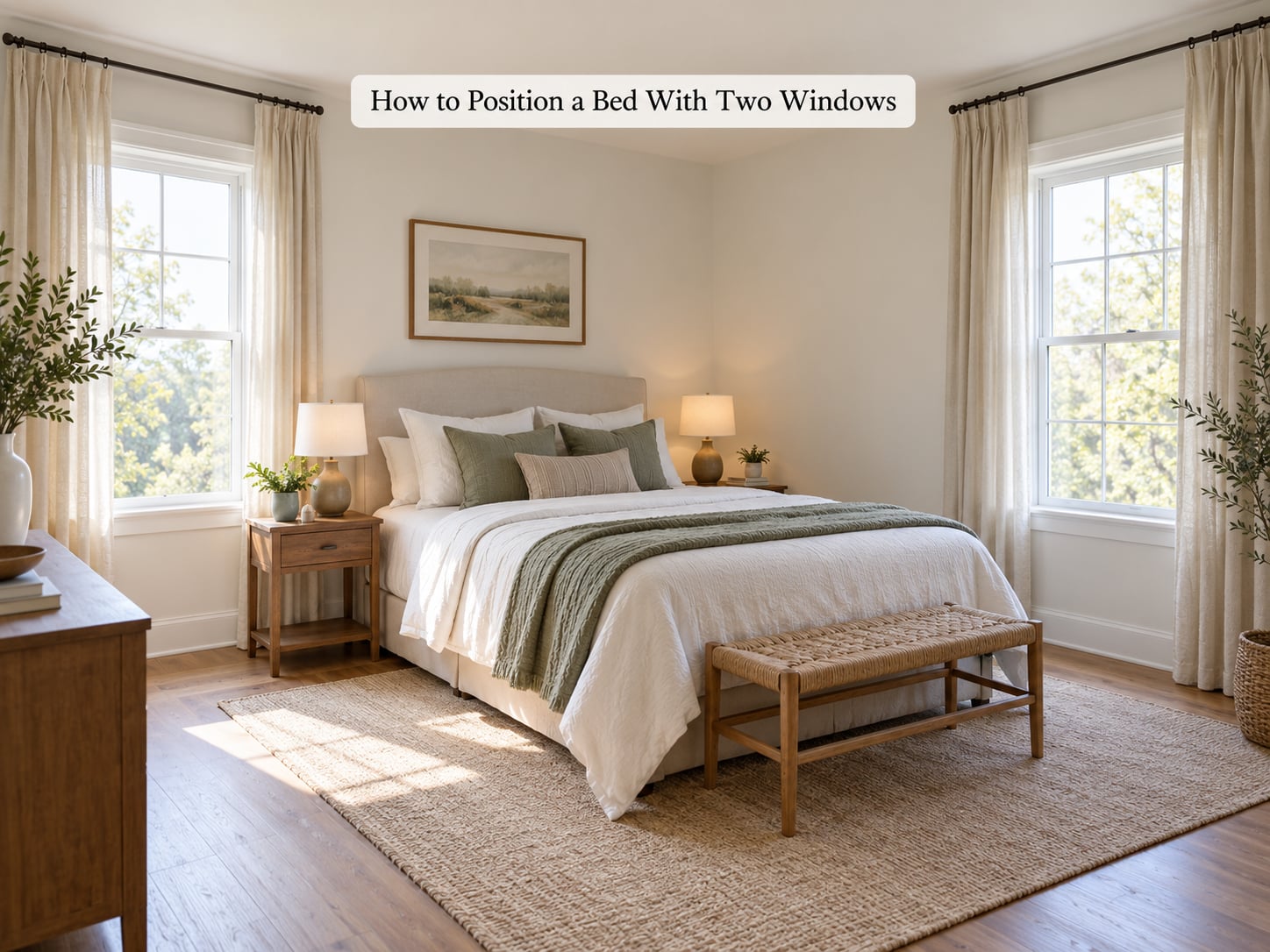
Measure the solid wall between the two windows before you fall for the centered look. That strip of wall, sometimes called a pier, is what makes or breaks this layout. A queen needs roughly 62 inches of wall. If the pier is 40 inches, the centered bed is a twin or a child-sized bed, full stop.
Between the two windows gives the room symmetry and a clear focal point. Center the bed on the pier, run the curtain rod across both windows at a consistent height, and let the panels frame the bed rather than fight it. This is the layout people end up happiest with in off-center-window rooms.
Beneath both windows means two beds, one under each window, which suits a shared kids’ room or a guest room with twin beds. It looks intentional with matching curtains and identical nightstands. It fails when one window is over a radiator and the other is not.
Perpendicular to the window wall means the bed’s long side runs toward the windows, headboard on a solid wall. This is the smart move for a narrow room with windows at the far end, because it turns a cramped dead-end wall into usable depth. Desk space often lands at the foot of the bed in this orientation, facing the light.
Beside both windows is the safe fallback when the pier is too narrow. The bed takes the best solid wall in the room and the two windows sit to one side as a light source. You lose the symmetry but you gain circulation and closet access, which usually matters more.
The failure mode in two-window rooms is predictable: the bed gets centered, then the nightstand collides with a curtain panel, the panel gets pushed permanently open, and the room loses both symmetry and privacy. Decide which window the bed centers on, then size the nightstand to the pier on that side.
Where to Put a Bed in a Corner With Windows
A window-side corner works when the corner has depth, not just width. Measure the corner diagonally: you want about 24 inches of clear floor beside the headboard for one nightstand, or 40-plus inches on both sides if you want two. A corner with 12 inches of pinch space is a spot for a laundry hamper, not a bed.
Curtain clearance is the part people miss. Rod-mounted panels need roughly 6 inches of wall space beyond the frame on each side to stack flat, and drapes that pool on the floor sweep a big arc when they swing. In a tight corner, mini-blinds or a cellular shade that stacks straight up beat drapery every time.
Placing a nightstand beside the bed in a corner is usually unrealistic. Put one across the foot of the bed, or use a narrow shelf that mounts to the wall at 24 inches, or a swing-arm sconce with a USB port so the bedside surface disappears entirely.
Two corners work well and two are traps. The corner on the wall with no windows and no closet doors is the good one. The corner directly under a window works only if the sill clears the headboard. Corners near the door swing and the closet path tend to feel crowded the moment you add a lamp.
Bed size in a corner
Measure before you shop and subtract 24 inches from each wall you intend to use. That leftover strip is your walking clearance, your nightstand, and the space you need to make the bed. A queen that measures perfectly against the wall often has nowhere to stand.
How to Keep Windows Usable After Placing the Bed
A bed under a window makes the window harder to use, not impossible. These fixes keep it functional:
- Choose a low headboard or a headboardless platform frame. It keeps the upper sash reachable and stops the bed from looking like it is hiding the window.
- Hang the rod 4 to 6 inches above the frame and 2 to 4 inches past each side. Panels stack clear of the glass and the window reads larger.
- Layer a sheer under a blackout drape. You get daylight by day and a dark room at night without swapping treatments.
- Use a cellular or Roman shade instead of drapery. No fabric to kick, no floor to pile on, and the sill stays free for plants or a lamp.
- Mount a swing-arm sconce instead of a nightstand. Frees the floor beside the bed and keeps the sill clear.
- Leave 24 to 36 inches behind the headboard. Enough to reach the sash, clean the glass, and open the curtains without moving the bed.
If the window is the only exit for a room, keep that path clear no matter how it looks. A bedroom window that opens is a usable escape route, and furniture in front of it is a real problem in a fire.
How to Choose Bed Placement Based on Room Shape
Narrow and long rooms
Put the headboard on the short wall so the length of the room reads as depth, not a hallway. If the short wall is all windows, run the bed’s long side toward them and place a desk at the foot facing the light. People often describe this as the layout that makes a 10-by-12 room feel like a proper bedroom.
Square rooms
Center the bed on the wall you enter from, opposite the door, with a window on each side if the room allows. Symmetry is doing all the work here: two nightstands, two lamps, curtains at equal height. A square room punishes asymmetry more than any other shape.
L-shaped rooms
Treat the corner as a closet, an office, or a reading nook, and keep the bed in the rectangular part. The short leg of an L usually fits a dresser or a desk better than a mattress. Trying to extend the bed into the corner usually produces a tight squeeze at the foot.
Irregular rooms with sloped ceilings
Push the bed toward the low side of the ceiling and use the tall part of the room as circulation. Under a slope, the headboard wants to sit at the lowest point so nobody wakes up hitting their head. Dress the slope with a curtain hung from a ceiling-mounted track, which turns an awkward wall into a deliberate one.
Bed Placement Ideas for Light, Privacy, and Small Rooms
To maximize natural light: put the bed beside the window rather than under it, and skip the heavy valance. Choose a headboardless platform frame so nothing interrupts the sightline to the glass.
To increase privacy: put the bed where it cannot be seen from the window or from the door’s swing, which usually means a wall you approach from behind. Add a blackout layer and hang it beyond the frame edges so light does not leak around the sides.
To fit a small room: turn the bed sideways against the window wall. It frees the long wall, keeps a path to the door, and lets two people pass on the same side. This is the compromise small-bedroom threads describe most often as working best.
To work around a closet: keep the bed out of the door swing arc. If the closet is a sliding door, you can tuck the bed closer to it because the panel slides rather than swings.
To make an off-center window look intentional: center the bed under one window, install full-height drapery that spans both, and let the asymmetry read as deliberate. Curtains wider than the window pair turn an awkward wall into the focal point.
To create a symmetrical room: center the bed on the largest solid wall and hang curtains on both sides of that wall regardless of the window layout. Symmetry can be manufactured with textiles when the architecture refuses to cooperate.
How to Test a Bed Layout Before Moving Furniture
Tape it on the floor first. Ten minutes with painter’s tape answers more than an hour of imagining.
- Measure the room and mark the fixed obstacles. Note the door swing, closet doors, radiators, outlets and the window casing width.
- Trace the actual bed footprint. Use a cardboard cutout or the mattress dimensions plus 3 inches on each side, then walk the taped outline at night and in the morning.
- Mark the walking paths. Tape a 24-inch-wide path from the door to the window and from the door to the closet. If the taped paths collide, the layout is wrong.
- Test window access. Stand where your head would be and reach the sash handle. Also test the curtain rod height and whether panels can open fully.
- Run the checklist below, then try two or three placements side by side before committing.
| Clearance | Minimum | Why it matters |
|---|---|---|
| Walk-behind-the-bed gap | 24 to 36 inches | Lets you make the bed and reach the window |
| Both sides of the bed | 24 inches each | One person passes while the other gets dressed |
| Foot of the bed to wall | 30 to 36 inches | Room to pull a chair out or open drawers |
| Curtain rod above frame | 4 to 6 inches | Makes the window look taller |
| Rod past each window side | 2 to 4 inches | Panels stack open instead of covering the glass |
| Nightstand top vs mattress | Level to 2 inches above | Easy reach without shoulder strain |
| Desk at the foot of the bed | 30 inches | The chair needs room to roll back |
On nightstand height, the common advice is level with the top of the mattress or up to 2 inches higher. Much lower and you are reaching down in the dark; much higher and you are lifting your arm every time.
If you rent, work through this checklist before buying anything heavy. A tension-rod treatment and a clip-on sconce solve most of a cramped bedroom without a single hole in the wall.
Frequently Asked Questions
Can I put a bed in front of a window?
Yes, when you have no other usable wall. A bed under a window works fine as long as the sill clears mattress height, the window still opens, and you can reach the sash without climbing onto the bed. Add a headboard and layered curtains so it reads as a deliberate choice. Skip it if a child will sleep there, since an operable window above a bed is a fall and escape risk.
What is the best bed position in a room with one window?
Put the headboard against the best solid wall with the window beside the bed, not behind it. You keep a real wall for the headboard, natural light reaches across the room instead of onto the pillows, and the curtains still open fully. Place it under the window only if every other wall is blocked by doors, closets or radiators.
Should a bed be centered between two windows?
Only if the solid wall pier between them is wide enough. Measure it first: a queen needs close to 62 inches, and many piers are well under that. If the pier is too narrow, center the bed under the larger window instead, or move it to a solid wall and let the two windows work as a light source from the side.
How far should a bed be from a window?
Leave at least 24 inches behind the headboard so you can walk behind the bed, reach the sash and clean the glass. If you cannot get 24 inches, aim for enough that your shoulders clear the bedding when you sit up, which is roughly 6 to 12 inches. Below that, the window becomes a decoration.
How do I place a bed in a small bedroom with windows?
Turn the bed sideways against the window wall. It keeps a clear path from the door, frees the long wall for storage, and lets two people pass on the same side. Pair it with wall-mounted or clip-on lighting, a low-profile frame, and a window treatment that mounts above the frame rather than draping to the floor.
Conclusion
Start by measuring: the room, the window casing, the pier between any two windows, and the distance from each candidate wall to the door swing. Then place the bed where it does not block the window or squeeze the path, add a headboard if the wall behind is thin or absent, and finish with curtains hung above the frame. That sequence answers where to put a bed in a room with windows for almost any shape of room.