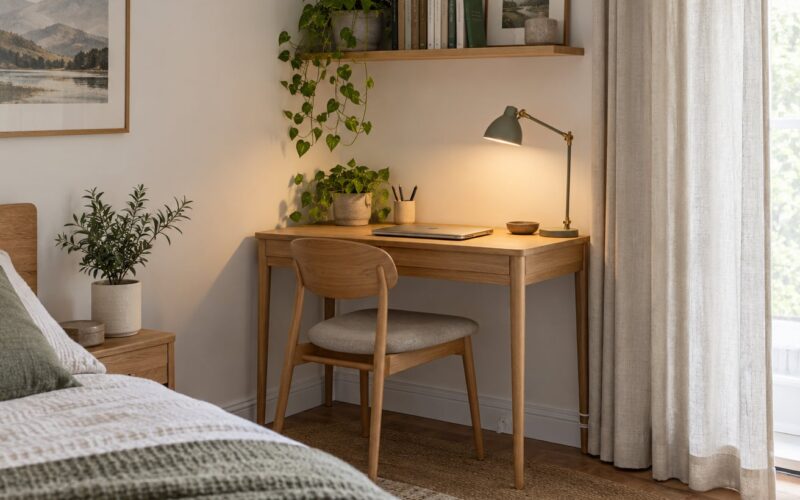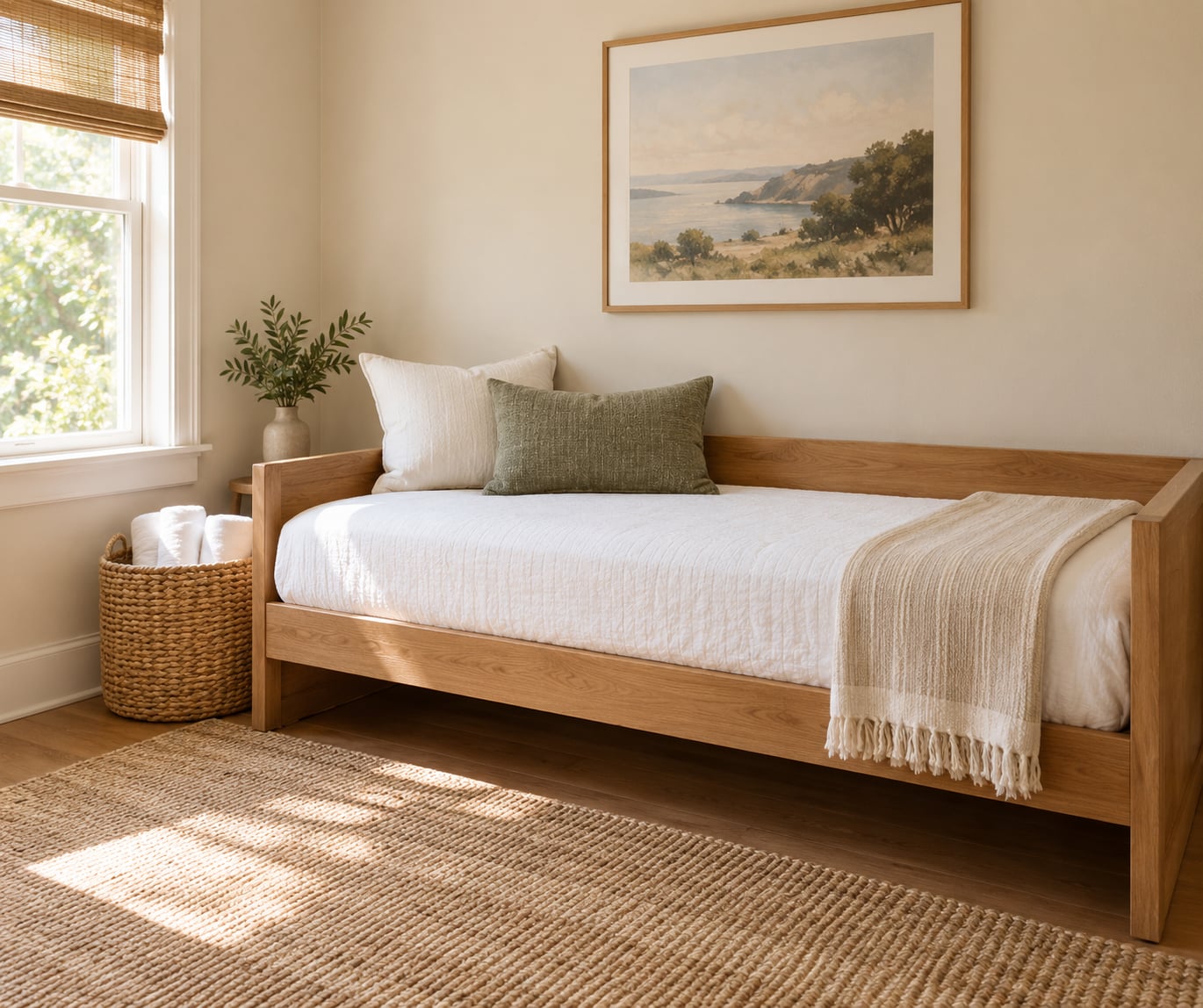
The short answer on how to set up a guest room with a daybed: measure the room, place the frame against the right wall, add the correctly sized mattress, dress it so it reads as a sofa by day, then add guest storage and lighting. Most of the work is placement and dressing, not furniture. A whole afternoon covers it.
This guide is for anyone with a spare bedroom, a corner of a studio, or a home office that has to sleep people twice a year. It covers the setup in order, plus the small details that decide whether a guest says the room was comfortable or merely tidy.
One thing worth saying up front: a daybed is not automatically a comfortable guest bed. It is a well-shaped piece of furniture that can be, and a few choices decide which one you get.
Table of Contents
- What You Need
- How to Set Up a Guest Room with a Daybed: Step-by-Step
- How to set up a guest room with a daybed: Choose the right location
- Make the daybed comfortable and guest-ready
- Add storage without crowding the room
- Create privacy and control light
- Style the room as a small sitting area
- Common Mistakes
- Frequently Asked Questions
- What size mattress does a daybed take?
- Is a daybed comfortable enough for an adult to sleep on?
- How much floor space does a daybed with a trundle need?
- What are the downsides of using a daybed in a guest room?
- How do I make a daybed look like a couch?
- Can two people sleep on a daybed with a trundle?
- Conclusion
What You Need
Start with the daybed frame, and measure your room before you shop. Measure the wall you intend to use, then measure the frame’s interior width rather than trusting the product name, because daybed sizing is inconsistent between makers.
Beyond the frame, you need six things. Each one solves a specific problem in a small room.
- A mattress that matches the frame. Most daybeds take a standard twin at 38 by 75 inches, but many take a twin XL at 38 by 80 inches, and wider frames take a full at 54 by 75. Bring a tape measure to the store or check the manufacturer’s spec sheet for the interior dimensions before you order.
- A fitted sheet and a duvet or coverlet. Skip the top sheet for guest use. A washable duvet cover with a flat sheet folded over the top is faster to change between visitors and survives more wash cycles.
- Two sleeping pillows and one accent pillow. Sleeping pillows are for the guest. The accent pillow is what makes the piece look like a sofa when nobody is sleeping on it.
- A privacy solution. A curtain on a tension-mounted rod, a folding screen, or a canopy frame. Renters get the tension rod for free, and it leaves no holes in the wall.
- Storage for guest belongings. Rolling under-bed bins, a slim shelving unit 12 to 18 inches deep, or a row of hooks on the wall. Guests arrive with more than they think they will.
- Task lighting. A wall sconce, a clip-on reading lamp, or a small lamp on a side table. Warm light around 2700K reads calmer than a cool overhead bulb.
Budget-friendly swaps are easy here. A secondhand metal or wood frame gets sanded and painted before guests arrive. Bedding in two colors lets you refresh the look without buying a full set, and a thrifted basket handles towels and chargers.
How to Set Up a Guest Room with a Daybed: Step-by-Step
Work through these in order. Skipping ahead to the styling step is the most common reason a room looks finished but feels wrong to sleep in.
How to set up a guest room with a daybed: Choose the right location
Floor space decides everything, so measure first. A twin-length daybed runs about 80 inches long and 40 inches deep, and a pull-out trundle adds another 35 to 40 inches of depth when it is extended. In a 9-by-10-foot room, placing the daybed against the longest wall leaves roughly 24 to 30 inches of clear walking path along one long side, which is enough for someone to carry a bag through without turning sideways.
Natural light is the next check, and it is the one homeowners argue about most. Putting the daybed under the window gives you the nicest light, but it blocks the glass, the sill, and the ability to open or clean it. The usual fix is to place the daybed on the wall opposite or beside the window rather than against it, which keeps the glass accessible and still lets daylight into the room.
Then run through four practical items:
- Outlets. There should be an outlet within reach of the head of the bed so a guest does not run a cord across the walkway. If none exists, add an outlet strip mounted under the frame rail, not a loose extension cord on the floor.
- Doors. Check that the door swing and any closet door open fully without catching the bedding. A daybed parked in front of a closet turns a storage problem into a daily fight.
- Traffic flow. Walk from the door to the bed in a straight line carrying an imaginary bag. If you have to turn sideways, the room is too tight.
- Ceiling height. Any canopy or tall corner posts need clearance above the mattress, and an overhead light should hang higher than a seated person’s head.
You will know the location is right when the room still reads as a room when you walk in, rather than as a bed parked in a space.
Make the daybed comfortable and guest-ready
Support matters more than anything else here. Daybed frames vary, and a cheap platform without a center support rail will sag in the middle after a few months. Check for a slatted base or a solid deck with a center rail, and if the frame is open underneath, add a support beam or a plywood sheet cut to the interior dimensions.
Layer the bedding in this order: fitted sheet, mattress topper, duvet or coverlet, two sleeping pillows, one accent pillow, and a throw folded across the foot. A 2 to 3 inch topper softens the seam down the middle of a two-piece daybed mattress, which is the part guests notice most.
Non-standard sizing catches people out. A daybed that takes a 54-inch full mattress will not take a full fitted sheet by coincidence, and some oversize frames take a 48 by 80 inch mattress that nothing off the shelf covers. Measure the actual mattress and buy deep-pocket fitted sheets, which have extra depth in the corners.
For fast dressing and undressing, keep one duvet cover and swap the accent pillow and folded throw. The whole room resets in under two minutes, which matters if the space doubles as an office or a playroom.
Add storage without crowding the room
Guests need somewhere to put a bag, a laptop, and a phone charger. If the daybed has built-in drawers, fill them with the linen set, extra blankets, and a spare pillow. If it does not, rolling under-bed bins on the same side as the wall solve the problem without adding a footprint.
A slim shelving unit 12 to 18 inches deep handles the overflow, and a row of hooks on the wall at about 60 inches off the floor takes hats, jackets, and tote bags. A small caddy that hangs on the frame rail keeps a phone, water glass, and a small charger within reach at the head.
Two habits keep storage from becoming clutter. Label the bins so whoever resets the room knows what is guest stock and what is family overflow, and put felt pads or a small rug under the bins so they do not scrape the floor every time they roll.
Leave the daybed accessible. Storage should never block the drawers, cover an outlet, or force a guest to climb over something to reach the far side.
Create privacy and control light
Privacy matters most in shared rooms, in basements, and in any room where the bed faces a doorway. A curtain on a tension-mounted rod solves it without tools or wall damage, and a folding screen works well when the guest and the rest of the household share one space.
Light control is the part hosts skip. A blackout curtain on the window does more for sleep quality than any mattress upgrade, because it removes the early morning glow that wakes people up an hour before the alarm. Layered shades let you keep the window visible during the day and dark at night.
For lighting, a sconce mounted at about 40 inches above the mattress head level lets a guest read without a second person stumbling to a floor lamp in the dark. If you rent and cannot drill, a clip-on reading lamp on the frame rail does the same job. Anchor anything you do screw into the wall into a stud, not drywall alone.
Style the room as a small sitting area
A daybed earns its keep by doing double duty, so style it as seating first. Add a small round table or a pouf within arm’s reach, centered art or a shelf above the backrest, a folded throw, and one woven basket. That is the whole kit.
Keep the palette to two or three colors. Daybed frames come in wood, metal, and upholstery, and the fastest way to make one look deliberate is to repeat its color in two or three places around the room, such as the throw, the basket, and one art print.
Use removable hardware for anything on the wall. Command hooks and removable picture strips let the room come back down to a plain sleep space in minutes, which matters if the walls are shared with the rest of the house or the room is a home office on a weekday.
Common Mistakes
Almost every disappointing daybed guest room traces back to one of these.
Parking the daybed against the only usable wall. It is the fastest way to make a room feel cramped, and it blocks the window. Push it to the longest wall, leave a walking path on one side, and give the room a second surface.
Using a narrow mattress with no support. A 38-inch twin on a wide frame leaves side ledges that nobody wants to sleep on, and a frame without a center rail sags. Match the mattress to the frame interior and add support underneath.
Skipping guest storage entirely. A room with nowhere to put a bag reads as unfinished within about a minute. Rolling bins and two hooks cost very little and fix the impression instantly.
Blocking the outlets. This forces a guest to stretch a cord across a walkway at night, which is both a trip hazard and a code problem in some rentals. Use an under-frame mounted strip instead of floor-level extension cords.
Choosing fragile decor. Ceramic lamps, glass vases, and anything sharp-cornered on a narrow bedside surface eventually break during a stay. Choose a plastic-shade lamp, a paper shade, and a metal or ceramic piece with no exposed edges.
Making the room too tight. If the walking path beside the bed is under about 20 inches, the room fails no matter how good it looks in a photo. Take the furniture out and reassess before adding anything back.
Failing to provide task lighting. A ceiling light alone leaves a guest reading by pulling the duvet over their head. Add a sconce, a clip lamp, or a table lamp with its own switch.
One final tip before guests arrive: sleep on it yourself for a night. You will notice the sag, the noise, the cold spot near the window, and the awkward reach for a light switch that no photograph will ever show you.
Frequently Asked Questions
What size mattress does a daybed take?
Most daybeds take a standard twin mattress at 38 by 75 inches, but many frames take a twin XL at 38 by 80. Wider oversize daybeds take a full at 54 by 75. Daybed sizing is inconsistent between makers, so measure the frame interior width and length before you buy, and take the mattress measurement with you when shopping for sheets.
Is a daybed comfortable enough for an adult to sleep on?
Yes, if the mattress and support are right. A 2 to 3 inch topper, a good duvet, and two firm pillows make a twin daybed comfortable for most adults for a night or two. The real risks are a sagging frame without a center support rail and a mattress that is too narrow for the frame, which leaves side ledges nobody wants to sleep on.
How much floor space does a daybed with a trundle need?
A twin daybed is about 80 inches long and 40 inches deep. A pull-out trundle adds another 35 to 40 inches of depth when extended, so plan for around 75 to 80 inches of total depth in the room. Pop-up trundles take less because the frame slides under, but they still need about 20 inches of clearance and space to be pulled out.
What are the downsides of using a daybed in a guest room?
The honest list is short. Daybeds are shallower than a standard bed, so the mattress needs a topper. Oversize frames lose their sofa-like look because the bed depth grows. Trundles can squeak and drift apart over time, which puts two guests on mismatched mattresses. Standard twin sheets rarely fit custom sizes, and a trundle rarely gives a couple the shared sleep surface they expect.
How do I make a daybed look like a couch?
Dress it the way you would a sofa. Use an accent pillow or two at the back, keep the sleeping pillows hidden in a closet during the day, fold a throw across the seat, and push the duvet flat underneath a fitted cover. Add a small table beside it and art centered above the backrest, and the frame reads as seating rather than as a bed.
Can two people sleep on a daybed with a trundle?
They can, but manage expectations. The upper bed sleeps one adult comfortably. The trundle below is narrower and lower, so it suits a child, a teen, or a lighter adult. Over time the two frames can drift apart and the lower one can squeak, so tighten the hardware and add a mattress topper to the trundle before guests arrive.
Conclusion
Setting up a guest room with a daybed comes down to three decisions made in order: measure the room and pick a frame that fits with a walking path, choose a mattress that matches the frame interior, and plan storage before you decorate. Get those right, then layer the bedding, add task lighting and a privacy curtain, and style the rest as a small sitting area.
Do the test sleep before anyone arrives. It is the cheapest fix available and the one that changes guest reviews and guest return visits.