A home office feels like work because of three things: cold overhead light, a bare surface covered in gear, and nothing that tells your brain the day is over. Learning how to make a home office feel less like work is mostly a matter of changing those cues, one weekend project at a time, and most of it costs nothing but time. The plan below works whether you rent, own, or share one wall with the living room.
The trick is that you are not remodeling. You are rearranging, softening, and hiding. After living with a workday setup for years, the fix that tends to matter most is physical rather than motivational: a room you can close, a lamp you switch off, a drawer that swallows the charger.
I have laid this out as a gradual process, refreshed for 2026, so you can do one step a week and live with it before moving on.
Table of Contents
- What You Need
- Step-by-Step
- Start With a Softer Work-Zone Layout
- Add Color Beyond Office Beige
- Layer Your Lighting
- Hide Everyday Work Clutter
- Make the Chair and Desk More Comfortable
- Add Personal and Decorative Elements
- How to Make a Home Office Feel Less Like Work at Night
- Common Mistakes
- Frequently Asked Questions
- What color makes a home office feel less like work?
- How can I make a small home office feel more relaxing?
- What can I use to decorate a home office on a budget?
- How do I hide work clutter in a small home office?
- Can I make a home office feel less work-like without replacing the desk?
- Start With One Change Today
What You Need
Before you buy anything, spend twenty minutes taking inventory. Walk into the room and list what is already there that you are not using: a basket, a lamp in a closet, a framed print stored behind the door. Most home offices are full of unused soft goods already.
Then gather a short supply list. Removable hooks and command strips handle most of the no-drill work. Painter’s tape lets you test a layout on the floor in an afternoon and peel it up when you change your mind. Lidded bins, drawer organizers, wall pockets, and a handful of cable clips take care of the clutter. Three warm LED bulbs rated 2700K, one task lamp, and one small lamp for the evening cover the lighting change. Fabric, a thrifted throw, and a rug handle the softness.
Budget tiers help here. The zero-dollar refresh is tape, decluttering, rearranging, and borrowing lamps. The under-50 refresh adds a rug, a set of lidded bins, and warm bulbs. The bigger refresh is fabric, a proper task lamp, and a new piece of art. Pick the tier that matches how much energy you actually have, not the one that looks best online.
One note before you start: if you rent, everything in this guide is removable. No paint, no drilling, no adhesive that leaves a mark.
Step-by-Step
Start With a Softer Work-Zone Layout
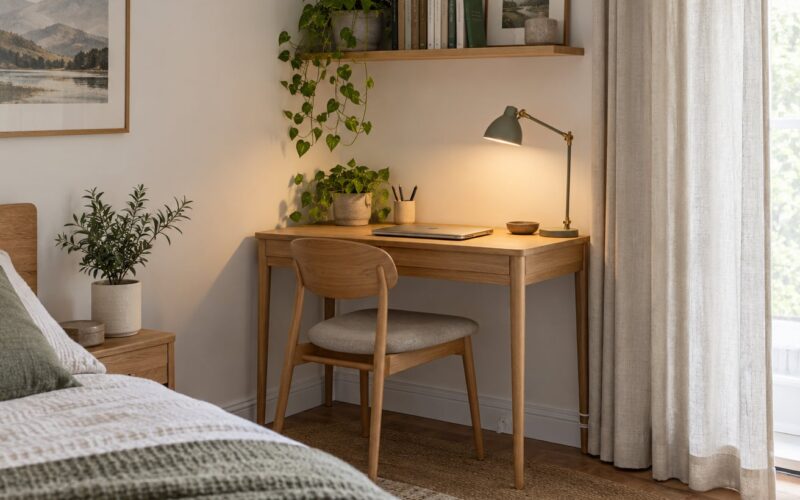
The single biggest change is usually where the desk sits. An office that takes over the whole room reads as a workplace, because there is nowhere else to be. Push it into one corner of a larger room and the rest of the space becomes living space again.
Tape the footprint of the desk and chair on the floor and walk around the room. Ask two questions: can a guest sit down without shifting your equipment, and is the door to the room or the hallway still usable? If either answer is no, the layout is too greedy.
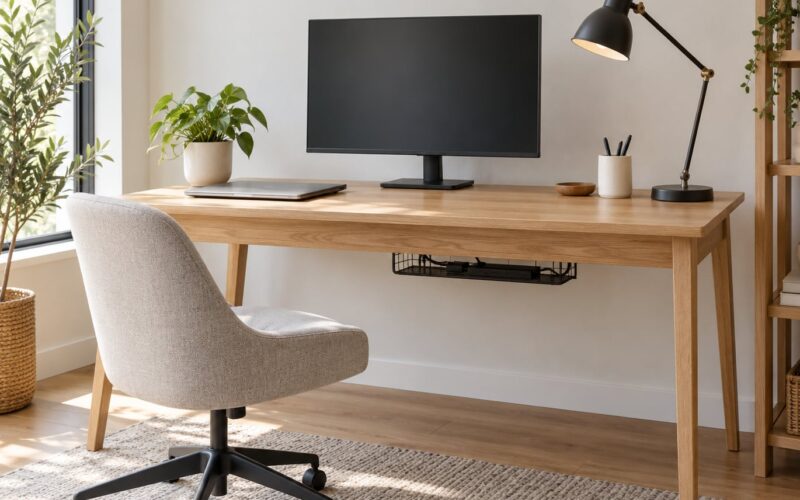
Pull the desk away from a blank wall if you can and angle it toward a window or into the room, not flat against plaster. A wall behind the monitor means your only background is paint, and a blank wall behind you is exactly what makes video calls feel grim.
You know the layout worked when you can walk into the room and see somewhere to sit, somewhere to put a mug, and something other than a computer. The office still functions. It just no longer runs the room.
Add Color Beyond Office Beige
Off-white and grey feel workplace because they are the colors institutions use. One calming accent, repeated deliberately, undoes that faster than redecorating the walls.
Pick one and place it in at least two coordinated spots, a rug and a cushion, a curtain and a throw, artwork and a book spine. Repeat one color across the room and the eye reads the whole space as intentional. A room with a dozen unrelated colors reads as clutter instead.
The colors people keep coming back to for calm are soft greens, muted blues, and warm clay tones. If you want more proof than decor magazines offer, look for paint and textile lines labeled for restful or low-stimulation rooms, which usually name the tone and the finish together.
Renters can skip paint entirely. Peel-and-stick panels on one narrow section of wall, a fabric drop on a rod, or even colored card stock inside a frame give the same accent hit and come down clean.
You will know the color worked when a visitor comments on the room before they comment on the computer.
Layer Your Lighting
One ceiling fixture is the reason most home offices feel institutional. It throws the same flat light on your face, your screen, and the ceiling, and it has nowhere to hide. Layering fixes that in an evening.
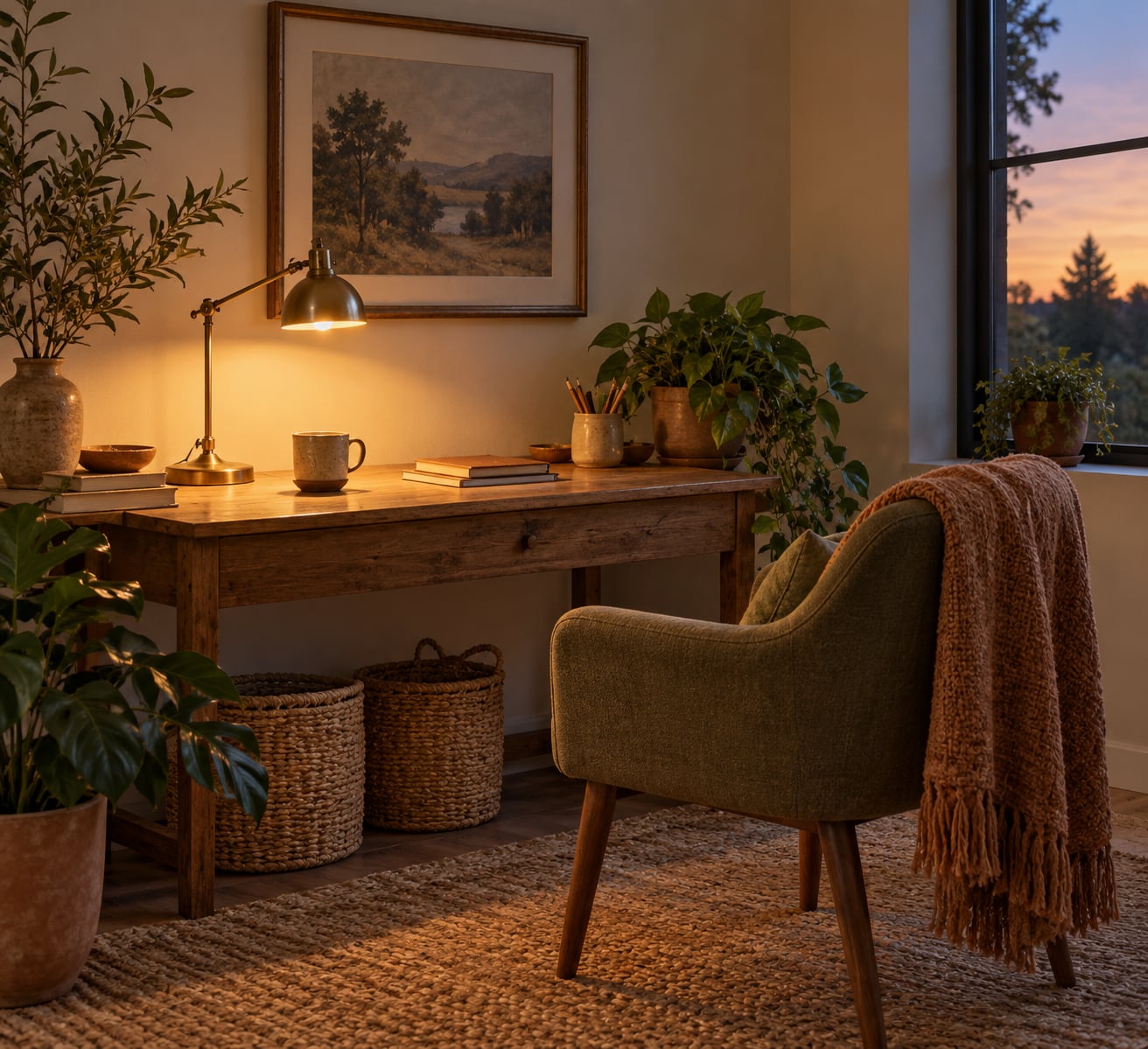
The three layers are simple. Ambient is the ceiling light, usually dimmed or off during the day. Task is a desk lamp aimed at your work surface. Accent is a small warm lamp on a shelf or side table. When all three are on, the room has depth instead of glare.
The detail that matters most is color temperature. Look for bulbs labeled 2700K and treat anything at 4000K or higher as too cool for an evening room. Cool light in the same space where you relax is one of the strongest cues that you have not clocked out.
Watch for glare while you are at it. If your screen reflects a bright window, angle the blinds so the light falls to the side of the monitor instead of straight into it. A lamp that sits opposite or behind the screen is the usual culprit, so move it beside the keyboard.
The test is simple: sit at your desk after dark and check that no part of the surface is blown out and no corner is black. If the desk is evenly lit with a little warmth on the walls behind you, the lighting is layered correctly.
Hide Everyday Work Clutter
Work gear is the thing that makes a home office feel permanent. Chargers, dongles, paper piles, sticky notes, a backup hard drive. Every one of those items is a small signal that the job follows you around the house.
Closed storage does more for mood than open shelving, and that is not a style opinion. Open shelves display the work; closed ones absorb it. A lidded basket for the charging cables, a shallow drawer organizer for stationery, and a wall pocket for the paperwork you are pretending to file handle most of it.
Cable clips stuck along the back edge of the desk turn a cable nest into three tidy lines in about five minutes. If you can do one thing today, pick a drawer, give everything in it a home, and close it.
Success here is a sixty-second clear. At the end of the day you should be able to wipe the work surface, drop the papers into one basket, and put the charger in one drawer without searching for anything. The rest of the room stays visible, the work goes behind a door.
Make the Chair and Desk More Comfortable
A hard chair for nine hours will make any room feel punishing. You do not need an expensive ergonomic replacement to fix the mood, you need the seat to feel softer than a folding chair.
A seat cushion or a folded throw over the back of the chair changes the feel of the whole setup for a few dollars. A footrest under the desk takes pressure off your legs, and it also stops your feet from wandering, which means less fidgeting by late afternoon. Both are the kind of fix that shows up in how you feel at hour six rather than in how the room looks.
On the desk side, a mat gives you a defined, tidy work zone and softens a hard wood or laminate surface. A shallow tray within forearm reach holds the pens and charger you actually use, so nothing gets sent sliding across the desk at the end of the day.
Check your screen height while you are there. The top of the monitor should sit near eye level when you are sitting upright, which for most people means a stack of books under the stand rather than a new riser.
You have got it right when you notice the room before you notice the chair, and when the end of the workday arrives before you expected it to.
Add Personal and Decorative Elements
Institutional rooms display nothing that belongs to anyone. A home office only stops feeling like a workplace when something in it is unmistakably yours.
Start with a wall. A gallery wall of thrifted frames, prints, postcards, and a mirror gives you vertical interest on a budget, and mismatched frames are fine once you paint them all the same color. One large piece above a small desk often looks calmer than six small ones, so pick whichever your wall can take.
Greenery does more work than people expect. Pick plants that forgive a missed watering and a heated room, and put them where you will see them from your chair. Users consistently name plants and natural light as the two changes that most alter how a space feels, and it costs a fraction of what a remodel does.
Then the small stuff: a stack of books you actually read, a bowl of collected objects, a mug you like holding, one plant on the windowsill that is purely decorative. If you take video calls in here, reserve one shelf or one section of wall as your backdrop and keep the clutter off it. Curating a background for the camera is a completely separate job from styling the room for yourself, and it works better when you separate the two.
How do you know when to stop? When the arrangement looks personal rather than crowded. If you have to walk past the desk sideways, you have gone too far.
How to Make a Home Office Feel Less Like Work at Night
Here is the step most guides skip, and it is the one that changes the most. There is no commute and no building you can leave, so the workday has no built-in end. If the room looks identical at 6 p.m. as it did at 9 a.m., work quietly keeps running in the background of your evening.
Build a shutdown ritual out of four physical actions. Switch the task lamp off and turn on the small warm lamp instead, so the light source changes before you do anything else. Close the storage: lids on the baskets, papers filed, gear in its drawer. Push the guest chair out from the desk and sit somewhere that is not the chair you type in. Then leave the room, even if it is only to make tea in the kitchen.
Each step is a cue. Lamps, lids, chairs, and doorways are the kind of signals your brain reads faster than a to-do list, because they mark a change of state rather than a change of intention.
Remote workers report that a visible-work problem, not a motivation problem, is what keeps them from clocking off, and that leaving the room is the fix that sticks. A change of clothes or a walk to the mailbox works the same way if you would rather not do it in a cardigan.
Do the same four things in the same order for two weeks and the room starts to close when you do. That is the version of how to make a home office feel less like work that lasts: not a room that looks nicer, but a room that knows when the day is over.
Common Mistakes
Decorating every surface. The instinct to fill the empty shelf is strong, and it makes the room busier without making it homier. The correction is to edit it back: leave one surface deliberately empty, and let it breathe.
Leaving one ceiling light as the only source. Flat overhead light is the fastest way to keep a room feeling like a workplace, and no amount of furniture fixes it. Add a task lamp and a warm accent lamp, and switch the overhead off during the day.
Filling the walls with motivational signs. A gallery of affirmations and a whiteboard full of to-dos are work objects, whatever the font. Reserve your personal wall for things that remind you of your life, not your output.
Buying style before solving storage. New shelves and pretty containers do not help if everything still has to live on the desk. Clear, contain, and close things first; then decorate what remains. The room reads calmer from the storage, not the accessories.
Changing the whole room in one weekend. People burn out, spend more than they meant to, and end up with a space they never learned to work in. One change a week, lived with for a few days, is slower and it sticks.
Making the office beautiful and useless. Low, soft seating and pale rugs feel lovely and wreck your back by the afternoon. Comfort is a work requirement, not a decoration, so treat the cushion, the footrest, and the screen height as priority items alongside the lighting.
Prioritization tip: spend the first hour on the three free things, which are the layout, the declutter, and the lamp swap. Those three are where nearly all of the improvement comes from, and none of them cost money.
Frequently Asked Questions
What color makes a home office feel less like work?
Soft greens, muted blues, and warm clay or terracotta tones are the shades most often used to make a home office feel less like work, because they read as restful rather than institutional. Keep the base neutral and repeat one accent color in at least two places, such as a rug and a cushion, instead of adding many colors at once. Renters can get the same effect with peel-and-stick panels or a fabric drop on a rod.
How can I make a small home office feel more relaxing?
Work on light, warmth, and hidden storage, since those three carry the most effect in a small room. Add a warm 2700K lamp and a task lamp instead of relying on the ceiling fixture, and use lidded baskets plus wall pockets so the desk surface stays clear. A rug in front of the chair and a plant in the corner soften hard surfaces without taking floor space you need.
What can I use to decorate a home office on a budget?
Thrifted frames, a secondhand rug, a lamp borrowed from another room, and warm LED bulbs cover most of the visible changes in a home office. Repaint mismatched frames one color for a gallery wall, and use fabric you already own for cushion covers. Painter’s tape and removable hooks let you test a layout and hang storage without drilling, so the whole refresh can be done with a few small purchases or none at all.
How do I hide work clutter in a small home office?
Closed storage changes the mood of a room more than open shelving, because it removes the sight of work gear. Use one lidded basket for chargers, a shallow drawer organizer for stationery, and a wall pocket for paperwork, then add cable clips along the back edge of the desk. If you can clear the entire work surface in sixty seconds and close one drawer, the clutter problem is solved.
Can I make a home office feel less work-like without replacing the desk?
Yes, and most people never need to. The desk is not what signals work, the light, the surface contents, and the lack of an end to the day are. Change the lamp to warm layered lighting, contain the gear behind lids, move the desk into one zone rather than letting it fill the room, and add a shutdown ritual that switches the lamps and closes the storage. The desk can stay exactly where it is.
Start With One Change Today
Do not start with paint. Clear the work surface and give the gear one drawer, swap the ceiling light for a warm task lamp and a small evening lamp, and put one object on the wall that has nothing to do with your job. That is an hour of work and it changes how the room reads more than any furniture purchase will.
Then repeat the same four steps every evening: lamps change, lids close, chair moves, you leave. Figuring out how to make a home office feel less like work is not really about decor. It is about giving the room a beginning and an end, and then making everything between them a little warmer.