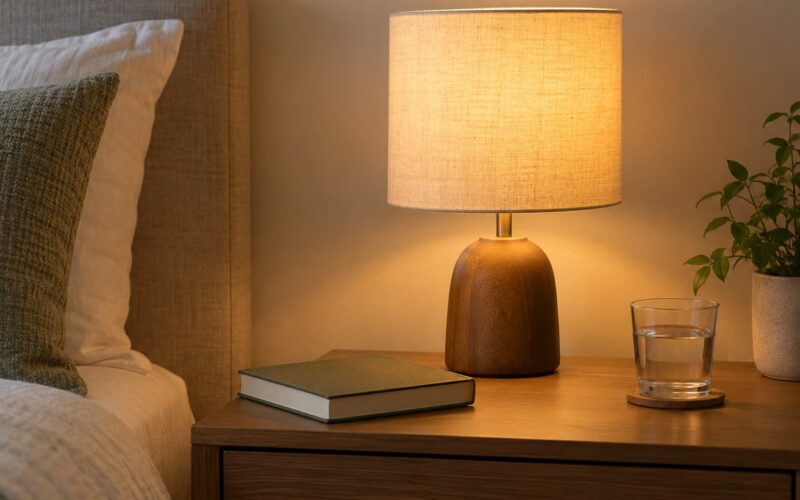
Renter friendly decor ideas that leave no damage all work the same way: they attach with a removable adhesive, hold by pressure in a window recess, or simply rest on the floor. Nothing gets drilled, painted or screwed in, so at move-out you pull it off, roll it up, and the wall looks exactly as it did on day one.
That matters more than most decor roundups admit. Leases in most places treat marks beyond normal wear and tear as damage, and those marks come straight out of your deposit. The ideas below are the ones I would use in a flat I have to leave eventually, ordered by how much visual change they deliver for how little risk they carry.
One thing to settle before you buy anything: read your lease for the words painting, drilling, nails and fixtures, and send your landlord a short written note listing what you plan to add. Renters who ask in writing and save every original bracket, rod and shade report that the conversation is the whole difference at inspection time.
Table of Contents
- 10 Renter-Friendly Decor Ideas That Leave No Damage at a Glance
- 1. Use Peel-and-Stick Wallpaper for an Accent Wall
- 2. Hang Framed Art with Damage-Free Strips
- 3. Add Color with Removable Wall Decals
- 4. Use Tension Rods for Curtains Without Drilling
- 5. Layer Washable Rugs for an Instant Style Change
- 6. Style a Freestanding Shelf or Ladder
- 7. Use Removable Light-Up or Battery-Powered Lighting
- 8. Refresh Cabinets with Removable Contact Paper
- 9. Create a Focal Point with Freestanding Art and Mirrors
- 10. Personalize with Washable Textiles and Temporary Accessories
- Frequently Asked Questions
- Will peel-and-stick wallpaper damage my rental walls?
- Can mold grow behind peel-and-stick wallpaper?
- Do 3M Command strips take off paint?
- How much weight can a Command strip hold?
- Are Command strips strong enough for floating shelves?
- What counts as normal wear and tear versus damage I am charged for?
- Conclusion
10 Renter-Friendly Decor Ideas That Leave No Damage at a Glance
| Idea | How it stays damage-free | Best for |
|---|---|---|
| Peel-and-stick wallpaper | Removable adhesive sheet peels off smooth walls | Hiding a dated wall color on one accent wall |
| Framed art on hanging strips | Adhesive strips release with a slow low-angle pull | A gallery wall over a sofa or desk |
| Removable wall decals | Thin vinyl film peels away at a low angle | A nursery, entryway or desk nook |
| Tension rod curtains | Held by pressure inside the window recess | Softening a bare window in a rental bedroom |
| Layered washable rugs | Rests on the floor over a nonslip pad | Defining a living area and covering worn carpet |
| Freestanding shelf or ladder | Stands on the floor, no wall contact | Storage and display in a studio |
| Battery or plug-in lighting | No wiring, no fixtures swapped | Layered light without touching the ceiling |
| Removable contact paper | Self-adhesive sheet lifts off sealed cabinet fronts | A dated kitchen or bathroom cabinet refresh |
| Leaning mirror or easel art | Balanced against a wall, nothing attached | A focal point above a console or bed |
| Washable textiles | Fabric only, goes in the washing machine | Color and pattern you can swap by season |
1. Use Peel-and-Stick Wallpaper for an Accent Wall
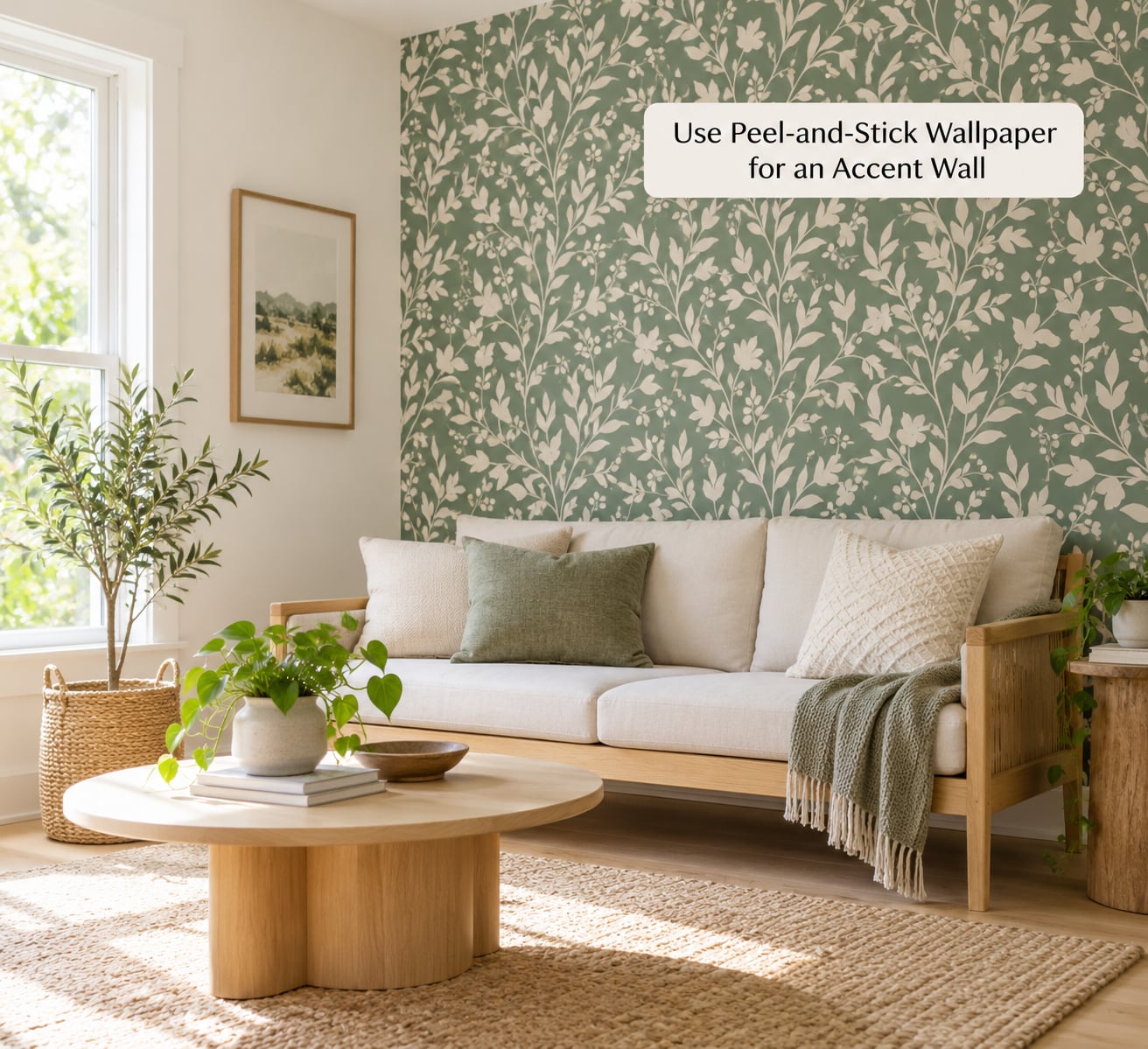
Peel-and-stick wallpaper is the biggest visual upgrade a renter can make, and it works best on one wall rather than four. A single accent wall behind a sofa or bed changes how the whole room reads without asking you to live with a pattern everywhere.
Surface decides the outcome. Paint the wall with a drywall roller the week before, let it cure fully, then wipe it down with a damp cloth and let it dry overnight. Skipping that step is how bubbles and tears happen, because the adhesive grips loose texture instead of the paint film.
Work in panels about half the width of the wall. Peel the backing off as you go, keep the sheet low and slightly off the wall, and push the air out toward the edges with a plastic card. Overlapping the seam by an inch is fine; a butt joint shows every lump.
For removal, start a corner and peel at a low angle, no more than about 30 degrees, and keep moving. Do not pause and pick at a spot, because that is what tears the topcoat. Warm stubborn areas with a hairdryer on low for a few seconds and the adhesive usually lets go.
Two cautions. Peel-and-stick over existing wallpaper is a bad idea, because both layers lift together. And on a bathroom wall, moisture behind the sheet can grow mould, so keep it off shower-adjacent surfaces.
2. Hang Framed Art with Damage-Free Strips
Removable hanging strips do the work of nails when the wall is smooth, painted and fully cured. The single most-reported failure on renter forums is a strip pulling paint off on removal, and it almost always comes down to three things: too much weight, a dirty wall, or an impatient pull.
Weigh the frame, then check the strip’s rated limit and use several strips rather than one oversized one. Small strips in the size range most packs carry are rated for a few pounds each; large strips are rated far higher. Spread the strips at all four corners so the load is even.
Press each strip onto the wall for a full 30 seconds, then wait at least 24 hours before hanging anything. Adhesive that has not set will creep under load, which is the moment things drift and eventually fall.
Removing is the part people rush. Hold the strip at one end, slide it slowly down the wall rather than pulling it straight out, and stretch it under its own weight. If paint comes with it, that was an under-rated strip or an uncured wall, not a bad product.
Floating shelves are the one item most renters ask about, and they are usually a no. The load is fixed to the wall permanently, and even adhesive-mounted versions fail at the bracket. Use a freestanding shelf instead.
3. Add Color with Removable Wall Decals
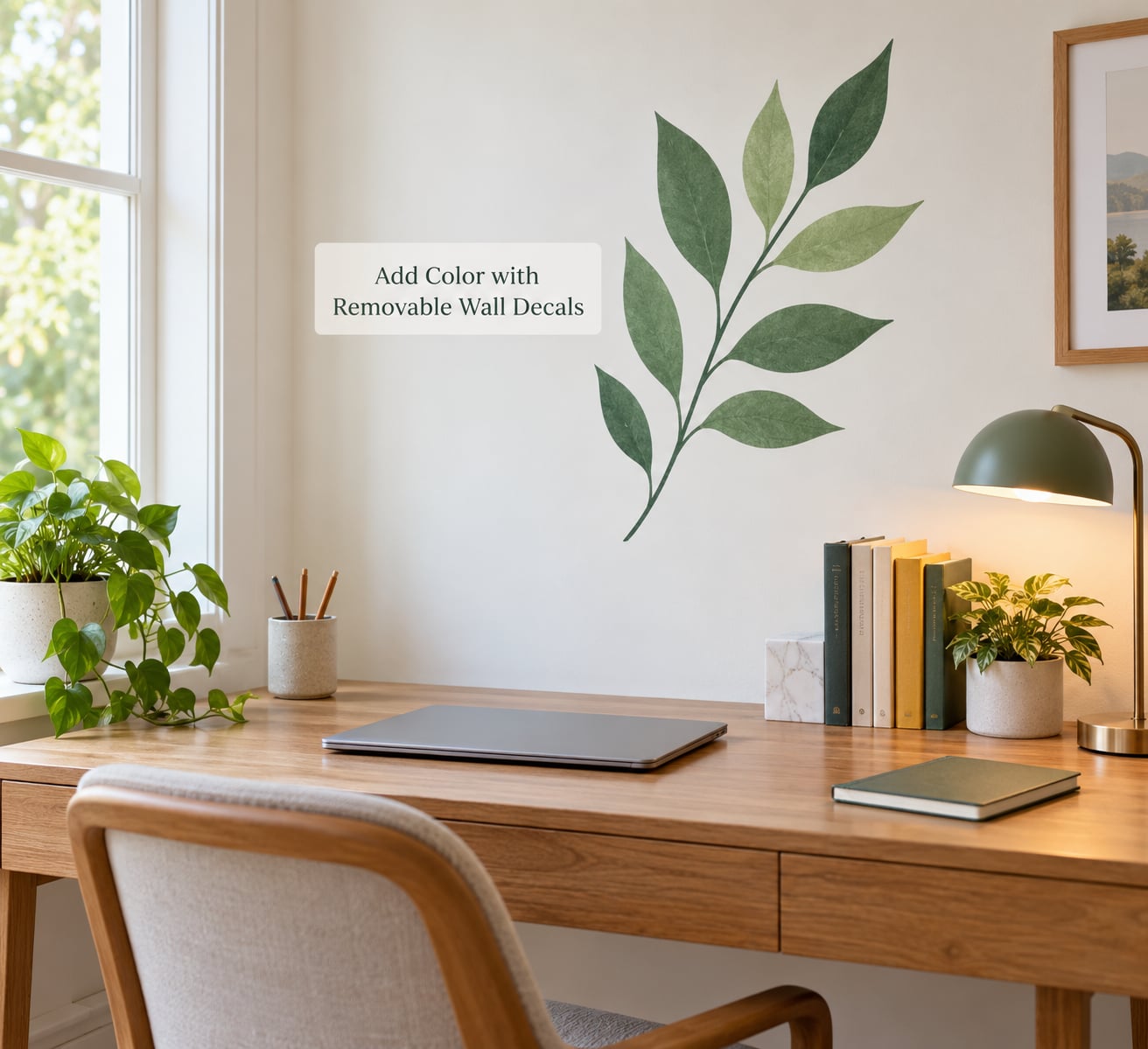
Decals are the cheapest way to cover a specific spot, like the wall above a desk or the panel behind a bed. They work well for a shape or a short phrase, and less well for imitating a full pattern.
Choose a product that states it is safe for painted walls and gives a removal instruction. That line on the backing is the difference between a decal that lifts cleanly and one that takes the topcoat with it.
Apply to a clean, dry wall with the room at normal temperature. Cold hands and cold rooms make vinyl brittle, and brittle vinyl tears. Rub a plastic card across the decal from the middle outward, then wait a couple of days before you touch it.
Lift it by the edge and peel slowly at a shallow angle, one continuous motion. If residue stays, warm it with a hairdryer and rub the edge with a finger; a little is normal, a lot means the wall was textured.
4. Use Tension Rods for Curtains Without Drilling
A tension rod grips the inside of the window recess with a spring-loaded end, so the wall is never touched. It is the fastest way to stop a rental bedroom from feeling like a storage unit.
Measure the recess width at the narrowest point, then pick a rod with a spring range that covers it with a little room to spare. Inside-mount rods sit neatly in the recess; outside-mount versions can sit against the frame for more drop length when you want the ceiling to look higher.
Clip-on rings are useful here too, since they let you change fabric without touching the rod. Keep the panel hem above the sill so it does not rest against a cold, damp wall, and change the fabric seasonally instead of installing anything new.
5. Layer Washable Rugs for an Instant Style Change
Rugs are the safest category on this list because nothing touches a wall or a fixture. A rug can define a seating area, hide a worn patch of carpet, and add pattern to a room that has none.
Size is the whole trick. In a small living room, a rug that stops well short of the sofa looks like a rug on a floor. A rug that reaches under the front legs of every seat looks like part of the room.
Layering a smaller patterned rug over a larger plain one gives depth without a second purchase if you already own a flatweave. Always put a nonslip pad underneath, especially over vinyl or laminate, because a shifting rug is what drags scratches into a floor.
Pick anything labeled machine washable, and wash it on cold before it goes down. That one habit saves you from a deposit deduction for a stain you could have removed.
6. Style a Freestanding Shelf or Ladder
A leaning ladder shelf, a narrow étagère, or a bookcase that stands clear of the wall gives you the vertical storage of a floating shelf with none of the drilling. It also moves with you, which is the point.
The tradeoff is stability. A ladder shelf needs a level floor and a gentle lean, so shim the feet with folded card if it wobbles. Place it where people walk past rather than through, and anchor nothing to the wall above it.
Weight is the other limit. Keep heavy books on the bottom shelves and reserve the top for plants and lighter objects. That habit prevents the top-heavy lean that tips a freestanding unit.
7. Use Removable Light-Up or Battery-Powered Lighting
Most rentals have one overhead fixture, one socket per room, and a landlord who will not let you touch the wiring. Portable lighting solves that without asking.
Rechargeable table lamps give you a warm corner with no cord crossing the floor. Battery-operated sconces add the look of hardwired lighting, though check how their mounting pad attaches before you buy, since some use adhesive and some clip onto a surface.
Layer the light instead of adding fixtures: a lamp for task lighting near a chair, a cooler bulb in the ceiling fixture, and something low near the floor to soften the ceiling line at night. Plug-in uplighters along a baseboard add a lot for the footprint of a book.
8. Refresh Cabinets with Removable Contact Paper
Contact paper is a self-adhesive sheet that lifts off sealed cabinet doors, and it is the fastest kitchen and bathroom upgrade available to a renter. The shine of a dated cabinet goes away in an afternoon.
Clean the surface with a degreasing cleaner and wipe it with a separate damp cloth, then let it dry. Any grease left behind is what makes the sheet lift in a corner later. Apply from one edge with a plastic card, working the air out as you go.
Check your lease first. Covering a fixed surface is a gray area that some agreements prohibit outright, and a conversation in advance beats an argument at move-out.
9. Create a Focal Point with Freestanding Art and Mirrors
A large mirror leaning against a wall behind a console reads as a deliberate design choice, and it bounces light in a way a small frame never will. Nothing is hung, so nothing is marked.
Lean large art on an easel or rest a stretched canvas flat against the baseboard. Both give you the scale of gallery art in a rental where a gallery wall is not allowed. A cane leaning ladder, a floor mirror, or a set of framed prints propped on the mantel all work the same way.
Keep the bottom edge tucked behind a sofa or console so nothing above about a foot clear needs to stand unsupported, and pad the contact point with a felt pad so the frame does not scuff the wall.
10. Personalize with Washable Textiles and Temporary Accessories
The lowest-risk category is fabric. Slipcovers, throw pillows, table runners, shelf liners and curtain panels all wash, all move, and all leave nothing behind when you take them.
A plant in a saucer is another quiet win, since terracotta pots leave rings on wood. Set it on a tray if you forget. Woven baskets handle the soft-storage problem that renters usually solve with shelves they are not allowed to mount.
For hooks, use the existing door hardware. An over-door hook or a hanger hooked over the top of a door needs no screw and no adhesive at all. Skip painter’s tape as decoration; it is a short-term masking product, and it will lift the paint in a way no renter wants to explain.
Frequently Asked Questions
Will peel-and-stick wallpaper damage my rental walls?
On a smooth, clean, fully cured painted wall it peels away cleanly. It can take the topcoat with it on textured drywall, on paint that was applied within about a month, or on top of existing wallpaper. Test a small corner for 24 hours and peel at a low angle in one continuous motion.
Can mold grow behind peel-and-stick wallpaper?
Yes, and it is the risk most renters never hear about. The sheet seals the wall, so condensation and damp patches behind it have nowhere to go. Keep wallpaper off exterior walls, bathroom surfaces near a shower, and any wall that feels cool or damp to the touch.
Do 3M Command strips take off paint?
They can, when you overload them, hang them on an unclean or textured wall, or rip them off instead of sliding them down. Rated limits apply to the whole set of strips, not to each one. Use the number of strips the item weight calls for and peel slowly under tension.
How much weight can a Command strip hold?
It depends on the strip size and how many you use. Small strips are rated for a few pounds each, medium strips for around ten pounds per strip, and the largest strips for up to twenty pounds per strip on a smooth painted surface. Halve that on textured drywall and never on fresh paint.
Are Command strips strong enough for floating shelves?
No. A floating shelf is fixed permanently and its load concentrates at two brackets, which is exactly the failure mode that takes paint off a wall. Use a leaning ladder shelf, a narrow étagère, or clip-on shelving instead, all of which carry the same weight with no wall contact.
What counts as normal wear and tear versus damage I am charged for?
Faded paint, scuffed baseboards in a hallway, and small nail holes from pictures the landlord approved are usually wear and tear. Marks from adhesive, drilling, painting, or unapproved fixtures are not. Keep photos of every wall on move-in, and save the original hardware for anything you swap out.
Conclusion
Start with the lease, then with fabric and freestanding pieces, since those need no permission and no removal technique at all. Add adhesive products second, one wall or one item at a time, and give each a 24-hour test in a spot nobody will see.
At move-out, work in reverse order of installation. Peel at low angles, slide strips down rather than out, wash anything that came off the floor, and patch small holes while the spackle is still cheap to buy. A renter who photographs the empty room on the last day usually gets the deposit back without asking.