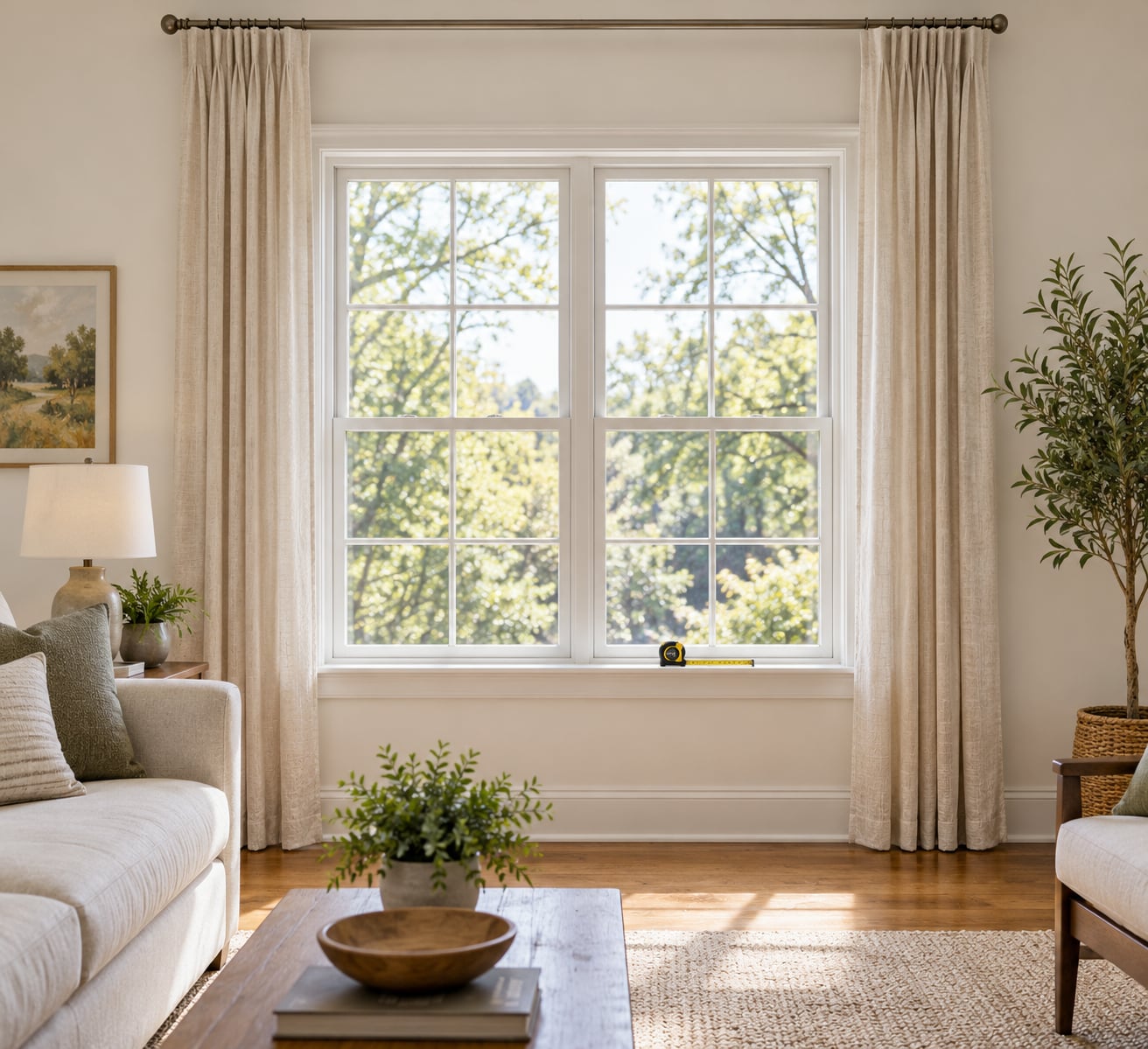
Hang the curtain rod 4 to 6 inches above the top of the window frame as a minimum, and closer to the ceiling for the taller, more finished look. If you are working out how high to hang curtain rods for a specific room, the ceiling height and the window’s position decide it, and here is how to get a number you can carry straight to the wall.
Measuring and marking takes about ten minutes before anything gets drilled. Get it wrong and even good curtains can make a good room look smaller than it really is.
Table of Contents
- How High Should You Hang Curtain Rods?
- How to Measure the Right Curtain-Rod Height
- The Best Curtain-Rod Height by Ceiling Type
- Standard ceilings, 8 to 9 feet
- Tall ceilings, 9 to 10 feet
- Vaulted and sloped ceilings, 10 feet and up
- How high to hang curtain rods when crown molding or a beam is in the way
- How Window Size Changes the Ideal Placement
- How Wide Should the Curtain Rod Be?
- How to Hang Curtain Rods Without Making Common Mistakes
- Frequently Asked Questions
- How high should a curtain rod be for 84 inch curtains?
- Is it better to hang curtains above the window or at the ceiling?
- How far should a curtain rod be from crown molding?
- How high should curtains hang in a room with a slanted ceiling?
- Should curtain rods go all the way to the ceiling?
- Conclusion
How High Should You Hang Curtain Rods?
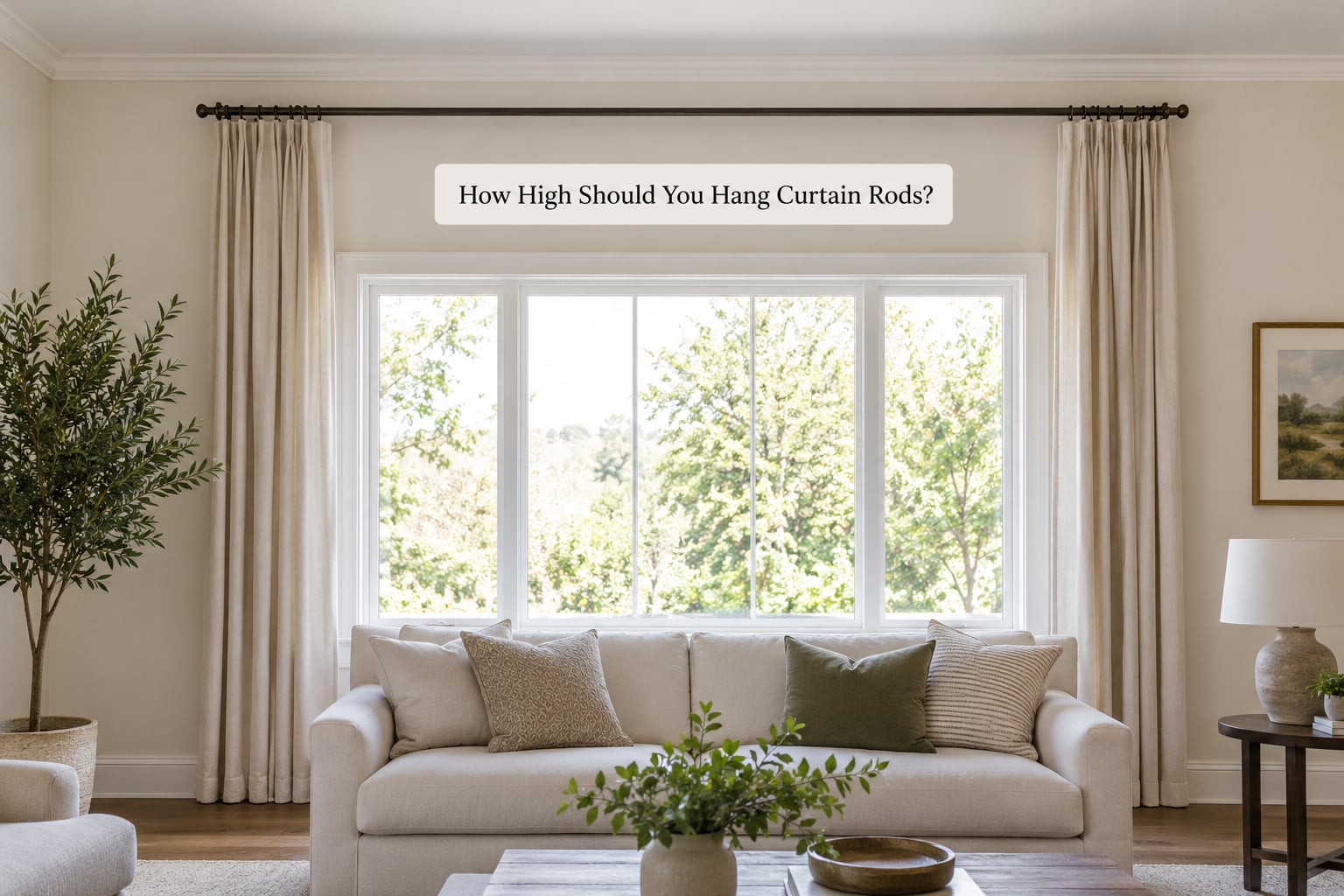
Most guides call 4 to 6 inches above the window frame the standard. Treat that as the floor, not the target. The polished look comes from closing the gap between the top of the window and the ceiling as much as the room allows, usually to within 2 to 4 inches of the ceiling.
The reason is optical. A wide band of empty wall above a window reads as dead space and chops the opening down to the size of the glass. Shrink that band and the window, and the room below it, appear taller.
As a starting point:
- Standard 8 to 9 foot ceiling: 4 to 6 inches above the frame, or higher if the wall between the frame and the ceiling is short.
- Tall 9 to 10 foot ceiling: 8 to 12 inches above the frame.
- Vaulted or cathedral ceiling over 10 feet: 12 to 18 inches below the ceiling line.
- Crown molding at the ceiling: 1 to 3 inches below the molding, never screwed into it.
- A beam or bulkhead that caps the wall: as high as the obstruction allows, with the rod kept level.
One rule of thumb fills the gap on an unusually deep wall: put the rod about two-thirds of the way from the top of the frame up toward the ceiling.
How to Measure the Right Curtain-Rod Height
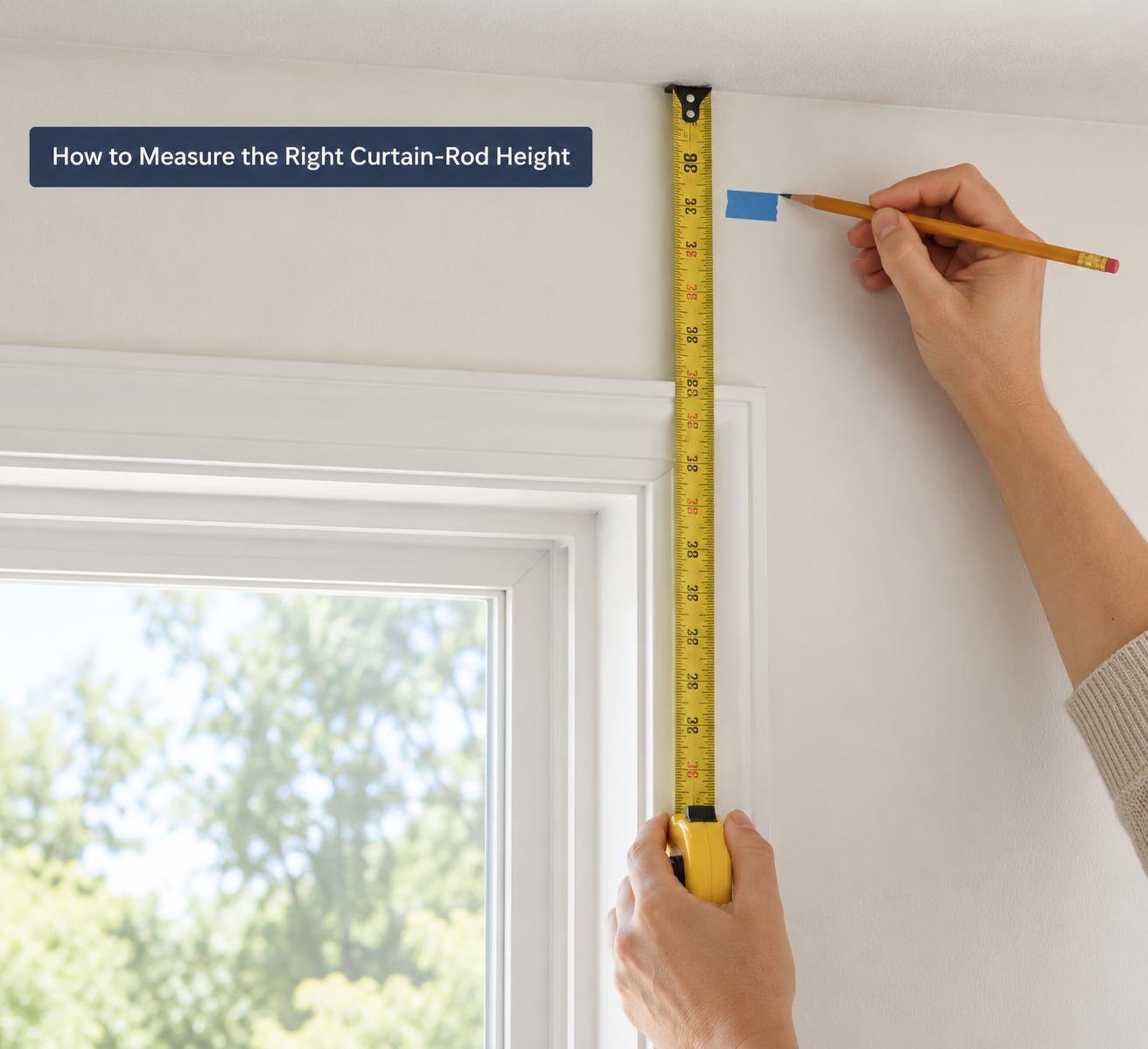
Measure in this order and the number writes itself:
- Measure the window, not the glass. Write down the width and the height of the frame, and note where the top of the trim sits if the rod will pass above it.
- Measure the wall from the top of the frame straight up to the ceiling. Do it directly above the window, not across the room.
- Look for anything in the way: crown molding, a beam or bulkhead, an outlet or switch plate, a ceiling vent, heavy texture, a smoke detector.
- Decide your gap and write the number down before you touch a bracket. Something like rod 10 inches above the frame is enough to work from.
- Tape the position up with painter’s tape, stand back across the room, and look. Markings cost nothing and moving one takes seconds.
- If you already own the curtains, measure up from the floor instead. Add roughly 4 to 6 inches to the panel length for rings, clips and the rod, and that becomes your rod height.
The two-thirds rule is worth doing once as a cross-check. Take a 9 foot ceiling and a window whose frame top sits 66 inches off the floor. That leaves 42 inches of wall above the frame, two-thirds of 42 is 28, so the rod goes 28 inches above the frame and 14 inches below the ceiling. High and dramatic, which suits a wide window or a formal room.
Working backwards from the panel length catches a mistake most people only notice after the curtains are up. An 84 inch panel puts the rod near 88 to 90 inches off the floor, which on a standard window means hanging about 12 inches above the frame rather than 6.
| Panel length | Approx. rod height from floor | What that usually means |
|---|---|---|
| 63 inches | about 68 inches | Sill or apron length, casual rooms |
| 84 inches | about 88 to 90 inches | Best on short windows or a low, relaxed rod |
| 96 inches | about 100 to 102 inches | The safe pick for 8 to 9 foot ceilings |
| 108 inches | about 112 to 114 inches | Needs a 9 foot ceiling or taller to hang well |
| 120 inches | about 124 to 126 inches | Tall ceilings and floor-to-ceiling schemes |
The Best Curtain-Rod Height by Ceiling Type
Ceiling height changes the answer more than window size does. Here is the spread most rooms fall into.
| Ceiling | Above the frame | Below the ceiling line |
|---|---|---|
| 8 feet | 4 to 6 inches | Usually too far to reach |
| 8 ft 6 in to 9 feet | 6 to 8 inches | 6 to 12 inches |
| 9 to 10 feet | 8 to 12 inches | 8 to 16 inches |
| Vaulted, 10 feet and up | 8 to 10 inches | 12 to 18 inches |
| Crown molding at the ceiling | 4 to 6 inches | 1 to 3 inches below the molding |
| Beam or bulkhead overhead | 4 inches minimum | Just under the obstruction |
Standard ceilings, 8 to 9 feet
Most living rooms and bedrooms sit here, and most of the time you will not be near the ceiling. A 9 foot ceiling gives you around 30 inches of wall above a typical window, and hanging all the way up would force short panels that stop well above the floor. Land 4 to 6 inches above the frame and let the panels run long.
Tall ceilings, 9 to 10 feet
Here the gap above the window gets generous, and the design rule starts to earn its keep. Push the rod to 8 to 12 inches above the frame so the curtains still reach the floor with a proper drop. If panels are already fixed at 84 inches, this is the height that makes them work.
Vaulted and sloped ceilings, 10 feet and up
Keep the rod level even when the ceiling is not. A rod cut parallel to a slope looks like a mistake, and the panels hang unevenly. Where the wall stops and the ceiling takes over, switch to ceiling-mounted track hardware or a drop-down rod so the curtains still hang straight. On very tall ceilings, staying 8 to 10 inches above the frame often looks calmer than chasing the peak.
How high to hang curtain rods when crown molding or a beam is in the way
Crown molding at the ceiling and trim around the window are two different problems. At the ceiling, set the rod 1 to 3 inches below the molding so it reads as intentional, and screw into the wall just below the crown, not into the molding itself. Molding is not a load-bearing surface, and a bracket anchored there can pull the whole run down later.
Trim on the window is easier: hang above it so the rod clears the casing. When a beam or bulkhead caps the available wall, mount as high as the beam allows and keep the rod level. A rod that stops 3 inches below a beam reads intentional; a slanted workaround reads like a mistake.
How Window Size Changes the Ideal Placement
Height and width travel together, so the window itself gets a say in the number.
- Tall, narrow windows. Keep the extension modest, 4 to 6 inches past each side, and hang high. Stretching the rod too wide flattens a window that already has strong vertical lines.
- Short, wide windows. These benefit most from the high-hang treatment, since a taller-looking window fixes the squat proportions. Add a little more width, closer to 8 to 10 inches per side, and use longer panels.
- Small windows in big rooms. Resist crowding them. Stay near the 4 to 6 inch minimum above the frame and let the panels fall to the sill or apron instead of the floor.
- Windows near a corner. Extend 8 to 12 inches on the side with wall and pull back to 3 or 4 inches on the corner side, or the finial ends up in the plaster.
- Bay windows. Either one rod per sash, following the shape, or one straight rod across the head of the bay. Both work as long as the rod sits above the highest trim.
- Windows over a radiator or a floor unit. Leave 6 to 8 inches of clearance so air can move, or drop the rod on two short risers fixed to the wall.
- Windows with a picture rail or a blind cassette. Add the depth of the existing hardware to your measurement before you mark the tape.
How Wide Should the Curtain Rod Be?
Width matters as much as height for how a window reads. The rod should extend at least 3 to 6 inches beyond each side of the frame, and 8 to 12 inches if you want the panels to stack fully clear of the glass.
That extra width is what makes stack back possible. Panels pushed to the side land on wall rather than on the window, so the full opening stays visible when the curtains are open and light control improves when they are closed.
Give the fabric enough to fill that rod. Most decorators aim for fabric at 1.5 to 2 times the rod width, and 2.5 times for sheers, which need extra body to hang straight. If the rod runs past 60 inches, add a center support bracket near the middle so it does not sag over time.
How to Hang Curtain Rods Without Making Common Mistakes
Hanging the rod too low. The single most common miss, and the one people notice most. Mounting 6 inches above the frame is a starting point, not a finish line, whenever the wall allows more.
Hanging at the ceiling in a low room. On an 8 foot ceiling, going to the ceiling leaves panels that cannot reach the floor. The look depends on long fabric, so match the height to the panel you actually have.
Squeezing a small window into a wide rod. A rod far wider than a narrow window stretches it and makes it look short. Match extension to the opening rather than to the wall available.
Screwing into crown molding or a picture rail. Neither is a reliable anchor. Mount below the molding into the wall, and use anchors matched to the material.
Cheap hardware on a wide span. Brackets rated for a light rod will bow across a long run. Match the bracket weight rating to the rod and the fabric, and follow the manufacturer’s instructions for spacing and fasteners.
Drilling without checking what is behind the wall. Run a stud finder and watch for wiring or plumbing near outlets before you pilot a hole. Use masonry bits and appropriate anchors on brick or plaster, and a proper bit on drywall rather than a standard one.
Skipping the tape check. Mark the height with painter’s tape, step back, and look from the doorway. It takes a minute and saves a row of holes to patch.
Forgetting the panels still need to open. Check the swing of the window and the sash before you fix the height. A rod set too low on an outward-opening window stops it opening fully.
In a rental where drilling is not allowed, tension rods fit inside the window opening and no-drill brackets mount on the trim just above the frame. Both lock you into a lower height, so plan the panels around that limit rather than around the design ideal.
Frequently Asked Questions
How high should a curtain rod be for 84 inch curtains?
An 84 inch panel puts the rod roughly 88 to 90 inches off the floor once rings and the rod are accounted for. On a typical window with a 48 inch frame, that lands about 12 inches above the top of the frame rather than 6, which is exactly the taller placement most rooms benefit from. Measure up from the floor to confirm before you mark the wall.
Is it better to hang curtains above the window or at the ceiling?
Near the ceiling is the polished choice when the panel is long enough to still reach the floor, usually 96 inches or more in a room with a 9 foot ceiling. Above the window frame is the practical choice in shorter rooms or with 84 inch panels. The deciding factor is not the rule but whether the fabric can still fall to the floor.
How far should a curtain rod be from crown molding?
One to three inches below the molding reads as a deliberate line rather than an accident. Mount the brackets into the wall just under the crown and never into the molding itself, which is not a load-bearing surface and can let a long rod drop over time. Panels hung from that position usually need the longer lengths to reach the floor.
How high should curtains hang in a room with a slanted ceiling?
Keep the rod level, not parallel to the slope. A rod cut to follow the ceiling angle makes the panels hang unevenly and reads as an error. Where the wall stops, use ceiling-mounted track hardware or a short drop-down rod so the fabric still falls straight to the floor on a level line.
Should curtain rods go all the way to the ceiling?
On tall rooms, yes, if the panels are long enough. In a standard 8 foot ceiling, reaching the ceiling leaves panels that stop well above the floor and looks worse than a moderate mount. Experienced decorators tend to stop a few inches below the molding for a cleaner line, and to use 96 inch or longer panels so the fabric still kisses the floor.
Conclusion
Measure the top of the window frame, measure up to the ceiling, then decide how much of that gap to close and write the number down. Pick a rod that extends 4 to 8 inches past each side, mark the height with tape, and mount it level on brackets rated for the fabric.