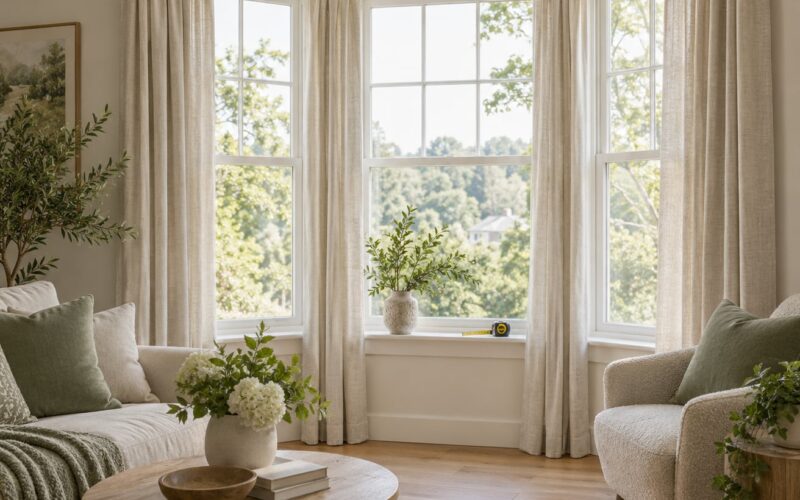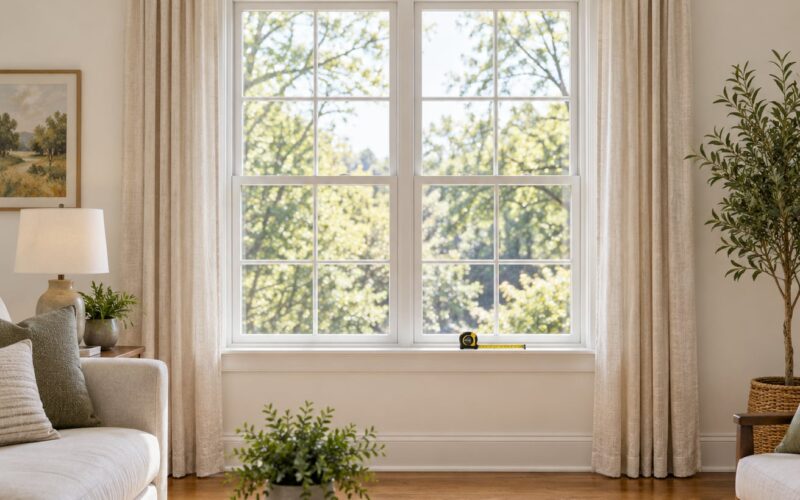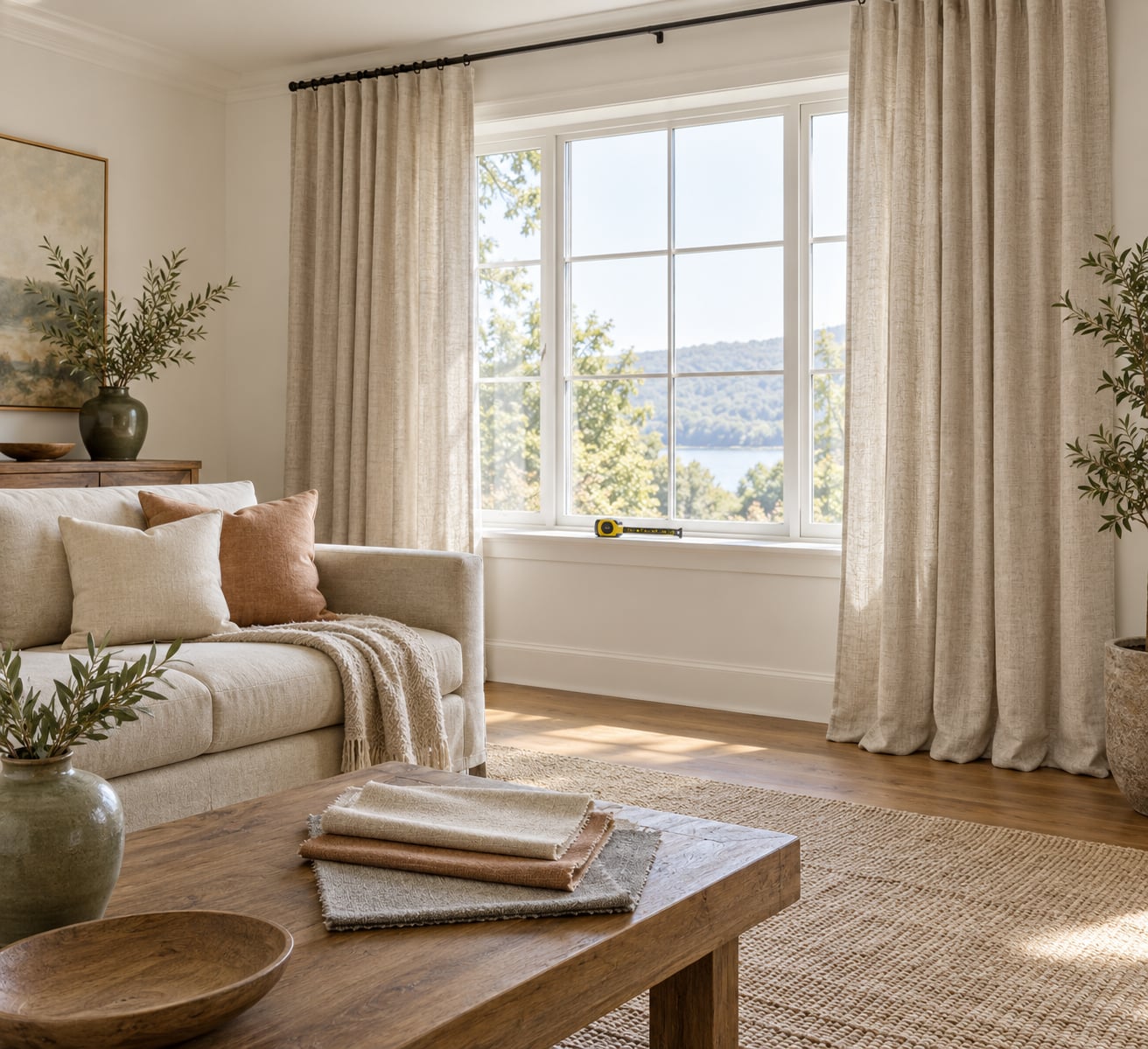
Knowing how to choose curtains for a living room comes down to four decisions: how much light the fabric lets in, how high the rod hangs, how far the rod reaches past the window frame, and how long the panels drop. Get those right and the rest — color, pattern, hardware — is a much easier conversation. Most of the work takes about twenty minutes with a tape measure and a pencil.
The biggest mistake I see again and again is measuring the window and nothing else. A panel that is exactly as wide as the window looks stretched and thin, and light leaks around both sides no matter how good the fabric is.
So here is the order I work in: measure, then decide light level, then fabric, then color, then hardware. Skipping ahead to the fun part is how rooms end up with beautiful curtains that are 6 inches too short.
Table of Contents
- How to Choose Curtains for a Living Room: Start With the Window
- Check the window shape and position
- Look up at the ceiling
- Note what sits under the window
- Work out how the room is used
- Measure for the Right Curtain Size
- How high and wide to hang curtain rods
- Fullness: the number most people get wrong
- Turn measurements into panel sizes
- Choose a Curtain Length for Your Room
- Choose Light or Blackout Curtains
- Pick the Right Fabric
- Match Curtain Color and Pattern to the Room
- Choose Curtain Hardware That Fits
- Set a Curtain Budget and Compare the Total Cost
- How to Choose Curtains for Different Living Room Styles
- Traditional
- Modern
- Farmhouse
- Minimalist
- Bohemian
- Transitional
- Quick Checklist Before You Buy
- Frequently Asked Questions
- Should living room curtains touch the floor?
- What size curtains should I buy for a wide window?
- Are linen curtains better than polyester for a living room?
- How high should I hang living room curtains?
- Do blackout curtains make a living room too dark?
- Can I mix curtain colors or patterns with existing furniture?
- Start With the Window Measurements
How to Choose Curtains for a Living Room: Start With the Window
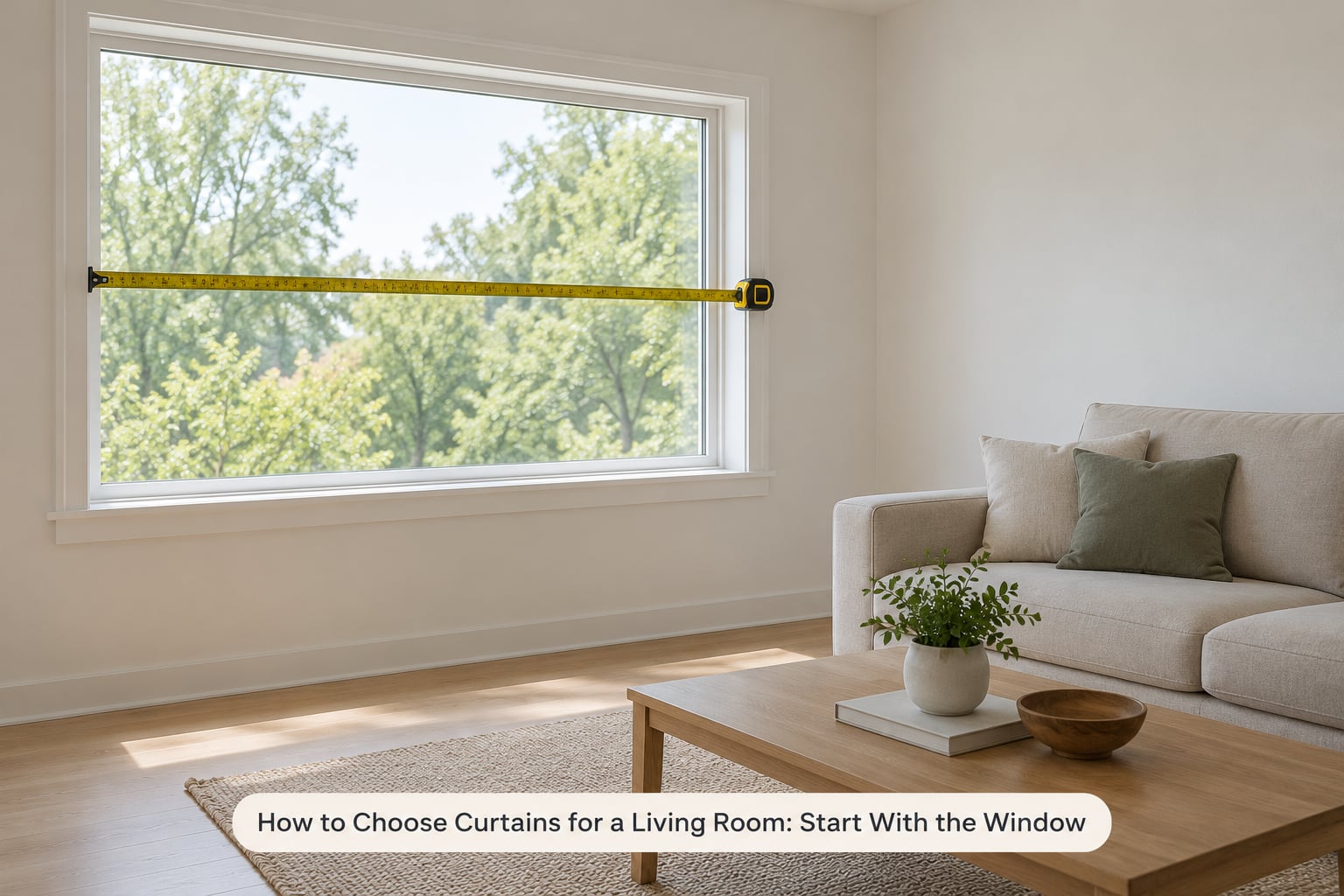
Curtains change the proportions of a room more than any other single item you can add. Your eye reads the space between the top of the fabric and the ceiling as ceiling height, and the space between the panel edge and the window as window width. Move the fabric and the same room reads taller, wider or smaller.
Before you fall for a fabric, look at the room you are actually working with.
Check the window shape and position
Standard rectangular windows are the easy case. Bay, arched, corner and street-facing windows each need their own approach, and the position matters as much as the size. A window tucked into a corner has no wall on one side, so a standard rod will not fit without poking into the room.
Look up at the ceiling
Standard eight-foot ceilings, vaulted ceilings and low cottage ceilings all want a different rod height, and low ceilings punish the ceiling-hanging rule harder than any other. Note your ceiling height before you note anything about the window.
Note what sits under the window
A tall sofa directly under a short window is a sizing problem, not a fabric problem. If a radiator or a media console sits below the sill, the panels may need to stop short of the floor to clear it.
Work out how the room is used
A reading corner needs privacy and low glare in the afternoon. A media room needs light control during the day so screens stay readable. A street-facing room needs opacity that sheer fabric simply cannot give you. Answer this before fabric shopping, not after.
Two other practical factors deserve a mention now. Sunlight through a south-facing window fades fabric over time, so color and fade resistance both matter more in that room. And if you rent, the hanging method is a decision, not a detail — tension rods and no-drill brackets limit you, and that should shape your plan before you measure.
Measure for the Right Curtain Size
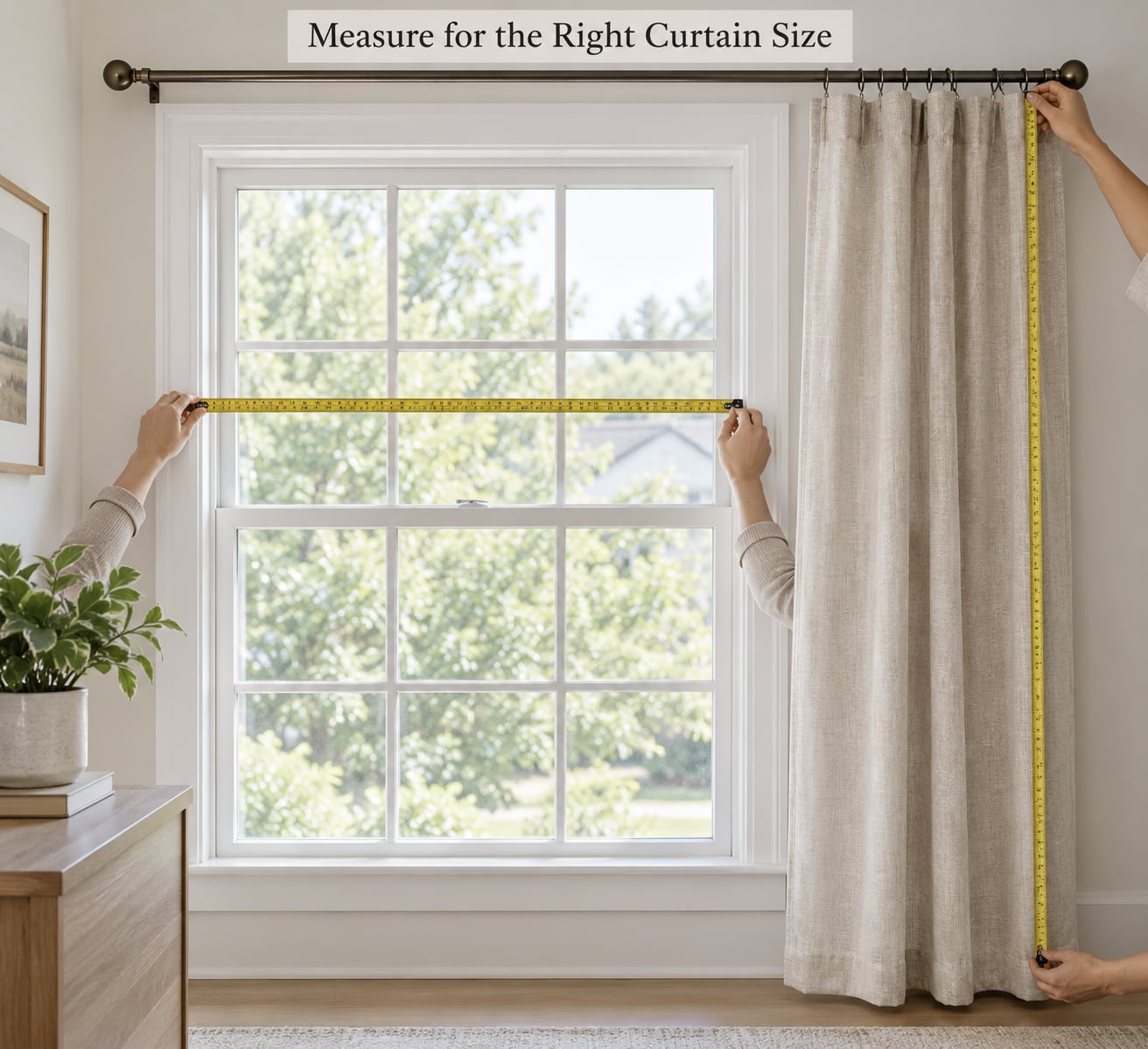
Measure four things: the width of the window frame, the height from the top of the frame to where you want the panel to end, the ceiling height, and the distance from the frame to whatever furniture sits below it. Write the numbers down. Retracing the room in ten minutes is easier than a second trip to the shop.
How high and wide to hang curtain rods
Hang the rod 4 to 6 inches above the top of the window casing for a standard look, with 2 inches as the absolute minimum. Leave about 1 inch between the rod and the ceiling if you are mounting near it, so the brackets have somewhere to attach.
For width, extend the rod 4 to 10 inches past the frame on each side. That extra reach is what makes the window look wider, and it gives the panels room to stack when you push them aside.
The stack-back is worth thinking about. A gathered panel takes up roughly 6 to 8 inches of wall space per side, and that is the space the rod extension has to cover.
Fullness: the number most people get wrong
Fullness is the ratio of fabric width to window width. A 1.5x ratio gives neat, structured pleats that suit a formal or tailored room. A 2x ratio gives generous, soft folds and is the standard for drapery panels.
Heavier fabrics need less fullness because they already hold their own shape. Sheers and lightweight linen blends need closer to 2.5x, or they hang flat and lifeless against the window.
Turn measurements into panel sizes
Take your window width, multiply by your fullness ratio, then split that total between two panels. A 60 inch window at 2x gives you 120 inches of fabric, so two 60 inch panels. Panels that are slightly wider than that number will stack back further and look fuller when open.
For length, measure from the top of the rod down to the floor, not from the top of the window frame. Add a couple of inches for hemming if the panels are unlined, or 8 to 12 inches for a generous weighted hem on made-to-measure drapery.
- Window width: measure the frame outer edge, not the glass.
- Rod height: 4 to 6 inches above the casing, or 6 to 12 inches higher for a taller-looking room.
- Rod width: 4 to 10 inches past the frame on each side.
- Panel width: window width x 1.5 for tailored, x 2 for soft.
- Drop: rod to floor, plus hem allowance.
You will also need a pencil, a level, a step ladder and the right fixings for your wall type. Brackets into plasterboard need different anchors than brackets into studs or brick, and a masonry bit is not optional for brick.
Choose a Curtain Length for Your Room
Floor length is the safest choice in a living room. A panel that just kisses the floor makes the wall read taller and the room read more finished. A half inch of daylight underneath is the detail that makes everything above it look slightly wrong.
Just skimming the floor, with a visible gap, suits rooms where you want a lighter feel or where the floor is uneven. Puddling, where the fabric pools on the floor, is dramatic and very soft-looking — but it collects dust, and it is a poor fit if you have pets or a busy walkway.
Café-length panels stop around the sill or just below it. Use them when the window is short, when the radiator is underneath, or in a casual room where you want to keep the sill clear. Shorter panels make a room look lower, so they are not the move in a room you are trying to open up.
One exception worth knowing: if the window is so short that floor-length panels would cover it entirely, stop fighting it. Roman shades, blinds or a café curtain will look intentional where a bunched-up panel will not.
Choose Light or Blackout Curtains
Light control is the decision that determines fabric opacity, and the honest version is that no fabric blocks light unless it is lined. Unlined sheers diffuse. Light filtering panels soften. Room-darkening panels with a white lining handle most glare. Full blackout with a foam or rubberized core blocks light almost completely and also thickens the panel noticeably.
Full blackout is worth it for a media room, a street-facing ground floor window in the evening, or a living room you use for daytime naps. It is rarely worth it on a north-facing window where you want daylight to come through.
Layering solves most rooms better than one fabric. Sheers hung close to the window soften the light all day, with a heavier panel on the outer rod for privacy after dark. The two rods need enough space between them that the sheer can still hang flat, which is another reason to plan hardware before ordering fabric.
Thermal lining is a separate upgrade from blackout, and it is the one that quietly lowers a heating bill in a draughty room. In a sunlit room it also protects the upholstery underneath from fading.
Pick the Right Fabric
Fabric choice is where budget, care and look intersect. The table below compares the options you will actually find in stores.
| Fabric | Light control | Drape and mood | Care | Best for |
|---|---|---|---|---|
| Linen and linen blends | Light filtering | Relaxed, casual, textured | Wrinkles; dry clean or cold gentle wash | Airy rooms, relaxed styles, layering under a panel |
| Cotton | Light filtering, depends on weight | Clean and crisp | Machine washable at lower weights | Everyday family rooms, easy-care budgets |
| Polyester | Any, depending on lining | Sharp, holds pleats | Machine washable, wrinkle resistant | Budget, high-traffic rooms, rentals |
| Velvet | Room darkening typically | Rich, formal, heavy | Brush or steam; do not crush | Formal living rooms, low light, winter palette |
| Sheer | Diffuses and softens | Weightless, floats | Hand wash or delicate cycle | Daylight control, paired with a panel |
| Performance fabric | Varies | Muted matte, built to last | Usually washable and bleach-tolerant | Sun-facing rooms, homes with pets and children |
One word of caution: velvet crush marks. Brushing and leaning show up as permanent flat patches, so velvet belongs on a low-traffic wall rather than behind a busy sofa.
Match Curtain Color and Pattern to the Room
Curtains are a large block of color, and the eye weighs them heavily. The rule most people find works: make them the same value as the sofa or a step lighter, never darker. Lighter panels let daylight reach the floor and make a room feel bigger; very dark curtains in a small room close it in from both sides.
Against walls, the reverse applies. Curtains the same tone as the wall disappear into it, which suits a calm, tonal room. A contrast between window and wall gives the window definition, which suits a room that needs a focal point.
Build from what you already own. Pull the sofa cushion, the rug border and one wood tone, and you have your palette. Repeating a color that already appears three times in the room makes the curtains feel deliberate rather than added on.
Pattern needs more care than color. If the upholstery is already patterned, go plain in the curtains and let the fabric texture do the work. Two patterns in one room need to differ clearly in scale — a small geometric with a large floral, say — and live far enough apart to read separately. If you are unsure, plain is the safer bet.
Warm wood floors pull toward warm neutrals: oatmeal, camel, soft clay. Cool gray or white walls handle cool-leaning neutrals and every shade of blue without looking thin.
Choose Curtain Hardware That Fits
Hardware is where most “cheap-looking” curtains give themselves away. A thin pole in a cheap finish makes a beautiful panel look like a temporary fix.
- Rods and finials work with gathered fabric, add vertical interest, and suit rooms with radiator clearance to spare. Finials give the classic, finished look.
- Tracks suit ceiling-to-ceiling panels, layers and stack-back systems, and disappear visually on a plain wall.
- Rings add visible hardware and a tailored heading. They sit well with velvet and heavier fabrics.
- Clip-on rings are the cheapest and most forgiving option, and they work with almost any rod.
- Grommet tops look clean and modern, and need a wide enough rod to pass through.
- Back tabs and rod pockets give the simplest, cheapest heading and the softest fold, and they are the easiest to sew or adjust.
Whatever you pick, check the weight rating. A velvet panel is much heavier than a sheer, and a thin pole with light fixings will sag. Also leave clearance from radiators and avoid placing a track directly over a heat source.
Set a Curtain Budget and Compare the Total Cost
People budget for panels and then get caught out by the rod, the fixings and the labor. Think in four lines: fabric, hardware, installation, and the cost of getting it wrong. That last one is the one that actually hurts — panels cut too short have to be bought twice.
Ready-made panels come in fixed lengths, usually 63, 84, 95 and 108 inches. If your drop lands near one of those, ready-made is the efficient choice. If it lands awkwardly between sizes, you pay more to live with a length that is wrong than you would to have panels made or altered to your drop.
Made-to-measure costs more and buys three things: your exact drop, wider panels that stack properly, and a heading sewn to your hardware. It is the right call for floor-to-ceiling, arched or non-standard windows. Readers on decorating forums describe made-to-measure quotes as genuinely startling, so get more than one, and ask whether the quote includes the heading, the lining and installation.
Ways to save without wrecking the fit:
- Buy the rod first and measure from the rod, not from an ideal length in your head.
- Use clip-on rings instead of custom pleats — same silhouette, far less cost.
- Thrifty or salvaged finials and brackets, mixed with a new rod, look deliberate and cost much less.
- Have panels hemmed to a longer standard length and shorten them yourself, which is far cheaper than a made-to-measure job.
- Wash and steam ready-made panels before hanging; a crease-free panel instantly looks higher quality.
One more option: curtains over existing blinds. It works well, but mount the rod wide enough that the blind head fits inside the curtain drop, and use a stack-back so you can reach the blind pull without dragging the panel across the glass.
How to Choose Curtains for Different Living Room Styles
Traditional
Floor-length panels with a tailored heading, a rod that extends well past the frame, and a pattern that echoes the upholstery. Fullness around 1.5x keeps the pleats crisp. Gold or bronze finials finish the look without shouting.
Modern
Clean lines, one strong color, and hardware that disappears. A wide track with a wave or ripple heading, hung near the ceiling, works better than gathered panels here. The trend most people are following in 2026 leans toward matte black or brushed metal hardware and a single flat color with no pattern.
Farmhouse
Gingham or a simple stripe in checked cotton, with a rod pocket or clip rings on a stained or painted pole. Café-length panels suit the style better than floor length, because the look is casual and the window is usually small.
Minimalist
One fabric, one color, generous fullness and nothing else competing. Neutral tones, no pattern, and hardware kept as thin as the budget allows. The fabric quality does all the work, so this is where a natural or linen-blend weave earns its cost.
Bohemian
Layering does the styling here. A sheer or loosely woven panel hangs over a simpler one, and tie-backs or a rod pocket at mid-height bring in texture. Warm earth tones and a little fringe or tassel detail push it over the edge without more spending.
Transitional
A neutral panel in a subtle texture, with the pattern living in the rug and cushions instead. This is the easiest style to pull off in a room that already has a mix of old and new furniture, and it is the safest choice if you may redecorate soon.
Quick Checklist Before You Buy
Run through this before you order anything.
- Window frame width measured, with rod extension of 4 to 10 inches on each side
- Rod height set 4 to 6 inches above the casing, or higher if the ceiling allows
- Drop measured from the rod to the floor, with hem allowance added
- Fullness ratio chosen, and panel width calculated
- Two panels per window, unless the window is genuinely too narrow to stack
- Light level decided: sheer, light filtering, room darkening or blackout
- Fabric chosen for the care you will actually do, not the care you hope for
- Color tested against the sofa, the walls and one wood tone in the room
- Hardware weight rating adequate for the fabric, and fixings correct for the wall
- Total cost for fabric, hardware and installation compared against at least two quotes
- Return policy checked on made-to-measure and altered panels before you commit
Frequently Asked Questions
Should living room curtains touch the floor?
Aim for the panel to just kiss the floor, with no daylight visible underneath. A visible half-inch gap is the single detail that most often makes an otherwise well-hung curtain look cheap. The exceptions are a radiator under the window, an uneven floor, or a busy walkway where the fabric would always be stepped on.
What size curtains should I buy for a wide window?
Multiply the window width by 2 for soft, generous fullness, or by 1.5 for a tailored look, then split that between two panels. A 90 inch window at 2x needs about 180 inches of fabric, so two 90 inch panels. Extending the rod 4 to 10 inches past the frame on each side makes the window look wider and gives the panels somewhere to stack.
Are linen curtains better than polyester for a living room?
Neither is better for every room. Linen and linen blends look softer and more relaxed and improve with age, but they wrinkle and are harder to wash. Polyester holds pleats, resists wrinkles, washes easily and costs less, which makes it the practical choice for family rooms and rentals. In a formal room where drape matters most, linen is the better-looking option.
How high should I hang living room curtains?
Standard advice is 4 to 6 inches above the top of the window casing, with 2 inches as a minimum. If your ceiling is higher than the window allows, mount the rod 6 to 12 inches above that and buy a longer drop. The exception is a very tall ceiling with a low window, where pushing the rod all the way up leaves an awkward gap above the fabric.
Do blackout curtains make a living room too dark?
Full blackout blocks almost all light and also makes the panel heavier and stiffer, which can look heavy in a small or low-ceilinged room. Room-darkening panels with a white lining are usually the better all-round choice: they cut glare for a screen or a street-facing window while still letting soft daylight through. Full blackout earns its place in media rooms and upstairs rooms.
Can I mix curtain colors or patterns with existing furniture?
Yes, as long as the curtains relate to the sofa by value. Make them the same value as the upholstery or a step lighter, never darker, and they will read as part of the room. If the upholstery is already patterned, choose plain curtains and let the pattern live in the rug and cushions. Two patterns only work when they differ clearly in scale.
Start With the Window Measurements
Start with the window. Measure the frame, decide where the rod will sit and how far it will extend, then work out the drop from the rod to the floor. Everything after that — light level, fabric, color, hardware — gets much easier, and far cheaper, once you know how to choose curtains for a living room on real numbers rather than a guess.