Most people searching how to decorate in a transitional style want the same thing: a room that feels calm and pulled-together without a full renovation. Transitional decorating is the middle path between traditional and modern — you keep the warmth and classic shapes of the furniture you already own, then add clean lines, softer colour and fewer competing patterns. The work happens in a specific order, and most rooms come together through layout, light and textiles rather than new furniture.
Table of Contents
- What Is Transitional Style?
- How to Decorate in a Transitional Style
- 1. Start with what you cannot change
- 2. Clear the room first
- 3. Settle the palette using the 60-30-10 ratio
- 4. Fix the layout before buying anything
- 5. Choose furniture by silhouette, then by comfort
- 6. Layer textiles and get the rug right
- 7. Layer the lighting in three parts
- 8. Style the accessories last
- What Colors Work Best for Transitional Decorating?
- Match the undertone before the shade
- Use room conditions to pick warm or cool
- Add contrast instead of more colours
- Keep metals to two finishes
- How Do You Mix Traditional and Modern Furniture?
- Let the biggest piece set the tone
- Repeat a finish, change a shape
- Blend inherited pieces without apology
- Give breathing room around the pieces
- Transitional Living Room Ideas on a Budget
- How to Style Transitional Bedrooms, Kitchens, and Offices
- Bedrooms and the bed wall
- Kitchens
- Home offices
- Common Transitional Decorating Mistakes
- Mixing too many styles at once
- A rug that is too small
- Over-accessorising surfaces
- Hanging curtains too low and too short
- Buying the accent piece first
- Mismatched undertones
- Matching everything perfectly
- Ignoring the focal point
- Frequently Asked Questions
- What is transitional modern design?
- What is the 3-5-7 rule in decorating?
- What items make your house look cheap?
- What are the four types of interior design?
- How do you mix traditional and modern decor?
- Can transitional style work in a small space?
- Conclusion
What Is Transitional Style?
Transitional style pairs traditional details and warm, classic furniture forms with clean lines, minimal ornament and a restrained neutral palette. The result is a room that reads as timeless rather than dated: softer and warmer than traditional, calmer and less stark than modern.
That definition only helps if you can spot the boundaries. Plenty of people in r/HomeDecorating and r/interiordesignideas describe this exact look for months before they find the word for it, which is why a vocabulary check is worth doing before you buy anything.
| Style | Palette | Furniture | Ornament and detail |
|---|---|---|---|
| Transitional | Warm or cool neutrals, one or two accents | Streamlined silhouettes with soft edges | Selective — classic shapes, simplified detail |
| Modern | Monochrome, often high contrast | Geometric, low profiles, minimal curves | Very little; form comes from shape |
| Contemporary | Neutrals with bolder, trend-led colour | Clean and current, often sculptural | Low, and it changes with the season |
| Traditional | Warm and layered, pattern on pattern | Ornate, carved, curved, symmetrical | High — crown moulding, tufting, carving |
Modern and contemporary are the two people confuse most often. Modern is stricter and more graphic, a look built on flat planes and few objects. Contemporary is looser and chases the current season, so a room styled last year can read dated. Traditional leans on ornament, symmetry and warm woods. Transitional sits between all three: it takes the shape of a traditional piece and removes about a third of the fuss from it.
Transitional modern, sometimes called modern transitional, pushes the same idea further toward the contemporary end. Expect flatter cabinetry, less pattern, and a tighter colour range than classic transitional.
How to Decorate in a Transitional Style
There is a reliable order of operations, and skipping ahead is what makes rooms look unfinished. Work through these eight steps and each decision you make afterwards gets easier.
1. Start with what you cannot change
Flooring, window placement, cabinetry and the paint you inherited from the last owner are your fixed points. A warm oak floor pushes you toward warm walls and brass hardware; a grey porcelain tile pushes you toward cool greige and brushed nickel. Decide which direction your fixed finishes already lean and decorate inside it instead of fighting it.
2. Clear the room first
Declutter is unglamorous and it is the single highest-return hour you will spend. Transitional styling depends on visual weight, and you cannot manage weight in a room that is already crowded. Move small furniture off surfaces, empty shelves down to two or three objects per shelf, and get a clear path between the door and the sofa.
3. Settle the palette using the 60-30-10 ratio
About 60% of the room is your neutral base, 30% is your secondary tone, and 10% is your accent colour. That last 10% is where personality lives, and it is the part people get wrong by using five accent colours instead of one. Pick your accent early because it decides which textiles, art and accessories you buy next.
4. Fix the layout before buying anything
Pull seating into a defined group and check that the front legs of the sofa and chairs sit on the rug. In a big square room with no obvious focal point, anchor the layout on the fireplace, the window with the best view, or the longest wall rather than on the doorway. Symmetry reads calmer; asymmetry reads more relaxed. Either works, as long as you commit to one.
5. Choose furniture by silhouette, then by comfort
Look for clean lines with soft edges: tapered legs, gentle curves, low backs, no deep tufting, no ornate carving. Upholstery in linen, cotton or a textured weave does more for a transitional room than any decorative accessory. Scale matters more than price — a large room with small furniture reads temporary, and a small room with oversized pieces reads cramped.
6. Layer textiles and get the rug right
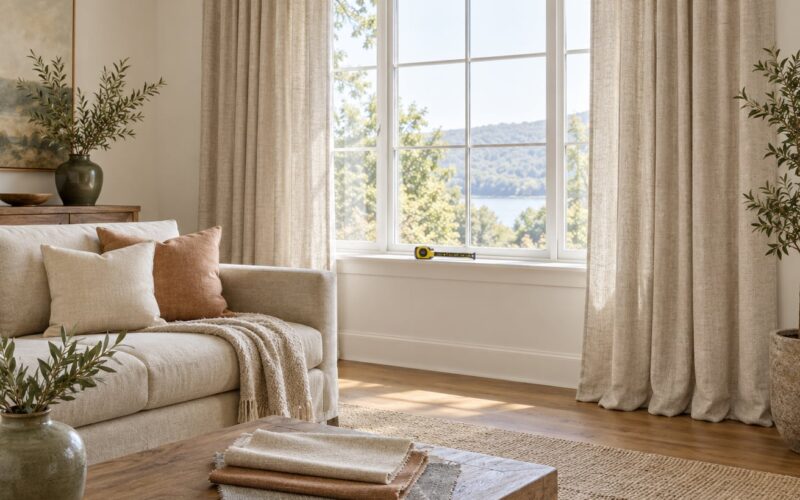
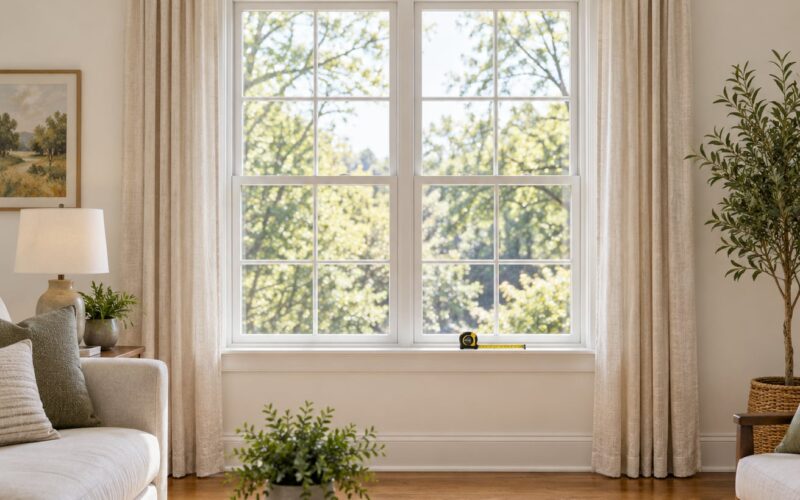
A rug should be large enough that the front legs of every main piece land on it. The most common sizing error is buying a rug that fits the coffee table only, which leaves the seating group floating on bare floor. Hang curtain panels as close to the ceiling as you can and let them break just past the sill; a gap of daylight above a rod makes a room look unfinished.
7. Layer the lighting in three parts
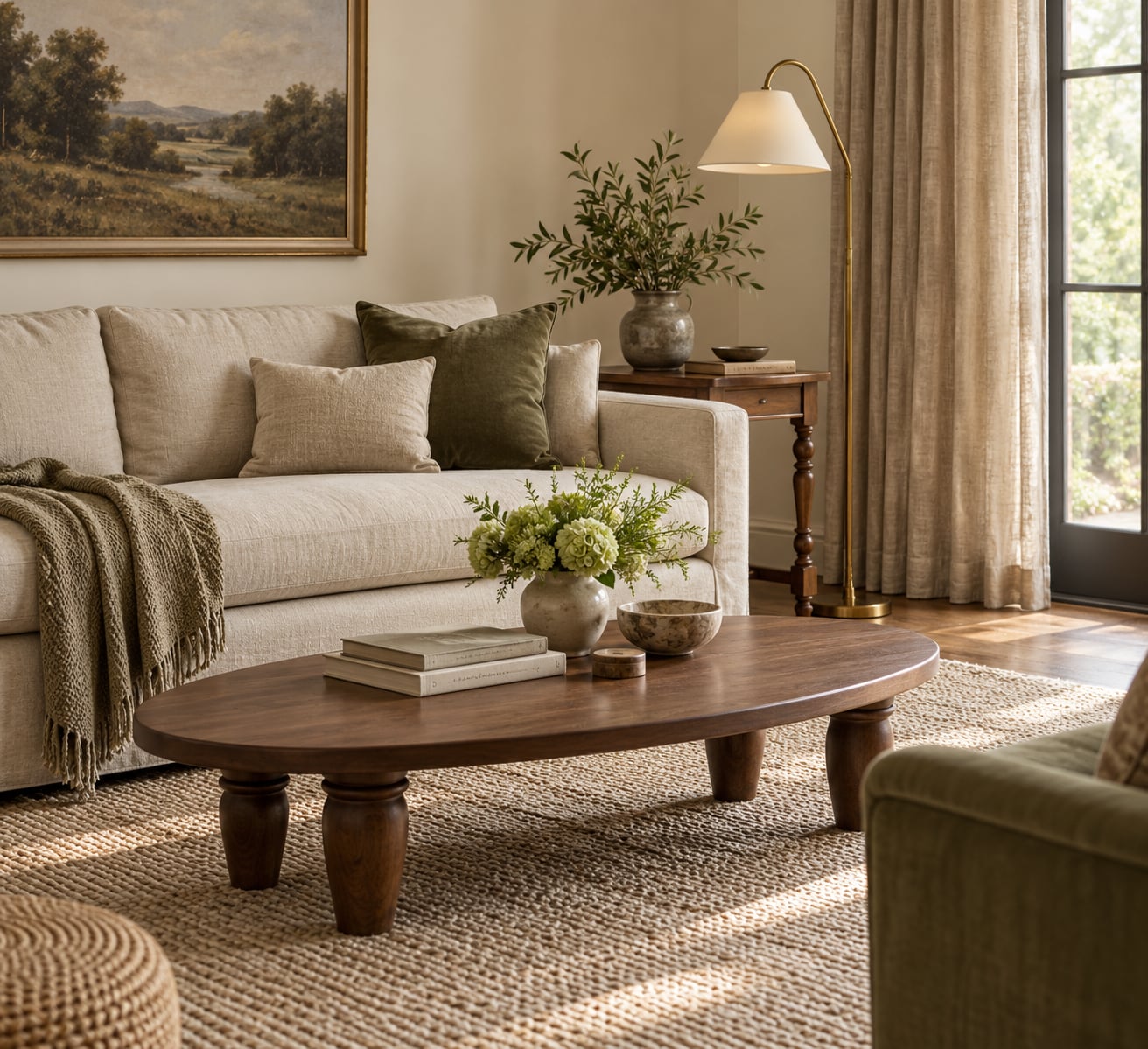
Ambient light is the general glow — table lamps, a floor lamp, wall sconces. Task light is directional and functional: a reading lamp beside the chair, a lamp on the desk. Accent light draws attention to a focal point, usually a picture light or a small lamp on a console. A room with only a ceiling fixture rarely reads as designed, no matter how good the furniture is.
8. Style the accessories last
Group in odd numbers, three or five, and vary scale within the group. Repeat two or three finishes somewhere else in the room so the eye reads them as a set. One statement piece — a large artwork, a mirror, a distinctive lamp — carries the focal point, and everything else stays quiet around it. You can live in a room for months and finish this step last.
What Colors Work Best for Transitional Decorating?
Neutral is the starting point, not the finish. The trick is picking neutrals that share an undertone and then adding contrast in a controlled way.
Match the undertone before the shade
Undertone is the warm or cool cast hiding inside a colour. Two greiges from different undertone families will fight even when they look like the same family of neutral. Sample paint on the actual wall and look at it at night, because artificial light shifts undertone noticeably. If you want named starting points, Benjamin Moore White Dove OC-17 and Pale Oak OC-20 or Sherwin-Williams Alabaster SW 7008 and Accessible Beige SW 7036 are widely used warm-leaning neutrals worth testing on your walls.
Use room conditions to pick warm or cool
Warm neutrals — putty, sand, oatmeal, camel — move forward visually and hold up well in rooms with lots of daylight and cool window light. Cool-leaning greiges recede slightly, which helps a small room feel larger, and they suit homes where the light already skews blue or grey. North-facing rooms usually look better warm; a dim basement usually looks better cool and light.
Add contrast instead of more colours
A grey-beige wall plus a grey-beige sofa leaves the room flat. Push contrast through texture and value instead: linen against velvet, a dark walnut table against pale walls, matte ceramics beside glossy glass. Then add one accent colour in two or three places rather than one everywhere. Olive, rust, terracotta, deep navy and forest green are the accents that sit comfortably beside warm and cool neutrals alike.
Keep metals to two finishes
Mixed metals work when they are deliberate. Pick two — brushed brass with black, or brushed nickel with warm walnut — and repeat each one in at least three places in the room. A third finish appears to be an accident rather than a decision, which is exactly the impression transitional rooms are supposed to avoid.
How Do You Mix Traditional and Modern Furniture?
Mixing works when you control four things: scale, finish, spacing and visual weight.
Let the biggest piece set the tone
Your sofa, bed or dining table is the sentence; everything else is punctuation. If the largest piece is traditional, keep other pieces simpler. If it is modern and streamlined, let a side table or a lamp bring back a curve or a turned leg. What looks wrong is three traditional pieces and three modern pieces of equal size competing for attention.
Repeat a finish, change a shape
Instead of hunting for a matching set, repeat one material across pieces that have different silhouettes. The same walnut appears on a traditional side table and a modern coffee table. The same linen tone appears on a classic wing chair and a streamlined bench. Repetition is what makes mismatched pieces read as one deliberate collection.
Blend inherited pieces without apology
Inherited furniture is usually solid wood, which suits this style better than almost anything else. What usually needs help is scale and upholstery. If a piece is too ornate for the room, reupholstery in a plain linen or a subtle weave removes most of the fuss while keeping the frame. If it is too big, a furniture painter can take it to a lighter or warmer tone in a weekend. Slipping a clean slipcover over a heavy sofa is the cheapest version of the same move.
Give breathing room around the pieces
Crowding is what makes a mixed room look accidental. Leave 30 cm or so of visible floor between freestanding pieces, and let one surface per room carry the traditional element rather than putting traditional touches everywhere. Visual weight should fall in one corner or one wall, not evenly everywhere.
Transitional Living Room Ideas on a Budget
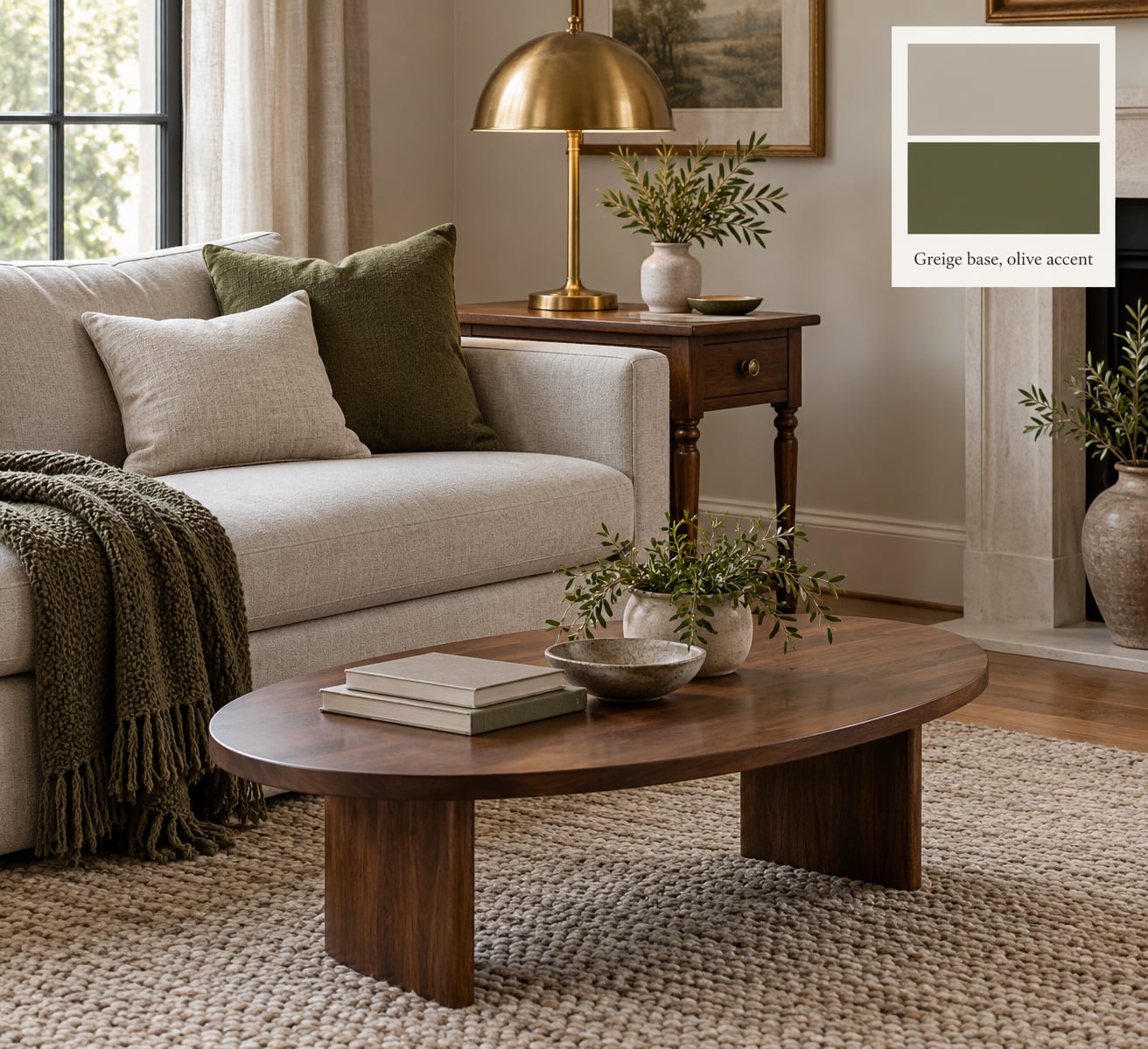
You rarely need to replace the big pieces. The changes below make the biggest difference for the least money, and most work in a weekend.
- Move the seating. Pull everything 5 to 10 cm away from the walls, group it onto a properly sized rug, and angle the armchairs slightly inward. This alone fixes the layout in a square room.
- Relight the ceiling. One warm table lamp instead of relying on the ceiling fixture changes how a room feels in the evening. Bulb temperature is part of the style — warm white flatters warm neutrals.
- Swap textiles. Slipcovers, new cushion covers, a throw with visible weave, and a pair of lined curtains do more than most people expect.
- Frame what you own. Thrifted artwork in mismatched frames looks intentional once the frames match each other in finish.
- Refinish rather than replace. A thrifted lamp gets a brass or nickel base spray; a tired side table gets a painted top in a soft neutral.
- Hang art higher and larger. Art hung 10 to 15 cm above the intended height, and 8 to 10 cm narrower than the furniture beneath it, looks deliberate.
- Edit the surfaces. Limit each table and shelf to one grouped arrangement plus one object. Empty space is a transitional tool.
Renters can get most of this without paint. Peel-and-stick wall panels, oversized art leaning against a wall, textiles, plants, baskets and mirrored hardware deliver the same look and come off at lease end.
How to Style Transitional Bedrooms, Kitchens, and Offices
Bedrooms and the bed wall
Keep the headboard simple — a clean-lined upholstered frame in linen reads transitional, while a heavily tufted headboard reads traditional. Two matching bedside tables in a light wood balance the bed, and one lamp on each side removes the need for matching hardware elsewhere in the room. Layer two throws rather than one, one large in a neutral weave and one smaller in your accent colour.
Kitchens
Kitchens lean transitional when cabinetry is simple — shaker doors or a flat slab profile — and texture comes from the surfaces instead. Stone or quartz counters, a wood cutting board leaned against the backsplash, a linen runner and open shelving with a small number of everyday pieces. Mixed metals work best here with a hard rule: all hardware in one finish, with the pendant or the faucet allowed to be the second.
Home offices
An office is the easiest room to make feel finished because the desk anchors it. Keep the desk clean-lined, add one upholstered or wood chair with shape, and hide the cables and the printer. Shelving with mixed wood tones reads collected rather than cluttered as long as each shelf has negative space. A rug under the chair defines the work zone in an open-plan room, where the office and living area usually need a boundary.
In a small apartment or condo the same rules compress well: light upholstery, one rug that is properly sized for the whole room, vertical storage, and curtains hung high. In an entryway, a narrow console, a wall mirror and a washable runner give a transitional first impression in about a metre of wall space. The same restrained approach works outside for a transitional exterior — simple planting, one or two planters per entry, a clean door colour and uncluttered sightlines.
Common Transitional Decorating Mistakes
Mixing too many styles at once
Transitional is a blend of two things, not five. The fix is to pick the two styles your furniture already represents and remove or relocate everything that belongs to a third.
A rug that is too small
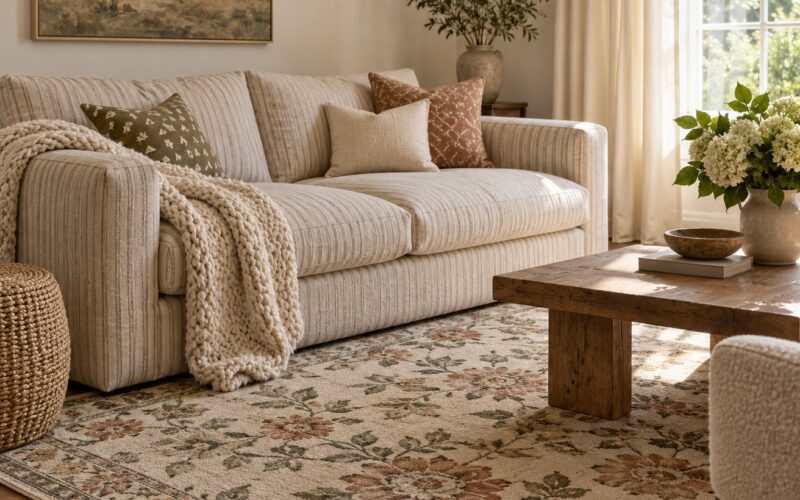
This is the most frequent problem in the style, and it flattens everything above it. Buy the largest rug the room can hold and let the front legs of the seating land on it. Patching two rugs together works if the colours match closely.
Over-accessorising surfaces
Transitional rooms read calm because they have gaps. Empty half of what is on your shelves and tables; the room usually looks better, not emptier.
Hanging curtains too low and too short
The gap between rod and ceiling, and the fabric stopping above the sill, signals an unfinished room more than almost anything else. Fixing it costs far less than new curtains in most cases, since panels can often be rehung higher.
Buying the accent piece first
People fall in love with a moss green sofa and then try to build a room around it. Choose the base neutral and the accent colour before the sofa, and let upholstery follow.
Mismatched undertones
Paint, flooring and upholstery each reading a slightly different temperature makes a room feel unsettled even when nothing clashes loudly. Pick one undertone and check samples against each other in the same room.
Matching everything perfectly
A room where every piece matches looks flat and showroom-like, which is the opposite of the style’s intent. Let shapes vary and repeat finishes instead of repeats of identical items.
Ignoring the focal point
If two statement pieces compete — a large mirror and oversized art on the same wall — the eye has nowhere to land. Keep one focal point per wall and let the rest of the room stay quiet.
Frequently Asked Questions
What is transitional modern design?
Transitional modern design is the point on the transitional style where the balance tips toward contemporary. Expect flat or shaker cabinetry, fewer patterns, tighter colour ranges with one bold accent, and streamlined furniture with almost no ornament. Traditional shapes may still appear in a side table or a lamp base, but the overall room reads cleaner and more current than classic transitional. It suits newer homes and open-plan spaces.
What is the 3-5-7 rule in decorating?
The 3-5-7 rule is a simple accessory formula: group three large items, five medium items and seven small items on a surface or in an arrangement. On a sofa that means three large pillows, five medium cushions and seven small ones, which sounds excessive but keeps sizes clearly different. Use it as a starting structure, then cut whatever makes the grouping feel busy. Odd numbers read intentional because even groupings feel accidental.
What items make your house look cheap?
The usual culprits are a rug that is too small for the seating group, curtains hung low and stopped above the sill, mixed metals in three or more finishes, overfilled shelves, visible cords and mismatched frames. Cheapness also comes from threadbare upholstery and from painting a whole room in a colour that fights the flooring. Fix scale and placement first, because those changes are free and they change the room more than anything you can buy.
What are the four types of interior design?
The four most commonly named types are traditional, transitional, contemporary and modern. Traditional relies on ornament, symmetry and warm woods. Transitional combines classic silhouettes with simplified detail and a neutral palette. Contemporary is current and trend-led, often with bolder colour. Modern is the most restrained, built on geometry, monochrome colour and very few objects. Each uses a different amount of decoration, which is usually the fastest way to tell them apart.
How do you mix traditional and modern decor?
Let your largest furniture piece set the tone, then repeat one material across pieces with different shapes. Keep traditional to one element per room rather than scattering it, and control visual weight so the classic pieces sit in one corner or on one wall. Leave visible floor between freestanding items and hold to two metal finishes. When a piece is too ornate, reupholstery or a slipcover keeps the frame and removes the fuss.
Can transitional style work in a small space?
Yes, and it is one of the better fits for small rooms. Light upholstery, a properly sized rug and curtains hung high all make the space feel larger. Work with a 60-30-10 palette so most surfaces stay in the neutral base, and use one rug rather than layered rugs, which add clutter at small sizes. Skip overhead-only lighting and add a floor lamp instead. In a rental, the whole look can be built from textiles, art, plants and peel-and-stick panels.
Conclusion
Transitional decorating works because it lowers the stakes. Neutral walls, simple furniture shapes and repeated finishes mean the pieces you already own can stay, and every swap afterwards makes the room calmer rather than different. If you want the look to hold up in 2026 and beyond, keep the palette and the focal point and change the textiles.
Start with three decisions: pick your neutral base and one accent colour using the 60-30-10 ratio, fix the layout so the seating group sits on a rug sized for all of it, and add a second light source at eye level. Get those right and the rest of the room is detail work you can spread out over months.