Most independent consignment stores will negotiate, especially on a piece that has been sitting for weeks, and asking is expected rather than rude. The whole conversation takes about two minutes at the register. What makes it work is walking in with a specific number and a specific reason, not a vague hope for a better deal.
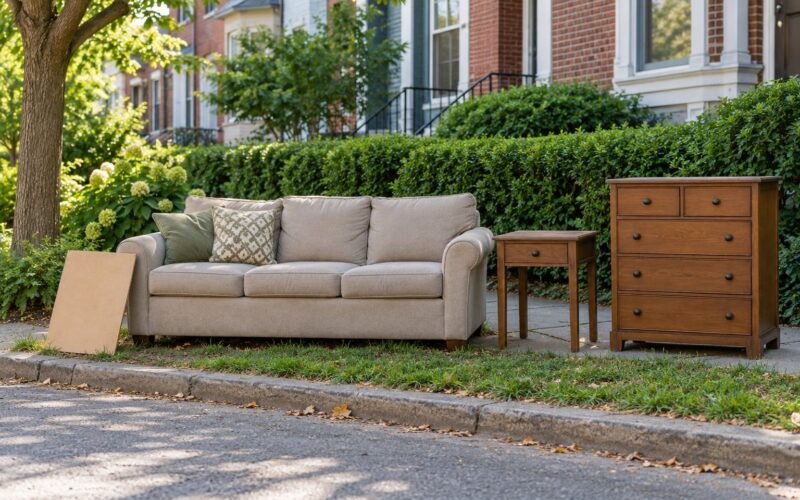
So if you are wondering how to negotiate price at a consignment furniture store without losing the sofa you came for, here is the part nobody tells you: almost nobody walks out because you asked. The staff need the piece gone as much as you need it in your living room. The buyer who loses the item is usually the one who haggled over nothing, argued about a small gap, or took so long that someone else bought it while they were still deciding.
What follows is the process I wish someone had handed me the first time: how to prepare, what to say word for word, roughly what to offer based on how long a piece has been on the floor, and how to walk away without burning a relationship at a local shop you might want to visit again. Updated for 2026.
Table of Contents
- What You Need Before You Negotiate
- Step-by-Step: How to Negotiate Price at a Consignment Furniture Store
- 1. Research the Piece Before You Shop
- 2. Inspect the Furniture for Condition and Value
- 3. Ask How the Store Sets Its Price
- 4. Make a Respectful Counteroffer
- 5. Negotiate the Total Purchase Price
- 6. Close the Deal or Walk Away
- Common Mistakes That Kill the Deal
- Frequently Asked Questions
- Can you negotiate prices at consignment furniture stores?
- When is the best time to ask for a lower price?
- How much lower should I offer on a consignment sofa or table?
- What if the salesperson says the price is final?
- Are consignment furniture prices negotiable when an item has been marked down?
- Conclusion
What You Need Before You Negotiate
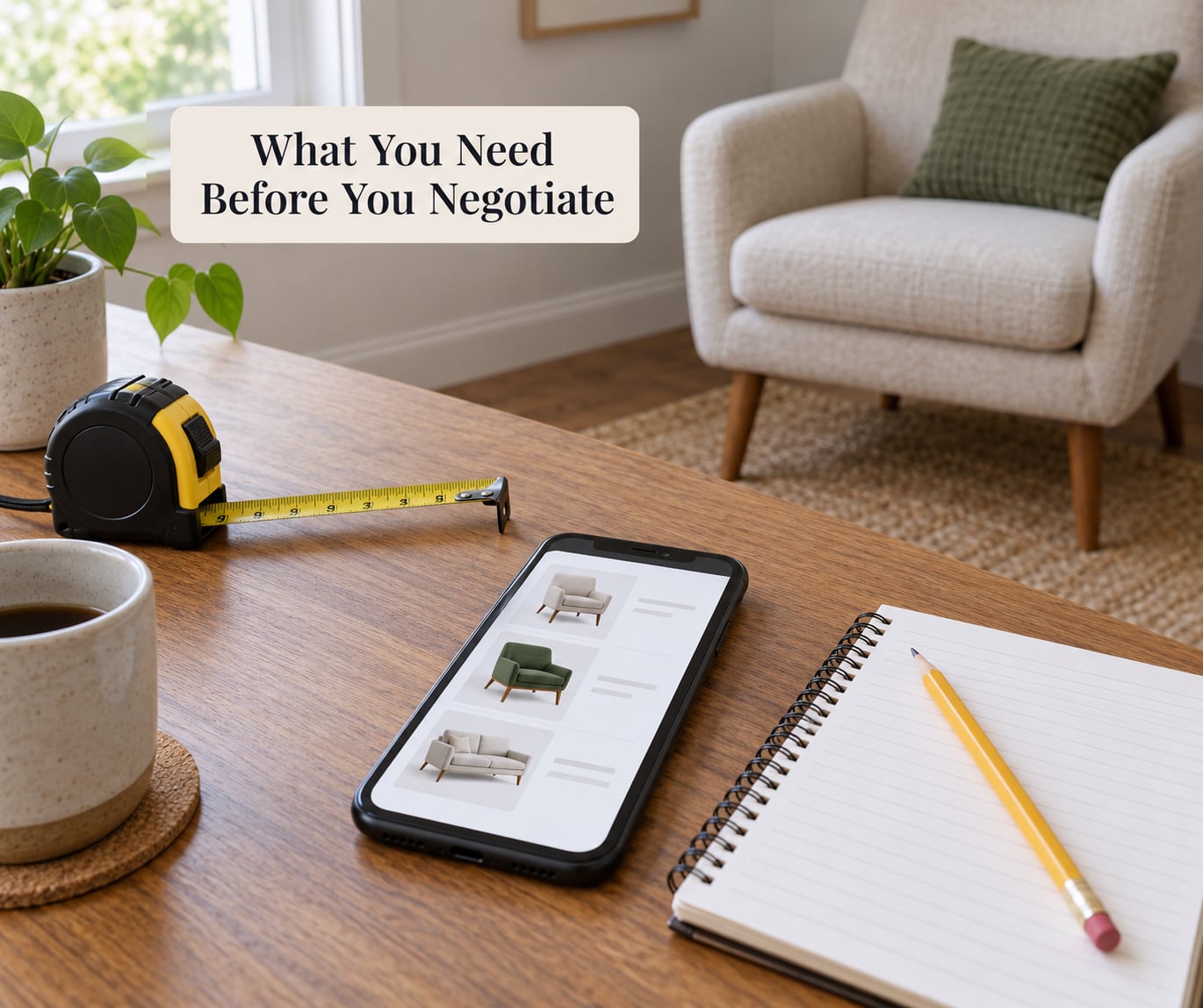
Preparation is what separates a request that gets answered with a real number from one that gets a flat no. Bring these five things and you will not be improvising at the counter.
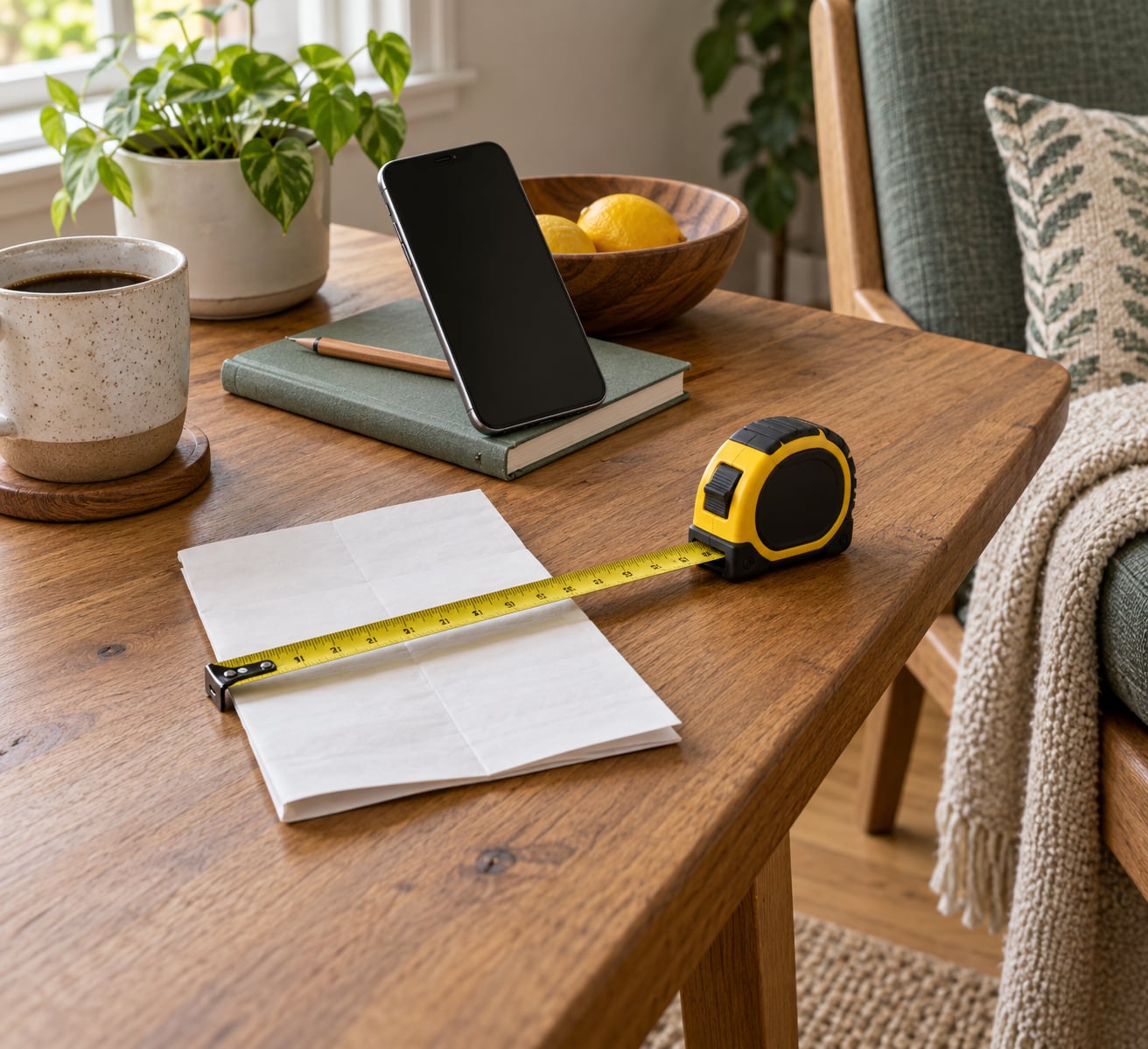
- A number you can live with, written down. Not your maximum, but the price you would happily pay today if the piece were available. Sellers can tell the difference between a buyer with a ceiling and a buyer fishing. “I can do fifteen percent under the tag today” lands better than “what’s your best price?”
- Tape measure and the room dimensions. Half of secondhand negotiation failure is really a measurement failure discovered after the fact. Check that the sofa clears the door and the stairwell before you spend any negotiating capital.
- Your phone, with listings open. Pull two or three comparable pieces: same category, same condition, same region. Marketplace and resale-listing apps are the fastest way to show staff that a number has a basis.
- A short list of flaws, with photos. A pulled thread, a water ring, a drawer that sticks, a faint smoke smell. Notes taken while you are still calm beat issues you raise for the first time at checkout, when you already sound annoyed.
- One honest sentence about why you are asking. Budget, condition, no vehicle, a piece you saw cheaper, a room that needs filling this month. That sentence is the whole negotiation.
One more thing worth deciding in advance: your walk-away number. Write it on the paper with the measurements. Deciding in the moment is how people talk themselves past their own limit and then resent the sofa for years.
Step-by-Step: How to Negotiate Price at a Consignment Furniture Store
1. Research the Piece Before You Shop
Know roughly what the item sells for in the open market before you say a number out loud. The tag on a consignment piece is a starting position, not a market fact, and buyers report it often carries a ten to twenty percent cushion over what the store will actually take. If you know the piece retailed for a certain amount new and you can see comparable secondhand listings in your area, you have a factual foundation rather than a feeling.
Check a few specific things before you go: whether the maker or style is genuinely desirable (a widely collected mid-century piece holds value, a generic oak sideboard often does not), what the materials are (solid wood and good hardware hold value; veneer over particleboard does not), and how the piece is priced locally versus online. Vendors in this trade talk about the difference between local market price and national listing price, and it is a fair thing to raise when your comparable is three states away and includes shipping.
Screenshot anything useful. Ten seconds of research at home is what lets you speak with certainty later without sounding like you are bluffing.
One research habit pays for itself twice: note what the same piece costs locally and what it costs through a national marketplace listing. Resellers in this trade talk about that gap openly, and when your comparable is a few states away the shipping and the return window are part of the comparison. Comparing a delivered local price against a bare listing price is how buyers accidentally overpay, and knowing the difference is something you can say out loud without sounding argumentative.
For a dining set or a sectional, count the seats or chairs as well as the piece. Bundled lots are often priced per item at a shop and sold as a group elsewhere, which is a real discount you can point at rather than request.
2. Inspect the Furniture for Condition and Value
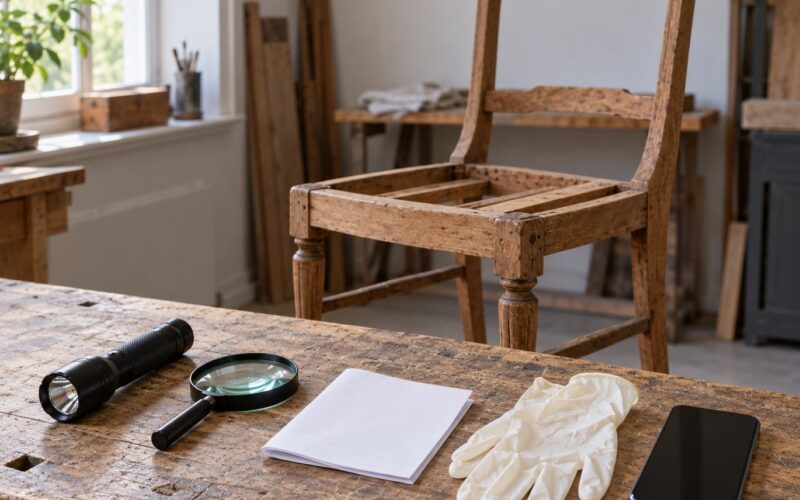
Condition is your strongest card, and the only one that never feels rude to play. Work through it systematically: push on the frame and the joints, sit and shift your weight, check that the springs and webbing hold, wiggle the legs, test every drawer and door, look under the cushions and along the back.
Then look at surfaces. Run a hand along the top edge of a dresser where hands land and finish wears. Check upholstery for stains, fading, pilling, and a cigarette smell that never quite fades. Look at rugs rolled at the edges for fiber loss or matting. Missing a hardware bag or a set of drawer pulls is a legitimate deduction because you will pay to replace them.
Photograph every flaw before you mention it, and ask directly whether sales are final. A store that sells as-is gives you less to negotiate with later, which usually means the negotiation has to happen now, up front. Stores with a short return window still give you a chance to come back, but assume you will not.
Flaws fall into two groups and they are worth different amounts. Cosmetic damage, a water ring, faded arms, a scuffed leg, moves a price a few percentage points. Functional damage, a sagging frame, a spring that has gone, a drawer that will not track, a piece that rocks, is a much bigger deduction because you are buying a repair bill you cannot see yet. Decide which group each problem belongs to before you mention it.
Secondhand furniture also carries problems you cannot photograph. Smoke and pet smell are the two most common, and both are worth asking about directly because sellers and staff often know. A piece that smells of smoke can sometimes be aired out over a weekend; a piece soaked into a cushion foam may not be salvageable at all.
Ask whether anything has been repaired, recovered, or reupholstered, and how long ago. A reupholstered seat in decent fabric is a plus. A frame welded back together by a previous owner is information you want before you fall in love with the shape.
“I see a water ring near the front edge of the top and the bottom drawer sticks. Would that change the price for you?”
3. Ask How the Store Sets Its Price
Ask, plainly and without accusation, how the price was arrived at. At a staffed resale chain the answer is usually policy, and the price is not yours to change. At an independent consignment shop the answer usually involves the person who dropped the piece off, how long it has been sitting, and when the store starts losing money on it.
That answer matters because it tells you where the real number lives. Most consignment stores keep a commission in the range of thirty to sixty percent of the sale price, and items are typically consigned for sixty to ninety days before the store either marks them down sharply or sends them home. Those two facts explain why asking is legitimate: the store’s income depends on moving the piece, and a piece past its consignment window is costing them floor space they could rent to something that sells.
Commission rates and consignment periods vary by shop and by category, so treat those numbers as a model of how the economics work rather than a figure you will hear quoted at the register. The staff member in front of you still has a real problem to solve, and their flexibility comes from it.
Ask how long it has been on the floor and whether it has already been marked down. Some stores write the date on the tag or the back of the price card; others will tell you if you ask about their markdown schedule. Here is a reasonable starting point based on time on the floor:
| Time on the floor | Where the store usually stands | Reasonable opening offer, as a share of the tag | When to ask |
|---|---|---|---|
| Under a week | Priced to sell quickly, barely any room | 85 to 90 percent | Only for a real flaw, or if you are buying several pieces |
| One to two weeks | Some flexibility, item still in its prime window | 75 to 85 percent | Ask once, politely, near the register |
| Three to four weeks | Store is thinking about the next markdown | 65 to 75 percent | This is where most people win a real discount |
| One to two months | Past the sweet spot, floor space pressure | 55 to 65 percent | Expect the first no, expect a counter, expect yes if you are patient |
| Over two months | End of the consignment window, likely headed home | 40 to 55 percent | Ask, then ask again in two weeks when the next cut is due |
Use that table as a floor for your own thinking, not a script to recite. A piece with a serious flaw sits lower in its row than a flawless one, and a designer name moves it up.
4. Make a Respectful Counteroffer
Now the actual ask. Keep it short, specific, and warm. One number, one reason, then stop talking. Silence is uncomfortable for both of you, and it is where most nervous shoppers give away their position by filling it.
“I love this table and I want to take it today. If I can do fifteen percent under the tag, it is mine right now.”
“I’ve been looking at this dresser for a while. There’s a scuff on the top and the bottom drawer needs work. Would you take fifteen percent off the tag for it as-is?”
“If I take the sofa and the two side tables, is there room on the total?”
Three rules keep this from going sideways. Acknowledge the arrangement first: the seller in the room is not a faceless retailer, and the person who dropped off that sofa gets part of whatever you pay. Say one sentence that shows you understand that, then make your ask.
Second, do not interrogate the price or the consignor. Curiosity about the process is welcome; treating the tag like an accusation is not.
Third, if you are negotiating over text or in an app, ask to come in instead, or at least offer to. People consistently report negotiating face to face works better because staff can read your interest, and because you can tell from their reaction whether to hold or move. An in-person ask also lets you inspect the piece again, which is the real reason to go back.
If you cannot go back in person, keep the exchange short and specific rather than chatty. Write the item, the tag price, your offer, and one reason, then stop. Shops that answer a text with a paragraph of questions usually want you in the room more than they want to negotiate over an app. Ask when the store is closed so you are not pulling staff away from a customer, and give them a day to answer before you assume the worst.
Then decide in advance what you will do with a counteroffer. A counter is not a rejection, and it is almost never the final figure. A reasonable response is to split the difference once, in the direction of the store but not all the way, and then accept. Two people who each moved a little usually close; three rounds of haggling over a small gap usually ends with someone walking.
5. Negotiate the Total Purchase Price
When the item price is firm, the deal is often still open. Sales tax is not negotiable, but almost everything attached to the purchase is: delivery, pickup help, loading, assembly, card convenience fees, and how long a piece can be held for you.
If you have no vehicle, delivery is the negotiation. If you do have one and they charge for pickup, ask to waive it. If you are furnishing a room, ask whether the store holds items for a few days while you collect the rest of your shopping, and whether layaway is available.
Other trades that work more often than a discount: including the matching ottoman, pillow set, or hardware bag; getting the store to hold the piece while you decide; splitting the fee with a friend who takes one of the chairs. These cost the store almost nothing and are easier to say yes to than a cut in the consignor’s payout.
Paying cash is worth mentioning once, then dropping. Some shops prefer it because card fees come out of their margin; others cannot accept it above a certain amount for accounting reasons. It is a request, not a lever.
Timing the payment conversation can matter more than the payment method. Paying at the counter, in full, in one visit is usually worth a small concession because it saves the store a second transaction and any risk of a buyer not showing up. Paying the same day you take delivery gets you the same benefit. If you need a week to arrange transport, say that plainly and ask for the piece to be held rather than slipping and hoping nobody notices.
One thing to establish before you leave the shop is what happens if the piece does not work when it arrives at home. Some shops will take a return within a short window for a fee or a store credit; many sell strictly as-is. If yours is as-is, that fact belongs inside your price calculation, not in a footnote you discover later.
6. Close the Deal or Walk Away
A good outcome is not the lowest number in the room. It is a price you are happy to live with and terms you understand. Before you say yes, confirm the total including tax and fees, the return or as-is policy, the pickup or delivery cost and date, and whether the piece is held or immediately sold.
If the store will not meet your number, thank them and leave. A short, gracious exit does real work in a small local shop:
“I appreciate you considering it. It’s just over what I can do right now. If it gets marked down, could I leave my number?”
Leaving your number is the underrated move. Many stores call people back when the next markdown lands, and the staff member who wanted to sell you that piece will remember you favorably for asking nicely rather than arguing.
The fear that asking costs you the piece is the reason most people never ask at all, and it is mostly unfounded. In most shops, a polite offer from someone who intends to buy today is welcome, because an unasked sale at full tag can turn into a sale at ninety percent of tag with a customer who tells their friends. What does cost you the piece is a long argument in front of other shoppers, or a second visit after you already turned the item down once.
If the price you need is well under what the store can take, the sensible move is not to bargain harder. It is to decide whether you can afford the piece at all, and be honest with yourself about it. Coming back empty-handed on a sofa you cannot afford is more expensive than the negotiation you skipped.
Common Mistakes That Kill the Deal
Nearly every failed consignment negotiation fails the same way. Here are the six that come up most often, each with the fix.
- Negotiating before researching. Anchoring on the tag with no comparison gets you a flat no. Fix: pull two or three comparable listings before you leave the house.
- Insulting the piece or the people. Commenting on the quality of the furniture, or implying staff are overcharging you, ends the conversation instantly. Fix: describe what you see, not what you think of it.
- Open-ended asks. “What’s your best price?” gives your position away. Fix: make a specific offer with a reason attached.
- Focusing only on the item price. Missing an open negotiation on delivery, pickup, or holding time. Fix: treat the total cost as the thing you are negotiating.
- Agreeing before the total is confirmed. Discovering fees and as-is terms at the door feels like a bait and switch, even when it is not. Fix: ask for the full total before you commit.
- Haggling at stores where it is unwelcome. Big-box charity thrift operations commonly run fixed prices and will pull unpriced items off the floor. Fix: ask at the desk, “Do you take offers on this, or is it fixed?” One question tells you which store you are in.
There is also a fair argument against haggling in some places, and it deserves an honest answer rather than a dodge. Some thrifting advocates feel that if you can comfortably afford the tag, you should not haggle, particularly where goods were donated. That view is reasonable, and it draws a real line: asking a store to move on aging inventory is business. Commenting on what a grieving family should accept for a dining table is not. Keep the negotiation about the store and the item, and you will stay on the right side of it.
Frequently Asked Questions
Can you negotiate prices at consignment furniture stores?
Usually, yes, but it depends on the store. Independent consignment shops and most small local shops will take an offer, particularly on pieces that have been on the floor for several weeks. Staffed resale chains and donation-based thrift stores more often run fixed prices with no room. Ask one question at the desk before you make an offer: do you take offers on this, or is it fixed? That answer costs you nothing and tells you whether to bother.
When is the best time to ask for a lower price?
Ask when the piece has been on the floor for a while. Most consignment items are given sixty to ninety days before the store marks them down sharply, so the three-to-four-week mark is where real room opens up. Timing also matters by day: late in the month and closer to a sale event, stores have more reason to move inventory. If a piece went up on the floor this week, keep shopping and come back.
How much lower should I offer on a consignment sofa or table?
A reasonable opening offer is usually ten to fifteen percent below the tag on a fairly recent piece, and twenty to thirty percent below once it has been sitting a month or more. Name one number with a reason attached rather than negotiating down in increments. If the seller comes back halfway, that is usually close to where they will land, so decide in advance the highest figure you are willing to say out loud.
What if the salesperson says the price is final?
Thank them, accept it, or shift the conversation to what you can negotiate instead: delivery, pickup, holding the piece, layaway, or an accessory thrown in. Politely ask whether the price would be revisited if the piece has not sold by a certain date, and leave your number. Fixed-price stores mean it, so this is not a battle worth having. Keep the exchange friendly, because you will probably be back.
Are consignment furniture prices negotiable when an item has been marked down?
A marked-down tag is the softest price in the store, and yes, you can usually still ask, because the markdown itself signals that the store wants the piece gone before the consignment window ends. Many stores also have a rule against stacking a discount on an existing markdown, so it is reasonable to ask instead for delivery, pickup, or a short hold. Expect a smaller concession than you would get on a fresh tag, but not zero.
Conclusion
If you do one thing before your next consignment run, spend ten minutes at home pulling up comparable listings for the piece you want. Then go in, look it over properly, note the flaws, and make one calm, specific offer based on condition and time on the floor. That single prepared sentence is where the discount comes from, not from how long you are willing to argue.