An unused fireplace is one of the biggest blank spaces in a home, and the fix is usually a weekend of simple styling rather than a renovation. Fill the firebox with one anchor object, style the mantel in odd-numbered groups, add practical storage inside the cavity, and finish with light. This guide walks through how to decorate a non working fireplace using reversible pieces first, so you can take everything down when you move or change your mind.
A dead fireplace reads as unfinished because the eye lands straight on a dark hole. Fill that hole well and the whole wall settles into balance, often for less than the cost of one armchair.
Before anything else, work out which four surfaces you are dealing with. The firebox is the recessed cavity. The hearth is the floor in front of it, sometimes raised a step above the boards. The surround is the brick, stone or tile framing the opening. The mantel is the ledge on top. Give each one a job and the rest of the styling writes itself.
Table of Contents
- What You Need
- How to Decorate a Non Working Fireplace Step by Step
- How to Choose a Focal Point for a Non Working Fireplace
- How to Add Storage Without Closing Off the Fireplace
- How to Style the Mantel and Hearth
- How to Make the Fireplace Feel Lighter or More Seasonal
- Common Mistakes
- Frequently Asked Questions
- What to put in a fireplace that does not work?
- Can I decorate a non working fireplace if I am renting?
- Is it safe to paint inside a non working fireplace?
- How do I hide leftover firebrick or an old cast iron insert?
- What are common mistakes when styling a fireplace mantel?
- Conclusion
What You Need
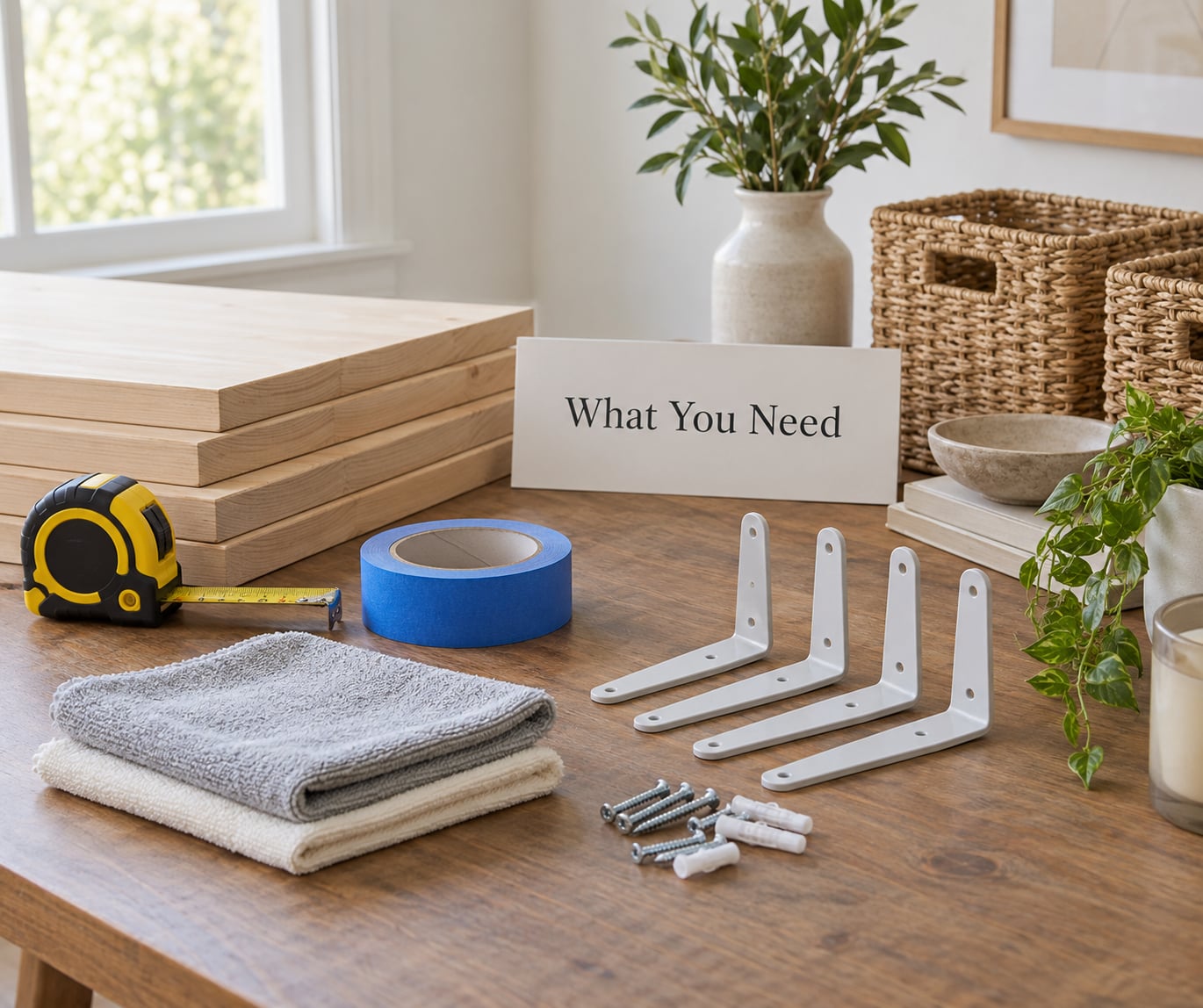
Most of this is styling, not building. What you actually reach for depends on whether you want a reversible arrangement or a more permanent one.
- Measuring tape — you need the width, height and depth of the firebox before you buy anything, and the depth is the number people skip.
- Painter’s tape and drop cloth — for masking the surround if you paint, and for protecting the hearth while you work.
- Cleaning cloths, brush and vacuum — fireboxes hold years of soot, even when they look clean from across the room.
- Shelf boards and brackets — for adding narrow ledges inside a deep cavity. Anchor them to masonry, not to crumbling plaster.
- Woven baskets or lidded boxes — the easiest way to get storage into the opening and hide what is inside it.
- One anchor object — a stack of logs, a leaning mirror, a group of pillar candles, a set of books. Just one.
- Basic hand tools — a drill with masonry bits, a level, and a stud finder if anything is being fixed to the chimney breast.
Renters should skip anything that needs a drill. Freestanding baskets, a log stack set on the hearth, leaning frames, and a fire screen propped against the opening all work without touching the wall.
One safety note belongs here rather than buried at the end. If you plan to paint, tile, or fix wood to the surround, check your local building regulations first, and get a qualified pro to look at anything structural. A bricked-up chimney is not a decorative object, and what is legal to cover varies by area. Keep anything combustible well clear of the flue opening.
How to Decorate a Non Working Fireplace Step by Step
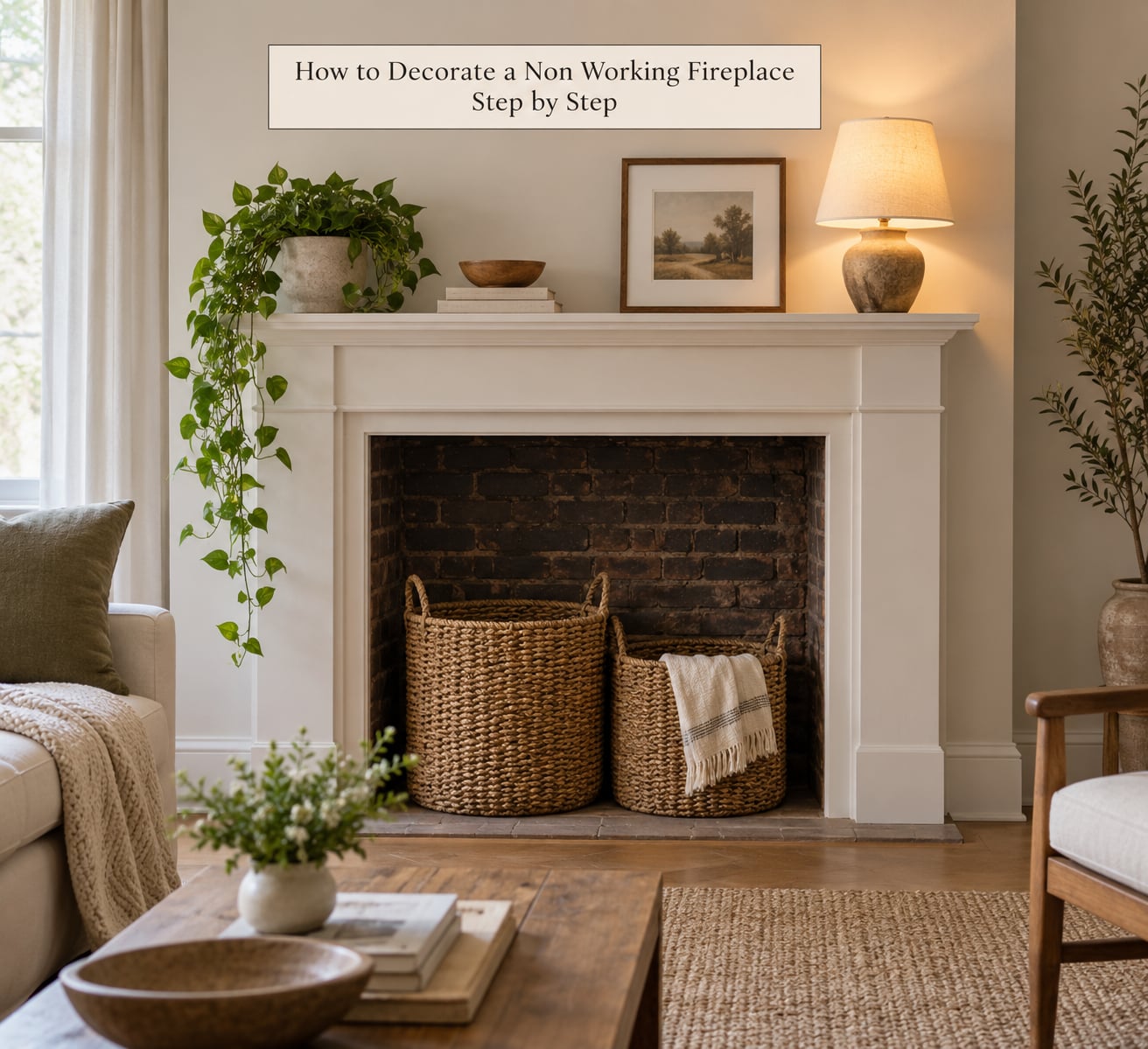
The order matters. Measure before you buy, choose the focal point before you arrange anything else, and let the mantel be the last surface you touch.
How to Choose a Focal Point for a Non Working Fireplace
Pick one thing that is clearly the biggest object in the room’s sightline, then let everything else defer to it. In a tall narrow firebox, that means vertical objects such as a column of pillar candles in mixed heights or a leaning mirror. In a wide shallow opening, the focal point should be low and wide, like a single long arrangement across the back wall.
A raised hearth changes the math as well, because the ledge in front becomes part of the display. Stack books flat there with one upright object at the end and the composition holds together. If the opening is genuinely awkward — a walk-around fireplace, or one with two inserts left in place — leave it emptier than feels comfortable. People lean heavy items against the surround and it looks settled rather than dressed.
The warm and cool test matters more than people expect. Blue-gray brick against honey-toned wood floors fights no matter what you put inside the cavity. A rug in a warmer tone, or a few wood and brass objects on the hearth, bridges the two. Getting the palette right first does more for the room than any single decorative piece.
How to Add Storage Without Closing Off the Fireplace
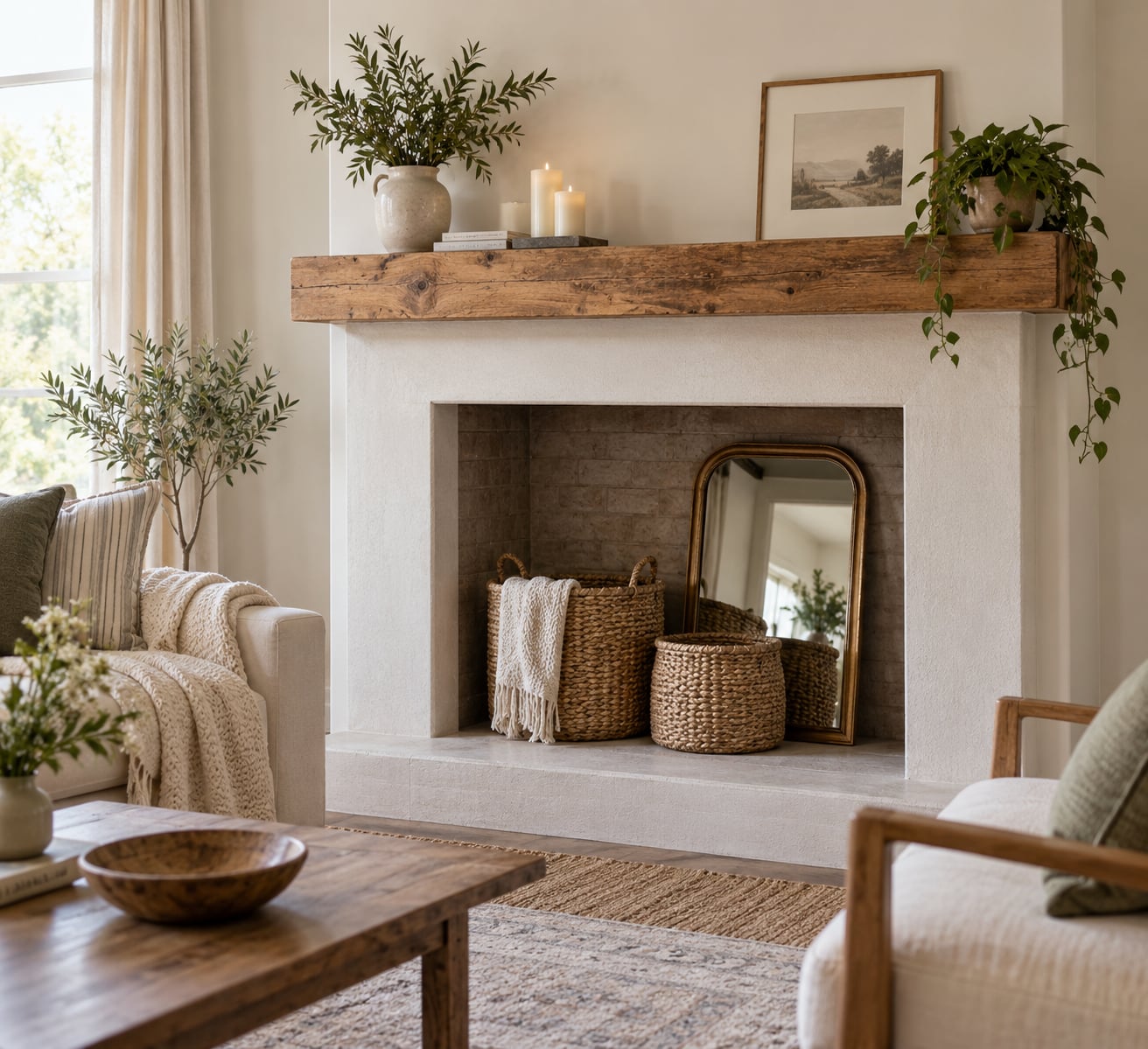
Storage is the most useful thing a cavity offers, and the trick is keeping it open enough that the fireplace still reads as a fireplace. Two baskets side by side work well in a standard opening. Leave a hand’s width of air on each side and above, so the firebox frame is still visible.
For a deeper cavity, add two narrow shelves across the back wall rather than filling the volume. Anchor them into the brick or the side masonry, and spread the load so the fixings are not clustered in one spot. Books stacked flat on the bottom shelf and a small basket on the upper one reads as styling rather than overflow.
A rolling cart is a good fit in a wide opening that you use daily, because you can pull it out. Leave the top shelf mostly empty. A firebox packed from floor to ceiling stops looking like a fireplace and starts looking like a cupboard.
How to Style the Mantel and Hearth
Treat the mantel as a small stage with three zones: something tall on one side, something low in the middle, and breathing room. Follow the odd-number rule for grouped items, three or five rather than four or six, because even counts make a mantel look accidental.
Repeat at least one material from inside the firebox up on the mantel. Logs and brick below, a woven basket or leather detail above, and the eye reads the whole thing as one arrangement. A mirror leaning against the chimney breast behind the mantel handles that job well and adds depth without taking shelf space.
On the hearth, one item is usually right. A single lantern, a low bowl, or a stack of logs sets the tone without crowding the opening. If the hearth is raised, treat the top of it as a display shelf and the front face as a blank wall you can leave alone.
How to Make the Fireplace Feel Lighter or More Seasonal
Swap what is inside rather than adding to it. In spring, a few branches in a tall vase with trailing greenery on the mantel lighten a dark cavity in minutes. In summer, shell groupings or a single oversized ceramic piece keep the palette pale.
Autumn takes warm tones and woven textures, and a garland along the mantel edge does most of the work. Winter is the easiest to change: battery-operated pillar candles in mixed heights inside the opening, a low garland, and one mirrored ornament. Battery candles are worth the swap because they give the glow without heat, smoke or soot, which is the version most people are copying.
Halloween works with the same base plus one themed object, not a full rebuild. Keep the anchor piece constant through the year and change only what surrounds it, so the fireplace looks intentional in any month.
Common Mistakes
Overcrowding the opening. Filling every surface makes a firebox look like storage. Fix it by removing one layer and leaving air at the top.
Using decor that is too small. A handful of small pieces in a large opening reads as a pile of clutter. Fewer, larger objects hold the space, and they are easier to dust, which is the trade-off most people discover about a month in.
Ignoring the color of the brick. No filler fixes a palette clash. Bridge it with the rug, the curtain fabric, or the objects on the hearth instead.
Blocking a vent or the flue. Leave openings clear and keep paper, fabric and fresh greenery away from any vent. Cut flowers and fresh cuttings also struggle when the cavity is cold and dark.
Leaving real candles in an open flue. If you cannot confirm the flue is sealed or capped, use flameless candles.
Leaning heavy or unstable pieces. A mirror leaning on an uneven hearth can slide. Use a lip or a support rather than relying on friction.
Ignoring renter restrictions. Every idea in this guide has a reversible version, and those are the ones to use when you cannot paint or drill.
A few quick habits keep the result looking sharp: dust the cavity every few weeks rather than hoovering it, store seasonal pieces in one bin so the swap takes ten minutes, and take a photo before you change anything so you can see what moved.
Frequently Asked Questions
What to put in a fireplace that does not work?
The most reliable fillers are a stack of birch or faux logs, pillar candles in mixed heights, a set of books stacked flat, two woven storage baskets, or a leaning mirror for tall narrow openings. Pick one as the anchor object and keep the rest of the cavity open so the fireplace still reads as a fireplace.
Can I decorate a non working fireplace if I am renting?
Yes, as long as nothing is fixed to the wall. Freestanding baskets, a log stack on the hearth, leaning frames, battery candles and a fire screen propped against the opening all work without a drill. Skip painting the brick, tiling, or anything that requires masonry fixings until you own the place.
Is it safe to paint inside a non working fireplace?
Only once you know what is behind it. Paint inside the firebox needs heat-resistant paint rated for high temperatures, and covering or attaching anything to a chimney breast can breach local building regulations. Check the rules for your area, and if a gas line or a working flue is involved, have a qualified professional confirm it is safe first.
How do I hide leftover firebrick or an old cast iron insert?
Paint the interior of the firebox a deep charcoal, white or a colour that matches your room so the brick recedes, then set logs or baskets in front of it. Some people line the back and side walls with boards painted in a contrasting tone, which makes whatever sits inside the cavity stand out. An old cast iron insert can be decorated around or removed if it is not part of the structure.
What are common mistakes when styling a fireplace mantel?
The usual problems are even numbers of objects, symmetric arrangements on both ends, covering the whole surface with small items, and mixing too many materials. Group items in threes or fives, vary heights, leave empty space in at least one spot, and repeat a material from inside the firebox so the mantel connects to what is below it.
Conclusion
Start with the easiest step: clear the firebox, vacuum the soot, and measure the opening. Choose one focal point that suits its shape, add a little storage that stays reversible, then style the mantel in odd groups that repeat a material from below. Keep the palette settled, leave air in the cavity, and check your local rules before you paint or attach anything.