To hang a heavy mirror on drywall, drive screws straight into a wall stud whenever you can; when no stud lines up, use toggle bolts or a metal sleeve anchor rated at twice your mirror’s weight. Anything over about 40 pounds, or wider than 36 inches, belongs on a French cleat. Most of the job is deciding how the load gets into the wall, and that decision takes about five minutes.
The reason people learn this the hard way is that drywall itself is nearly weightless. It’s a gypsum core wrapped in paper, so a plain screw spins in it like it was threaded into foam. A properly installed anchor changes that by spreading the load across enough board to carry real weight.
Studs sit roughly 16 inches apart on center, and your mirror’s D-rings almost never happen to land on one. So plan on hollow wall and treat the anchor choice as the main decision rather than an afterthought. The order of operations matters just as much: check the wall, find framing or pick an anchor, mark and level, install, then test before you walk away.
Table of Contents
- What You Need
- Tools
- Hardware
- Before You Start, Know the Wall
- Step-by-Step: How to Hang a Heavy Mirror on Drywall
- 1. Check the mirror, the wall and the mounting area
- 2. Locate studs or choose the right drywall anchor
- 3. Mark and level the mounting points
- 4. Install the anchors or screws
- 5. Attach the mirror and test the hold
- Common Mistakes
- Rating the anchor at exactly the mirror’s weight
- Using two anchors where one would do — or one where two are needed
- Over-tightening screws and bolts
- Drilling to guess instead of to find
- Skipping the load test, then leaving
- Hanging something oversized over a bed, stairs, or above a fireplace without planning the fall
- Removing the mirror and leaving the holes
- Frequently Asked Questions
- What is the best anchor for a heavy mirror on drywall?
- Can I hang a heavy mirror on drywall without finding a stud?
- How heavy can a mirror be before I need a professional installer?
- How do I remove mirror hardware from drywall without making a large hole?
- Do I need to worry about electrical wires when drilling into drywall?
- Should I use screws, toggle bolts, or adhesive strips for a heavy mirror?
- Conclusion
What You Need
Gather everything before the mirror is off its floor. The list is short, and the two items people skip — a stud finder and a proper step drill bit — are the two that decide whether this goes smoothly.
Tools
- Stud finder — a magnet-and-electronic combo is worth the money here, because a magnet finder will stop on a nail or an old picture hanger instead of the stud.
- Drill/driver — cordless is fine. Add a 1/2 inch and 3/4 inch step bit or hole saw for toggle bolts, since a standard twist bit tears the paper face.
- Tape measure and pencil — for marking stud centers and transferring your mirror’s hanger spacing to the wall.
- 6-foot or 9-foot level — a short torpedo level can’t span a wide mirror.
- Stud sensor or, in a pinch, a 3-inch drywall screw — for confirming a stud before you commit your drill.
- Gloves, safety glasses and a helper — for anything over about 3 feet wide or past 30 pounds. Glass is heavy and it fails without warning.
Hardware
- Wood screws — for stud mounting, long enough to bite 1.5 to 2 inches into the stud.
- Toggle bolts — 1/8 inch for moderate loads, 1/4 inch for genuinely heavy ones. Bring the matching step bit.
- Metal sleeve anchors (molly bolts) — a good middle option, and they hold when the wall is thin or the edge is close.
- French cleat — for wide or oversized mirrors, sold as a matched pair of interlocking cleats.
- D-rings, hanging wire or a picture-hanger bracket — if the mirror has no back hardware. Thrifted and frameless mirrors almost never do.
- Spare drywall anchors and a patch kit — because a mis-marked hole gets patched eventually.
Before You Start, Know the Wall
Knock on the wall and press your thumb into it. Modern homes give a hollow, papery feel. Older homes with lath and plaster give a solid thud and may crumble when drilled, and concrete block feels like stone. Toggle bolts bite into wood lath nicely, but on solid plaster or block you want masonry anchors or a stud in the framing. Anchors sized for 1/2 inch drywall will disappoint you on 5/8 inch board, since the void behind the face is narrower and the toggle has less room to spread.
Step-by-Step: How to Hang a Heavy Mirror on Drywall
1. Check the mirror, the wall and the mounting area
First, get a real weight number. Glass plus backing plus frame means a “medium” mirror can surprise you, and the number drives every other decision. Weigh it if you can. Otherwise use the bathroom-scale trick: stand on the scale, note the reading, then step on holding the mirror and subtract. The difference is the weight. A larger estimate from a furniture site is fine too, as long as you round up.
Next, look at the wall. Press on any soft or bulging spots — those signal moisture or an impact that’s already broken the board, and they’ll crush under a heavy load. Clear the area below, move furniture, and check for outlets, switches, and light fixtures near the intended spot.
Look at the back of the mirror too. D-rings or a wire mean you’re choosing anchor positions. A frameless or thrifted mirror with nothing attached needs hardware installed before it ever touches the wall; string wire corner to corner across the back and fasten it to two D-rings, which spreads the load and stops the frame from twisting.
2. Locate studs or choose the right drywall anchor
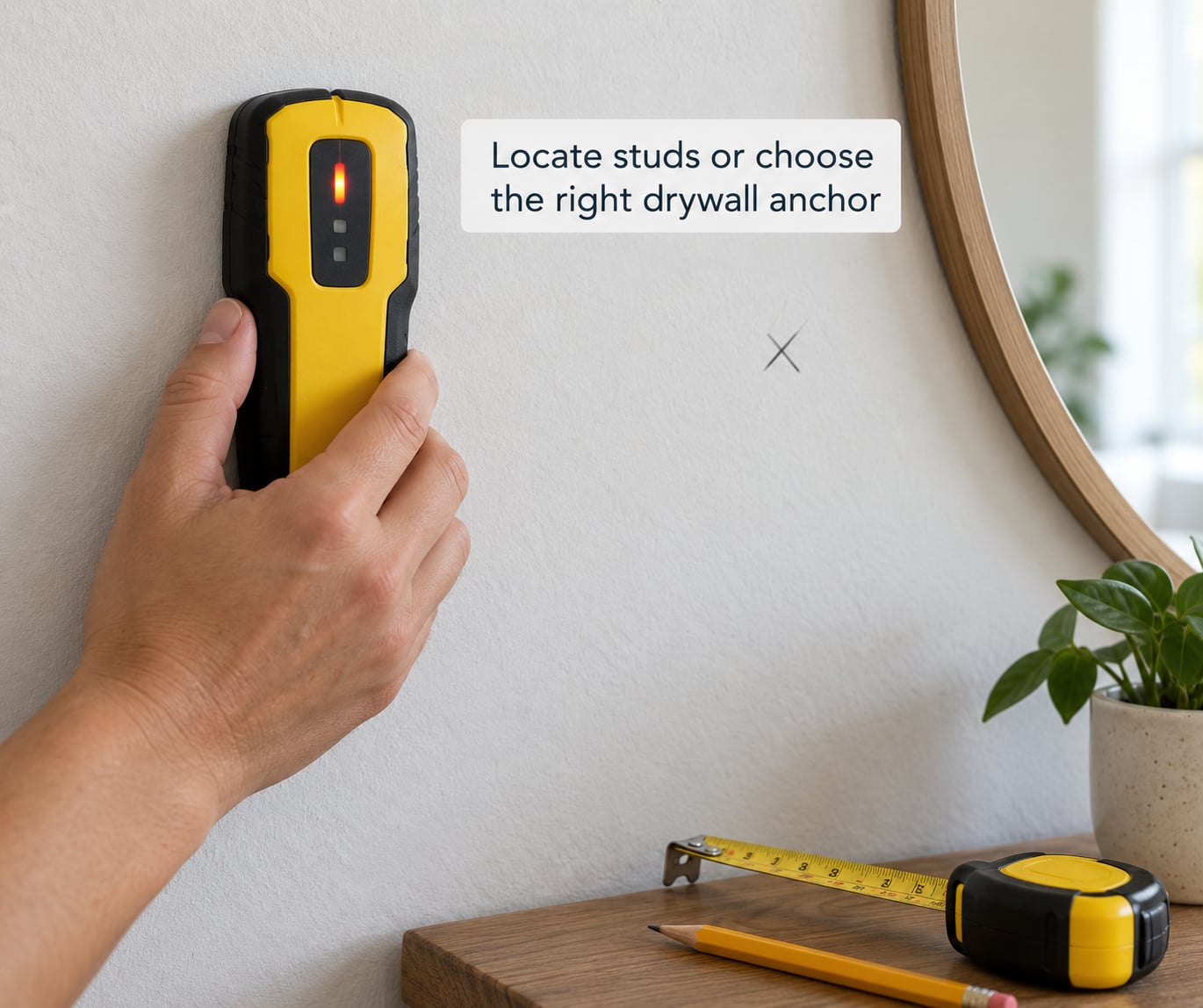
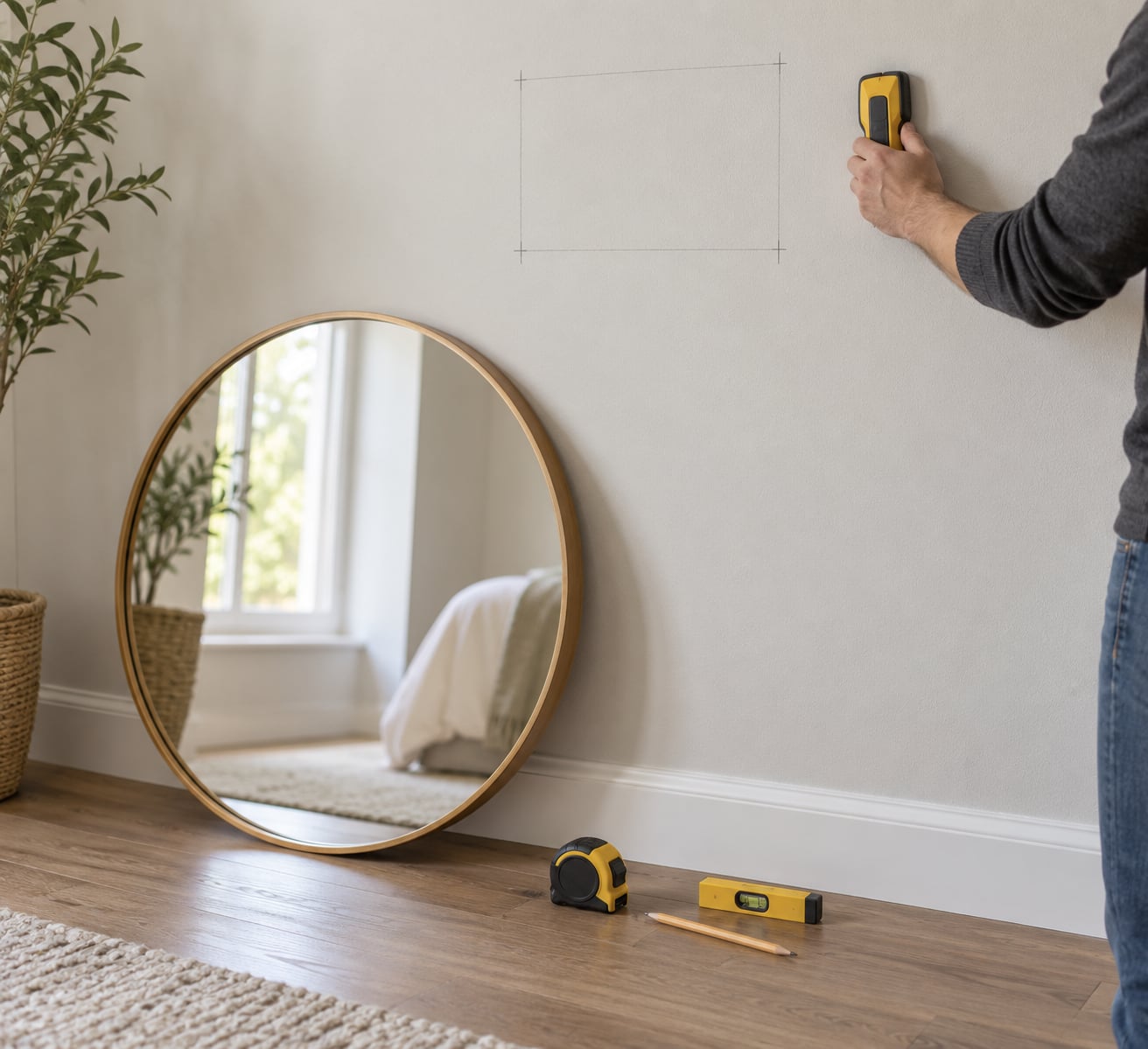
Run the stud finder across the wall at the height you want and mark both edges of each stud, then mark the center. In standard framing that puts studs 16 inches apart, so your search area is wider than it looks at first. Confirm a suspected stud with a short screw or a stud sensor before trusting it.
When no stud lines up with your hanger positions, match the anchor to the weight instead. A useful rule is to rate hardware at twice the mirror’s weight, because an anchor listed at exactly your mirror’s number leaves no margin for the swing that happens every time someone walks past or shuts a door.
| Anchor type | Typical rating | Drilling needed | Pilot hole | Best for |
|---|---|---|---|---|
| Self-drilling zinc anchor | 30-50 lbs | No, it screws in | None | Light to medium mirrors, quick installs |
| Plastic expansion anchor | 20-40 lbs | Yes | 1/4 inch | Frames and picture hangers under about 20 lbs |
| Metal sleeve anchor (molly bolt) | 50-90 lbs | Yes | Size-specific | Mid-weight mirrors, walls with little cavity |
| Toggle bolt, 1/8 inch | Up to 100 lbs | Yes | 1/2 inch | Heavy mirrors on hollow wall |
| Toggle bolt, 1/4 inch | 200 lbs and up | Yes | 3/4 inch | Oversized and frameless glass |
| French cleat | Rated by cleat length | Yes, two points | Per cleat | Wide mirrors and anything over 40 lbs |
Here is the short version of how to hang a heavy mirror on drywall when there is no stud in reach: up to about 20 pounds, a self-drilling or plastic anchor is fine; 20 to 40 pounds calls for a toggle bolt or sleeve anchor; 40 pounds and up, or any mirror wider than 36 inches, deserves a French cleat or 1/4 inch toggle bolts on both sides. Use two anchor points on a wide mirror even when each one would technically hold alone. A mirror hanging out from the wall levers itself off the fastener the way a cupboard door swings its hinge loose.
3. Mark and level the mounting points
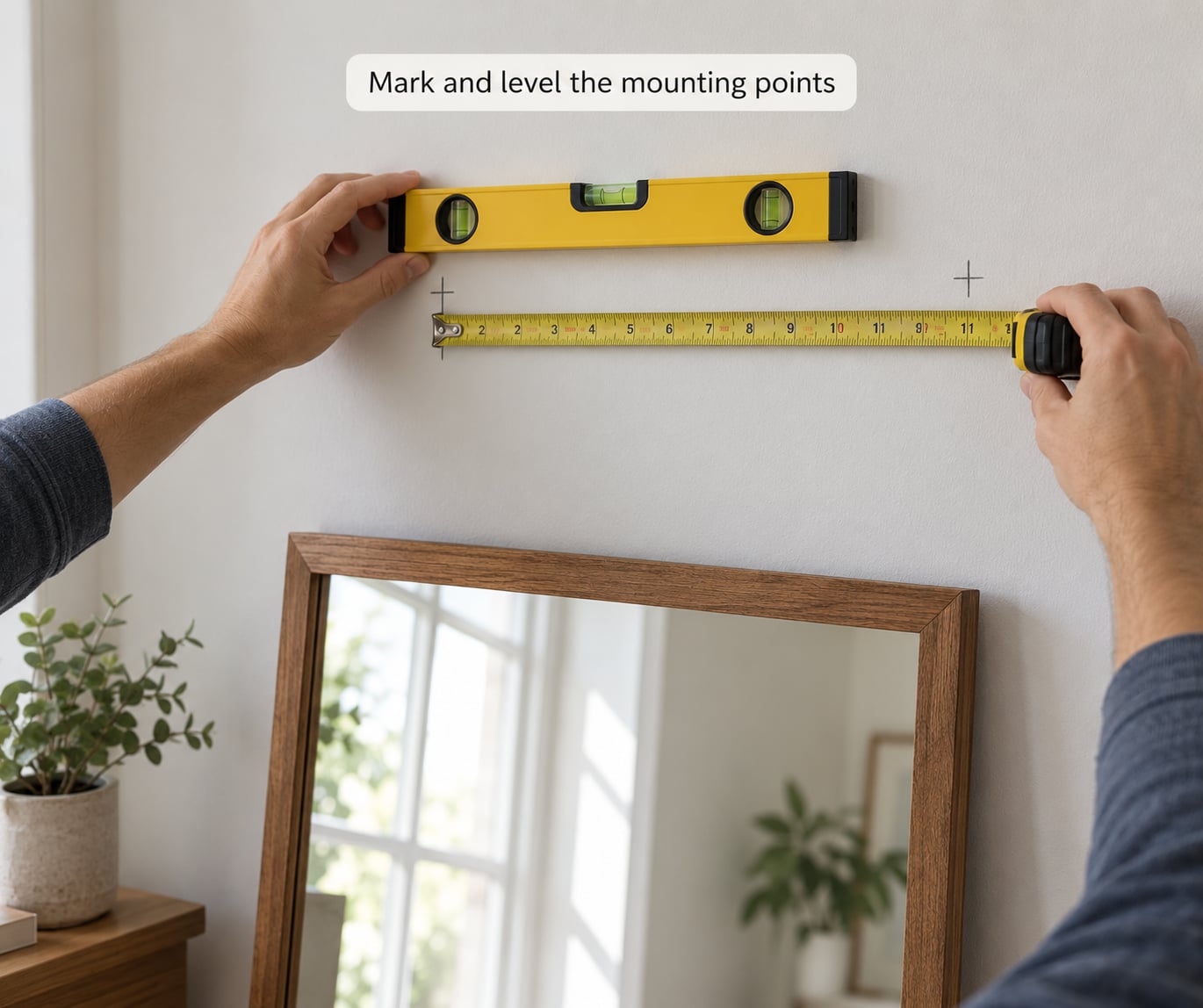
Measure the distance between your D-rings or hanger brackets and transfer that spacing to the wall. Mark both positions, then check them against your stud lines: if a stud edge falls within an inch of either mark, shift the whole layout slightly so both screws land in wood. Lay the level on your marks and adjust until the bubble sits centered, then re-check your spacing.
Mark a third reference point — a pencil line at the center of the mirror or a light tap mark — so you can confirm later that it’s straight. If you’re above a console or dresser, measure from the top of the furniture to your lowest mark and use that same distance at the other end. Over a bed, keep the bottom of the frame roughly 8 to 10 inches above the headboard. Above a fireplace, plan for well above the mantel so heat rising off the flue doesn’t hit the glass or the adhesive on the frame.
4. Install the anchors or screws
Put on your glasses and eye protection before drilling. For a stud, drive wood screws straight in at your marks until the head sits flush and stop — over-tightening crushes the drywall face and strips the screw’s grip in the stud’s outer inch.
For hollow wall, mark every position before you drill anything. A step bit or hole saw makes a clean round hole that a toggle’s wings can pass through; a twist bit in slow speed works too if you go gently. Drill straight, keep the bit square to the wall, and clear the hole of dust. Push the toggle bolt through, expand the wings by pulling the bolt head toward you, then tighten with a screwdriver until the head sits flat. Never pull the head back out to reset it once the wings are behind the wall; unscrew it fully or break it off instead.
Avoid holes near pipes, wiring and fire stops. Drilling into an electrical line is the one mistake here with a real emergency attached, so if you have no stud finder, use one. Cable gets run through bays that people assume are empty, usually without anyone noting it, and a bit through a live line is a bad afternoon in a good home.
5. Attach the mirror and test the hold
With a helper, lift the mirror to the wall and seat the wire or D-rings on the screws. Tighten the screws partway, then finish them by hand so the weight stays even across both points — one side fully tightened first is how glass cracks in a frame. Leave a small amount of play if the manufacturer’s hardware calls for it.
Then load test. Press the lower edge steadily for 10 to 15 seconds, then add a gentle sideways nudge and watch for movement, dust, or a soft sound in the wall. A faint bit of give in the first seconds is normal as the board compresses; continuous movement, or a fine powder of drywall dust on your baseboard, is a failure signal. Take it down, move the hardware, and go up a size. Walk past it a few times over the next week, because swing load is what loosens anchors that static weight held fine.
Common Mistakes
Rating the anchor at exactly the mirror’s weight
An exact match leaves nothing for the swing when someone walks by or a door shuts. Anchors sized precisely right tend to work on day one and then drift loose over the following weeks, usually announcing themselves with a dusting of gypsum on the trim. Rate at double and the problem goes away.
Using two anchors where one would do — or one where two are needed
Wide mirrors need two points spaced apart, because the leverage of the frame sticking out from the wall pulls harder than the weight suggests. Narrow mirrors only need what their hanger demands, and adding unnecessary anchors just gives you more holes to patch later.
Over-tightening screws and bolts
The failure isn’t the screw, it’s the board. Driving a screw until it feels solid often means the drywall face is now cratered, so the fastener loses its bearing surface and creeps out. Snug and flush is the target.
Drilling to guess instead of to find
A couple of small exploratory holes are cheap insurance. Studs are almost never where the mirror’s hardware wants them, which is why people guess, and guessing is how you meet wiring. Use a stud finder or a stud sensor and check nearby switches and outlets, which are usually on the same circuits as the cable in that bay.
Skipping the load test, then leaving
The fifteen seconds of testing catches a loose anchor while you’re still holding the mirror. Waiting until you’ve left the room means finding out from the sound of glass.
Hanging something oversized over a bed, stairs, or above a fireplace without planning the fall
Nobody intends to walk into a mirror. If the spot is over a headboard, a stair landing, or a mantel, add a safety strap or a French cleat so the frame cannot tip off its hardware, and confirm the glass is safety-rated if it sits where a person could reach it.
Removing the mirror and leaving the holes
Toggle bolts and sleeve anchors cannot be removed cleanly; the wings stay behind. Patch the holes with setting-type compound or a self-adhesive drywall patch, sand flush, prime, and paint. Expect minor texture differences under raking light. Renters should check the lease first, since some agreements treat small filled holes differently from bare ones.
Frequently Asked Questions
What is the best anchor for a heavy mirror on drywall?
Toggle bolts are the usual answer on hollow wall. A 1/8 inch toggle bolt handles up to about 100 lbs, and a 1/4 inch bolt goes considerably higher. Metal sleeve anchors are a solid middle option, and a stud remains best of all when one lines up. For any mirror over 40 lbs or wider than 36 inches, use a French cleat and rate the hardware at twice the mirror’s weight.
Can I hang a heavy mirror on drywall without finding a stud?
Yes, with a properly rated anchor. Toggle bolts and metal sleeve anchors both grip the cavity behind the board and behave like their own anchor points, which is why they hold far more than the printed rating of a plastic plug. Skip adhesive hangers for anything heavy; they work well for frames under about 10 pounds and fail quietly on large glass.
How heavy can a mirror be before I need a professional installer?
There is no hard limit set by drywall, but your hands and the wall’s condition set a practical one. Past about 75 pounds, or anything wider than 3 feet, bring in a second person at minimum, and consider a handyperson who can add blocking behind the wall. Very heavy pieces over a bed, stairs, or a mantel deserve professional hardware because the consequences of failure are high.
How do I remove mirror hardware from drywall without making a large hole?
Wood screws back out and leave a small hole you can fill with a dab of compound. Toggle bolts and sleeve anchors do not come out cleanly, because the wings stay behind the board, so expect a 1/2 inch or larger hole. Fill it with setting-type compound or a self-adhesive patch, sand flush after it dries, prime the repaired spot, and repaint the whole wall for an even finish.
Do I need to worry about electrical wires when drilling into drywall?
Yes, and the risk is real enough to check before you drill. Cable is commonly routed through the same bays as outlets and switches, so treat any wall with an outlet or switch as live. Drill only between studs, keep the bit shallow, and stop if you feel unusual resistance. A stud finder, or a stud sensor plus a few careful exploratory holes, is far cheaper than repairing cable or a faceplate.
Should I use screws, toggle bolts, or adhesive strips for a heavy mirror?
Screws into a stud for light pieces and moderate weights. Toggle bolts for heavy mirrors on hollow wall, always rated at double the weight and ideally with two points on a wide frame. Adhesive strips only for small, light frames; they rely on the wall’s paint and finish rather than its structure, and they let go under the load and swing of a large mirror.
Conclusion
If you only remember one thing about how to hang a heavy mirror on drywall, make it this: weigh the piece first, then find out what’s behind that spot. If a stud is close enough, drive two wood screws into it and stop worrying. If it isn’t, pick hardware rated at double the mirror’s weight, install it with the correct pilot hole, level carefully, and load test the lower edge for fifteen seconds before you walk away. That’s the whole job.