The short version of how to hang art above a sofa: keep the bottom of the frame 6 to 10 inches above the top of the sofa back, and pick a piece about 60 to 75 percent as wide as the sofa. Center it on the sofa itself, not on the wall. Once those two numbers are right, the rest is a tape measure, a level, and about an afternoon.
The reason that hangs up people is not the drilling. It is that the numbers floating around online disagree with each other — 4 inches, 6 inches, 8 inches, 12 inches — and nobody explains which one applies to your sofa. This guide sorts that out, then walks through the physical process of getting the piece on the wall.
Quick answer: the four rules
- Height: bottom edge of the frame 6 to 10 inches above the sofa back.
- Width: art spanning 60 to 75 percent of the sofa’s width.
- Centering: center the art on the sofa, not the room.
- Multiple pieces: treat the group as one rectangle, 2 to 3 inches between frames.
Table of Contents
- What You Need
- Step-by-Step: How to Hang Art Above a Sofa
- Measure the Sofa and Choose the Art Placement
- Mark the Center and Check the Wall
- Find Studs and Add the Right Hardware
- Hang the Art and Make the Final Adjustments
- Common Mistakes and Easy Fixes
- Frequently Asked Questions
- How high should you hang art above a sofa?
- What size art should go above a couch?
- How far apart should picture frames be on a gallery wall above a sofa?
- What works for a low-back sofa or a sectional with no single center?
- How can a renter hang art without drilling holes?
- How do I match art to my sofa and the rest of the room?
What You Need
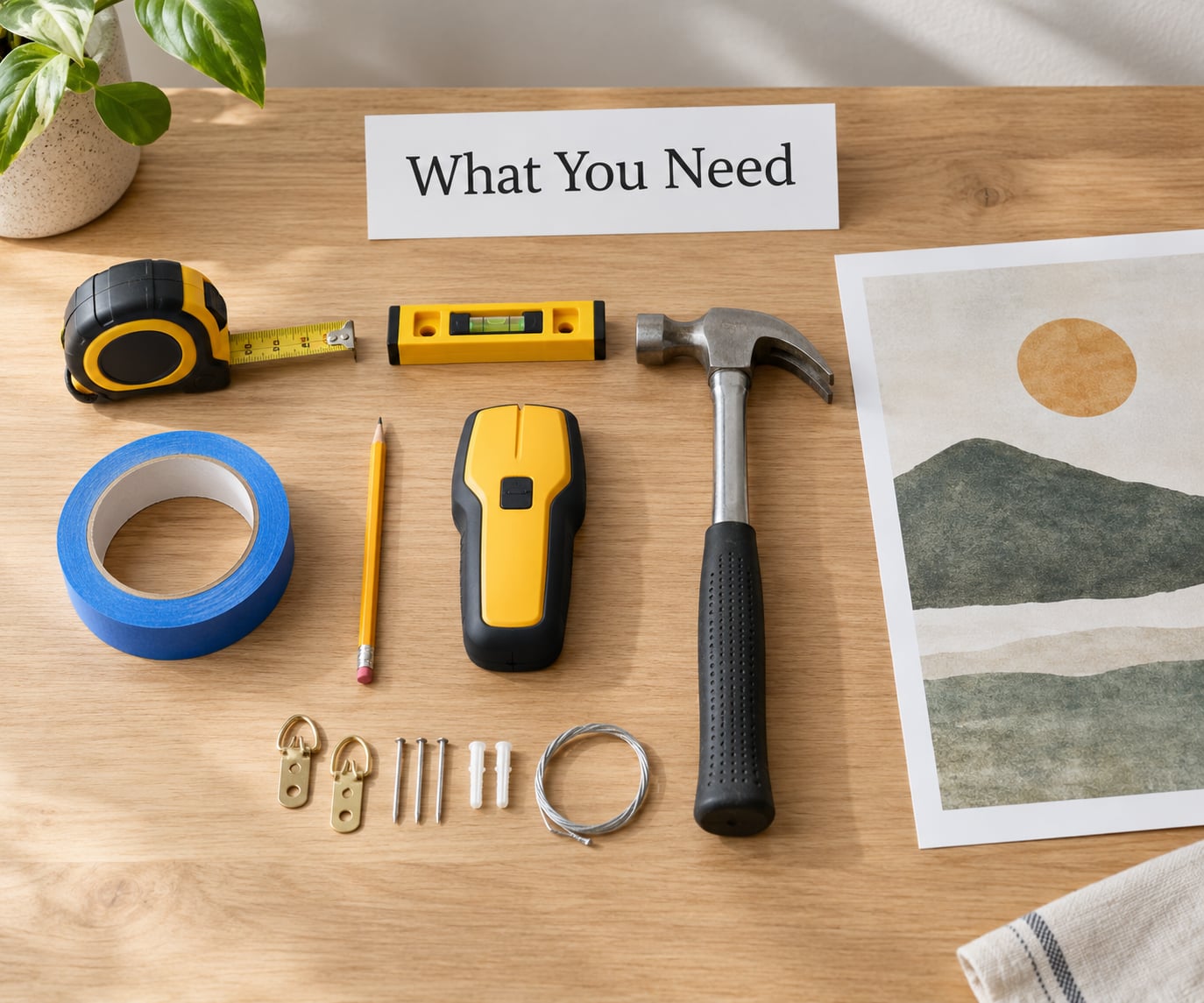
A short shopping list covers this. Most of it you already own, and two items matter far more than the rest.
- Tape measure — a 25 foot tape handles wide walls and tall ceilings better than a short one.
- Pencil and painter’s tape — for marking the center and templating the position before anything touches the wall.
- Small level — a 9 or 12 inch torpedo level is enough, and it catches the tilt most people miss.
- Stud finder — or a 1/8 inch drill bit and patience, since you can locate studs by sound.
- Hammer and a bit set — only if you are going into studs or using anchors.
- Hanging hardware — D-rings with picture wire for most frames, sawtooth hangers for frames with a flat top edge.
If you rent, swap the drill for damage-free hardware: heavy-duty adhesive strips rated well above the weight of the frame, or removable hooks that bite into the drywall paper. Both have weight ceilings, and I cover where they stop working below.
Step-by-Step: How to Hang Art Above a Sofa
Measure the Sofa and Choose the Art Placement
Start with the sofa, not the art. Measure its total width from outer arm to outer arm, then measure the height of the back from the floor to the top edge. Those two numbers decide your art size and your hang point.
For width, multiply the sofa width by 0.60 for a restrained look and by 0.75 for something bolder. Anything narrower than 60 percent leaves the sofa looking oversized and the wall looking empty.
- 72 inch sofa: 43 inches of art at 60 percent, 54 inches at 75 percent.
- 84 inch sofa: 50 inches of art at 60 percent, 63 inches at 75 percent.
- 96 inch sofa: 58 inches of art at 60 percent, 72 inches at 75 percent.
- 108 inch sectional: 65 inches of art at 60 percent, 81 inches at 75 percent.
For height, the bottom of the frame goes 6 to 10 inches above the sofa back. Add those two numbers together and you have the exact height of the bottom edge of your frame from the floor. That single figure is the hang point, and it beats guessing.
A 32 inch high sofa back plus an 8 inch gap puts the bottom edge at 40 inches off the floor. Add the frame height on top of that and you know where the top edge lands, which is how you check the ceiling clearance before you ever unroll the tape.
Mark the Center and Check the Wall
Find the horizontal center of the sofa and mark it with a small piece of tape. Then check the wall before committing to it, because three things routinely move the number.
Low-back sofas. A shallow modern frame often measures 28 to 30 inches at the back. On those, 6 to 10 inches looks cramped once somebody sits up, so 10 to 12 inches reads better.
High-back sofas. A tall rolled or tufted back needs less air above it. 4 to 6 inches keeps the art grouped with the furniture instead of floating off on its own.
Standard backs in the 32 to 34 inch range. This is the case the 6 to 10 inch rule was written for, and it is where the number is most reliable.
Standard advice says to hang art at eye level, around 57 to 60 inches from the floor. Above a sofa that rule loses. A seated viewer’s sightline is well below standing eye level, and art hung to the standing number ends up looking like it is floating over the back cushion. Judge the position from where the art is actually seen — sitting down.
Two more wall checks matter. If a window, door casing, or crown molding sits on the same wall, leave clearance from the trim or the composition looks accidental. And on tall ceilings, keep roughly twice your sofa-to-art gap between the top of the art and the ceiling; below eight-foot ceilings the gap can shrink to about a foot.
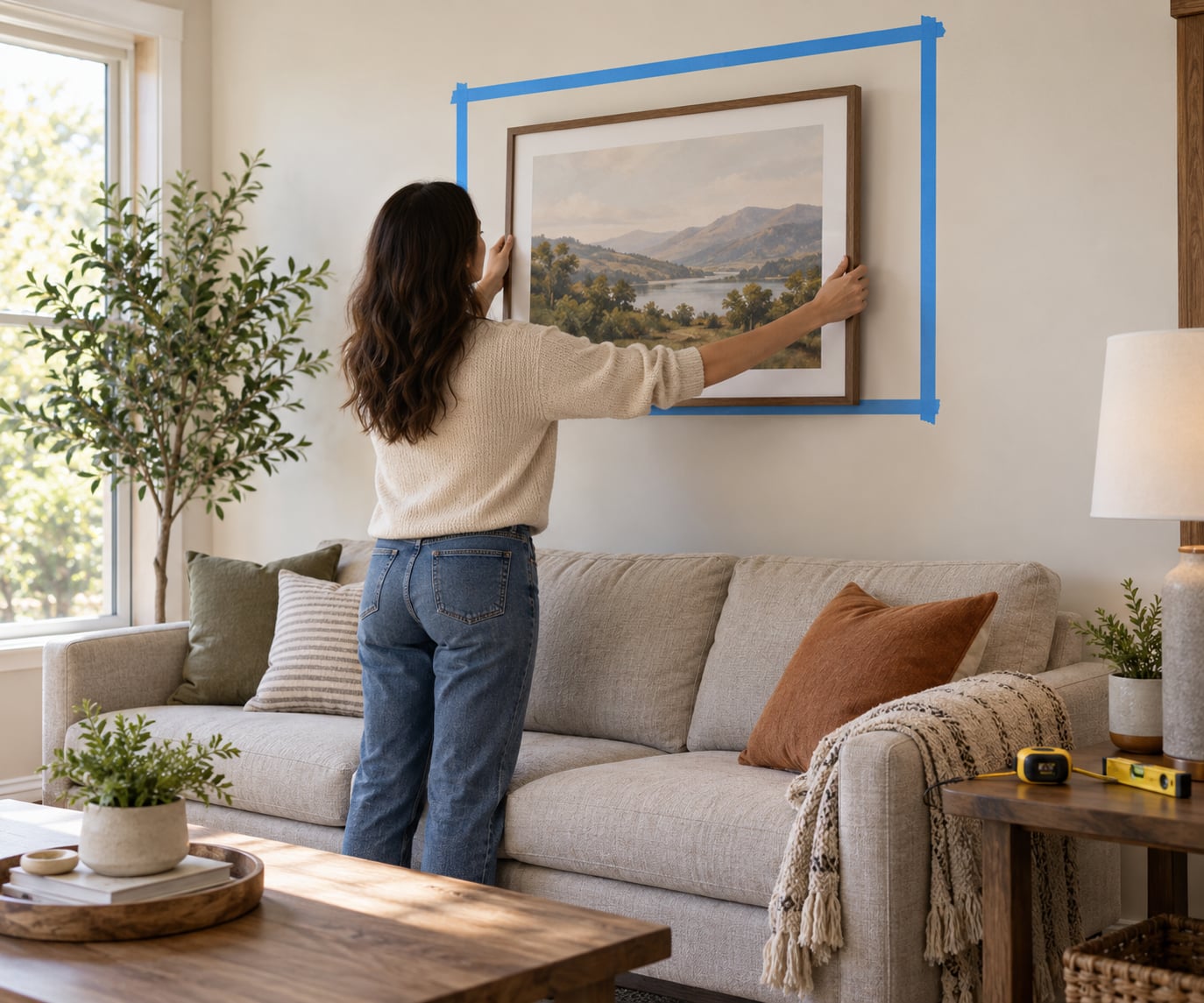
Once the number feels right, tape the outline of the frame on the wall and stand back. Painter’s tape on bare drywall is fine, and it takes an afternoon to fade if you miss a spot and touch it up.
Find Studs and Add the Right Hardware
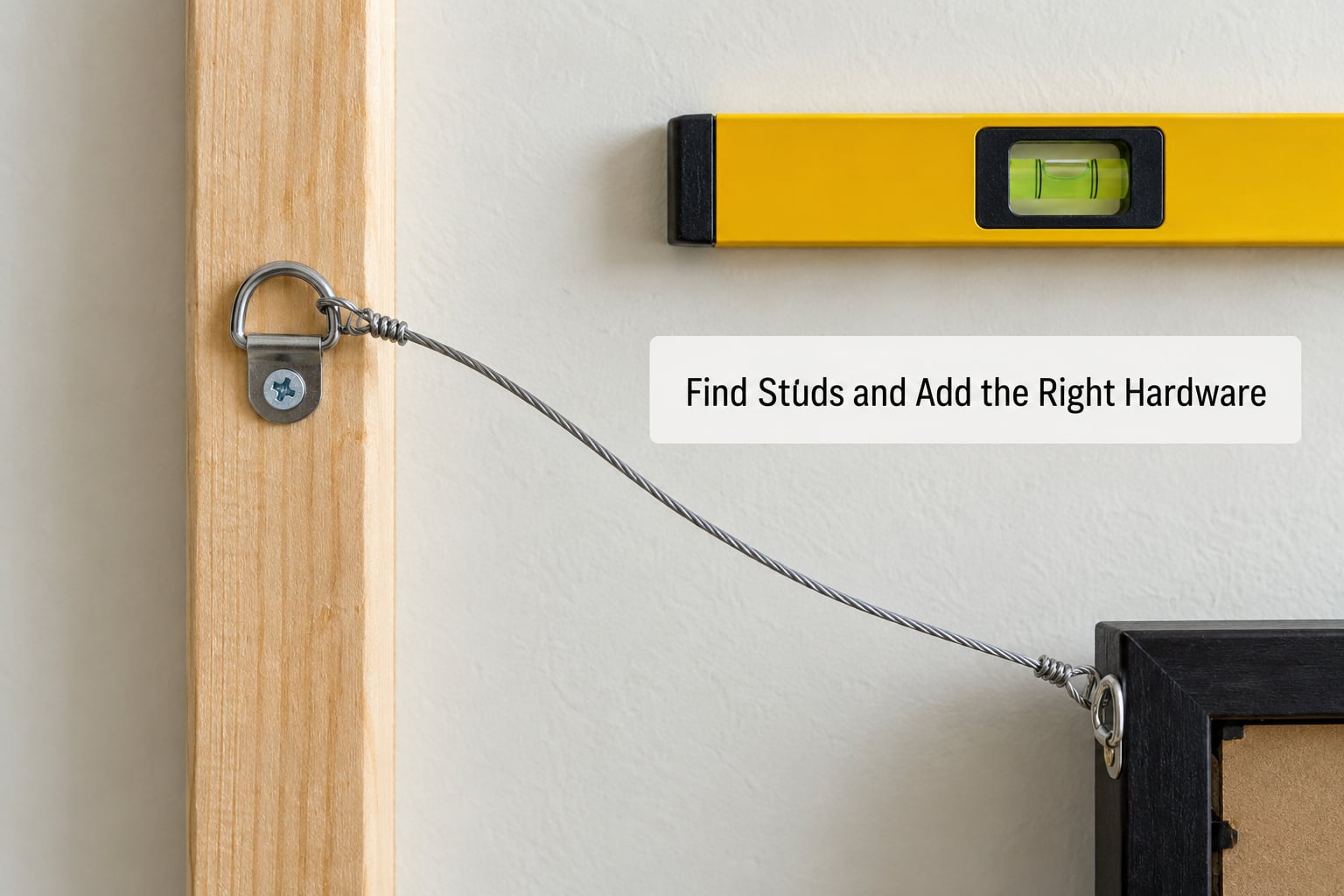
Studs are the easy case. They usually sit 16 inches apart in modern homes, and a stud finder finds the edges in a few seconds. Drive a screw into the stud and the frame is not going anywhere. Homeowners in r/homeowners generally favor screws over light plastic anchors for anything heavy, and they are right — a screw into a stud outlasts nearly every anchor.
Between studs, you are working with drywall, and the anchor has to match the load.
- Under 5 pounds — a small picture hanger or a single hook is usually enough.
- 5 to 20 pounds — use self-drilling drywall anchors, which bite into the board rather than relying on plaster.
- Over 20 pounds, or a large canvas — use toggle or molly bolts, or find the nearest stud.
- Renters — heavy-duty adhesive strips rated to at least twice the frame weight, and never on textured or freshly painted drywall.
For most frames, two D-rings on the back corners with picture wire between them beat a single sawtooth hanger, because you can slide the frame along the wire to fine-tune the height after it is on the wall.
Hang the Art and Make the Final Adjustments
Transfer the tape marks to the wall with a level held against it, and mark the hanger locations rather than the nail locations. Hang the piece, then step back six feet and look.
If it sits crooked, do not shim it. Loosen the wire tension by pulling the frame down slightly and re-hanging one D-ring a fraction lower on the same wire. Small shifts of an eighth of an inch fix most tilts.
For two or more frames, hang from the same reference line. Decide the height of the top edge first, mark it once across the whole arrangement with the level, then hang every frame to that line. Mismatched frame heights then read as a deliberate salon arrangement rather than a mistake.
Finally, sit down on the sofa and look at the wall from where people actually sit. If it looks right from there, it will look right from the doorway too.
Common Mistakes and Easy Fixes
Hanging it too high. This is the most common complaint in decorating forums, and it is the easiest to undo. Take the picture down, measure the actual distance between the sofa back and the bottom of the frame, and reset it to 6 to 10 inches. A lot of people find they were a full foot too high the whole time.
Art that is too small. If the frame spans less than 60 percent of the sofa, the wall reads unfinished no matter how well it is hung. Fixing it means a bigger piece, a wider mat, or a group of frames treated as one rectangle. When people are torn between two sizes, they almost always end up glad they took the larger one.
Centering on the wall. A sofa pushed a few inches off-center leaves a visible void over one end if the art follows the wall. Center on the furniture. If a window or fireplace on the same wall dictates the layout, center on the architectural feature instead and accept a slightly off-center relationship to the sofa.
Ignoring the sofa’s shape. A deep, low sectional swallows a small piece and a high-backed traditional sofa crowds a tall one. Match the art’s proportions to the furniture, not just its width.
Drilling without checking what’s behind. Run the stud finder across the whole area, and check for plumbing or wiring near kitchens and bathrooms. Moving a hole two inches is cheap; hitting a line is not.
Sectionals with no single center. Hang one piece over the main seating section rather than across the chaise, or split the art into two groups, each centered on its own seat run.
Frequently Asked Questions
How high should you hang art above a sofa?
Six to 10 inches above the top of the sofa back is the standard, and it is the right number for most sofas with backs between 32 and 34 inches tall. Low modern backs do better with 10 to 12 inches, and tall rolled backs need only 4 to 6. Ignore the 57 to 60 inch eye-level rule here, since it is written for solo wall art and leaves art floating over a sofa.
What size art should go above a couch?
Aim for a piece 60 to 75 percent as wide as the sofa, which is the two-thirds rule. An 84 inch sofa wants roughly 50 to 63 inches of art. Undersized art is the fastest way to make a wall look unfinished, so when you are choosing between two widths, take the larger one.
How far apart should picture frames be on a gallery wall above a sofa?
Leave 2 to 3 inches between larger frames, 1.5 to 2 inches between small ones, and 2 to 4 inches in an eclectic mix. Treat the whole arrangement as a single rectangle, then center that rectangle on the sofa and hang the bottom of the group 6 to 10 inches above the back.
What works for a low-back sofa or a sectional with no single center?
For a low-back sofa, push the gap to 10 to 12 inches so seated heads have clearance and the art does not feel cramped. For a sectional, hang one piece over the main seating run rather than across the chaise, or split the art into two groups and center each one on its own section.
How can a renter hang art without drilling holes?
Heavy-duty adhesive strips rated to at least twice the weight of the frame work well on smooth painted drywall for lighter pieces. Avoid them on textured walls and freshly painted surfaces. For anything over about 10 pounds, use removable hooks that bite into the drywall paper, and test the full weight before you walk away.
How do I match art to my sofa and the rest of the room?
Pull one color from the upholstery or the rug and let it appear in the artwork or the frame, so the two read as one composition. Keep the palette tight and let the scale do the work. A bold, busy sofa pairs well with quieter art, and a neutral sofa can carry a large, high-contrast piece.
Measure the sofa before anything else — width and back height — and the rest of the decision falls out of those two numbers. Tape the frame’s outline on the wall, check it from sitting height, and only then reach for the drill.