Mixing frame styles in one room comes down to repetition, not matching. Repeat two or three shared colors across every frame, let one frame style dominate, and hold the same 2-to-3-inch gap between each piece, and a thrifted wooden frame next to a sleek black one reads as a set instead of leftovers. Planning first, hanging second. Allow an afternoon, and no tools beyond a tape measure and a level.
Table of Contents
- What You Need
- Step-by-Step: How to Mix Frame Styles in One Room
- Set a Simple Color Palette
- Choose One Dominant Frame Style
- Vary Shape, Size, and Texture
- Plan the Layout Before Hanging
- Common Mistakes
- Matching every frame exactly
- Using too many competing finishes
- Ignoring frame scale
- Over-spacing, which is mistake number one
- Hanging without a level
- Mixing subject matter instead of frames
- Frequently Asked Questions
- How many frame styles can you mix in one room?
- Do frames have to match on a gallery wall?
- How do you mix frame colors without it looking messy?
- Where should I start when mixing frames?
- Can I hang mixed frames in a rental without damaging the wall?
- How do you hang a gallery wall with mismatched frames so it looks level?
- Final Tip
What You Need
You need the frames and artwork you already own, then a few cheap tools that keep a mixed wall from drifting out of balance.
- Your frames and artwork, including any thrifted, inherited, or already-hung pieces
- A measuring tape, 25 feet or longer if you are covering a whole wall
- A level, either a 6-inch torpedo style or a phone app
- Painter’s tape and a pencil
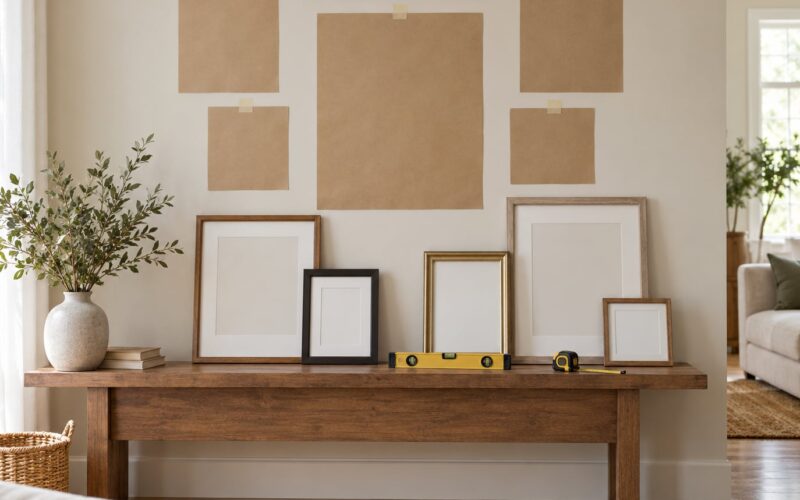
- Paper for templates: butcher paper, kraft paper, or plain newsprint
- Optional renter hardware, such as hanging strips rated above the weight of each frame
Before buying anything, spread every candidate frame out on the floor in one place. If a frame looks homeless in that group, it does not go on the wall yet.
Step-by-Step: How to Mix Frame Styles in One Room
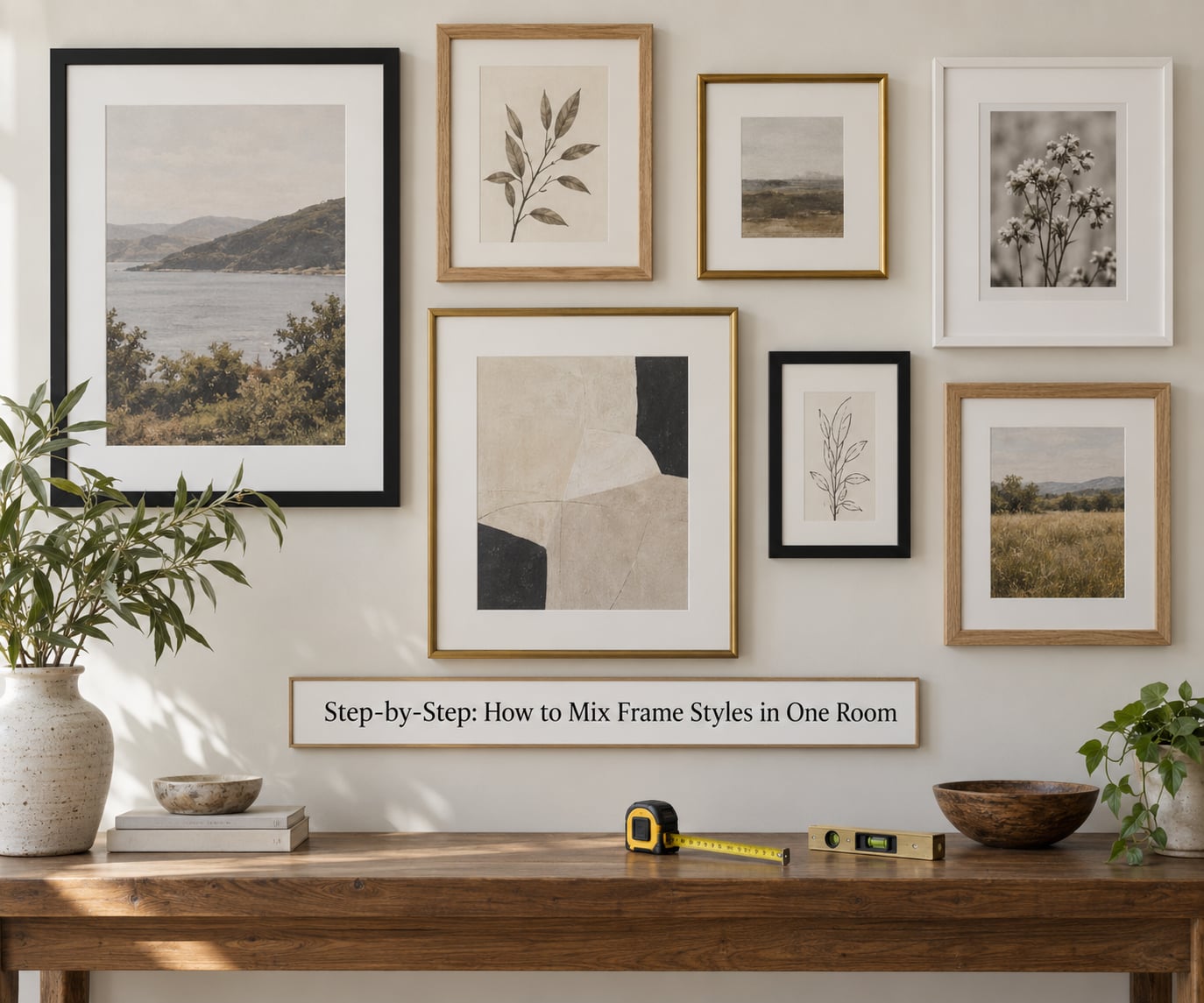
Four decisions do most of the work here: the shared colors, the dominant style, what varies, and the layout. Get those right and the frames you already own are enough.
Set a Simple Color Palette
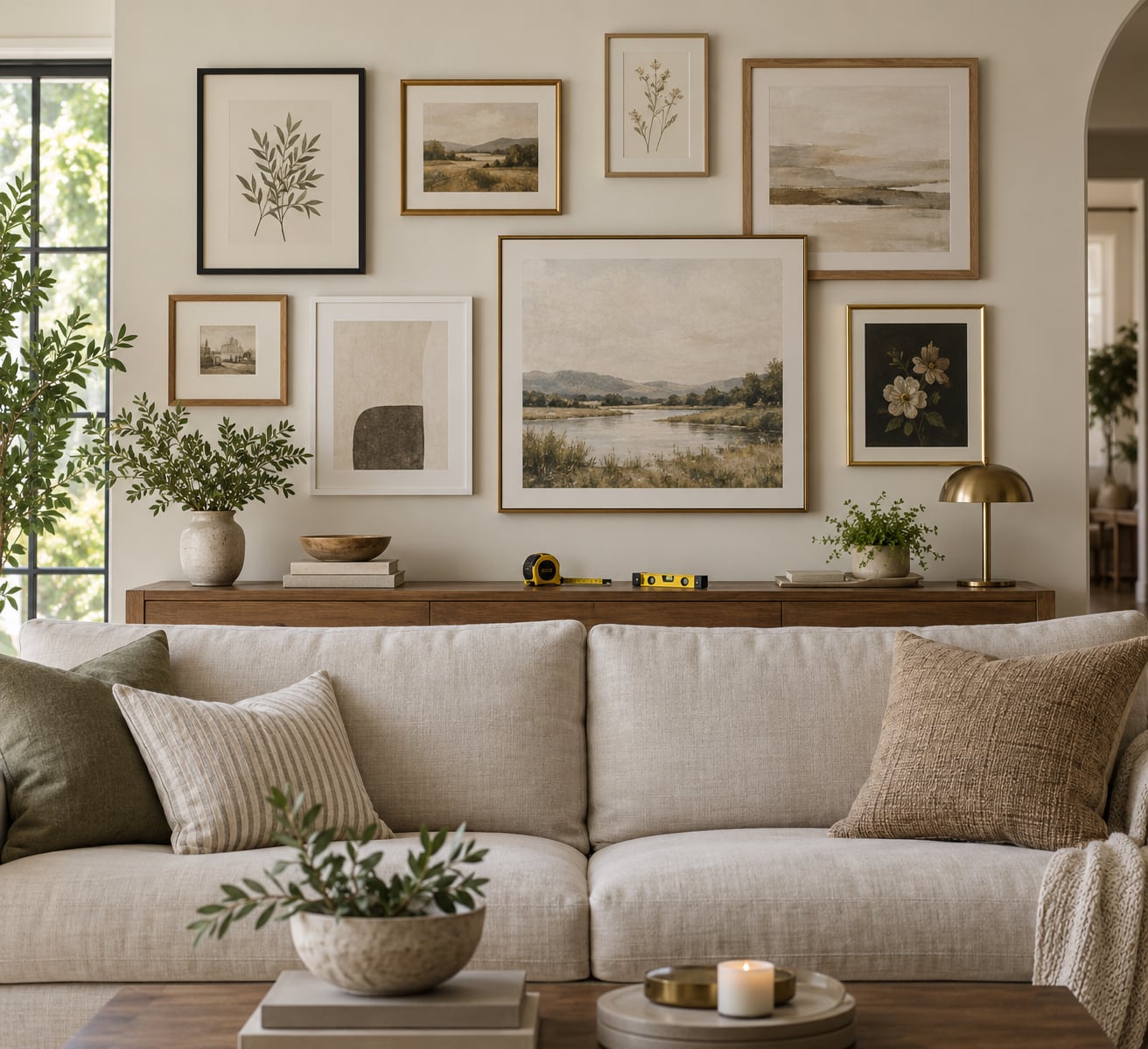
Two or three shared colors are enough to connect wood, metal, and painted frames that have nothing else in common. Warm wood alongside black and white is the easiest combination to pull together: the wood keeps the wall from feeling cold, and the black and white give you somewhere to put contrast.
Brass paired with dark green is another reliable route, especially when the art leans warm. The important part is that each shared color shows up in more than one place. A black metal frame, a black line in a print, and a black photo frame all count as the same anchor.
You do not need a palette pulled from a swatch book. Take the color that already appears most in the artwork you own, and repeat it in two or three frames.
Choose One Dominant Frame Style
Roughly half of your frames should read as one family, so the wall has a visual anchor. That style does not have to be the nicest frame you own. It should be the easiest one to repeat.
Thin black metal as the base, with wood and one ornate frame as accents, is the most forgiving version. Natural wood as the base with a couple of painted frames scattered through works just as well.
Accent frames earn their place because they appear in small numbers. Three contrasting finishes inside a group of nine is mixing. Three inside a group of three is just noise.
Vary Shape, Size, and Texture
Once the dominant style is set, vary the shapes around it.
- Mix vertical and horizontal frames instead of lining up one orientation
- Change the frame width, not only the outer size, so a thin profile reads consistently at every scale
- Alternate matte and ornate profiles, and matted art with full-bleed prints
- Group in odd numbers, usually three, five, or seven, which reads as deliberate rather than leftover
Keep the artwork itself related. Mixing frames is the fun part, but mixing a color photograph, a folk-art print, and a neon sign is a separate problem, and spacing will not fix it.
Plan the Layout Before Hanging
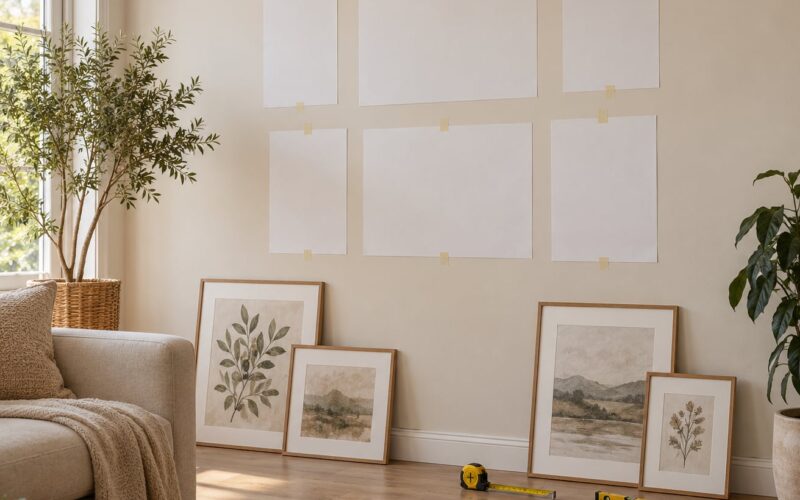
Paper templates are the step people skip and later regret. Trace each frame onto paper, cut it out, and tape the outlines to the wall in the arrangement you want. The tape marks the outer edge, the frame overlaps it, and you can move the whole layout in minutes instead of patching holes.
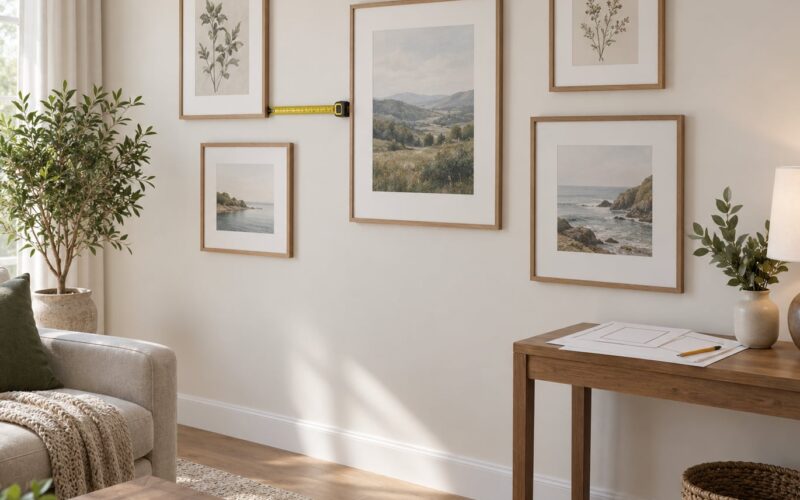
Leave 2 to 3 inches of wall showing between every frame, and make those gaps identical. Measure one gap, then mark that same distance across the wall rather than judging each one by eye.
| What to measure | How much | Why it matters |
|---|---|---|
| Gap between frames | 2 to 3 inches, identical everywhere | Spacing does more for a mixed wall than frame matching does |
| Gap above a sofa or console | 6 to 8 inches | Connects the group to the furniture instead of floating it |
| Center of the arrangement | 57 inches from the floor | Standard eye level, and the center, not the bottom, sits there |
| Mat border | 2.5 to 3 inches | Keeps matted and unmatted pieces feeling related |
| Largest piece | About two-thirds of the width of the furniture below it | Gives the arrangement a focal point |
| Neighbor width difference | Under 1 inch between adjacent profiles | Prevents a thin frame from looking lost beside an ornate one |
Hang to the center of the group at 57 inches from the floor, and check the level before the last nail goes in. Then stand back from the middle of the room. If one side reads heavier, shift a single frame rather than adding another piece.
Common Mistakes
Mixed-frame walls usually fail on spacing and scale, not on the frames themselves. Each of these has a quick fix.
Matching every frame exactly
This is safe and it is dull, and it hides any spacing errors you make. The fix: introduce one contrasting frame for every three matching ones, and no more.
Using too many competing finishes
Three different metals in one group is the most common clash, and it is the reason mixing gold, silver and black within a single frame gets debated. The fix: pick one metal as an accent only, and let wood or black carry the wall.
Ignoring frame scale
A cluster of small frames on a wide wall reads as a stamp on the wall rather than a composition. The fix: make your largest piece about two-thirds of the width of the furniture beneath it, then build the rest around it.
Over-spacing, which is mistake number one
Frames floating four, five, or six inches apart is the single most common gallery wall error, and it usually happens because someone was nervous about crowding. The fix: 2 to 3 inches, the same distance everywhere, every time.
Hanging without a level
One tilted frame makes a good wall look careless. The fix: mark every hole first, then check every mark with the level before you drill the first one.
Mixing subject matter instead of frames
Noise in the art is often mistaken for a frame problem. The fix: edit photos to a similar tone, or put family photos in their own grouping instead of interleaving them.
To check your own wall, step back to the far side of the room and squint until the frames blur. What should be left is one shape with a clear center and even gaps. If the center is fuzzy, you have a weight problem, not a style problem.
Frequently Asked Questions
How many frame styles can you mix in one room?
Three finishes is comfortable, four is usually the limit before a room starts to feel restless. Count finishes rather than individual frames, so black, natural wood and brass is three styles even when you own eight frames. Past three, everything else has to be tightly controlled: identical spacing, one mat color, one shared subject thread. Fewer than three gives you a calmer wall, just a less interesting one.
Do frames have to match on a gallery wall?
No. Matching every frame is the safest route and the least interesting one. What a mixed wall needs is repetition, not sameness: repeat one frame finish, one mat color and one subject or color thread, then let profile, width and size vary freely. Identical frames also hide bad spacing, while mixed frames make uneven gaps impossible to ignore, which is exactly why the gaps have to be right.
How do you mix frame colors without it looking messy?
Pull two or three colors from the artwork itself and repeat them across the room. Warm wood with black and white is the easiest pairing to get right. Keep one metal as an accent rather than a partner, since gold, silver and black in the same group fight each other. The most useful test is free: squint at the wall from across the room, and whichever color shouts loudest becomes your anchor.
Where should I start when mixing frames?
Start with the frame you already own that you like most, and hang that one first as your anchor. Then lay the rest out on the floor before anything touches the wall. A practical sequence is to hang empty frames first, settle the arrangement, then buy or print the art to fit. Paper templates let you revise a layout in minutes rather than moving hook holes.
Can I hang mixed frames in a rental without damaging the wall?
Yes. Hanging strips rated above the weight of each frame work on smooth painted drywall, and a leaning arrangement on a long shelf needs no hardware at all. Skip strips on textured or freshly painted walls, since the adhesive grips the texture and pulls the paint with it. For heavier or glass-glazed frames, use two strips per frame and check the weight rating printed on the pack.
How do you hang a gallery wall with mismatched frames so it looks level?
Trace every frame onto paper, cut out the outlines, and tape them to the wall in your arrangement before you drill anything. Hang to the outer edge of each template, mark all your holes with a pencil, then pull the paper down and check every mark with a level before the first nail. Hang the largest and center pieces first, fill in the smaller ones around them, then check the balance from across the room.
Final Tip
Start with the largest wall you have, or the one frame you already love, and make that your anchor. Repeat one color and one finish in every room it appears in, hang the balanced layout first, and only then add the contrasting frames. Do it in that order and mixing stops being a gamble.
Last reviewed for 2026.