For most bedroom lamps, the answer is a 40- to 60-watt equivalent bulb, which delivers roughly 450 to 800 lumens from an LED that actually draws only 8 to 10 watts. That is the sweet spot for a bedside lamp you read by and relax next to. Before you buy anything, though, check the maximum wattage printed on your lamp and stay under it.
That last part is the one people skip, and it is the only rule in this guide that is not negotiable. Everything else — brightness, color, dimming — you can adjust until it feels right. Exceeding the socket rating is how lamps start fires.
Table of Contents
- How Much Light Does a Bedroom Lamp Need?
- Actual watts and equivalent watts are two different numbers
- What Wattage Should You Use for a Bedroom Lamp?
- Wattage by lamp and by what you do in the room
- How Do I Choose the Right LED Equivalent Wattage?
- What to read on the package
- Does the Lamp Shade Change the Wattage?
- How Bright Should a Bedroom Lamp Be?
- Lumen targets by task
- What If the Lamp Has a Dimmer Switch?
- How Do You Stay Within the Lamp’s Wattage Limit?
- Frequently Asked Questions
- Is 40W or 60W better for a bedroom lamp?
- Is 60W too bright for a bedroom?
- How many lumens should a bedroom lamp have?
- What color temperature bulb is best for a bedroom?
- What size light bulb fits a small bedside lamp?
- Can I use a higher-wattage LED bulb than my lamp is rated for?
- Choose the First Wattage That Fits Your Bedroom Lamp
How Much Light Does a Bedroom Lamp Need?
A bedroom table lamp usually needs between 400 and 800 lumens. Below 300 lumens you get a soft glow that is fine for winding down and terrible for reading. Above 1,000 lumens, a bedside lamp starts competing with your ceiling light instead of supporting it.
Brightness is measured in lumens. Wattage only tells you how much electricity the bulb pulls, and it no longer tells you how bright the light looks. An LED that draws 9 watts and an incandescent that draws 60 watts can produce identical light, which is why the two numbers have drifted so far apart.
Actual watts and equivalent watts are two different numbers
When a bulb box says 60W, check whether that 60W is printed in small type near the base or shouted in large type at the top. The big number is the incandescent equivalent — a comparison figure. The small number is what the bulb really uses.
A 60W-equivalent LED typically draws 8 to 10 actual watts and puts out about 800 lumens. The equivalent label tells you what old bulb it replaces. The actual wattage tells you what it costs you to run and how hard it works the socket.
What Wattage Should You Use for a Bedroom Lamp?
Start at 40 to 60 watts equivalent for a bedside lamp and adjust from there. Small lamps with narrow shades need the lower end, larger shades and floor lamps can take more, and anything you read by sits at the top of the range.
Here are the conversions you will actually use at the bulb aisle.
| Incandescent or halogen | LED actual watts | Approximate lumens | Best for |
|---|---|---|---|
| 25W | 3 to 5W | 250 to 350 | Night-light glow, dark or pale shades |
| 40W | 6 to 8W | 400 to 500 | Ambient bedside lighting |
| 60W | 8 to 10W | 700 to 800 | Reading in a shaded lamp |
| 75W | 11 to 13W | 1,000 | Large drum shade or side table lamp |
| 100W | 16 to 20W | 1,600 | Big shades and open floor lamps |
Numbers like these are approximations, not promises. Two brands of 60W-equivalent bulbs can differ by a hundred lumens, so treat the table as a starting point and buy a single bulb first rather than a twelve-pack.
Wattage by lamp and by what you do in the room
| Situation | Equivalent watts | LED watts | Lumens |
|---|---|---|---|
| Small bedside lamp, narrow shade | 25 to 40W | 4 to 6W | 250 to 500 |
| Medium bedside table lamp | 40 to 60W | 6 to 10W | 450 to 800 |
| Large shade on a dresser | 75 to 100W | 12 to 18W | 1,000 to 1,600 |
| Floor lamp in a corner | 60 to 100W | 9 to 18W | 800 to 1,600 |
| Reading in bed | 60W | 9W | 800 |
| Getting ready at a mirror | 75 to 100W | 12 to 18W | 1,000 to 1,600 |
| Night-light level glow | Under 25W | 2 to 4W | Under 300 |
Whichever row you land on, the maximum wattage printed on the lamp wins. A tiny bedside lamp rated for 25W gets 25W of equivalent light even if you would prefer more.
How Do I Choose the Right LED Equivalent Wattage?
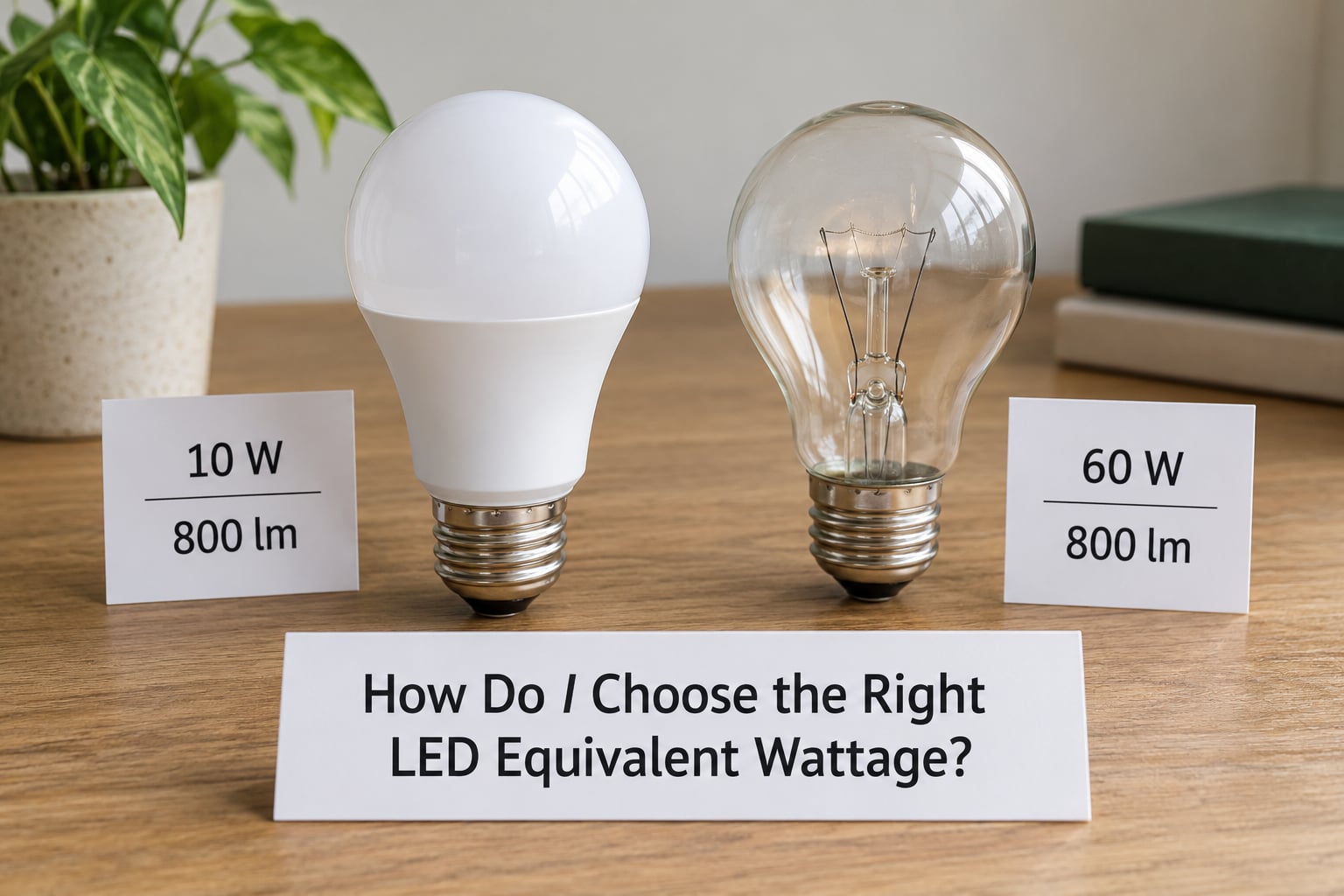
Convert by dividing the old incandescent wattage by roughly seven. Sixty watts becomes about 9 watts of LED, forty watts becomes about 6, and a hundred watts becomes about 15 to 18. Divide by six and you are at the brighter end of each range.
That division is the whole trick. LEDs produce the same light as an incandescent using roughly one-sixth to one-seventh the power, so the box prints the old number at the top to help you shop and the real number in small type near the base to tell you what you are paying to run it.
What to read on the package
Look for four things: the actual wattage printed small, the lumen figure, the incandescent equivalent in large type, and the color temperature in Kelvin. The base type matters too — E26 and E27 are the standard screw-in bases in most homes, while E12 candelabra and GU10 are smaller fittings found in chandeliers and some sconces.
Shape comes next. An A19 bulb is the classic round one at about 3.75 inches across, A21 is the same shape half an inch wider, and B10 candle bulbs are narrow tubes for tight harp fittings.
One practical tip: read the lumens, not the equivalent watts. Two bulbs both labeled 60W can deliver 650 and 800 lumens, and that spread is the difference between a pleasant bedside glow and a lamp you turn off the moment you sit down.
Does the Lamp Shade Change the Wattage?
Yes, and it changes it a lot. The shade is a filter, and a heavy one can swallow a third of the light before it reaches the room. A pale, thin shade passes nearly everything through.
Material sets the ceiling. Dark, lined, or opaque shades eat light and soften it into a warm pool. White or translucent shades pass more light and can look harsh on the eye. Open weaves and beaded shades scatter light into patterns rather than throwing it in one direction.
Size matters in the opposite direction from what people expect. A large drum shade spreads the same lumens across a wider area, so it needs more of them to feel bright. A small shade concentrates what little light it gets and looks hotter as a result.
Here is where I would begin for each shade type.
| Shade type | Starting equivalent watts | Why |
|---|---|---|
| Pale linen or white fabric, medium size | 40 to 60W | Balanced starting point for most bedside lamps |
| Dark, lined or heavy fabric | 60 to 75W | Absorbs light before it reaches the room |
| Opaque metal or ceramic | 75 to 100W | Almost nothing gets through except up and down |
| Large drum or drum-style shade | 75 to 100W | Light spreads across a wide surface |
| Small tapered bedside shade | 25 to 40W | Concentrates light; more than this reads as a glare |
| Clear or glass shade | 40W | You see the bulb directly, so keep brightness low |
Height plays a role too. A shade that sits low over a nightstand throws light onto your face, while a taller lamp spreads it across the wall and ceiling where it does less damage to your eyes.
How Bright Should a Bedroom Lamp Be?
Brightness should follow the task. Reading in bed wants 800 lumens and a tight shade aimed at the page. Relaxing wants 300 to 500 lumens and something warm you can stare past. Ambient fill light can sit near 250 lumens.
Color temperature changes how the same lumens feel. Anything at 4,000K or higher reads as office light and keeps some people alert well past bedtime. Most bedrooms do best between 2200K and 2700K, which is the soft amber end. 3,000K is a reasonable ceiling if you also want to check colors for clothing in the morning.
Warm light in a bedroom is not just an aesthetic preference. Bright, cool light in the evening works against the melatonin your body releases as the sun goes down. If your bedside lamp is the last light you turn on, 2200K to 2700K is the range to shop.
Lumen targets by task
- Winding down: 200 to 300 lumens
- Casual reading in a chair: 450 to 600 lumens
- Reading in bed: 800 lumens, ideally under a shade that blocks glare
- Getting dressed at a dresser: 800 to 1,000 lumens
- Applying makeup at a mirror: 1,000 to 1,600 lumens, ideally a higher CRI bulb so colors look true
Color rendering index, or CRI, is the number that tells you how accurately a bulb shows colors. A 90+ CRI bulb makes skin tones and fabric colors look right, which matters most at a mirror.
What If the Lamp Has a Dimmer Switch?
A dimmable bulb only dims smoothly with a dimmer built for LED loads. Pair a dimmable LED with an old rotary or slide dimmer designed for incandescent bulbs and you get flicker, buzz, or a bulb that glows faintly and never turns off.
Check the dimmer itself first. Many inexpensive in-line dimmers say they support incandescent and halogen only, and swapping that switch is usually a cheap part behind a single wall plate — though if you are not comfortable with wiring, hire an electrician.
Buy the bulb labeled dimmable, and prefer one that lists a specific dimmer compatibility range or names tested dimmer brands. Those bulbs use a different driver than standard LEDs, which is why they dim in smooth steps instead of sudden jumps.
Lower-wattage bulbs dim more gracefully in general. A 6-watt bulb has so little output that a dimmer never has to work hard, while a 20-watt bulb in a small nightstand shade can produce a flicker as the dimmer struggles at the bottom of its range.
If flicker is your complaint and everything is already rated for LED, the culprit is usually the bulb rather than the lamp. Try a different brand before you replace hardware.
How Do You Stay Within the Lamp’s Wattage Limit?
Four checks cover almost every case, and each one takes under a minute.
- Read the socket collar. Look inside the socket where the bulb screws in. A marking such as MAX 60W or 40W is stamped or printed on the metal collar or the ceramic base. This is the rating that matters most.
- Check the harp and the shade fitting. Table lamps often print the limit on the metal harp, the ring that holds the shade, or on a sticker near the socket assembly inside the base.
- Look under the base and at the cord. Turn the lamp over. A paper label or sticker with a certification mark and the model number sits under the base or on the cord near the plug. The model number lets you look up the original lamp’s rating.
- Confirm the base and shape fit. E26 and E27 screw-in bases are standard; E12 is the smaller candelabra thread. An A19 is wider than a B10 candle bulb, and undersized bulbs rattle inside narrow harps.
Two-socket and multi-bulb fixtures work per socket, not as a total. A two-lamp fixture marked 60W MAX per socket takes two 60W bulbs. A marking of 100W total across two sockets means each bulb gets 50W.
If you find no rating anywhere on the lamp, treat it as an open fixture. In practice, home maintenance forums treat open table and floor lamps as accepting up to 100 watts, while anything with a fabric or paper shade stays conservative at 40 to 60 watts.
Stop using the lamp if you see a scorched socket, a cord that is cracked, brittle or warm to the touch, a plug with bent prongs, or a bulb that sits loose and needs to be tightened constantly. A scorched socket is a replacement, not a cleaning job.
LEDs run much cooler than incandescent bulbs, and many people assume that makes the rating irrelevant. It does not. The rating exists because of heat, and a socket or shade designed around a certain wattage can still suffer from a bulb that is physically too large or has a driver that traps heat in a closed shade.
Staying under the limit also pays off in energy. A 60-watt incandescent running three hours a night uses about 66 kWh a year. A 9-watt LED doing the same job uses about 10 kWh, a difference of roughly 56 kWh per lamp per year.
Frequently Asked Questions
Is 40W or 60W better for a bedroom lamp?
40W equivalent suits most bedside lamps because the shade filters the light and you are close to it when it is on. Choose 60W equivalent if you read in bed, use a pale or open shade, or want the lamp to light part of the room as well as the page. Neither is wrong. Bulbs are cheap enough that trying one of each is a reasonable move.
Is 60W too bright for a bedroom?
Only if it is the last light you turn on and you keep looking straight at it. A 60W equivalent, about 800 lumens, is right for reading and feels too bright for winding down. Lower wattage does not fix a harsh lamp on its own, so pair lower lumens with a warm 2200K to 2700K bulb and a shade that hides the filament from your line of sight.
How many lumens should a bedroom lamp have?
Aim for 450 to 800 lumens on a standard bedside lamp. Around 300 lumens works for ambient mood light, 800 lumens handles reading in bed, and 1,000 to 1,600 lumens suits a dresser or mirror light. Bulbs of the same equivalent wattage vary by a hundred lumens between brands, so reading the lumen figure rather than the wattage label gives you a more honest comparison.
What color temperature bulb is best for a bedroom?
Between 2200K and 2700K. That range reads as soft amber rather than white, and warm light in the evening works with the melatonin your body releases after dark. 3000K is a reasonable limit if the same lamp gets used in the morning. Anything at 4000K or above tends to feel like an office and can leave you wired when you want to sleep.
What size light bulb fits a small bedside lamp?
An A19 at about 3.75 inches across fits most table lamps, and the A21 is the same shape a half inch wider. If your lamp has a tight harp, a B10 candle bulb or a small globe may be the one that clears the shade. E26 and E27 are the standard screw bases; E12 is the smaller candelabra thread found in chandeliers and some sconces.
Can I use a higher-wattage LED bulb than my lamp is rated for?
The rating applies to the actual wattage the bulb draws, not the equivalent number on the box. A 15-watt LED labeled 100W equivalent draws 15 watts, so it is fine in a lamp rated 25W MAX, and a 9-watt 60W-equivalent LED fits anywhere. The number to watch is the small wattage printed near the base, and it must never exceed the lamp’s stated maximum.
Choose the First Wattage That Fits Your Bedroom Lamp
Start with a 40- to 60-watt equivalent LED for a bedside lamp, which means an 8- to 10-watt bulb putting out 450 to 800 lumens at 2700K. Move up for a large drum shade, a dark or opaque shade, or reading in bed. Move down for a small tapered shade, a night-light glow, or a room that already feels bright enough. Before any of that, read the maximum wattage stamped inside your socket, because that number outranks everything else here.