Baskets work as storage and decor because they hold everyday items out of sight while adding warmth and texture a plastic bin never will. The trick is matching each basket to the space, giving it one job, and styling what shows. Most rooms come together in an afternoon once you measure first.
Updated for October 2026. If you are renting or have no built-in cabinetry, this is the cheapest way to gain a full storage system that still looks deliberate.
One honest note up front: wicker and seagrass are not waterproof, and a thrift-store basket can carry a musty smell. Both problems are manageable, and I cover them below.
Table of Contents
- What You Need
- Basket materials and what each one is good for
- Step-by-Step: How to Use Baskets for Storage and Decor
- 1. Choose the Right Basket for Each Space
- 2. Sort and Group What You Plan to Store
- 3. Measure the Shelf, Cabinet, or Display Area
- 4. Add Liners, Labels, or Covers
- 5. Use Baskets for Storage and Decor in Every Room
- 6. Keep the Display Balanced and Functional
- Common Mistakes
- Frequently Asked Questions
- What size baskets are best for storage in different rooms?
- Should I use lined or unlined baskets for home decor?
- Where should I place baskets in a living room or entryway?
- How do I keep baskets from looking cluttered?
- What is the best way to label decorative storage baskets?
- Can baskets provide storage without making a room look messy?
- Start With One Room
What You Need

You do not need a big haul to get started. Three or four baskets in mixed sizes, a tape measure, and a way to mark each one is usually enough for a whole room.
- Baskets in at least three sizes: one small for odds and ends, one medium for a category like blankets or snacks, and one large with cut-out handles for things you carry weekly.
- A mix of open and lidded styles: open baskets for anything you want to see, lidded ones for clutter you would rather hide.
- Measuring tape: write the depth of every shelf and the clearance under your bed before you buy anything.
- Fabric liners: washable cotton or linen in a neutral tone, cut to sit a few inches below the rim so the fabric shows.
- Labels: small chalkboard stickers, leather tags, or even a strip of masking tape with the category written on it.
- Cleaning supplies: a soft brush, a barely damp cloth, a soft toothbrush for the weave, and baking soda for thrift finds.
- Styling tools: two or three stems of dried grass or faux greenery, a battery-operated fairy light strand, and one tray to gather small items.
Basket materials and what each one is good for
Every material has a failure point. Knowing it up front saves you from putting damp towels in a basket that goes musty or hanging heavy tools on a weave that sags.
- Wicker: good for pantry goods, blankets, and general room storage. Watch for water spots and dust settling into the weave.
- Rattan: best for lightweight display, wall hangings, and shallow shelves. It is less rigid than wicker and dents under weight.
- Jute or seagrass: ideal for entryway catch-alls and laundry hampers, but it snags easily and dislikes moisture.
- Hyacinth: suited to coffee table trays, console styling, and shallow dishes. Too soft for lifting heavy loads.
- Wire or metal: takes pantry cans, plant pots, and anything that gets damp, though it can read cold and industrial against warm woods.
- Tobacco leaf: nice for wall display, magazines, and kindling. It is brittle with age, so do not load it heavily.
- Fabric-lined rattan: a good pick for under-bed linens, closets, and baby items, though repeated washing can loosen the weave over time.
- Plastic with a bamboo lid: practical in the garage or for craft supplies and wet items, but in a living space it reads as storage, not decor.
Wicker is a weaving technique and rattan is the vine used to do it, so many baskets sold as wicker are rattan underneath. If moisture is a factor, the wire option is the one that forgives you.
Step-by-Step: How to Use Baskets for Storage and Decor
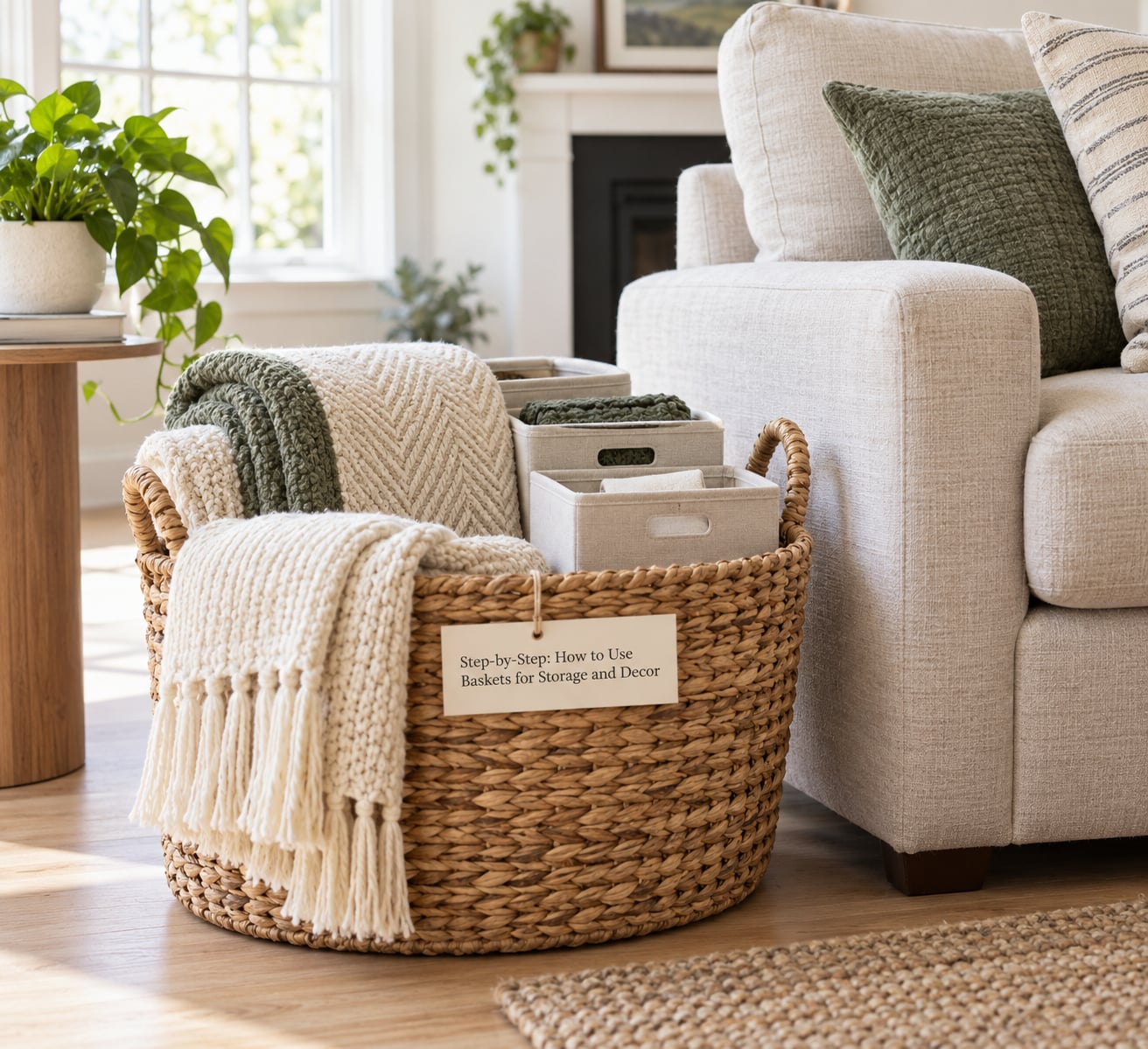
1. Choose the Right Basket for Each Space
Pick the shape after you pick the spot, not before. Round baskets soften a square shelf, rectangular baskets fit narrow cubbies, and shallow trays only work where the surface is deep enough to sit level.
Decide per basket whether it is on show or hidden. A basket living on a coffee table should be open and pretty even when it is half full, because you will look at it daily.
A lidded basket earns its keep in closets and cabinets where nobody is styling anything. If a room has one display basket and two hidden ones, the display basket should be the nicer of the three.
2. Sort and Group What You Plan to Store
Declutter before you sort, because a basket will happily hold things you were meaning to throw out. Pull everything from the space onto the floor, keep what is used weekly, and donate the rest.
Then give each basket exactly one category. Keys and mail. Dog leashes. Kids’ bath toys. Snacks. Blankets. One job per basket is the single habit that makes an open shelf look intentional instead of random, and it is the first thing most people miss when a basket wall goes wrong.
Keep daily items within arm’s reach. Baskets on the top shelf of a bookcase or buried in a closet defeat the purpose, which is the most common complaint people have about basket storage going wrong.
3. Measure the Shelf, Cabinet, or Display Area
Measure width, depth, and height, and write the numbers down. Most basket sizing mistakes happen because someone eyeballed the shelf instead of checking it.
Leave two to three inches of breathing room at the front so you can actually grip a basket and pull it out. If the basket is flush with the shelf edge, the handles catch on things and the whole thing looks jammed in.
For under-bed storage, measure the gap between the floor and the frame with the bed fully made, then subtract an inch. Bed slats sag, and a basket that fits perfectly on day one can jam by month three.
Check the basket mouth as well as the base. Baskets that taper narrow are attractive but they eat usable space, and they will not hold a row of canned goods the way a straight-sided one does.
4. Add Liners, Labels, or Covers
A liner does three jobs at once. It hides the interior weave, protects the basket from spills and pet hair, and gives you a neutral band of color that ties mixed baskets together.
Cut the fabric a few inches shorter than the basket’s depth and tuck it over the rim so it stays put when you pull things out. Cotton percale and washed linen hold their shape better than polyester, which slides.
Labels solve the other half of the problem. Put one on the front of every storage basket, in the same typeface or the same handwriting, and a row of baskets reads as a system rather than a pile.
Consistent labels are not just an aesthetic preference, they are the fix. When several people share a room, a labeled basket is the difference between a system and a scavenger hunt.
5. Use Baskets for Storage and Decor in Every Room
Give each room two baskets at most, so the storage stays a layer in the room rather than the main event. A little restraint here is what separates a styled corner from a storage unit with a plant on it.
Entryway: a shallow tray on the console table for keys, coins, and sunglasses, with a taller handled basket underneath for shoes and leashes. Stack them vertically so one small footprint does two jobs.
Living room: one basket on the bottom shelf of a bookcase to corral the loose blankets and magazines that always spread. A second small basket anchors a vignette on the coffee table with a candle and two stems of dried grass.
Bedroom: fabric-lined baskets under the bed for seasonal linens, and one open basket on a bedside table for the book and glasses you actually reach for at night.
Bathroom: a metal or water-tolerant basket for damp towels, and a lidded wicker one under the sink for toiletries so the messy half of the room stays behind a cover.
Kitchen and pantry: straight-sided baskets sized to your shelf depth for snacks, tea, and cans, plus a shallow tray on the counter that holds the oil and vinegar you use daily. Keep the daily tray within one step of the stove.
Home office and laundry: a handled basket for chargers and cords beside the desk, and a jute hamper for laundry that you can move a full load at a time. The handle is the deciding feature for both.
Kids’ room and nursery: low, open baskets for toys so children can reach in without an adult lifting anything, and a lidded basket for anything breakable or small enough to be a choking risk. Baskets in a kids’ room only stay tidy if the children can put things back themselves.
Porch and garden: a tobacco or wire basket for kindling, and a sturdy woven basket for garden debris. Outdoors is also the honest home for a thrift find that still smells musty.
6. Keep the Display Balanced and Functional
Group baskets in odd numbers, and vary the height rather than matching everything. Three baskets at three different heights reads as a layered arrangement; three identical ones read as a set from a catalog.
Pick one metal finish and one natural weave per room, and let everything else stay in the same neutral family. Mixing eight different weaves in a small room is the fastest way to make basket storage look cheap.
Do not fill a display basket to the brim. Two thirds full is the sweet spot: full looks overstuffed, empty looks forgotten. A little negative space is what makes the basket read as decor.
Give yourself a five-minute reset every Sunday or the first Friday of the month. Pick up, wipe the rim, and return anything that has drifted from its category. Displays survive on maintenance, not on the initial setup.
Common Mistakes
Almost every basket setup I have seen fail shares one cause: the basket was chosen before the space was measured. Here are the seven recurring ones, with the fix for each.
- Oversized baskets. A basket wider than the shelf overhangs or blocks the cabinet door. Measure the opening, not the interior, and buy the size that fits with room to lift it out.
- Undersized baskets. Tiny baskets waste vertical space and turn one shelf into three wasted inches. Look for height first when the shelf is narrow, since a taller narrow basket still gives you stacking room above.
- Mixing storage zones. A basket on a high shelf holds daily items nobody can reach. Zone by height: daily items at waist to shoulder level, seasonal items up high or under the bed.
- Overfilling containers. A packed basket cannot be pulled out without a fight, and the contents never look styled. Cap each basket at two thirds and keep overflow in a lidded basket behind a door.
- Fragile baskets under heavy loads. Tobacco leaf and hyacinth are display and light-duty materials. Use wire or straight-sided wicker for firewood, canned goods, or bags of pet food.
- Inconsistent labels. Mixed handwriting and mixed label styles undo the tidy effect instantly. Use identical tags, or write every label in the same pen.
- Decorating without thinking about access. A vignette built from items you need twice a week becomes a problem within a month. Style with things you genuinely reach for.
Two more worth naming: damp items in a dry weave cause musty odor that never fully leaves, and fresh thrift baskets deserve a sniff test before they come inside. Air them outside for a day, scrub with a soft dry brush, and sprinkle baking soda inside overnight for anything that still smells off.
For plants, set the potted plant on a plastic tray inside the basket so the weave never touches the drainage water. That one habit is why a wire basket in a bathroom survives a year while a wicker one does not.
Frequently Asked Questions
What size baskets are best for storage in different rooms?
Measure the space and buy so there are two to three inches of clearance at the front. Entryway: shallow trays, roughly 8 to 12 inches wide. Coffee table: low trays under 5 inches tall. Under-bed: measure the clearance and subtract an inch. Pantry: straight-sided baskets matched to your shelf depth. Tall narrow baskets give you the most storage in the least shelf width.
Should I use lined or unlined baskets for home decor?
Line any basket that holds fabric, food, or items you grab daily. Cut the fabric a few inches below the rim and tuck it over the edge so it stays put. Leave display baskets unlined when you want the weave itself to be the texture. Lined baskets hide a worn or thrifted interior, which makes an imperfect find look intentional.
Where should I place baskets in a living room or entryway?
In a living room, put one basket on the bottom shelf of a bookcase to corral blankets and magazines, and one small basket on the coffee table as a tray for a candle and dried stems. In an entryway, use a shallow tray on the console for daily items with a taller handled basket underneath for shoes and leashes. Keep daily items at waist to shoulder height.
How do I keep baskets from looking cluttered?
Give every basket exactly one category and stop filling it past two thirds full. Group in odd numbers, vary heights rather than matching sizes, and limit each room to one metal finish and one natural weave. Label the front of every storage basket in the same handwriting so a row of them reads as a system instead of a pile.
What is the best way to label decorative storage baskets?
Use the same label style on all of them, and put it on the front where it can be read from standing height. Small chalkboard stickers, leather tags, or strips of masking tape all work. Write the category, not the contents, since categories stay stable while contents change. Skip labels on open display baskets unless the room is shared.
Can baskets provide storage without making a room look messy?
Yes, if the storage is zoned by height and the styling is restrained. Daily grab items go at waist to shoulder level, seasonal items go under the bed or on a high shelf, and display baskets stay two thirds full. Two baskets per room is usually the ceiling before the room starts to read as a storage closet rather than a living space.
Start With One Room
Pick the room that annoys you most and do only that one this weekend. Measure the shelves, declutter the spot, then place one basket per category with a matching label. Add a second basket once the first one has stayed organized for two weeks. That is faster than buying six at once and wondering where to put them.