Styling a coffee table means grouping a handful of objects so the surface reads as one intentional arrangement rather than a pile: one clear focal piece, objects at three different heights, a mix of textures, and enough open surface that you can still set a drink down. Most of it takes about fifteen minutes using things you already own.
The reason coffee tables trip people up is that they have to do two jobs at once. They are the most visible surface in the room and they are also where the remote, the mail and the snack bowl land every evening. A display that looks perfect on Monday looks like clutter by Friday.
So the method below is less about filling the table and more about arranging what you have. You will measure the space, pick one focal point, build from largest to smallest, and then check the result from where people actually sit.
Table of Contents
- What You Need
- Step-by-Step: How to Style a Coffee Table
- Start by Checking the Table’s Proportions
- Choose One Clear Focal Point
- How to Style a Coffee Table from Largest to Smallest
- Layer Color, Pattern, and Texture
- Leave Room for Everyday Use
- Step Back and Adjust the Finished Look
- Common Coffee Table Styling Mistakes
- Frequently Asked Questions
- What is the 2/3 rule for coffee tables?
- What should I put in the middle of my coffee table?
- How high should decor on a coffee table be?
- How many pieces should be on a coffee table?
- How do I keep a styled coffee table from looking cluttered?
- Start With One Focal Piece
What You Need
You need very little. Most people style a good coffee table with things sitting in a cupboard somewhere.
- The room around the table. Look at your sofa, rug, curtains and any wall art before you pick anything up. You are repeating colours that are already there.
- A tape measure. Or a piece of painter’s tape if you want to mark the footprint of an arrangement on the surface and slide things around inside it.
- What you already own. Books, a bowl, a candle, a vase, a small plant, a tray from the kitchen or a platter you bought for a party and never used.
- A tray. Optional, but it corrals the daily clutter and gives a group of small objects somewhere to sit.
- One or two inexpensive pieces. A bud vase or a pillar candle is usually enough. Buy these only after the arrangement is built and you can see what is missing.
If you are styling a table you just bought, the first job is not decorating. It is finding out what the table wants to hold, which usually has less to do with the table itself than with the shape of the sofa behind it.
Step-by-Step: How to Style a Coffee Table
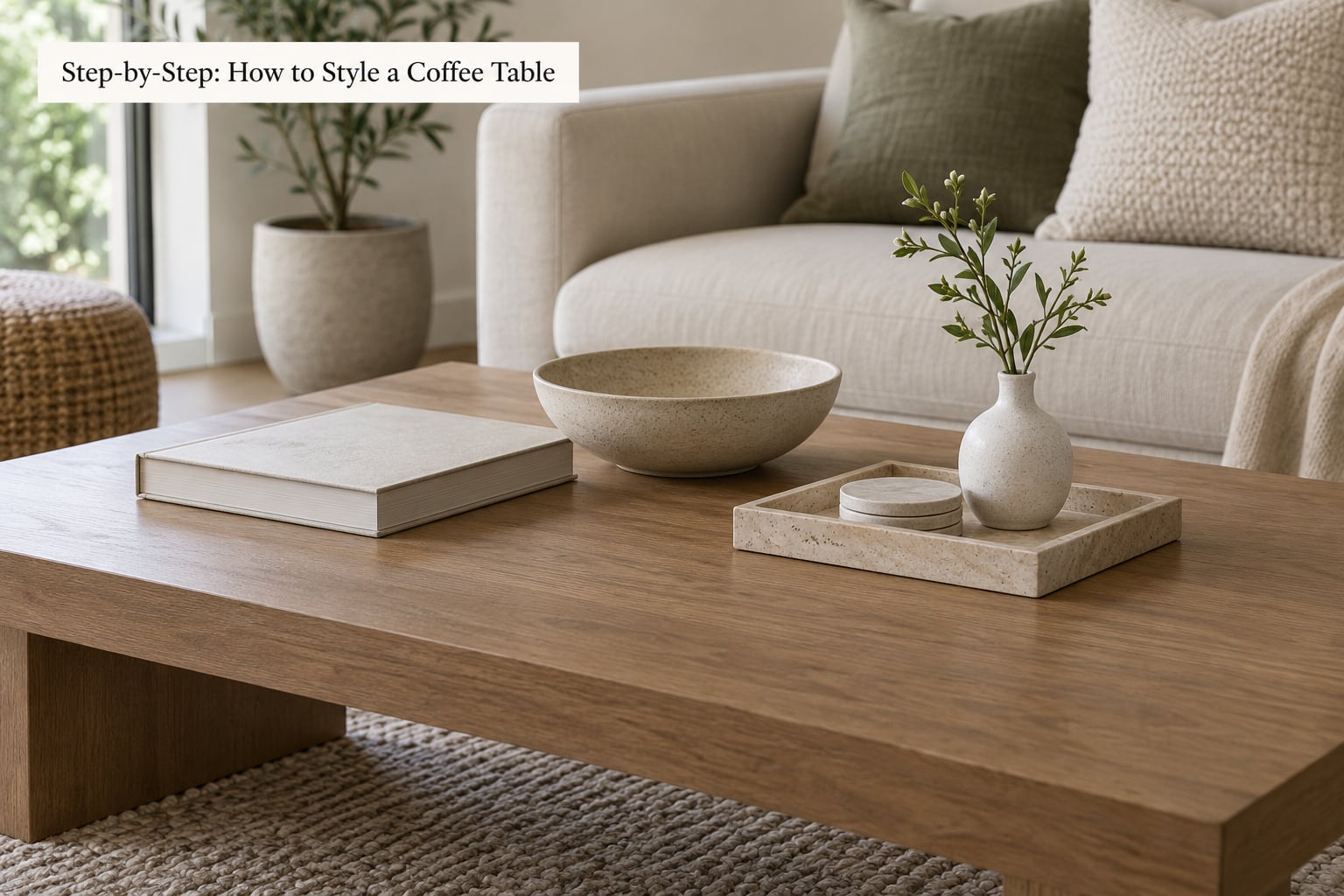
Six steps, in this order. Do them in order and the arrangement holds together, because each one fixes the problems the previous one creates.
Start by Checking the Table’s Proportions
Table size decides how much goes on top of it, and getting this wrong is why some arrangements look cramped on a large surface and lost on a small one.
A few measurements do most of the work. Leave about 18 inches between the table and the sofa, which is close enough to reach a drink and far enough to walk past. Keep the tabletop height within about 4 inches of the seat height, so nobody is looking down at a tall stack or up at a tray. Most decorators also follow the 2/3 rule: the table length should be about two-thirds the length of the sofa.
That clearance number comes up constantly in decorating forums, because a table sitting too close to the sofa is the most common reason a room feels wrong even when nothing is technically out of place.
On the surface itself, leave roughly a third empty and keep the tallest object at 12 to 14 inches. Anything higher blocks the conversation across the sofa.
Choose One Clear Focal Point
Everything else on the table exists to support one dominant object. Without a focal point you get a group of objects all shouting at the same volume.
The usual candidates are a stack of large coffee table books laid flat, a low ceramic bowl, a sculptural vase, a tray, a pillar candle in a hurricane, or a small planter. What you choose depends on your table and your room rather than on the object itself.
On a rectangular table, put the focal piece toward one end rather than dead centre. Centre placement on a long table splits the visual weight in half and leaves two awkward empty patches. On a round table, a square tray is worth considering, because the straight edges read clearly against the curve and the table stops looking like a display dish.
How to Style a Coffee Table from Largest to Smallest
Build the arrangement in three size tiers, and the visual balance takes care of itself.
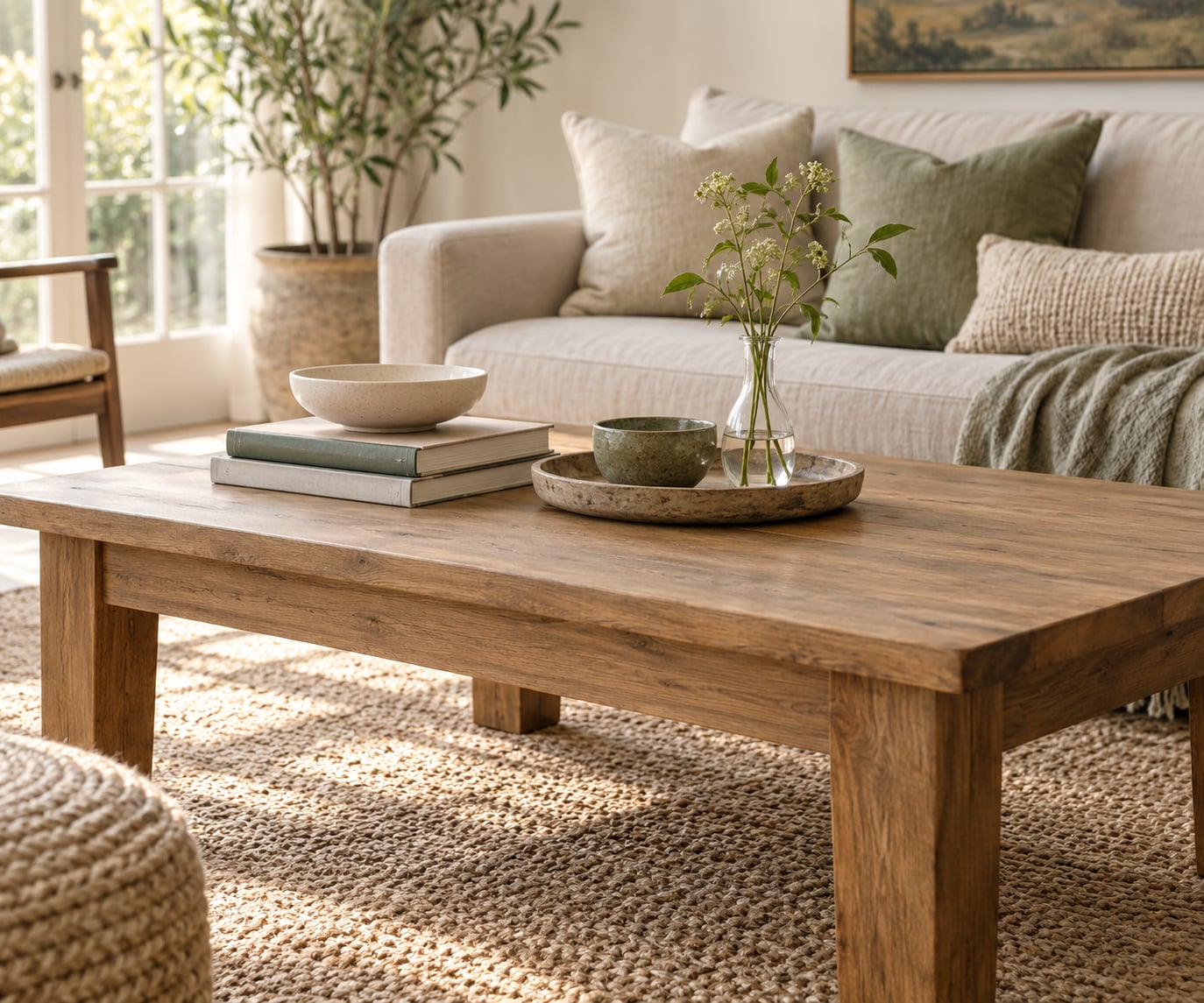
- One large anchor. A stack of two or three big books, a bowl, a plant. This sets the scale for everything else.
- One or two medium pieces. A candle, a small vase, a framed card. Roughly half the height of the anchor.
- One small accent. A shell, a bead string, a coaster stack. This is what people pick up and put down.
Vary the heights rather than lining everything up in a row. Three objects of the same height read as a border, not a composition. Stacking books and setting a candle on top is the cheapest way to create a second tier without buying anything.
Then aim for asymmetrical balance, which simply means one side carries more visual weight while the other side stays deliberately open. Visual weight comes from height and size, not from matching. A tall thin vase on one side can balance a low wide bowl on the other.
Layer Color, Pattern, and Texture
Pull two or three colours out of the room and repeat them on the table. The rug, the sofa and the curtains are your source list. Repeating a colour already in the room is what makes a table look deliberate rather than shopped.
You do not need to match. A monochromatic arrangement in three shades of one colour, a neutral base with one accent colour, or two colours that sit opposite each other on the wheel all work. What matters is that the table belongs to the room.
Mix finishes as well as colours. Pair a hard surface with a soft one, a shiny one with a matte one. Wood against glass, ceramic against metal, woven basket against smooth paper, something rough next to one very smooth piece. Texture is doing most of the work here, which is why a warm wood table with a cool glass or metal object on it usually looks better than one with all wood.
Leave Room for Everyday Use
This is the step that separates a table you keep for a week from one you keep for years. Decide where the daily clutter lives before you arrange anything else.
A tray does the job best, because it defines a zone that is allowed to look untidy without ruining the whole surface. Remotes, coasters, a small dish of keys and the TV clicker all go on the tray, off to one side. Many decorators also keep a clear patch of table in the middle or front edge so a mug has somewhere to land that is not balancing on a book stack.
With kids or pets in the room, the practical version is simpler: skip breakables at table height and favour washable ceramics over glass. A basket works as well as a tray for corralling small toys, and a covered dish handles snacks without turning the surface into a crumb field.
Leave a clear walking path too. A table that sits close to the sofa still needs to be passable on the other side if your layout runs through it.
Step Back and Adjust the Finished Look
Now check the work, and check it from two positions rather than standing over it.
Sit down on the sofa and look at the table at your normal eye level. This is the view that matters, because tall objects will block the people across from you if the arrangement is too busy. Then stand up and look at the table from the doorway, where you will see the shape of the whole group for the first time.
If something looks off, move one object at a time. Most of the time the problem is a single item that is competing with the focal point, or a grouping that has drifted to one end of the table. Move that one thing and look again before you change anything else.
Finally, remove clutter from nearby surfaces that pulls the eye away from the table. The coffee table cannot be the focal point of the room if the sideboard next to it is carrying three times as much.
Common Coffee Table Styling Mistakes
Almost every bad coffee table arrangement I have seen comes down to one of the same handful of problems.
Too many objects. The fix is subtraction, not rearrangement. Take away everything except your focal point and rebuild with three pieces.
Everything at the same height. A line of items of equal height reads as clutter no matter how good the pieces are. Raise one or two things on books and you get a second tier for free.
Tiny objects on a large table. Scale has to match. Three small things on a wide rectangular table disappear in the middle of the surface. Use one bigger object instead, or fill the length rather than the centre.
Everything pushed to the edges. A ring of objects around an empty middle reads as unfinished. Group the pieces on one side and let the other half of the table stay open.
Ignoring daily use. If there is nowhere for the remotes or a cup, the arrangement will not survive the first week. Define that zone before you style.
Matching everything perfectly. Objects that are the same colour, same material and same height flatten into a still life nobody can read. Vary one dimension at a time.
For a seasonal refresh, swap two pieces rather than starting over. A lighter object for spring, a heavier one for autumn, and something on the table that echoes the season outside. You can restyle a table four times a year with four objects you already own, which is usually enough.
Frequently Asked Questions
What is the 2/3 rule for coffee tables?
The 2/3 rule means the coffee table should be about two-thirds the length of the sofa above it. It gives enough surface to hold a group of objects and a cup without the table looking undersized. Pair it with roughly 18 inches of clearance between the table and the seat, and a tabletop height within 4 inches of the sofa seat.
What should I put in the middle of my coffee table?
The middle of a coffee table works best when it is empty or lightly used. Put your focal point toward one end of a rectangular table, or offset to one side of a round one, then leave the centre as the clear zone where a mug or a snack bowl can land. A grouped vignette on one side reads calmer than a ring of objects around an empty middle.
How high should decor on a coffee table be?
Keep the tallest object at about 12 to 14 inches, and nothing much higher, so people can see over it from a seated position. Height variation is what makes a grouping interesting, so build two or three tiers with stacks of books and candles rather than one tall object. If the tallest piece blocks eye contact across the sofa, it is too tall.
How many pieces should be on a coffee table?
Three tiers works for almost every table: one large anchor, one or two medium pieces, and one small accent. That usually means four or five objects in total. On a small table, fewer. On a large rectangular table, repeat the grouping rather than adding new kinds of things. Leave about a third of the surface empty.
How do I keep a styled coffee table from looking cluttered?
Give the daily clutter a home first. A tray corralling remotes, coasters and keys keeps the untidy stuff in one defined zone instead of scattered across the surface. Then add a non-negotiable reset rule: everything that is not part of the arrangement goes back on the tray at the end of the day.
Start With One Focal Piece
If you do one thing this week, gather everything you own that could plausibly go on the table and put it on the floor first. Pick the single largest piece as your anchor, add one or two things about half its height, then one small accent. Leave a third of the surface empty and give the remots a tray.
Check it from the sofa, check it from the doorway, and change one object at a time until the table looks like it belongs to the room. That is the whole method in 2026, and it works just as well on a table you have had for ten years as on one you brought home last week.