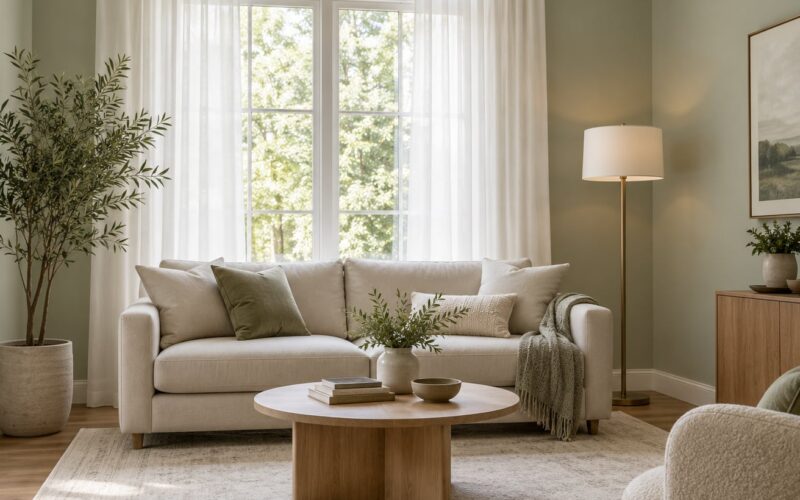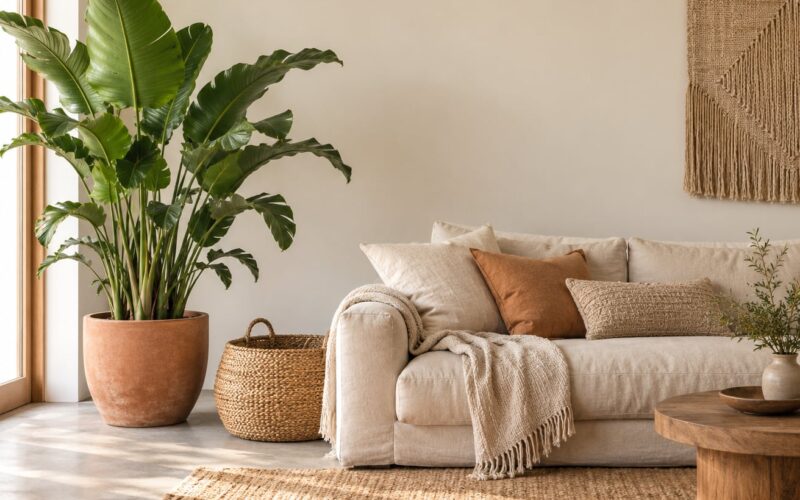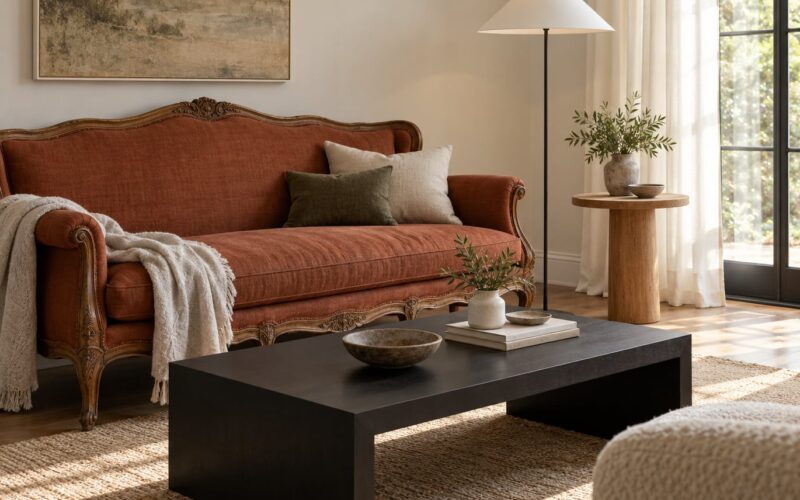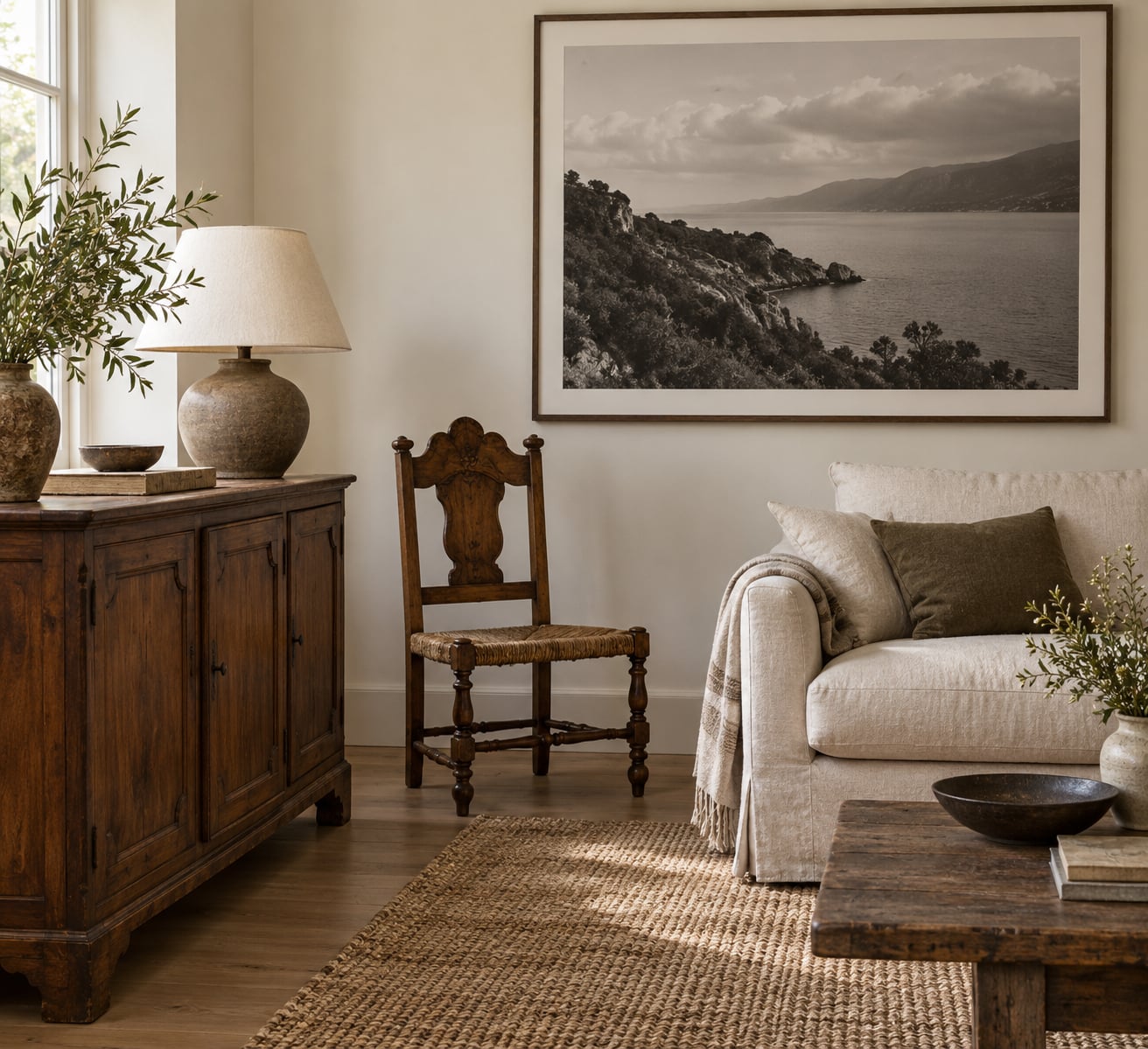
If you are figuring out how to decorate with antiques without looking dated, update everything around the old pieces rather than the antiques themselves: keep one strong piece, repeat two or three colors across walls, textiles and art, add lighting that is bright and layered, and leave open space around the old stuff. A Chippendale chair or a Victorian settee is not the problem. The muddy palette around it is.
I have watched this happen in real rooms. A walnut dining table that looked heavy in a beige-on-beige living room suddenly looked like the best thing in the house once we painted the walls a warm off-white, hung one oversized black-and-white photograph over it, and replaced the ceiling fixture with something simple and bright.
Antiques are still the fastest way to make a home feel collected instead of catalog-bought. The technique matters as much as the find, though, because the default styling around old furniture is what now reads as dated. Here is how to get the look without turning your home into a period set.
Table of Contents
- What You Need
- Step-by-Step
- How to Decorate with Antiques Without Looking Dated: Start With One Strong Piece
- Balance Old and New
- Use a Restraintive Color Palette
- Layer Modern Textures Around Antiques
- Edit the Display
- Finish With Updated Details
- Common Mistakes
- Frequently Asked Questions
- How do I mix antiques with modern furniture without making the room look cluttered?
- What colors work best when decorating with older pieces?
- Should I paint antique furniture or leave the original finish?
- How can I make an antique piece look less old-fashioned?
- What kinds of accessories should I avoid when styling antiques?
- How do I know if an antique is valuable enough to display prominently?
- Conclusion
What You Need
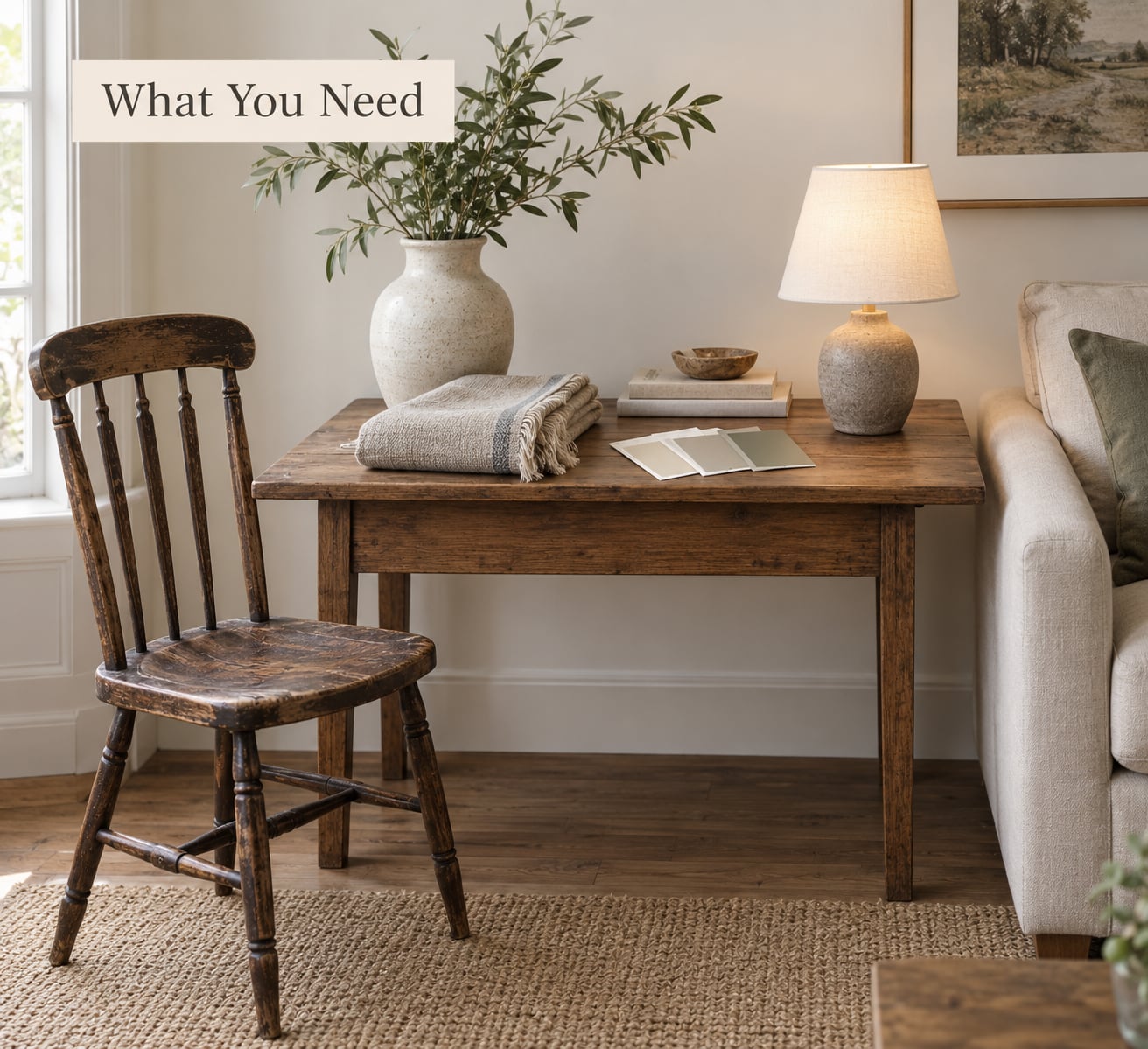
You do not need a shopping list. You need decisions made before anything moves, plus a few cheap modern pieces that give the old ones somewhere to sit.
Gather this before you start:
- One honest look at what you own. Photograph each piece and write down its actual dimensions. Half the dated look in an antique-heavy room is scale that nobody measured.
- A neutral base. Warm white, soft putty or a pale clay. Neutral walls are what let a dark walnut piece read as an accent rather than the whole room.
- Two or three modern pieces. One sofa, one lamp, one rug is plenty. These are the contrast that tells the eye the antique is a choice, not a leftover.
- Bright, layered lighting. A ceiling fixture that actually lights the room, plus table lamps. Warm white bulbs, not the yellow-orange ones that flatten everything.
- Fresh textiles. A rug with no fringe-heavy Victorian pattern, plain linen or cotton curtains, two or three throw pillows. Fabric updates a room faster than paint.
- Paint swatches, if you plan to paint. Bring home the samples and tape them to the wood for a day before you commit.
- A limited color palette, written down. Pick your colors before you shop. Every accessory afterward should match one of them.
- Empty floor space. Moving furniture is free, and rearranging is usually the fix nobody tries first.
Step-by-Step
How to Decorate with Antiques Without Looking Dated: Start With One Strong Piece
Pick the single antique that has the best lines, the best condition or the best story, and let it be the anchor. Everything else you do is in service of that piece. Rooms with six good antiques and one clear focal point look collected; rooms with six antiques competing equally look like a showroom.
Clean it properly before you judge it. Dust the carved edges, polish the original brass hardware with a soft cloth, and check that the drawer runs and the joints are tight. Most “dated” antiques are not dated at all, they are just tired.
Then place it where you can see it from the door, but not wedged into a corner. Leave at least a foot of clear space on at least two sides. If your best piece is a Victorian settee, pull it away from the wall by six inches and let it float in the room.
How do you know the anchor works? Sit in the room and check that your eye lands there first, then moves to something else. That second glance is usually a lamp or a rug, which is exactly right.
Balance Old and New
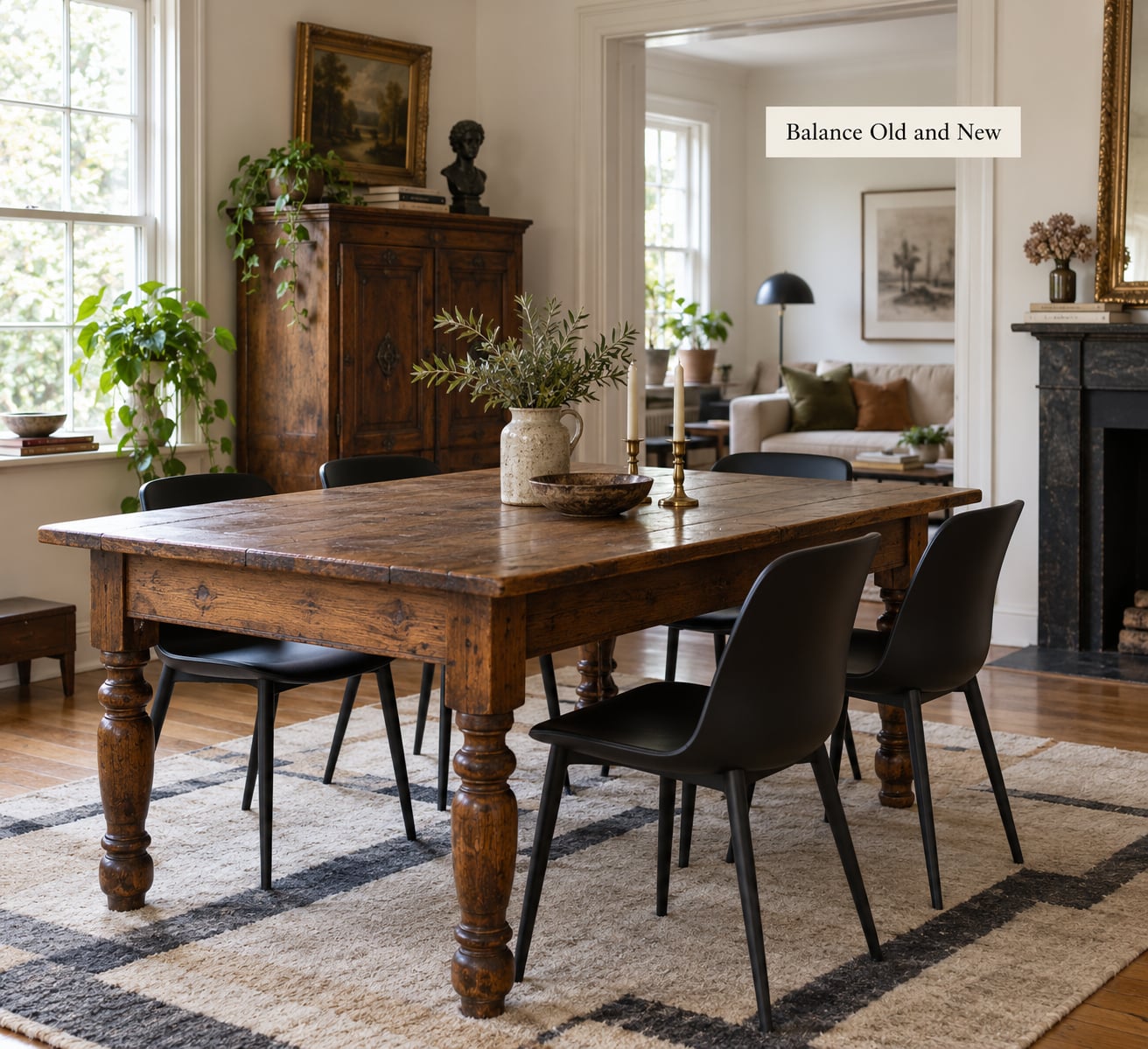
Mixed rooms need one clearly modern counterweight per antique, or the whole thing reads as a period set. The rule I use is simple: pair each heavy old piece with something light, plain and current.
An ornate Victorian sideboard with clean-lined black dining chairs. A carved oak table with a simple wool rug in flat weave. An Art Deco mirror with a matte black floor lamp. The contrast is the point, not the theme.
Watch the scale. Inherited pieces often run big for the room they land in, because they came from somewhere with higher ceilings. If a piece overwhelms the space, use it as a secondary anchor in a corner rather than centering the whole room on it. Resizing an antique is not an option, so work with the size you have.
Keep the modern pieces simple. A sofa in a plain weave, a lamp with a clean shade, a rug with no pattern. Modern furniture does the quiet work here, and the antique does the talking.
Watch for mismatched wood finishes, which is the complaint that comes up most often in decorating forums. Four pieces in walnut, oak and maple read as three different rooms. Painting two of them in related neutral tones is the fastest way to unify a group without touching the best one.
Use a Restraintive Color Palette
Two or three colors, repeated in at least five places each, is what makes a collected room read as designed. Choose them first, then assign every piece a job.
A palette that works well with antiques is warm white with deep charcoal, putty with walnut brown, or a pale clay with one saturated accent such as oxblood or forest green. Antique wood and aged metal count as texture, not as color. Do not let six different old finishes dictate six different hues.
The dated move is the all-brown room: brown walls, brown sofa, brown rug, brown wood. It has been the default for twenty years and it now signals period holdover on its own. If you love brown, keep it in the wood and put your walls somewhere else.
Repetition is what makes a palette visible. Same green on the throw pillows, the art, the lamp shade, one book stack and a framed print. Same charcoal in the lamp, the picture frames and the curtain trim.
Judge it this way: squint until the room blurs. What color do you still see? If it is three colors, you have a palette. If it is one muddy brown, widen it.
Layer Modern Textures Around Antiques
Old furniture looks old because everything touching it feels old. Change the fabric and the piece looks reconsidered. This is the fastest, least destructive update available and it works on an upholstered armchair, a settee or a Victorian sofa.
Reupholstery in a plain linen, a wool boucle or a flat-weave cotton moves a piece thirty years forward. You do not have to match a fussy original pattern, and you usually should not. Keep the original fabric if it is genuinely period-correct and in good shape, because it is part of the piece’s history.
Layer next to it. A smooth ceramic lamp against a nubby throw, a matte ceramic vase next to a glossy brass candlestick, a sleek glass coffee table in front of a carved oak one. Mixing matte and gloss across eras is what separates a designed room from a themed one.
Change the soft goods wholesale, even if you keep the frame. New cushion covers in the palette colors, a new throw, plain curtain panels hung high. This is renter-friendly, reversible and takes an afternoon.
Leave the wear. Honest patina on a wood top or worn brass is a feature, not a defect. A room where everything is smooth reads fake, and fakes cheapen the real pieces next to them.
Edit the Display
Over-decorating with small vintage objects is the most common reason an antique room looks tired. Group instead of scattering. Three objects on a tray reads as a collection; the same three spread across three surfaces reads as clutter.
Vary heights. Put the tallest object at the back, a medium piece beside it, and one small item in front. That triangle is the whole trick. Odd-numbered groups of three or five sit more comfortably than pairs or a straight row.
Leave real open space. Empty wall and empty floor are what make a piece read as valuable, because there is nothing competing with it. If a surface feels busy, take one thing off and look again in a day.
Edit the replicas too. Surrounding a genuine Chippendale chair with mass-produced faux-bronze candlesticks makes visitors assume the chair is also a fake. Real imperfection, uneven glaze, a slightly crooked drawer, is the signal that says authentic. Group the real pieces with plain modern objects instead of with themed imitations.
As a budget test, photograph the room and look at the picture, not the room. Anything you cannot name in one glance probably needs to move to another surface.
Finish With Updated Details
The last five percent of effort changes how a piece reads. Swap the doorknobs, add new finials, replace a dated shade, hang the mirror higher.
Hardware is the cheapest update with the biggest effect. Warm brass or aged bronze on a painted piece pulls it into the room and quietly ties it to the palette. Keep original hardware if it is intact, since original fittings add to what a piece is worth.
Lighting does more work than paint. Warm white bulbs, a ceiling fixture that actually illuminates the room, and a table lamp at sofa height. That combination is the most repeated fix in decorating communities for rooms that feel dim and dated, and it costs almost nothing.
On paint, the honest answer is that you are trading some value for a look you like. Reupholstery and new hardware are safer than stripping a top. If you paint, use a bonding primer, a matte or eggshell finish rather than high gloss, and light colors rather than a coat of stark white.
Never sand away original surface or gilding to get a clean look. Removing history from a piece is the one change that cannot be undone.
Common Mistakes
Almost every dated antique room makes at least one of these moves. Each row below is a move that dates the room and the swap that fixes it.
- Matching everything. When every chair, cabinet and frame belongs to the same era, the room becomes a set. Break the set with two or three clearly modern pieces and the antiques suddenly look intentional.
- All-brown walls, rug, sofa and wood. Put neutral walls up and let the brown stay in the wood, where it reads as texture.
- Ignoring scale. Measure before you move. A tall antique hutch in a low-ceilinged room needs to go somewhere it can be seen rather than centered.
- Overcrowding. If the antiques are shoulder to shoulder, none of them reads as special. Removing half the small objects is a free refresh. Floated pieces need a foot of clear space rather than a wall at the back.
- Themed accessories. Tulle lampshades, doilies, toile in the kitchen and toile in the bathroom all at once. Pick one era reference per room and stop there, grouping in odd-numbered sets of three or five.
- One dated detail in an otherwise current room. A plastic gold-framed print or a heavy swag valance is enough to age everything near it. Replace one thing before you redecorate the whole space.
- Reproduction pieces beside real antiques. Group genuine pieces with plain modern basics so the originals keep their authority.
- Stripped finish on every wooden piece. Keep the patina and spend the effort on lighting and hardware instead.
- Yellow-orange bulbs and one dim ceiling fixture. Warm white bulbs plus layered lighting fix a dim room for very little.
Two of these come up more than the rest. The all-brown room and the crowded surface. Fix either one and the rest of the room usually improves on its own.
Frequently Asked Questions
How do I mix antiques with modern furniture without making the room look cluttered?
Give each antique one clearly modern partner and leave open space around both. A carved table with clean-lined chairs, a Victorian settee with a plain linen sofa, an Art Deco mirror with a matte lamp. Vary heights in odd groups, keep small objects on trays instead of scattered, and photograph the room to see what reads as clutter.
What colors work best when decorating with older pieces?
Two or three colors repeated in at least five places each. Warm white with deep charcoal, putty with walnut brown, or pale clay with one saturated accent like oxblood or forest green work well. Treat antique wood and aged metal as texture rather than color so old finishes do not dictate the palette. Avoid the all-brown room.
Should I paint antique furniture or leave the original finish?
It depends on whether the piece is museum quality or good-but-not-rare. Painting a common oak table to match a palette is a reasonable trade. Repainting a genuine Chippendale or Art Deco piece usually costs value. Safer options that change the look are new hardware, new fabric and better lighting. Never strip original surface or gilding.
How can I make an antique piece look less old-fashioned?
Change what surrounds it rather than the piece itself. Put clean-lined modern furniture beside it, hang one oversized simple artwork above it, add fresh textiles in your palette colors, and light it properly with warm white bulbs and a table lamp at seated height. New knobs or finials update the look in an afternoon.
What kinds of accessories should I avoid when styling antiques?
Skip era-matched filler like doilies, matching floral swag valances and tassel lampshades, plus mass-produced replicas placed near genuine pieces, which make the real thing look questionable. Also avoid leaving every surface filled. Real open space around a piece is what makes it read as valuable.
How do I know if an antique is valuable enough to display prominently?
Check construction first: hand-cut dovetail joints, irregular hand-planed surfaces, secondary wood panels and period-correct hardware point to an older piece. Then look up known makers, and consider a member appraiser for anything you would be upset to lose. For the rest, condition matters more than age, so display it well and keep it out of direct sun.
Conclusion
Start with the antique you like most, put one modern piece next to it, and pick two colors to repeat through the room. Add warm white bulbs and one good lamp. Take half the small objects off the surfaces and see how the space changes.
That is most of the work, and it takes an afternoon rather than a budget. Getting how to decorate with antiques without looking dated right is about contrast, restraint and light, not about hiding what makes the pieces worth keeping.