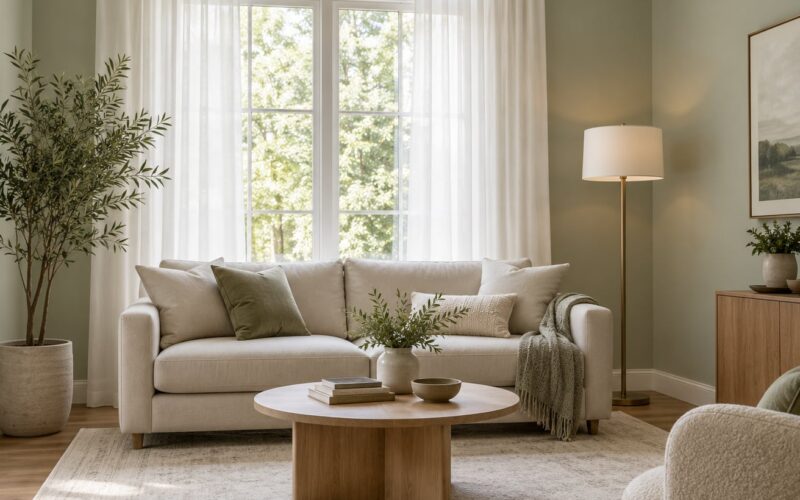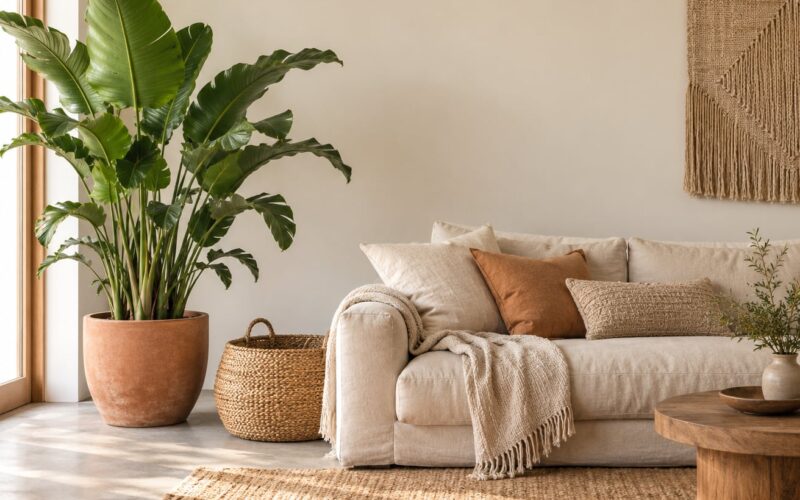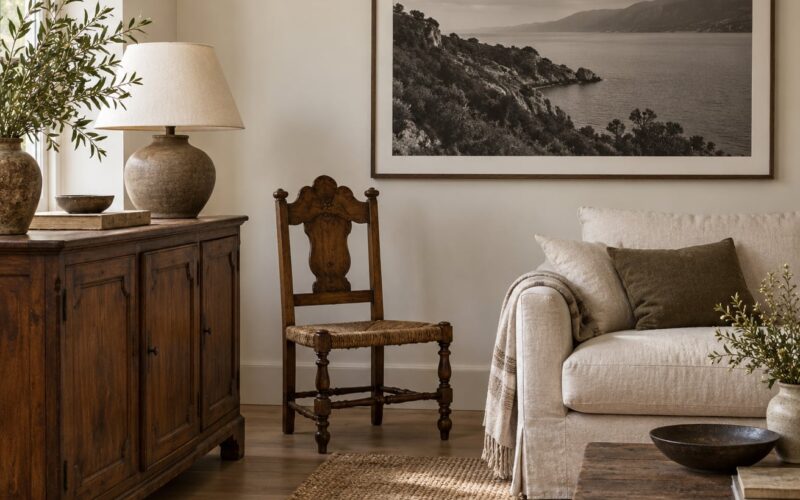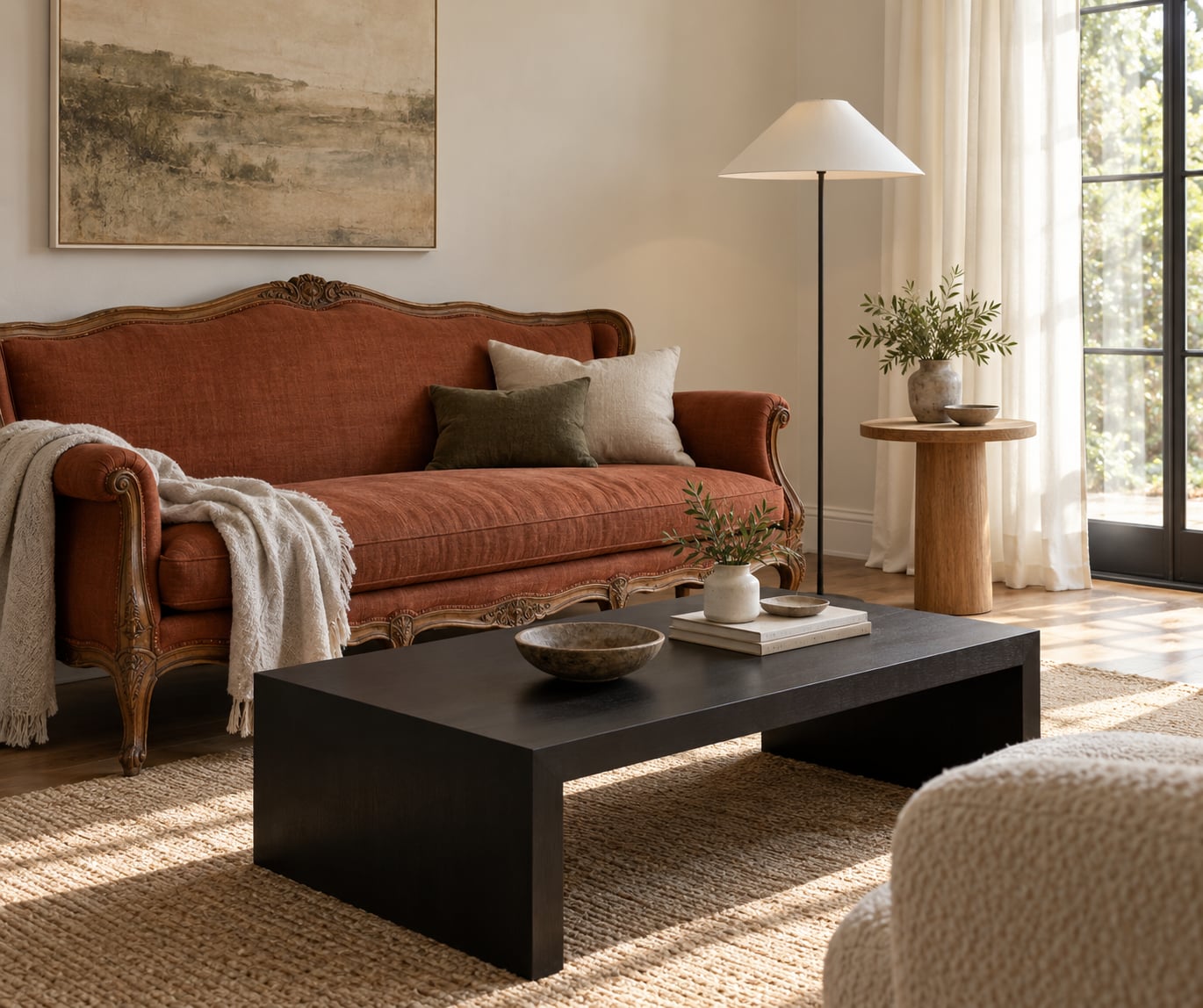
To mix vintage and modern furniture, let one era lead and the other support it, then tie everything together with a tight color palette, balanced proportions, and a few repeated materials. Most rooms that go wrong aren’t missing good pieces — they’re missing a hierarchy. Set the dominant style first, place the largest items, repeat three colors, and edit at the end. The whole process takes an afternoon of planning and a weekend of arranging.
The idea sounds simple, but it’s the reason thrift-store finds keep ending up in a corner. You bought a walnut credenza because it was a good deal, and it doesn’t go with the grey sectional you already owned. On its own, each piece is fine. Together, without a plan, they read as a yard sale.
What changes that is repetition. A room holds together when three or four visual elements repeat across every era — a color, a wood tone, a metal finish, a leg shape. Repeating those elements across a 1940s dining table and a plain white modern console reads as intentional layering instead of a mismatch. That’s the whole trick, and the steps below walk through it in order.
Table of Contents
- What You Need
- Step-by-Step: How to Mix Vintage and Modern Furniture
- 1. Choose a Clear Style Direction
- 2. Measure the Room and Map the Big Pieces
- 3. Mix Shapes and Proportions
- 4. Repeat a Small Set of Colors
- 5. Layer Old, New, and Interesting Textures
- 6. Style in Odd Groups and Finish with Restraint
- Common Mistakes
- Frequently Asked Questions
- How many furniture styles should I mix in one room?
- Should I paint a vintage furniture piece to match modern furniture?
- How do I mix vintage wood furniture with modern pieces?
- What should I do first when restyling a room?
- How do I know if a room looks mismatched?
- Can I mix vintage and modern furniture in a small room?
- Conclusion
What You Need
You don’t need a designer or a big budget. You need a few things that make decisions faster.
A tape measure. Write down the room’s length and width, window widths, door swings, and ceiling height. Old furniture often fools you on scale because its proportions are slimmer than modern pieces, so the numbers matter more than they would if everything came from one catalog.
A rough floor plan. A notebook sketch is plenty. Mark the windows, the door, the radiator or fireplace, and the walkway from the entry. Draw the biggest pieces as rectangles at true scale. Doing this on paper takes ten minutes and saves you from dragging a dresser across the room twice.
Phone photos of what you already own. Photograph each piece in good daylight, including a close-up of any wood grain, metal hardware, or upholstery. These become your reference when you’re out hunting and can’t tell whether a piece fits.
Color swatches. Cut a few squares from paint cards or grab fabric samples in the two or three colors you already live with. Hold them next to wood and stone samples in the shop. This is faster and far more reliable than trying to imagine your sofa in someone else’s living room.
A small set of material samples. Bring a wood chip, a piece of leather, a metal knob, and a fabric swatch. A bag of samples you can pull out on the spot makes the 80/20 call on a sofa much faster.
Painter’s tape and a helper. Tape marks the footprint of each piece on the floor so you can judge spacing before moving anything heavy. A second pair of hands saves a wrenched back more often than it saves time.
Step-by-Step: How to Mix Vintage and Modern Furniture
1. Choose a Clear Style Direction
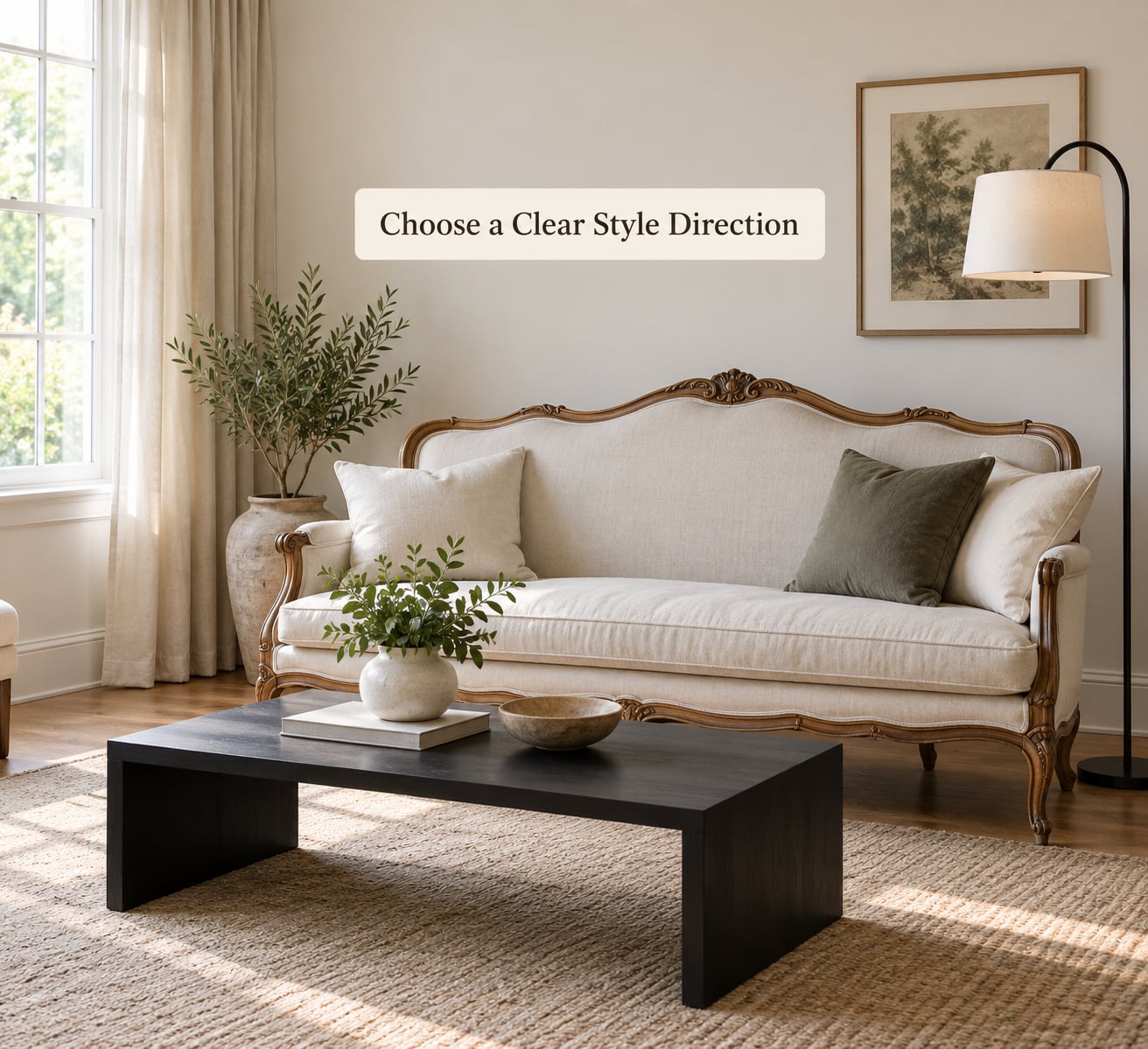
Decide which era is in charge before you move a single piece. The most workable ratio is roughly 80/20: about four of every five pieces belong to the leading style, and the rest are the supporting style. A pure-vintage room can run closer to 50/50 and still work, but only when color and scale are handled tightly.
Pick the leading style based on what you already own most of. If the room is mostly clean-lined and functional, let modern lead and give vintage the supporting role — a carved sideboard, a tufted armchair, a framed print. If you inherited a formal dining set and a heavy antique mirror, let vintage lead and use modern for the lamps, the side table, and the artwork.
Then choose one anchor piece and let it set the tone. A mid-century walnut credenza, an antique oak dining table, a Victorian settee — the anchor is the largest, most characterful thing in the room, and everything else defers to it. If you can’t name your anchor in a single sentence, the direction isn’t clear yet.
2. Measure the Room and Map the Big Pieces
Mixing eras makes scale problems worse, because a vintage sofa and a modern one can share the same nominal width and feel completely different in the room. Measure the actual pieces, not the listed dimensions, and tape their footprints on the floor before you commit.
Place the largest pieces first: sofa, dining table, bed, the tall case piece. Leave a walkway of about 30 inches (76 cm) through the main path and 36 inches (91 cm) in front of seating. Then check the room from the doorway — that’s the view that has to work first, because it’s the view everyone gets.
One practical test: squint, or take a photo with your phone and look at it blurred. Details blur first, so what you’re left with is the big shapes. If those read as balanced, the arrangement is probably fine even if individual pieces are from different decades.
3. Mix Shapes and Proportions
Balanced vintage and modern furniture is mostly a question of visual weight. A heavy, low, dark piece counterbalanced by something tall and light will settle a room faster than any color choice.
Pair bulky with slender. A deep rolled-arm vintage sofa next to a slim-legged modern chair stops looking heavy. Pair curved with angular, so a scalloped antique mirror doesn’t sit beside three round-edged pieces. And vary the heights: a low modern coffee table under a tall vintage hutch gives the eye somewhere to travel.
Two widely cited design rules are worth knowing here. The 2/3 rule says furniture should occupy about two-thirds of a room’s floor area — if the pieces look stranded, they’re probably too small, or pushed into corners. The 3-5-7 rule sorts decor into groups of threes, fives, or sevens rather than scattering singles, which keeps a surface looking collected instead of picked over.
Watch for one specific failure: a large, ornate vintage piece beside a delicate modern one always loses. Scale the modern piece up or move the vintage piece to a wall where it stands alone.
4. Repeat a Small Set of Colors
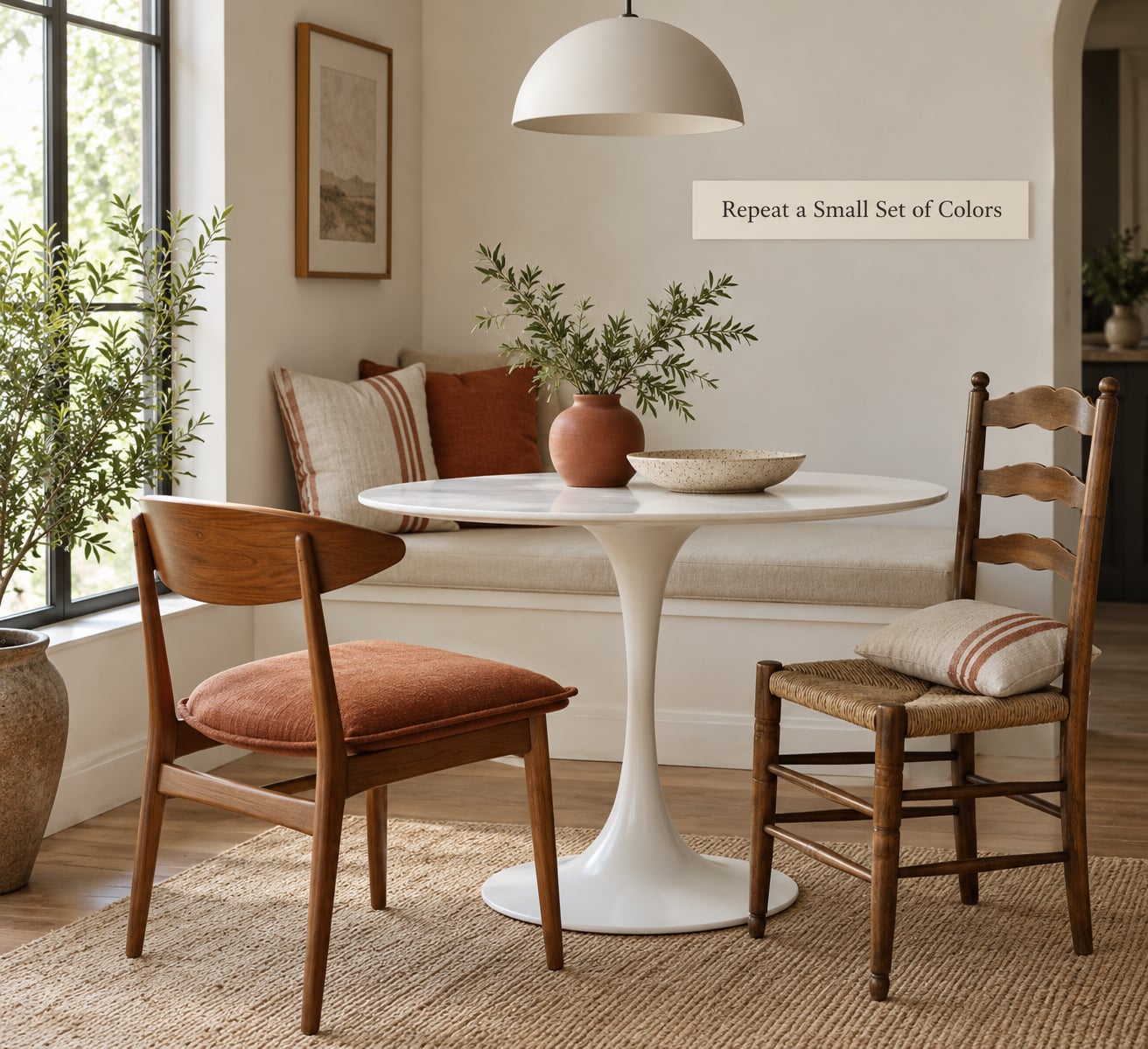
Color is what makes different eras look related. Choose a dominant neutral that covers roughly 60% of the room, add one supporting color, and hold accents to a very small number.
Then repeat those colors deliberately. The same cream that appears on the walls should show up in the rug, the lampshade, and the vintage chair’s cushion. A rust tone pulled from the old sofa’s fabric can become the throw, the book spines, and the bowl on the coffee table. When a color appears in three eras, it stops being a coincidence and becomes a throughline.
Apply the palette across wood, paint, textiles, and metal finishes — not just the soft goods. Repeating a warm walnut across a vintage table and a modern bed frame is one of the fastest ways to make two eras agree with each other.
5. Layer Old, New, and Interesting Textures
Texture does the bridging that color starts. Smooth surfaces read as modern; tactile, irregular surfaces read as vintage or handmade. Alternating them across the room keeps the eye moving without adding another color.
Try aged or unlacquered brass beside matte black metal, leather next to linen, hand-knotted wool over a smooth painted wall, stone or marble on top of worn oak. Rough against smooth, matte against shine.
You can also bring a single piece closer to the modern side without losing its character. New hardware on an antique dresser, a fresh coat of paint on a plain frame, updated upholstery on a mid-century chair, or new legs on an old cabinet will each do it. If you rent, hardware swaps, new legs, slipcovers, and removable upholstery pads cover most of it without touching the original finish.
One caution: keep some surface treatments distinct. If you paint the dining table, reupholster the chairs, and refinish the sideboard, the room loses every trace of age. Pick one or two interventions, not five.
6. Style in Odd Groups and Finish with Restraint
Style surfaces in odd numbers. Three objects on a side table or five books on a shelf read as arranged, while two or four read as leftover. Repeat the same object type more than once — three candlesticks in graduated heights, or a set of six frames on the wall — so the grouping has internal logic.
Vary height inside every group: something tall, something medium, something flat. Then leave breathing room. Negative space around the major pieces does more for a mixed room than any accessory, and it is the first thing people overfill.
Finish by stepping back and removing, not adding. Take out anything that doesn’t repeat a color, a material, or a shape already in the room. A mixed room should look like it accumulated over years, and that impression depends on editing more than on collecting.
Common Mistakes
Most mixed rooms that feel wrong are failing in one of a handful of predictable ways. Here’s what to look for and how to fix it.
Matching every piece to the same era. Trying to coordinate perfectly is what produces furniture that looks like it came out of one showroom. Fix: remove one “safe” piece and replace it with something from another decade in a color already in the room.
Choosing only oversized statement pieces. Several heavy carved or brutalist pieces in one room fight each other, and no single one wins the focus. Fix: keep one statement piece per room and scale the rest down.
Treating every vintage find as valuable. A chipped, wobbly, badly repaired find from a great era is still a difficult piece to live with. Fix: judge condition before character, and use the questionable ones as doors, screens, or plant stands where wobble doesn’t matter.
Ignoring scale. This is the mistake that makes a house look outdated more than any other. A small sofa floating in a large room with tall ceilings, or a massive table in a narrow dining room, will read as wrong no matter how good the color match is. Fix: measure first, and if the room feels empty, work up in size rather than adding more small pieces.
Scattering accessories one at a time. Singles spread around a room create the yard-sale look every decorator is trying to avoid. Fix: cluster into odd groups and clear the surfaces entirely before you start again.
Matching every wood tone exactly. Identical finishes across all the furniture can make a room feel dated and a little lifeless. Fix: pick two or three tones to repeat and let one or two others appear once, so the grain reads as variety rather than error.
Over-restoring. Stripping a piece back to bare wood and refinishing it as if new throws away the patina that made it worth having. Fix: change one element, such as hardware or paint, and leave the rest alone.
The final check is simple. Walk to the far end of the room, then to the window, then back to the doorway, and look each time. If the room holds together from all three viewpoints, the mix is working. If one angle falls apart, it’s usually a scale or spacing problem, not a style problem.
Frequently Asked Questions
How many furniture styles should I mix in one room?
Two is comfortable, three is workable, and more than three usually reads as clutter. The key is not the number of styles but how strongly one of them leads. Keep roughly 80% of the visible pieces in your dominant style and let the other one or two eras appear as accents, then repeat three colors across all of them.
Should I paint a vintage furniture piece to match modern furniture?
Sometimes, and only when the piece has no character worth keeping. Painting works well on plain mid-century cabinets, thrifted dressers with dated laminate, and anything already stripped back. Skip it on pieces with real patina, carved detail, or good grain, since paint covers exactly the evidence that made the piece worth having.
How do I mix vintage wood furniture with modern pieces?
Match the tone rather than the finish. Repeat two wood tones across the room so a warm walnut piece connects to a modern bed frame in the same family, then allow one contrasting tone to appear only once. Finish matters less than tone: a matte modern oak table sits comfortably beside a glossy 1970s walnut desk if the colors are close.
What should I do first when restyling a room?
Take the largest existing piece, measure the room, and decide which style it belongs to. Everything else you do flows from that decision. Start by removing accessories and at least one piece you dislike, then add back only what repeats a color or material already present.
How do I know if a room looks mismatched?
Stand at the doorway, then at the window, and check whether the room reads as one composition from each spot. If a single piece pulls your eye and seems unrelated to anything else, that is the mismatch. Squinting helps too, because it strips detail and leaves only shapes, scale, and color to judge.
Can I mix vintage and modern furniture in a small room?
Yes, and small rooms actually suit mixing well because fewer pieces mean fewer competing eras. Keep the leading style to about 80% of what you own, choose low-profile pieces so sightlines stay open, and use one vintage statement piece against plain walls. Vertical storage and a limited palette keep a small space from getting busy.
Conclusion
Mixing vintage and modern furniture works when one era leads, the palette stays small, and the shapes balance each other out. Everything else is editing. Start by naming your room’s lead style and its anchor piece, place the largest items first and check them from the doorway, and repeat three colors across upholstery, wood, metal, and textiles before adding any small pieces.
After that, it’s just removing. If a piece doesn’t share a color, a material, or a shape with something already in the room, take it out and see how the room reads without it.